

Atithi Devo Bhava, a Sanskrit phrase meaning the guest is equivalent to God, expresses one of the most deeply held principles of Indian social and cultural life. Rooted in ancient scripture, the phrase has come to summarise a broader ethic of hospitality that shapes how guests are welcomed, treated and cared for across Indian households, regardless of their relationship to the host. This spirit of warm welcome finds expression during major festivals such as Diwali, when homes are opened to relatives and neighbours alike. This guide explores the origins, customs and continuing relevance of this tradition of hospitality.
Quick Facts
| Detail | Information |
|---|---|
| Meaning | “The guest is equivalent to God” |
| Origin | Sanskrit phrase from ancient Hindu texts |
| Core Principle | Guests are to be treated with reverence and care |
| Common Customs | Warm welcome, offering food, comfortable stay |
| Applies To | Households, temples and broader Indian hospitality |
| Modern Usage | Adopted as a tourism and hospitality slogan |
Meaning and Origins of the Phrase
Atithi Devo Bhava is a Sanskrit phrase generally translated as the guest is equivalent to God, expressing a principle that has long shaped Indian attitudes toward hospitality. The phrase elevates the act of welcoming a guest from a matter of simple courtesy to one carrying a degree of reverence more commonly associated with religious devotion.
While the phrase itself is concise, its influence is broad, informing everyday behaviour toward visitors, whether relatives, acquaintances or complete strangers. This elevated framing of hospitality is one of the most frequently cited expressions of traditional Indian values, both within the country and in descriptions of Indian culture abroad.
Atithi Devo Bhava in Ancient Texts
The phrase Atithi Devo Bhava is traced to ancient Hindu scriptural literature, where guidance on household conduct includes instructions to treat guests with the same regard given to revered figures. Such texts, composed and transmitted over a long period, reflect a broader ancient concern with codifying household duties, of which hospitality was considered an important part.
Because these instructions form part of a wider body of traditional ethical teaching, Atithi Devo Bhava is best understood as one expression of a broader value system emphasising duty, generosity and respect toward others, rather than an isolated rule confined to guest treatment alone.
The Concept of the Guest in Indian Thought
In traditional Indian thought, the atithi, or guest, is often described as one who arrives without a fixed date or invitation, reflecting an older social expectation that hospitality should be extended even to unannounced visitors. This framing positions hospitality as an ongoing readiness rather than something prepared only for expected occasions.
This conception has shaped a broader cultural comfort with unplanned visits among family and community, where dropping in without formal notice is often met with genuine welcome rather than inconvenience, a pattern still visible in many Indian households today.
Traditional Rituals of Welcome
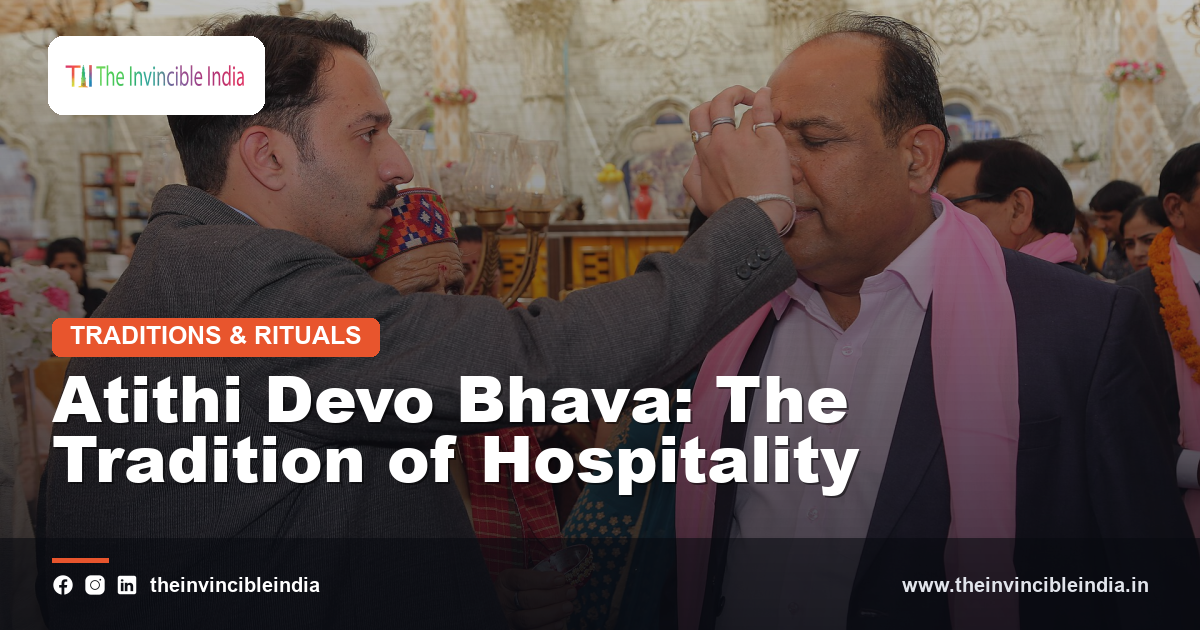
Indian households have long observed specific rituals to welcome guests, including offerings such as a tilak mark on the forehead, a garland of flowers, and the waving of a lit lamp in some more formal or ceremonial welcomes. Guests are typically offered water and refreshments immediately upon arrival, before any conversation or business begins.
These small but consistent gestures reflect an underlying priority: attending to a guest’s comfort before anything else. Even in simplified modern form, elements of this welcoming ritual, from a warm greeting to an offered drink, remain a familiar part of receiving visitors across much of India.
Hospitality in the Indian Household
Within the home, hospitality traditionally extends to ensuring that guests are comfortably seated, offered food and drink without excessive delay, and given attentive, unhurried company during their stay. Households often prepare specific dishes considered suitable for guests, and hosts frequently insist on guests eating more than they might otherwise, a gesture reflecting generosity rather than mere politeness.
This emphasis on guest comfort often takes precedence over the convenience of the host, with many families going to considerable lengths to accommodate a visitor’s preferences, reflecting the deep cultural weight placed on treating guests well regardless of the household’s own circumstances.
Food and Hospitality
Sharing food is one of the most central expressions of hospitality in Indian culture, with guests almost always offered something to eat or drink, regardless of the time of day or the length of their visit. Refusing to offer food to a guest, or a guest declining what is offered without good reason, is generally considered socially unusual.
This food-centred hospitality extends to festivals and celebrations, where elaborate meals are prepared specifically to welcome visiting relatives and friends, reinforcing the broader cultural understanding that feeding a guest well is among the most direct ways of honouring them.
Hospitality Toward Strangers and Travellers
Beyond the household, the ethic of Atithi Devo Bhava has historically extended to travellers and strangers, with various traditions of offering shelter, food or assistance to those passing through unfamiliar places. Religious institutions such as temples, gurudwaras and ashrams have long played a role in extending hospitality to pilgrims and visitors regardless of their background.
This broader tradition of hospitality toward the unfamiliar reflects the underlying principle that generosity should not be limited to known relationships, but extended more widely as an expression of shared human dignity, a value frequently cited as central to Indian cultural identity.
Religious Dimensions of Guest Reverence
Many religious institutions across India embody the spirit of Atithi Devo Bhava through the practice of offering free communal meals to all visitors regardless of background, a custom particularly associated with Sikh gurudwaras but echoed in various forms across other religious traditions as well.
This religious dimension reinforces the broader cultural association between hospitality and merit, with the act of feeding or sheltering a guest often described in religious teaching as carrying spiritual value, further embedding the principle within everyday religious practice rather than confining it to abstract ethical teaching.
Hospitality During Festivals
Major festivals across India, including Diwali, Eid and various regional harvest celebrations, are occasions on which hospitality is particularly visible, with households opening their doors to relatives, neighbours and friends for shared meals and celebration. Sweets and festive dishes are typically prepared in quantities intended for sharing rather than solely for the immediate family.
This festival-time hospitality often extends the household’s usual guest customs to a wider circle, reinforcing community bonds and reflecting how the principle of Atithi Devo Bhava scales naturally from individual visits to larger, celebratory gatherings.
Regional Expressions of Hospitality
While the underlying value of guest reverence is shared nationally, its specific expression varies across India’s regions, reflecting differences in cuisine, ritual and social custom. Coastal, northern, southern and eastern households each bring their own culinary and ceremonial traditions to the act of welcoming a guest, even as the core sentiment remains consistent.
These regional variations illustrate how a broadly shared cultural value can manifest in distinct local forms, a pattern seen throughout Indian tradition, in which unity of principle coexists comfortably with considerable diversity of practice.
Atithi Devo Bhava in the Hospitality and Tourism Industry
The phrase Atithi Devo Bhava has been formally adopted within India’s tourism and hospitality sector as a guiding slogan, used to promote the country’s tradition of guest welcome to domestic and international visitors alike. Hotels, tour operators and cultural campaigns frequently reference the phrase when describing the character of Indian hospitality.
This adoption reflects a recognition that the underlying cultural value has genuine appeal and relevance beyond the household, offering a concise and meaningful way of summarising the broader hospitality ethic to visitors unfamiliar with its scriptural origins.
Hospitality Etiquette and Social Expectations
Certain unwritten expectations accompany the practice of hospitality in India, including offering a guest the best available seating, prioritising their comfort over household routine, and avoiding any indication that their visit is inconvenient. Hosts are generally expected to insist at least once when a guest politely declines an offer of food, a small ritual of persistence considered part of genuine hospitality.
These etiquette norms, while informal, are widely understood and followed, reflecting how deeply the underlying value of guest reverence has been absorbed into everyday social behaviour rather than remaining a purely abstract ideal.
Balancing Hospitality with Practical Limits
While Atithi Devo Bhava expresses an ideal of generous, unconditional welcome, households naturally balance this value against practical realities such as time, resources and circumstance. Most families interpret the principle as a guiding spirit rather than a literal, unlimited obligation, adapting their hospitality to what is reasonably possible.
This practical balancing reflects a broader, common-sense approach to tradition found throughout Indian cultural life, in which deeply held values are honoured in spirit even as their specific expression is shaped by the realities of modern, often busy, household life.
Hospitality in Rural and Urban India
Hospitality customs are often described as especially pronounced in rural India, where close-knit communities and slower daily rhythms allow for more elaborate and unhurried guest welcome. In urban settings, hospitality persists but is frequently adapted to constraints of space, time and busier schedules, sometimes taking simpler or more condensed forms.
Despite these differences in scale and setting, the underlying commitment to making a guest feel welcome and cared for remains broadly consistent across both rural and urban contexts, illustrating the resilience of the tradition amid changing lifestyles.
Lessons and Values Embedded in the Tradition
Atithi Devo Bhava is frequently cited as an example of a broader Indian cultural emphasis on generosity, humility and community over narrow self-interest. The principle encourages looking beyond immediate convenience toward a wider ethic of care for others, whether known or unknown to the household.
This value is often taught to children informally through observation of family behaviour rather than explicit instruction, reflecting the way many core cultural values in India are transmitted through everyday example rather than formal teaching, ensuring their continuity across generations.
Hospitality Toward Guests of Different Backgrounds
The principle of Atithi Devo Bhava is generally understood to apply irrespective of a guest’s background, community or social standing, reflecting an ideal of hospitality that does not distinguish between visitors on such grounds. This inclusive framing is often highlighted as one of the more admirable aspects of the tradition, extending a similar standard of welcome to all who arrive as guests.
In practice, many households and institutions continue to draw on this inclusive spirit when receiving visitors from different regions, faiths or countries, treating the act of hosting as an opportunity for genuine exchange rather than mere formality. This openness has contributed to the tradition’s continued relevance in an increasingly diverse and interconnected society.
Atithi Devo Bhava Today
In contemporary India, Atithi Devo Bhava continues to inform both everyday household behaviour and formal hospitality and tourism initiatives, remaining a widely cited expression of Indian cultural identity. Households continue to welcome guests with warmth, even as busier modern lifestyles have adapted some of the more elaborate traditional customs.
The endurance of this principle across centuries of social change reflects its deep roots in Indian ethical and religious thought, and its continuing relevance suggests that the underlying value of treating guests with genuine care remains as meaningful today as it has historically been.
Sources & Further Reading
- Ministry of Tourism, Government of India (tourism.gov.in).
- Ministry of Culture, Government of India (indiaculture.gov.in).
Frequently Asked Questions
What does Atithi Devo Bhava mean?
Atithi Devo Bhava is a Sanskrit phrase meaning “the guest is equivalent to God”, reflecting a traditional Indian principle of treating guests with great respect and care.
Where does the phrase originate?
The phrase traces to ancient Hindu scriptural literature that offered guidance on household conduct, including the reverent treatment of guests.
How is this principle expressed in everyday life?
It is expressed through customs such as warmly welcoming visitors, offering food and refreshments promptly, and prioritising a guest’s comfort during their stay.
Is Atithi Devo Bhava used in India's tourism industry?
Yes, the phrase has been adopted as a tourism and hospitality slogan to describe India’s broader cultural tradition of welcoming visitors.
Does this tradition still apply to strangers, not just relatives?
Yes, the underlying ethic has historically extended to travellers and strangers as well, reflected in customs of offering shelter or food at religious institutions and along travel routes.


