

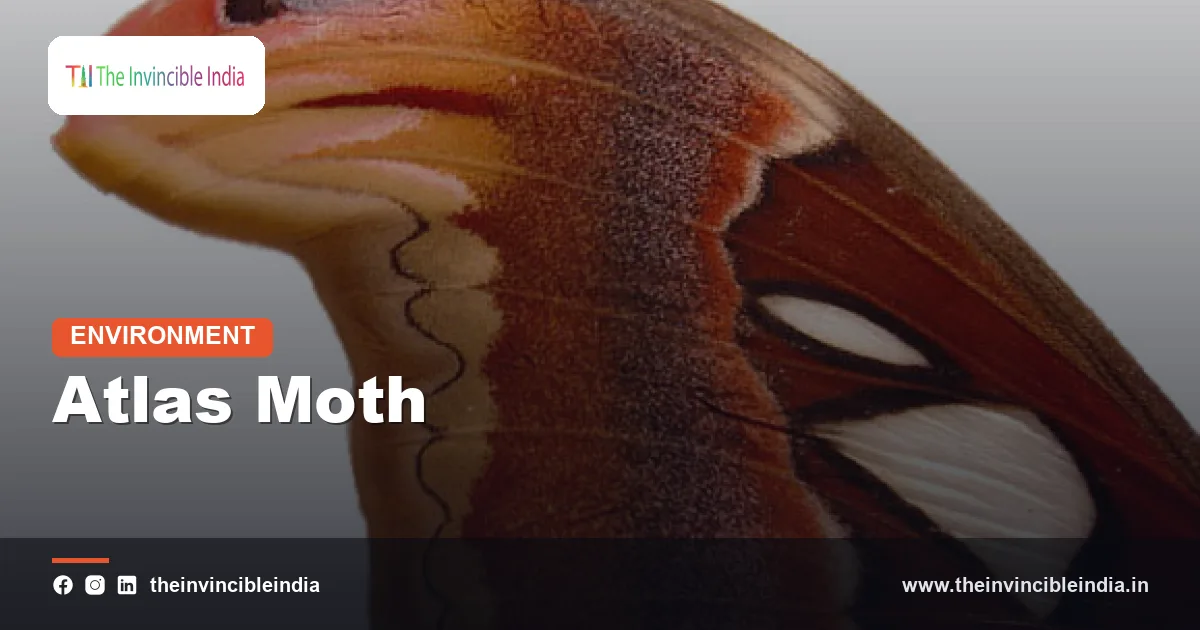
The atlas moth (Attacus atlas) is one of the largest moths in the world, a giant silk moth of Asian forests whose broad maroon-brown wings, up to about 25 cm across, carry transparent triangular windows and wingtips that resemble the heads of snakes. In India it lives in the humid forests of the Western Ghats, the Himalayan foothills and the northeast, and the adult cannot feed and survives only a week or two.
The atlas moth is harmless to humans: it does not bite, sting or spread disease, and its caterpillar is not a serious crop pest. The moth is part of a forest food web, and its large cocoons yield a wild silk long used in parts of Asia.
| Quick Fact | Detail |
|---|---|
| Common name | Atlas moth; known as “snake’s head moth” in parts of East Asia |
| Scientific name | Attacus atlas (Linnaeus, 1758) |
| Family | Saturniidae, the giant silk moths |
| Wingspan | Up to about 25 cm in large females; males are somewhat smaller |
| Adult lifespan | About one to two weeks; the adult has no functional mouthparts and does not eat |
| Caterpillar | Plump, pale green and dusted with white waxy powder; feeds on the leaves of many trees |
| Range in India | Forests of the Western Ghats, northeast India, the Himalayan foothills and other humid forests |
| Silk | Cocoons yield a coarse wild silk, called “fagara” in India |
Key Takeaways
- The atlas moth (Attacus atlas) is a giant silk moth with a wingspan of up to about 25 cm, making it one of the largest moths in the world by wing area.
- The tips of the atlas moth’s forewings are shaped and patterned like the heads of snakes, which is thought to scare off predators such as birds.
- An adult atlas moth has no functional mouthparts and cannot eat, so it lives only about one to two weeks on fat stored during its caterpillar stage.
- The atlas moth caterpillar feeds on the leaves of many forest and garden trees, including citrus, cinnamon and guava, and then spins a large silk cocoon.
- The atlas moth is completely harmless to people, as it has no biting mouthparts and no sting.
- Atlas moths depend on healthy forest, so clearing trees and bright night-time lighting are the main pressures on their numbers.
What is the atlas moth?
The atlas moth is a very large wild silk moth, Attacus atlas, that belongs to the family Saturniidae and is native to the tropical and subtropical forests of South and Southeast Asia. The Swedish naturalist Carl Linnaeus described it in 1758, in the work that founded modern animal naming. The English name is often explained as a reference to the Greek Titan Atlas or to the map-like patterns on the wings.
Saturniids are the giant silk moths, a family that includes the Indian moon moth, the Assam muga silk moth and the tasar silk moth. They share features such as robust bodies, large wings with eye-like markings, and adults that do not feed. The atlas moth is among the most famous members of the family because of its sheer size and its dramatic markings.
Most people in India come across the atlas moth by chance, when a large moth lands on a window, a veranda wall or a forest rest-house lamp in the night, and it is often mistaken for a bat or a small bird because of its size.
How big is the atlas moth?
The atlas moth can have a wingspan of up to about 25 cm, and females are larger and heavier than males. Its wing area is among the greatest of any moth, which is why it is regularly named as one of the world’s largest moths, though comparisons of “largest” differ depending on whether wingspan or wing area is measured.
| Moth | Region | Why it is notable |
|---|---|---|
| Atlas moth (Attacus atlas) | South and Southeast Asia | Very large wing area; snake-head wingtips |
| Hercules moth (Coscinocera hercules) | New Guinea and northern Australia | Often cited for largest wing area or wingspan; males have long tails |
| White witch (Thysania agrippina) | Central and South America | Often cited for the greatest wingspan |
| Indian moon moth (Actias selene) | South and Southeast Asia | Pale green with long tails; found in Indian forests as well |
The caterpillars and cocoons of the atlas moth are also large. A full-grown caterpillar may be about 10 cm long, and the cocoon is a thick, papery pod, often brown, of a size that can be held in the palm of the hand.
What does an atlas moth look like?
An atlas moth has reddish-brown to maroon wings crossed by wavy bands of white, pink and black, with a large triangular transparent patch on each wing that lacks scales, and thickly furred, rust-coloured body. The wing edges are lined with a fine pale border, and the forewing tips are drawn out into curved points.
Males have broad, feathery antennae, which they use to detect the scent chemicals released by females from a long distance. Females have somewhat narrower antennae but heavier bodies, since they carry eggs. The overall effect is of a large, handsome moth that looks almost like a piece of patterned leather.
Why do the wingtips look like snakes?
The tips of the forewings of the atlas moth are shaped and marked like the heads of snakes, complete with an eye-like spot and a line resembling a mouth. When a bird or other predator approaches, the moth can display these tips and shake its wings so that they seem to move, which may startle the predator for the vital moment the moth needs to escape. The resemblance is a form of mimicry. In parts of China the moth is called the “snake’s head moth” for this reason.
Scientists consider the snake-head pattern a classic example of defensive mimicry, in which a harmless animal copies a frightening one. The moth also relies on camouflage: resting among dead leaves, its muted colours blend into the forest floor and trunks.
Why can the adult atlas moth not eat?
The adult atlas moth cannot eat because it has no functional mouthparts, so it lives off the fat reserves it built up as a caterpillar, and it lives for only about one to two weeks. This is typical of many giant silk moths, where the adult stage exists mainly for mating and egg-laying and not for feeding.
The adult spends its brief life resting during the day and flying at night. Females release a pheromone, a chemical scent, from a gland at the tip of the abdomen, and males follow the scent plume with their large antennae and may find females several kilometres away. After mating, the female lays her eggs on host plants and dies soon afterwards. The male dies too, usually within a few days.
Because the adult does not feed, it does not visit flowers and is not a pollinator. The moth’s ecological role is mainly as a leaf-eating caterpillar and, later, as food for birds, bats, mantises and other predators.
What is the life cycle of the atlas moth?
The atlas moth life cycle has four stages: egg, caterpillar (larva), pupa inside a cocoon, and adult moth. A complete cycle usually takes a few months, depending on temperature and the availability of food, and in warm regions there may be two or more generations a year.
- Egg: a female lays clusters of round, cream-coloured eggs, often a couple of hundred in all, on the leaves of host trees. They hatch in about two weeks.
- Caterpillar: the larva grows through several moults over several weeks. It is pale green, plump, with fleshy spiny projections and a dusting of white wax, and eats large quantities of leaves.
- Cocoon and pupa: the full-grown caterpillar spins a large cocoon of silk among leaves or twigs and pupates inside it. This stage can last for several weeks.
- Adult: the moth emerges, often in the morning, expands and dries its wings and takes flight at dusk.
The spines of an atlas moth caterpillar are soft and are not stinging, so the caterpillar is safe to look at, though it is best left undisturbed.
What do atlas moth caterpillars eat?
Atlas moth caterpillars eat the leaves of many different trees and shrubs, and recorded host plants include citrus, cinnamon, guava, jamun, Ailanthus, Terminalia and several forest species. Because they feed on a broad range of plants, the moth can live in forest edges, plantations and gardens next to forest.
Despite their size, the caterpillars are not usually considered a serious pest in India. They are scattered individuals, not swarms, and the damage they do to a tree is normally slight. In gardens and plantations near forest, finding a large caterpillar on a citrus tree or a cinnamon bush is more often a pleasant surprise than a problem.
The huge leaf intake builds the fat stores that the adult will later live on, so what the caterpillar eats determines how long the moth survives.
What are atlas moth silk cocoons used for?
Atlas moth cocoons yield a coarse, strong wild silk that has been used by people in parts of Asia, and in India it is known as fagara silk. The cocoon is thick and often has a gap at one end through which the moth emerges, so the silk cannot be reeled in a single continuous thread like mulberry silk, and it is usually spun from short fibres.
In Taiwan and elsewhere, the empty cocoons have been fashioned into small pouches and purses, because the dense silk is durable and water-resistant. The silk of the atlas moth is wild silk, unlike eri silk, which is produced in Assam and the northeast by a domesticated moth.
| Silk moth | Silk | Main Indian region |
|---|---|---|
| Atlas moth (Attacus atlas) | Fagara wild silk | Forests, with limited local use |
| Muga silkmoth (Antheraea assamensis) | Golden muga silk | Assam |
| Eri silkmoth (Samia ricini) | Eri silk, often called peace silk | Assam and the northeast |
| Tasar silkmoth (Antheraea mylitta) | Tasar silk | Jharkhand, Chhattisgarh, Odisha and Bihar |
The sericulture industry of India mostly relies on other silk moths, and the atlas moth plays a minor role commercially. Its main importance is ecological and cultural, as a spectacular wild species.
Where does the atlas moth live in India?
The atlas moth lives in the humid forests of India, including the Western Ghats, the hill forests of the northeast, the foothills of the Himalaya and other moist, wooded areas, as well as across South and Southeast Asia. It is a forest species that is also seen at forest edges, in plantations and in gardens close to forest.
Adults are mainly seen between the monsoon and the early winter months, although in some warm, wet places they appear for longer. They are active at night and are drawn to lamps near forest rest houses, tea estates and hill villages. During the day they rest motionless on the underside of a leaf, in a sheltered corner or on a tree trunk.
In India, naturalists and moth enthusiasts record the species at lights in places such as Karnataka, Kerala, Meghalaya, Arunachal Pradesh and Uttarakhand. These records help to track how the species is doing.
Is the atlas moth dangerous or a pest?
The atlas moth is not dangerous: the adult cannot bite or sting, and its caterpillar is neither poisonous nor stinging. Handling an atlas moth gently will not hurt you, though the moth can lose scales from its wings, which damages its ability to fly. It is better to watch it without touching.
The moth is not a notable pest, as noted above. If an atlas moth comes into a house, it can be guided with a card or soft cloth to a tree or shrub outside, where it will settle until dusk. Switching off nearby bright lights will help to stop it circling around them.
The one risk is to the moth itself. Strong lights confuse nocturnal insects, which circle until they are exhausted or fall prey to predators.
Why is the atlas moth important?
The atlas moth is important because it is a food source for many forest animals, a sign of intact forest, and a species that draws people’s attention to the diversity of Indian insects. Caterpillars and adults are eaten by birds, bats, mantises, lizards and other predators, and so they link trees to the animals that depend on them.
The moth also has cultural and educational value. Its size and snake-head wingtips make it a favourite subject for nature photographers, school projects and citizen science. Because it needs a reasonable amount of forest, the presence of atlas moths is a positive sign that a patch of woodland is still healthy.
Habitat loss from deforestation and land conversion is the main long-term threat, and bright artificial lights at night add to the pressure. Protecting forest patches, planting native trees and using shielded, warm-toned outdoor lights are simple steps that help.
Bottom Line
The atlas moth is a giant, harmless silk moth whose snake-headed wingtips, short non-feeding adult life and large cocoons make it one of the most remarkable insects of Indian forests. Enjoy it from a distance, keep forests intact, and it will continue to be a spectacular night visitor.
Frequently Asked Questions
How big is the atlas moth?
The atlas moth can have a wingspan of up to about 25 cm, with females being larger than males. Its wing area is among the largest of any moth. It is therefore regularly listed as one of the biggest moths in the world.
Why do atlas moth wings look like snake heads?
The wingtips of the atlas moth look like snake heads because they have a curved shape and markings resembling eyes and a mouth. This is a form of defensive mimicry that may startle birds and other predators. It gives the moth a better chance to escape.
How long does an atlas moth live?
An adult atlas moth lives only about one to two weeks. It has no functional mouthparts and cannot eat, so it survives on fat stored while it was a caterpillar. Its adult life is spent mating and, for females, laying eggs.
Is the atlas moth dangerous to humans?
No, the atlas moth is not dangerous to humans. The adult has no biting mouthparts and no sting, and the caterpillar is not poisonous. It is best left alone because touching it can remove wing scales and harm the moth.
Where can I find atlas moths in India?
Atlas moths are found in the humid forests of the Western Ghats, the northeast and the Himalayan foothills. They fly at night and are drawn to lights near forests, plantations and hill settlements. The best time to look is from the monsoon through the early winter.
What do atlas moth caterpillars eat and what do they make?
Atlas moth caterpillars eat the leaves of many trees, including citrus, cinnamon, guava and other forest species. When full grown, they spin a large silk cocoon. The cocoon yields a coarse wild silk known in India as fagara silk.
{“@context”:”https://schema.org”,”@graph”:[{“@type”:”FAQPage”,”mainEntity”:[{“@type”:”Question”,”name”:”How big is the atlas moth?”,”acceptedAnswer”:{“@type”:”Answer”,”text”:”The atlas moth can have a wingspan of up to about 25 cm, with females being larger than males. Its wing area is among the largest of any moth. It is therefore regularly listed as one of the biggest moths in the world.”}},{“@type”:”Question”,”name”:”Why do atlas moth wings look like snake heads?”,”acceptedAnswer”:{“@type”:”Answer”,”text”:”The wingtips of the atlas moth look like snake heads because they have a curved shape and markings resembling eyes and a mouth. This is a form of defensive mimicry that may startle birds and other predators. It gives the moth a better chance to escape.”}},{“@type”:”Question”,”name”:”How long does an atlas moth live?”,”acceptedAnswer”:{“@type”:”Answer”,”text”:”An adult atlas moth lives only about one to two weeks. It has no functional mouthparts and cannot eat, so it survives on fat stored while it was a caterpillar. Its adult life is spent mating and, for females, laying eggs.”}},{“@type”:”Question”,”name”:”Is the atlas moth dangerous to humans?”,”acceptedAnswer”:{“@type”:”Answer”,”text”:”No, the atlas moth is not dangerous to humans. The adult has no biting mouthparts and no sting, and the caterpillar is not poisonous. It is best left alone because touching it can remove wing scales and harm the moth.”}},{“@type”:”Question”,”name”:”Where can I find atlas moths in India?”,”acceptedAnswer”:{“@type”:”Answer”,”text”:”Atlas moths are found in the humid forests of the Western Ghats, the northeast and the Himalayan foothills. They fly at night and are drawn to lights near forests, plantations and hill settlements. The best time to look is from the monsoon through the early winter.”}},{“@type”:”Question”,”name”:”What do atlas moth caterpillars eat and what do they make?”,”acceptedAnswer”:{“@type”:”Answer”,”text”:”Atlas moth caterpillars eat the leaves of many trees, including citrus, cinnamon, guava and other forest species. When full grown, they spin a large silk cocoon. The cocoon yields a coarse wild silk known in India as fagara silk.”}}]}]}


