

Atmanirbhar Bharat, meaning “self-reliant India”, is the national mission announced by Prime Minister Narendra Modi on 12 May 2020 to make India economically self-sufficient, globally competitive and resilient through domestic manufacturing, stronger supply chains and policy reform. The mission was launched alongside a large economic relief and reform package introduced during the COVID-19 pandemic, and it has since become the umbrella theme for India’s industrial, trade and defence-production policy.
Atmanirbhar Bharat does not mean economic isolation. The government has repeatedly described it as a way of building domestic strength so that India can engage with the world as a larger and more dependable participant in global trade, investment and technology. This explainer covers what the mission is, its five pillars, the tranches of the 2020 package, how it connects to Make in India, Production Linked Incentive (PLI) schemes and defence indigenisation, and the main criticisms.
| Attribute | Details |
|---|---|
| Full name | Atmanirbhar Bharat Abhiyan (Self-Reliant India Mission) |
| Announced | 12 May 2020, in an address to the nation by Prime Minister Narendra Modi |
| Package details announced by | Finance Minister Nirmala Sitharaman, in five press briefings between 13 and 17 May 2020 |
| Headline size of package | Announced as roughly Rs 20 lakh crore, about 10 per cent of India’s GDP at the time, including earlier relief and Reserve Bank of India measures |
| Five pillars | Economy, Infrastructure, System, Demography and Demand |
| Core slogan | “Vocal for Local” (promoting and using local products) |
| Related flagship programmes | Make in India (2014), PLI schemes (from 2020), Atmanirbhar Bharat Rozgar Yojana (2020) |
| Nodal approach | Cross-ministry policy theme led by the Ministry of Finance, the Ministry of Commerce and Industry and the Ministry of Defence |
Key Takeaways
- Atmanirbhar Bharat is the self-reliant India mission that Prime Minister Narendra Modi announced on 12 May 2020 during the COVID-19 pandemic.
- The Atmanirbhar Bharat package was announced at roughly Rs 20 lakh crore, about 10 per cent of India’s GDP, and was detailed by the Finance Minister in five tranches over 13-17 May 2020.
- The Atmanirbhar Bharat vision rests on five pillars: Economy, Infrastructure, System, Demography and Demand.
- Atmanirbhar Bharat is defined by the government as self-reliance with global engagement, not as protectionism or withdrawal from world trade.
- Production Linked Incentive (PLI) schemes, defence import-embargo lists and higher FDI limits in defence are among the main policy tools linked to Atmanirbhar Bharat.
- Critics argue that parts of the package were credit guarantees rather than direct fiscal spending and that higher tariffs risk raising costs, while supporters point to rising domestic manufacturing and defence production.
What is Atmanirbhar Bharat Abhiyan?
Atmanirbhar Bharat Abhiyan is India’s self-reliance mission, announced on 12 May 2020, which aims to reduce critical dependence on imports, strengthen domestic production and make the Indian economy more resilient to external shocks. The Hindi word “Atmanirbhar” literally means self-reliant, and “Abhiyan” means campaign or mission.
The mission was announced when the national lockdown had disrupted supply chains, migrant labour movement and small businesses. The Prime Minister linked the immediate crisis to a longer-term goal: a country that can meet more of its own needs in medicines, equipment, electronics, energy and defence while still exporting to the world.
The mission is best understood as both a relief package and a development philosophy. The relief side covered liquidity for businesses, support for farmers and migrant workers, and credit for small enterprises. The philosophy side set a direction of building domestic capacity, improving competitiveness and encouraging Indians to buy local.
What was the Atmanirbhar Bharat economic package?
The Atmanirbhar Bharat economic package was a set of fiscal, monetary and regulatory measures announced in May 2020 and described as being worth around Rs 20 lakh crore, or about 10 per cent of India’s GDP. The figure combined new government measures with earlier relief announcements under the Pradhan Mantri Garib Kalyan package and liquidity and rate measures announced by the Reserve Bank of India (RBI).
Finance Minister Nirmala Sitharaman explained the details over five consecutive days. Each briefing, informally called a tranche, focused on a different segment of the economy.
The five tranches of May 2020
- Tranche 1: Support for micro, small and medium enterprises (MSMEs) and liquidity for non-banking finance companies and power distribution companies. A flagship element was the collateral-free automatic loan scheme for MSMEs, delivered through the Emergency Credit Line Guarantee Scheme (ECLGS). The definition of MSMEs was also revised.
- Tranche 2: Measures for migrant workers, street vendors, small farmers and the urban poor, including free foodgrain provisions, the extension of the One Nation One Ration Card initiative, affordable rental housing for migrants and credit support for street vendors.
- Tranche 3: Agriculture and allied sectors, including the creation of an Agriculture Infrastructure Fund of Rs 1 lakh crore, support for food processing and fisheries, and legal reforms such as changes to the Essential Commodities Act.
- Tranche 4: Structural reforms for growth in sectors such as coal, minerals, defence production, civil aviation, power distribution, space and atomic energy. Commercial coal mining was opened up and the FDI limit in defence manufacturing under the automatic route was raised to 74 per cent.
- Tranche 5: Government reforms and enablers, including higher allocation for the rural employment guarantee programme (MGNREGS), health and education measures, relaxation of some company law provisions and a policy for public sector enterprises in strategic and non-strategic sectors.
Two later packages, often called Atmanirbhar Bharat 2.0 and 3.0, followed in October and November 2020. They added measures such as the Atmanirbhar Bharat Rozgar Yojana for formal job creation, support for housing and infrastructure, and the extension of PLI schemes to additional sectors.
What are the five pillars of Atmanirbhar Bharat?
The five pillars of Atmanirbhar Bharat are Economy, Infrastructure, System, Demography and Demand, as set out by the Prime Minister in the 12 May 2020 address. Each pillar addresses one dimension of building a self-reliant economy.
| Pillar | Meaning in the mission | Illustrative focus areas |
|---|---|---|
| Economy | An economy that delivers quantum jumps rather than incremental change | Ease of doing business, manufacturing scale, MSME support |
| Infrastructure | Modern infrastructure that identifies India with a new era | Roads, ports, logistics, digital networks, energy |
| System | A technology-driven, rule-based system aligned with 21st-century governance | Reforms in law, digital public platforms, simplified compliance |
| Demography | Using India’s large, young population as a source of strength | Skills, employment generation, entrepreneurship |
| Demand | Strengthening the cycle of demand and supply in the domestic market | Consumer spending, local value chains, procurement of domestic goods |
The pillars are not separate programmes with their own budgets. They work as a framework that the government uses to group reforms, and they are often cited when ministries explain how a particular scheme supports self-reliance.
Does Atmanirbhar Bharat mean economic isolation?
No, Atmanirbhar Bharat does not mean economic isolation, and the government has stated that it is not about shutting India off from the world. In his May 2020 address, the Prime Minister described self-reliance as building capacity at home so that India can contribute more to the global economy, including as a reliable supplier in global value chains.
Official statements describe Atmanirbhar Bharat as combining domestic capability with open engagement: India continues to sign trade agreements, attract foreign investment and export goods and services. The distinction drawn in policy documents is between healthy openness, in which India holds its own in world markets, and heavy dependence on a single supplier or country for critical goods.
This reading also separates the mission from the older import-substitution model of the 1950s to 1980s, when high tariffs and licences protected domestic industry from competition. Modern Atmanirbhar Bharat policy relies more on incentives for production and exports, such as PLI schemes, than on blanket licensing, although tariff increases on selected imports have also been used.
How is Atmanirbhar Bharat linked to Make in India?
Atmanirbhar Bharat builds on Make in India, the manufacturing initiative launched on 25 September 2014, by widening the goal from attracting manufacturing to achieving broader self-reliance in strategic sectors. Make in India focused on ease of doing business, foreign direct investment and 25 priority sectors, while Atmanirbhar Bharat added an emphasis on resilience, local value chains and reducing critical import dependence.
The two initiatives are complementary rather than competing. Make in India provides the manufacturing push and the investment-promotion machinery, and Atmanirbhar Bharat sets the national objective and the policy tools used in recent years.
- Make in India (2014): Opening sectors to foreign investment, simplifying approvals and promoting India as a manufacturing destination.
- Atmanirbhar Bharat (2020): Package of reforms, credit support and incentives, with a stress on local sourcing and strategic self-sufficiency.
- Shared aims: More jobs in manufacturing, a stronger share of manufacturing in the economy and higher exports.
What are PLI schemes and how do they support self-reliance?
Production Linked Incentive (PLI) schemes are government programmes that pay manufacturers a financial incentive, calculated on incremental sales of goods made in India, in order to build domestic scale and exports. PLI became the signature industrial-policy tool of the Atmanirbhar Bharat era.
The first PLI scheme covered large-scale electronics manufacturing and mobile phones and was notified in early 2020. In November 2020, the Union Cabinet approved PLI schemes across a wider set of sectors, and further schemes followed in later years. The sectors have included, among others:
- Mobile phones and electronic components
- Pharmaceuticals and medical devices
- Automobiles and auto components
- Advanced chemistry cell batteries
- Solar photovoltaic modules
- Textiles, including man-made fibre
- Food processing
- White goods such as air conditioners and LED lights
- Specialty steel and telecom equipment
The reasoning behind PLI is that incentives tied to actual production reward results rather than promises. Supporters point to the growth in mobile phone manufacturing and exports as a visible outcome. Evaluations of other sectors vary, and the effect of each scheme depends on how quickly companies meet their investment and sales targets.
How does Atmanirbhar Bharat apply to defence?
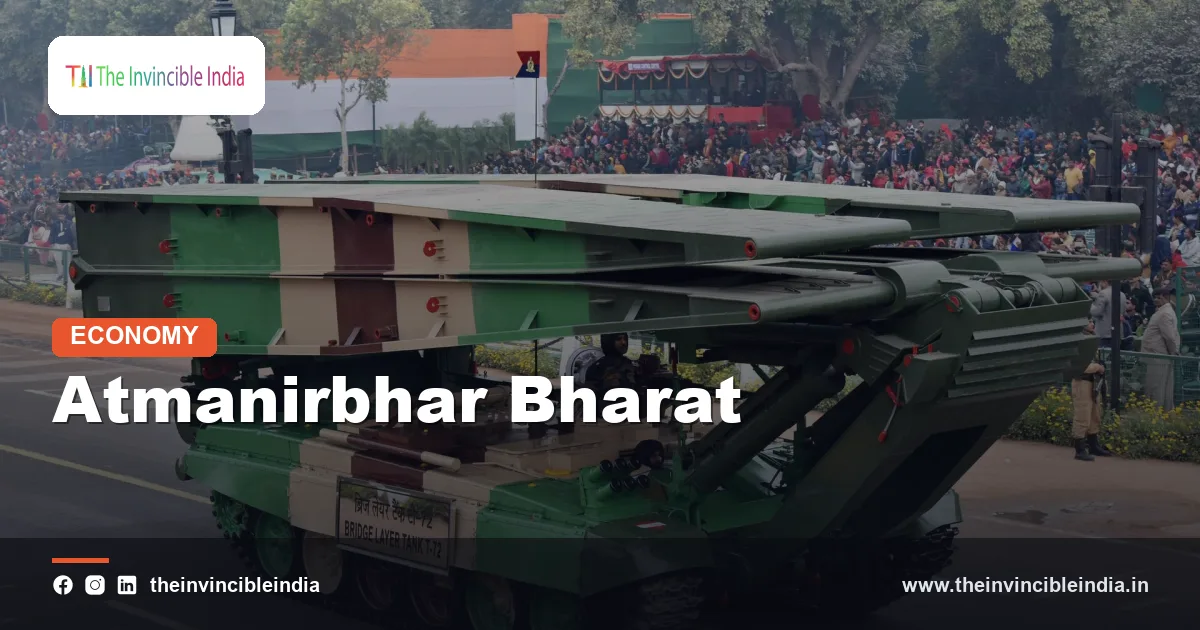
Atmanirbhar Bharat applies to defence through a policy of indigenisation, in which the Ministry of Defence restricts imports of certain items and gives priority to equipment designed, developed and manufactured in India. India has long been among the world’s largest importers of defence equipment, so self-reliance in defence is treated as both an economic and a security priority.
Main defence measures
- Positive indigenisation lists: Beginning in August 2020, the Ministry of Defence notified lists of items, covering weapons, platforms, sensors and components, that the armed forces will not import after specified dates and will procure from Indian industry. Several further lists followed.
- Higher FDI limit: The limit for foreign direct investment under the automatic route in defence manufacturing was raised from 49 per cent to 74 per cent in 2020, with higher levels possible through the government route.
- Defence Acquisition Procedure: The Defence Acquisition Procedure 2020 gave top preference to the “Buy (Indian-IDDM)” category, which stands for Indigenously Designed, Developed and Manufactured, and set minimum indigenous content requirements.
- Corporatisation of ordnance factories: The Ordnance Factory Board was restructured in 2021 into seven new defence public sector undertakings.
- Defence corridors: Dedicated defence industrial corridors were announced in Uttar Pradesh and Tamil Nadu to cluster manufacturers and suppliers.
- Innovation support: Schemes such as Innovations for Defence Excellence (iDEX) connect start-ups and MSMEs with the armed forces.
The policy has also supported defence exports, and platforms such as the Tejas light combat aircraft, indigenous artillery, missiles and naval vessels are often cited as examples of domestic capability.
What was the local-manufacturing and “Vocal for Local” push?
The “Vocal for Local” push is the Atmanirbhar Bharat call for citizens, businesses and governments to buy, use and promote locally made products and to take Indian brands to global markets. The Prime Minister introduced the phrase in 2020 as a cultural and consumer-side companion to the industrial measures.
In practice, the local-manufacturing push has taken several forms:
- Preference for local suppliers in certain government procurement, through public procurement orders that favour domestic goods and services.
- Restrictions on global tenders for smaller government purchases, to give Indian firms a better chance.
- Promotion of local and traditional products through initiatives such as One District One Product.
- Support for MSMEs through credit guarantees, a revised MSME definition and a self-reliant India fund for equity support.
- Higher customs duties on selected imports to encourage domestic production.
Alongside these, the government brought in sector reforms intended to make domestic production easier, such as opening commercial coal mining, allowing private participation in space activities and simplifying compliance rules.
What are the criticisms of Atmanirbhar Bharat?
The main criticisms of Atmanirbhar Bharat concern the real fiscal size of the 2020 package, the risk of protectionism and the effectiveness of incentive schemes. Economists and commentators have raised these points in a range of reports and public debates.
Common points of criticism
- Fiscal size: Critics noted that a large part of the headline figure consisted of loan guarantees, liquidity facilities and RBI measures, while the direct additional fiscal spending was a much smaller share of GDP.
- Protectionism risk: Higher tariffs on imported inputs can raise costs for domestic manufacturers and consumers, and may invite retaliation from trading partners.
- Dependence on imported inputs: Many sectors, including electronics, still rely on imported components, so assembling in India does not always mean deep local value addition.
- Uneven PLI outcomes: Some schemes were slow to attract investment or to meet targets, and critics question the cost per job created.
- Employment and small business: Informal workers and very small enterprises sometimes struggled to access credit guarantees in practice.
Supporters respond that the pandemic exposed real vulnerabilities in supply chains, that credit guarantees helped many small firms survive, and that domestic manufacturing, electronics exports and defence production have grown since 2020. The debate is ongoing, and assessments differ by sector.
What is the broader significance of Atmanirbhar Bharat?
Atmanirbhar Bharat is significant because it frames India’s economic policy around resilience and strategic capability, and it provides the rationale for many later industrial, trade and defence decisions. The mission also connects to the longer-term national vision of a developed India by 2047, which is the centenary of independence.
The mission also has a diplomatic dimension. As global companies diversify supply chains away from over-reliance on any single country, India presents itself as an alternative manufacturing base. Free trade agreements, investment treaties and the PLI framework are used together to support that positioning.
Finally, the mission has changed how government and business talk about priorities. Terms such as indigenisation, local value addition and import substitution of critical items now appear regularly in budgets, procurement policy and corporate announcements.
Bottom Line
Atmanirbhar Bharat is India’s self-reliance mission, launched in May 2020 with a large relief and reform package and organised around five pillars. It seeks stronger domestic production and resilience, not isolation, and works through Make in India, PLI schemes and defence indigenisation. Its success is judged sector by sector, and its critics continue to question the package’s fiscal scale and the risks of protectionism.
Frequently Asked Questions
What does Atmanirbhar Bharat mean?
Atmanirbhar Bharat means self-reliant India. It is the national mission announced on 12 May 2020 to build domestic capacity in manufacturing, technology and defence while staying connected to global trade.
When was Atmanirbhar Bharat Abhiyan launched?
Atmanirbhar Bharat Abhiyan was announced on 12 May 2020 by Prime Minister Narendra Modi. The Finance Minister explained the package in five tranches between 13 and 17 May 2020.
What are the five pillars of Atmanirbhar Bharat?
The five pillars are Economy, Infrastructure, System, Demography and Demand. Together they form the framework the government uses to group reforms for a self-reliant economy.
How big was the Atmanirbhar Bharat package?
The package was announced as roughly Rs 20 lakh crore, about 10 per cent of India’s GDP. This headline figure included earlier relief measures and Reserve Bank of India liquidity steps, and critics note that direct fiscal spending was a smaller part of the total.
Is Atmanirbhar Bharat the same as Make in India?
No, Atmanirbhar Bharat is not the same as Make in India, although the two are closely linked. Make in India, launched in 2014, focuses on promoting manufacturing and investment, while Atmanirbhar Bharat, announced in 2020, sets a wider goal of self-reliance and resilience in strategic sectors.
How does Atmanirbhar Bharat affect defence?
Atmanirbhar Bharat affects defence by promoting indigenisation of military equipment. Measures include positive indigenisation lists that bar imports of listed items, a higher FDI limit of 74 per cent under the automatic route, priority for indigenously designed equipment and the restructuring of ordnance factories into defence public sector undertakings.
{“@context”:”https://schema.org”,”@graph”:[{“@type”:”FAQPage”,”mainEntity”:[{“@type”:”Question”,”name”:”What does Atmanirbhar Bharat mean?”,”acceptedAnswer”:{“@type”:”Answer”,”text”:”Atmanirbhar Bharat means self-reliant India. It is the national mission announced on 12 May 2020 to build domestic capacity in manufacturing, technology and defence while staying connected to global trade.”}},{“@type”:”Question”,”name”:”When was Atmanirbhar Bharat Abhiyan launched?”,”acceptedAnswer”:{“@type”:”Answer”,”text”:”Atmanirbhar Bharat Abhiyan was announced on 12 May 2020 by Prime Minister Narendra Modi. The Finance Minister explained the package in five tranches between 13 and 17 May 2020.”}},{“@type”:”Question”,”name”:”What are the five pillars of Atmanirbhar Bharat?”,”acceptedAnswer”:{“@type”:”Answer”,”text”:”The five pillars are Economy, Infrastructure, System, Demography and Demand. Together they form the framework the government uses to group reforms for a self-reliant economy.”}},{“@type”:”Question”,”name”:”How big was the Atmanirbhar Bharat package?”,”acceptedAnswer”:{“@type”:”Answer”,”text”:”The package was announced as roughly Rs 20 lakh crore, about 10 per cent of India’s GDP. This headline figure included earlier relief measures and Reserve Bank of India liquidity steps, and critics note that direct fiscal spending was a smaller part of the total.”}},{“@type”:”Question”,”name”:”Is Atmanirbhar Bharat the same as Make in India?”,”acceptedAnswer”:{“@type”:”Answer”,”text”:”No, Atmanirbhar Bharat is not the same as Make in India, although the two are closely linked. Make in India, launched in 2014, focuses on promoting manufacturing and investment, while Atmanirbhar Bharat, announced in 2020, sets a wider goal of self-reliance and resilience in strategic sectors.”}},{“@type”:”Question”,”name”:”How does Atmanirbhar Bharat affect defence?”,”acceptedAnswer”:{“@type”:”Answer”,”text”:”Atmanirbhar Bharat affects defence by promoting indigenisation of military equipment. Measures include positive indigenisation lists that bar imports of listed items, a higher FDI limit of 74 per cent under the automatic route, priority for indigenously designed equipment and the restructuring of ordnance factories into defence public sector undertakings.”}}]}]}


