

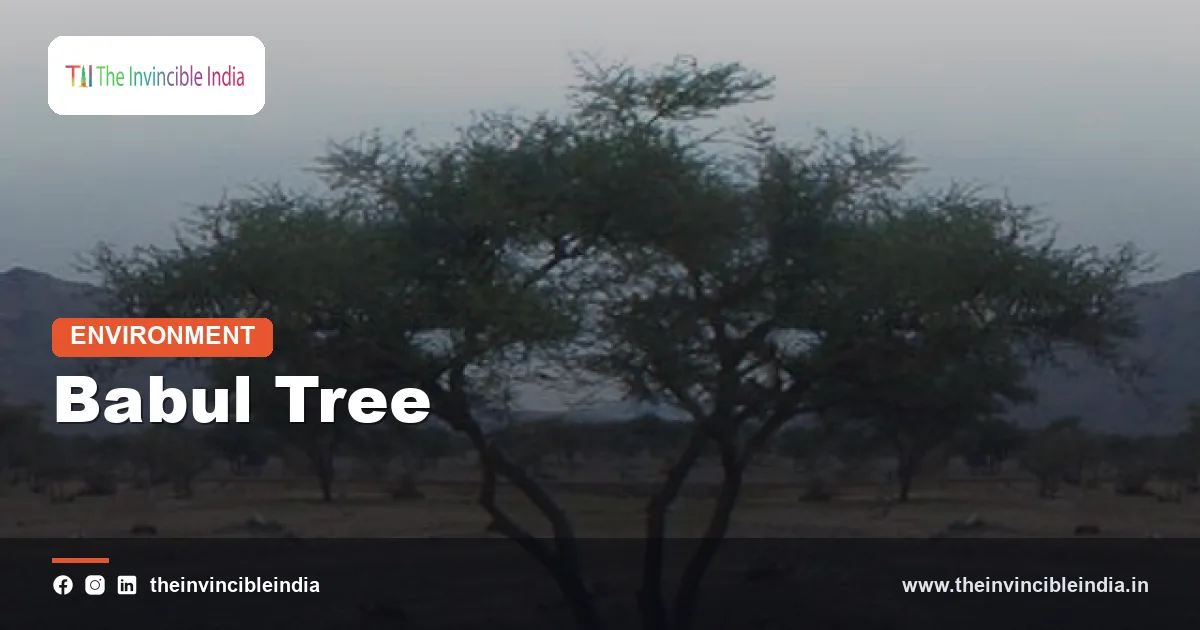
The babul tree (Vachellia nilotica, formerly Acacia nilotica) is a thorny, medium-sized acacia of the pea family that grows wild and planted across the dry plains of India and is valued for its hard timber, tannin-rich bark and pods, edible gum and nutritious fodder. It is one of the most familiar trees of the Indian countryside, standing along field bunds, canal banks, village commons and railway lines from Punjab and Rajasthan to Maharashtra and Tamil Nadu.
The babul tree is known by many local names, including kikar in the north, babla in Gujarat and karuvelam in Tamil. It tolerates drought, heat, salty soil and periodic flooding, and it supports wildlife as well as rural livelihoods. This explainer describes what the babul tree is, how to recognise it, what it is used for, how it differs from similar trees, and why it is both prized in India and treated as a pest in some other countries.
Quick Facts
| Scientific name | Vachellia nilotica (earlier Acacia nilotica); the Indian form is often listed as subspecies indica |
|---|---|
| Family | Fabaceae (legume or pea family) |
| Common Indian names | Babul, babool, kikar, babla, babhul (Marathi), baval (Gujarati), karuvelam (Tamil), nalla tumma (Telugu), gobbali (Kannada), babbula (Sanskrit) |
| Typical height | About 5 to 15 metres, occasionally taller, with a dark rough trunk and a flat or rounded crown |
| Native range | Africa (including the Nile valley), the Middle East and the Indian subcontinent |
| Main uses | Timber and charcoal, tannin for leather, gum, fodder, fuelwood, traditional tooth-cleaning twigs, soil binding |
| Habitat | Dry plains, scrub, riverbanks, canal sides and saline or alkaline land |
| Notable features | Paired white spines, round yellow flower heads, necklace-like pods, nitrogen fixation |
Key Takeaways
- The babul tree (Vachellia nilotica) is a thorny acacia of the legume family and is native to Africa, the Middle East and the Indian subcontinent.
- A babul tree has paired, straight white spines, small feathery leaves, ball-shaped yellow flowers and pods that are narrowed between the seeds like a string of beads.
- The bark and pods of the babul tree are rich in tannins and have been used for generations in India to tan leather.
- Babul timber is hard, heavy and durable, and it is used for farm implements, cart wheels, fence posts, fuelwood and good-quality charcoal.
- The babul tree should not be confused with vilayati babul (Prosopis juliflora), an introduced tree from tropical America that is a separate and often invasive species.
- Outside its native range, for example in Australia, the babul tree is known as prickly acacia and is classified as a serious invasive weed.
What Is the Babul Tree?
The babul tree is a thorny, drought-tolerant acacia, scientifically named Vachellia nilotica, that is widespread in the dry zones of India, Pakistan and Africa. It was long classified in the genus Acacia, and many books and field guides still use the older name Acacia nilotica, because botanists later moved most African and American thorny acacias to the genus Vachellia.
The word “nilotica” refers to the Nile, where the species was first described, while the Indian population is generally treated as subspecies indica. The tree is called babul or babool in much of the Hindi-speaking region, kikar in Punjab and Haryana, and by dozens of other names in other languages. It is a leguminous tree, so it carries root nodules that help it fix nitrogen, and its pods contain a number of hard seeds.
Because the tree grows quickly in poor soil, it was widely planted in India for fuelwood, shelter belts and soil binding, and it also spreads naturally by seed carried by cattle, goats and floodwater.
How Can You Identify a Babul Tree?
A babul tree can be identified by its paired, sharp white spines, its small bipinnate leaves, its round golden-yellow flower heads and its pods, which look like a string of beads. The bark is dark grey to almost black, rough and deeply fissured, and the crown is usually flat-topped or round.
Spines
The spines are straight, slender and usually in pairs at the base of leaves. They can be several centimetres long and are white or light grey, which makes them easy to spot against the dark bark. These thorns defend the tree against browsing animals, although goats and camels still eat the leaves and pods.
Leaves, flowers and pods
The leaves are made of many tiny leaflets arranged in pairs along side branches. The flowers are small, fragrant, bright yellow and packed into round heads about the size of a marble, and they attract bees. The pods are flat, greyish and constricted between seeds, so that they look like a necklace. Each pod contains several hard, dark seeds.
Size and growth
Most babul trees in India grow to ten metres or so, although well-watered trees in river valleys can be taller. Growth is relatively quick for a dry-zone tree, and the wood becomes hard and heavy as the tree matures.
Where Does the Babul Tree Grow in India?
The babul tree grows across most of the drier parts of India, including Punjab, Haryana, Rajasthan, Gujarat, Uttar Pradesh, Madhya Pradesh, Maharashtra, Karnataka, Andhra Pradesh, Telangana and Tamil Nadu. It is especially common on black cotton soils, river floodplains and canal-irrigated land.
Its tolerance of stressful conditions explains its wide range:
- Drought: It survives long dry seasons with only a few hundred millimetres of rainfall.
- Salinity and alkalinity: It grows on saline and alkaline soils where many trees fail, and is therefore used for reclaiming degraded land.
- Waterlogging: It tolerates temporary flooding, which suits river valleys and low-lying fields.
- Heat: It grows in areas with very high summer temperatures.
The tree is less suited to cold, high-rainfall hill zones. In the Western Ghats and the north-east it is uncommon, while in the Indo-Gangetic plain, the Deccan plateau and the semi-arid west it is a regular presence.
What Are the Main Uses of the Babul Tree?
The main uses of the babul tree are timber and charcoal, tannin from bark and pods, gum, fodder, fuelwood and traditional medicine. Very few other tree species in dry India supply so many products from a single plant.
Timber and fuel
Babul wood is hard, strong and heavy, and it resists wear well. It is used for ploughs, cart wheels, tool handles, agricultural implements, posts, boat parts and rural furniture. It also makes excellent fuelwood and a high-quality charcoal, which is why the tree has been a common source of energy in villages and small industries.
Tannin and leather
The bark and the pods contain high levels of tannins. In traditional leather making, babul bark was one of the standard materials for tanning hides, and the pods are also a source of tanning material. Tannin from babul has also been used in dyeing and in making ink.
Gum
The trunk exudes a gum when it is injured. Babul gum is used in some sweets, as an adhesive, and in minor pharmaceutical and industrial uses. In many regions edible gum known as gond is added to winter laddus. Babul gum is related to, but not identical with, the commercial gum arabic traded internationally, most of which comes from other African acacias such as Senegalia senegal.
Fodder
Leaves and pods are eaten by goats, sheep, cattle and camels. The pods are protein-rich and are collected and stored as a dry-season feed for livestock. Because the pods are available when grass is scarce, they are a significant resource for pastoral families.
Traditional and medicinal uses
Babul twigs have long been chewed as natural toothbrushes, called datun, and Ayurvedic and folk medicine use the bark and gum for their astringent properties. These traditional uses are widespread, but they are not a substitute for modern medical or dental care.
Why Is the Babul Tree Important for the Environment?
The babul tree is important for the environment because it fixes nitrogen, binds soil, provides shade and nesting sites, and grows on degraded land where few other trees survive. Its roots stabilise banks and bunds, and its fallen leaves add organic matter to poor soils.
Several ecological roles stand out:
- Soil improvement: Nitrogen-fixing root nodules raise soil fertility under the crown.
- Erosion control: Roots hold sandy and silty soils on canal banks and riverbanks.
- Habitat for birds: The thorny crown protects nests, and weaver birds, doves, parakeets and many other species nest in babul trees. Baya weavers often hang their woven nests from babul branches.
- Bee forage: The yellow flowers provide nectar and pollen for honeybees.
- Shade for livestock: The tree offers shade in open farmland and rangeland.
Foresters have also used babul for shelterbelts and for rehabilitating saline and alkaline soils, because it grows where more demanding trees fail.
Is the Babul Tree the Same as Vilayati Babul?
No, the babul tree is not the same as vilayati babul, which is a different thorny tree called Prosopis juliflora that was introduced to India from tropical America. The two trees look somewhat alike at a glance, and the names are similar, but they belong to different genera and behave very differently in the landscape.
| Feature | Babul (Vachellia nilotica) | Vilayati babul (Prosopis juliflora) |
|---|---|---|
| Origin | Native to Africa, the Middle East and India | Introduced from tropical America |
| Flowers | Round yellow balls | Pale yellow-green cylindrical spikes |
| Pods | Constricted, necklace-like, greyish | Long, yellowish, straight to curved, with only slight constrictions |
| Spines | Paired, long and white | Axillary thorns, usually greener and less conspicuously white |
| Spread | Spreads, but regarded as a useful native in India | Spreads aggressively; considered invasive in many areas |
| Main role | Timber, tannin, gum, fodder | Fuelwood, charcoal; often a land-management problem |
The word “vilayati” means foreign or English in many Indian languages, which is why the introduced species is distinguished from the native babul. The native khejri tree (Prosopis cineraria) of Rajasthan is a third, separate species in this group of look-alike thorny trees.
How Is the Babul Tree Grown and Managed?
The babul tree is grown from seed, which germinates readily after the hard seed coat is softened by soaking in hot water or by passing through an animal’s gut. Seedlings are raised in nurseries or sown directly on prepared ground at the start of the monsoon, and they grow quickly if protected from grazing in the first year or two.
In farm forestry, babul is often planted along field boundaries, on wasteland and on bunds. It is generally cut on a rotation of several years for fuelwood or poles and longer for timber, and it regrows from stumps after cutting. Pruning of lower branches can produce straighter trunks, and thinning improves the size of the remaining trees.
Because the species can spread by seed into grazing land, managers in areas where it is not wanted need to control seedlings early. In its native range in India, however, the tree is regarded as a useful, hardy component of dryland agriculture and forestry.
Why Is the Babul Tree a Weed in Some Countries?
The babul tree is considered a serious weed in some countries, most notably in Australia, because it spreads rapidly and forms dense thorny thickets on grazing land. In Australia the species, introduced in the late nineteenth century as a shade and fodder tree, is known as prickly acacia and is listed as a Weed of National Significance.
The same traits that make babul useful in India, including tolerance of drought, fast growth, hard seeds and animal-dispersed pods, make it a problem where it has no natural controls and where open rangeland is the main land use. The case shows that a tree is not inherently good or bad: its value depends on whether it is native, how it is managed and what ecosystem it enters. In India, the babul is part of the native flora and is mostly treated as a resource, though local managers may still remove it from some grasslands and conservation areas to protect open habitats.
Bottom Line
The babul tree is one of India’s most useful dryland trees, offering hard timber, tannin, gum, fodder and soil improvement from a thorny, tough and fast-growing acacia. Understanding the difference between native babul, introduced vilayati babul and the native khejri helps farmers, foresters and nature lovers choose and manage the right tree for the right place.
Frequently Asked Questions
What is the babul tree used for?
The babul tree is used for hard timber, charcoal and fuelwood, tannin for leather, edible and industrial gum, and fodder for livestock. Its twigs are also used as traditional datun for cleaning teeth. The tree is valued in dry regions because it supplies many products at once.
What is the scientific name of the babul tree?
The scientific name of the babul tree is Vachellia nilotica, which was earlier called Acacia nilotica. It belongs to the legume family, Fabaceae. The Indian form is usually listed as subspecies indica.
Is babul the same as kikar?
Yes, babul and kikar usually refer to the same tree, Vachellia nilotica, with kikar being the common name in Punjab, Haryana and nearby regions. Different regions use different names, such as babla in Gujarat and karuvelam in Tamil Nadu. People should still check whether the speaker means the native babul or the introduced vilayati babul.
What is the difference between babul and vilayati babul?
Babul is the native Indian acacia Vachellia nilotica, while vilayati babul is Prosopis juliflora, an introduced tree from tropical America. Babul has round yellow flower heads and necklace-like pods, whereas vilayati babul has cylindrical flower spikes and straighter pods. Vilayati babul is considered invasive in many dry regions.
Does the babul tree produce gum arabic?
The babul tree produces a gum that is similar to gum arabic, but most commercial gum arabic comes from other African acacias, particularly Senegalia senegal. Babul gum is collected locally and used in some foods, adhesives and traditional products. In many parts of India the edible form is known as gond.
Why is the babul tree called prickly acacia in Australia?
Australians call the babul tree prickly acacia because of its sharp spines, and they treat it as an invasive weed. It was introduced there in the late nineteenth century and spread across large areas of grazing land. In India the same species is native and generally regarded as useful.
{“@context”:”https://schema.org”,”@graph”:[{“@type”:”FAQPage”,”mainEntity”:[{“@type”:”Question”,”name”:”What is the babul tree used for?”,”acceptedAnswer”:{“@type”:”Answer”,”text”:”The babul tree is used for hard timber, charcoal and fuelwood, tannin for leather, edible and industrial gum, and fodder for livestock. Its twigs are also used as traditional datun for cleaning teeth. The tree is valued in dry regions because it supplies many products at once.”}},{“@type”:”Question”,”name”:”What is the scientific name of the babul tree?”,”acceptedAnswer”:{“@type”:”Answer”,”text”:”The scientific name of the babul tree is Vachellia nilotica, which was earlier called Acacia nilotica. It belongs to the legume family, Fabaceae. The Indian form is usually listed as subspecies indica.”}},{“@type”:”Question”,”name”:”Is babul the same as kikar?”,”acceptedAnswer”:{“@type”:”Answer”,”text”:”Yes, babul and kikar usually refer to the same tree, Vachellia nilotica, with kikar being the common name in Punjab, Haryana and nearby regions. Different regions use different names, such as babla in Gujarat and karuvelam in Tamil Nadu. People should still check whether the speaker means the native babul or the introduced vilayati babul.”}},{“@type”:”Question”,”name”:”What is the difference between babul and vilayati babul?”,”acceptedAnswer”:{“@type”:”Answer”,”text”:”Babul is the native Indian acacia Vachellia nilotica, while vilayati babul is Prosopis juliflora, an introduced tree from tropical America. Babul has round yellow flower heads and necklace-like pods, whereas vilayati babul has cylindrical flower spikes and straighter pods. Vilayati babul is considered invasive in many dry regions.”}},{“@type”:”Question”,”name”:”Does the babul tree produce gum arabic?”,”acceptedAnswer”:{“@type”:”Answer”,”text”:”The babul tree produces a gum that is similar to gum arabic, but most commercial gum arabic comes from other African acacias, particularly Senegalia senegal. Babul gum is collected locally and used in some foods, adhesives and traditional products. In many parts of India the edible form is known as gond.”}},{“@type”:”Question”,”name”:”Why is the babul tree called prickly acacia in Australia?”,”acceptedAnswer”:{“@type”:”Answer”,”text”:”Australians call the babul tree prickly acacia because of its sharp spines, and they treat it as an invasive weed. It was introduced there in the late nineteenth century and spread across large areas of grazing land. In India the same species is native and generally regarded as useful.”}}]}]}


