

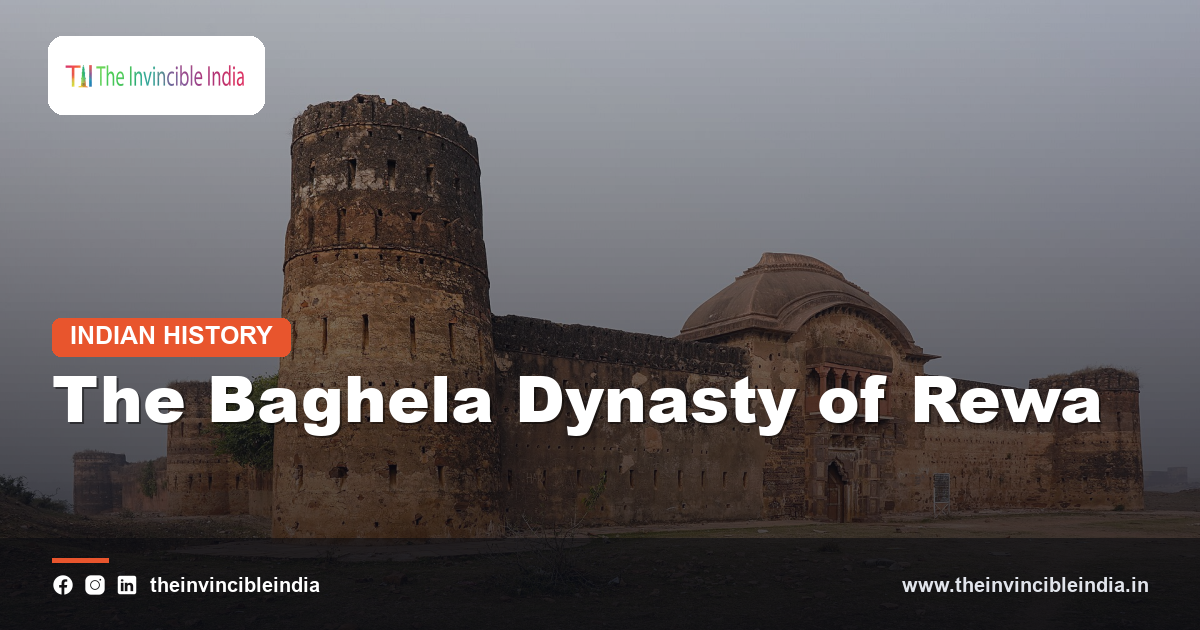
The Baghela dynasty of Rewa, also called the Baghel dynasty, was a Rajput ruling house that governed the Rewa state in the Baghelkhand region of present-day Madhya Pradesh. A Rajput house of central India, it gave its name to the surrounding tract of Baghelkhand and held its territory through the medieval and modern periods. According to tradition, the family traced its origin to the Solankis, also known as the Chaulukyas of Gujarat, though such genealogical links are matters of tradition and scholarly discussion. The dynasty is associated in its earlier history with the hill fort of Bandhavgarh, now famous for its national park, and later with the town of Rewa, which became its capital. Under British paramountcy the house ruled the recognised princely state of Rewa, and after independence in 1947 the state acceded to India. As a Rajput house, it belongs to the wider world described in our guide to the Rajputs. Because several dates and details rest on tradition, this account keeps to general terms where the record is uncertain.
Quick answer: The Baghela dynasty, also called the Baghel dynasty, was a Rajput ruling house that governed the Rewa state in the Baghelkhand region of present-day Madhya Pradesh. A Rajput house of central India, tradition traces its origin to the Solankis or Chaulukyas of Gujarat. It is associated in its earlier history with the hill fort of Bandhavgarh and later with the town of Rewa, its capital. Under British paramountcy it ruled the princely state of Rewa, and after independence in 1947 the state acceded to India.
Key Takeaways
- The Baghela dynasty, also spelled Baghel, was a Rajput ruling house of the Rewa state in present-day Madhya Pradesh.
- The dynasty gave its name to the surrounding region of Baghelkhand.
- Tradition traces the family’s origin to the Solankis, also known as the Chaulukyas of Gujarat.
- Its earlier history is linked to the hill fort of Bandhavgarh, now famous for its national park.
- The town of Rewa later became the capital of the state.
- Under British paramountcy the house ruled the princely state of Rewa, which acceded to India after 1947.
Read on for the history, culture, and legacy in detail.
Quick Facts
| Detail | Information |
|---|---|
| Dynasty | Baghela (Baghel) dynasty of Rewa |
| Type | Rajput ruling house |
| Period | Medieval to the twentieth century; early dates traditional |
| Region | Baghelkhand, present-day Madhya Pradesh |
| Early Fort | Bandhavgarh |
| Capital | Rewa (in later history) |
| Traditional Origin | The Solankis / Chaulukyas of Gujarat |
| Later Status | Princely state under British paramountcy |
| Acceded to India | After independence in 1947 |
What Was the Baghela Dynasty of Rewa?
The Baghela dynasty of Rewa was a Rajput ruling house that governed the Rewa state in the Baghelkhand region of present-day Madhya Pradesh. Also spelled Baghel, the family was a Rajput house of central India whose name became attached to the surrounding tract of country, known as Baghelkhand. The dynasty held its territory through the medieval and modern periods, ruling first from the hill fort of Bandhavgarh and later from the town of Rewa, which became its capital. In the age of British paramountcy it governed the recognised princely state of Rewa, one of the notable states of central India. The house endured until the integration of the states into independent India after 1947. As a Rajput ruling house with a long continuity, the Baghela dynasty holds an important place in the history of central India. Its story reflects the world of the Rajput houses and the princely states of the region.
Where Was the Baghela Kingdom Located?
The Baghela kingdom was located in central India, in the region of Baghelkhand, which lies in the eastern part of present-day Madhya Pradesh and extends toward the neighbouring country. A land of hills, plateaus, forests and river valleys, the region took its very name from the Baghela dynasty that ruled it. The kingdom controlled a tract of this central Indian country, with its early centre at the hill fort of Bandhavgarh and its later capital at the town of Rewa. Its position placed it among the states of central India, in contact with the powers of the north, the Deccan and the surrounding regions. The terrain of hills and forests shaped the character and fortunes of the kingdom. The centres at Bandhavgarh and Rewa anchored the dynasty in the historical geography of Baghelkhand. The Baghela kingdom was thus firmly rooted in the eastern uplands of central India.
What Is Baghelkhand?
Baghelkhand is the region of central India that takes its name from the Baghela dynasty, lying in the eastern part of present-day Madhya Pradesh and extending into adjoining areas. The name reflects the historic rule of the Baghela Rajputs over this tract, which became identified with their house. A country of hills, plateaus, forests and rivers, Baghelkhand formed a distinct region with its own character within central India. The region was home to the Rewa state and other territories associated with the Baghela house and related chiefs. Its geography, culture and history were closely bound up with the rule of the dynasty that gave it its name. Baghelkhand thus stands as both a geographical region and a historical identity shaped by the Baghela dynasty. The region remains a recognisable cultural and geographical unit of central India today, preserving in its name the memory of its former ruling house.
Who Were the Baghela Rajputs?
The Baghela Rajputs were the Rajput clan and ruling house behind the Baghela dynasty of Rewa, one of the Rajput communities of central India. As Rajputs, they belonged to the wider body of martial and princely houses that ruled many states across northern and central India through the medieval and modern periods. The Baghela house claimed the traditions of Rajput kingship, with its ideals of lineage, honour and martial valour. According to tradition, the clan traced its origin to the Solankis, also known as the Chaulukyas of Gujarat, from whom it was said to have branched, though such genealogies rest on tradition. From this community arose the line of rulers who built and governed the Rewa state over a long history. The Baghela Rajputs thus represent both a clan and a ruling house whose identity is woven into the history of central India and the wider world of the Rajputs.
How Are the Baghelas Linked to the Solankis of Gujarat?
The Baghelas are linked by tradition to the Solankis, the dynasty also known as the Chaulukyas of Gujarat, from whom the house is said to have descended. According to the traditional genealogy, the Baghela family branched from the Solanki or Chaulukya line of Gujarat and in time established itself in the country of central India that became Baghelkhand. Such accounts of descent are a common feature of Rajput genealogies, which often traced a house to an older and prestigious line, and they rest on tradition rather than firm documentation. The link expresses the way the Baghela house understood and presented its origins and its place among the Rajput clans. Scholars treat these genealogical traditions with care, recognising both their cultural importance and their uncertainty. The connection to the Solankis of Gujarat thus forms part of the traditional self-understanding of the Baghela dynasty. It reflects the broader pattern of Rajput lineage and memory.
Who Founded the Baghela House of Rewa?
The founding of the Baghela house of Rewa is attributed in tradition to an early ancestor remembered as the progenitor who established the family in the country of central India that became Baghelkhand. According to the traditional accounts, the house arose from its claimed Solanki or Chaulukya origins and settled in the region, where it built its early power around the hill fort of Bandhavgarh. As with other Rajput houses, the details of this early history rest largely on tradition and genealogy and are treated with scholarly care, with several points debated. The foundation of the house marks the beginning of the long rule of the Baghela dynasty over the Rewa country. From these early origins the family rose to govern the state that bore its influence for centuries. The founding figures of the Baghela house thus belong to the traditional memory of the dynasty, preserved in its genealogies rather than in firm record.
What Was the Role of Bandhavgarh Fort?
Bandhavgarh was the early hill fort associated with the Baghela dynasty, a stronghold set upon a great hill in the country that became Baghelkhand, long serving as a seat of the house. In the earlier history of the dynasty, before the capital moved to Rewa, Bandhavgarh was an important centre of Baghela power, its commanding position upon the hill making it a formidable fortress. The fort is remembered for its ancient associations and its remains, which bear witness to a long history reaching back before the Baghela period. In later times the area of Bandhavgarh became famous for its forests, now protected as a renowned national park celebrated for its wildlife. The fort itself survives as a historic monument within this landscape. As the early seat of the Baghela house, Bandhavgarh holds an important place in the memory of the dynasty. It stands among the notable heritage sites of the region today.
Why Did the Capital Move to Rewa?
The capital of the Baghela dynasty moved in time from the hill fort of Bandhavgarh to the town of Rewa, which became the principal seat of the house in its later history. According to tradition, the shift of the seat to Rewa reflected the changing circumstances and needs of the dynasty, as the town grew into the main centre of its power and administration. Rewa, set in the country of Baghelkhand, developed as the capital of the state, giving its name to the Rewa state ruled by the Baghela house. The move marks the transition from the earlier hill-fort phase to the established kingdom centred on Rewa. The town became the focus of the political, administrative and cultural life of the state. The details of this shift are drawn from tradition and the records of the region and are described in general terms. The establishment of Rewa as the capital thus defined the later history of the Baghela dynasty.
How Was the Rewa State Governed?
The Rewa state was governed by its Baghela ruler, who bore the title of raja and later maharaja, and whose authority rested on control of the territory of Baghelkhand, its people and its resources, from the capital at Rewa. The administration managed the resources of a region of hills, forests and agricultural land, drawing revenue from the lands and produce of the state. The ruler depended on the support of nobles, chiefs and officials who held responsibilities within the government and the military. Within the state, local chiefs and feudatories held their own lands under the authority of the ruling house. Under British paramountcy, as a princely state, Rewa conducted its internal affairs under its ruling house while acknowledging the overarching authority. The details of the administration are drawn from the records of the region and are described in general terms. This system of governance enabled the Baghela dynasty to hold its state through its long history.
What Was the Culture of the Rewa Court?
The culture of the Rewa court was shaped by its Rajput ruling traditions, its central Indian setting, and the patronage of its rulers over the arts, religion and learning. As a Rajput house, the Baghela dynasty upheld the ideals and customs of Rajput kingship, with their emphasis on lineage, honour and martial tradition. The court patronised temples, religious institutions and the devotional life of the region, in keeping with the role of a Hindu ruling house. The culture of the state blended the broader traditions of Rajput heritage and Hindu devotion with the distinctive character of Baghelkhand, with its own folk traditions, music, crafts and ways of life. The rulers, as patrons, were closely tied to the religious and cultural life of their country. The arts and architecture of the state, including its forts and palaces, reflected this heritage. The details of this culture are described in general terms, reflecting the broadly known heritage of Rewa.
Was Tansen Connected to the Rewa Court?
Tradition connects the celebrated musician Tansen with the court of Rewa in the period before he joined the Mughal court, a link cherished in the cultural memory of the region. According to this widely repeated tradition, Tansen, one of the most renowned musicians in the history of Indian classical music, was associated with the Baghela court of Rewa before his fame carried him to the service of the Mughal emperor Akbar. Such accounts belong to the traditions surrounding the great musician, whose life is remembered through a rich body of story and legend, and they are treated as tradition rather than firm record. The connection, true or embellished, reflects the cultural standing of the Rewa court and its place in the memory of the region. It links the heritage of Rewa to the wider story of Indian classical music. The tradition of Tansen and Rewa thus forms part of the cultural lore of the Baghela state.
How Did Rewa Relate to the Mughals?
The Baghela state of Rewa related to the Mughal empire through the patterns of submission, service and accommodation by which many Rajput and central Indian houses dealt with the imperial power. As the Mughal empire extended its authority across northern and central India, the states of the region, including Rewa, came within its sphere of influence. The Baghela rulers, like many houses of the time, entered into relations with the Mughals, acknowledging imperial authority while retaining their own territory and standing. These relations involved the forms of allegiance and service common among the subordinate rulers of the empire. The connection placed Rewa within the wider framework of Mughal power in central India. The details of these relations are drawn from the records of the period and are described in general terms. Through such accommodation the Baghela house preserved its state through the age of Mughal dominance in the subcontinent.
How Did Rewa Become a Princely State Under the British?
Rewa became a recognised princely state under British paramountcy in the course of the nineteenth century, as the British established their overarching authority across central India. Under this arrangement, the Baghela rulers of Rewa continued to govern their territory and manage its internal affairs while acknowledging the paramount power. Rewa was among the notable princely states of central India, and its rulers held their royal standing within the framework of British relations with the states. The period brought developments in administration and public works to the state, in keeping with the wider trends among the princely states. The relationship with the British framework shaped the fortunes and continued existence of the state. The Baghela house retained its royal standing and its association with the heritage of Baghelkhand. The details of this period are drawn from the records of the time and are described in general terms. Under British paramountcy, Rewa thus continued as a Rajput princely state.
How Did Rewa Join India?
Rewa, the Baghela princely state, acceded to independent India after independence in 1947, as the princely states were integrated into the new nation. With the end of British paramountcy, the rulers of the princely states acceded to India, and Rewa was merged into the republic, becoming part of the area that today forms the state of Madhya Pradesh. This transition brought to a close the long rule of the Baghela dynasty as a ruling house, though the family retained its historical standing and heritage. The integration of the states was part of the great reshaping of the political map of the subcontinent after independence. The accession marked the end of Rewa as a separate ruling state. The details of the integration belong to the broadly recorded history of the period. The joining of Rewa to India thus closed the final chapter of the Baghela dynasty as a princely house of central India.
Why Is the Baghela Dynasty Significant?
The Baghela dynasty is significant as one of the enduring Rajput ruling houses of central India and as the house that gave its name to the region of Baghelkhand. Its long continuity, from its early history around the hill fort of Bandhavgarh to its rule of the Rewa state as a princely house, illustrates the world of the Rajput dynasties and the princely states of the subcontinent. Its traditions, including the claimed descent from the Solankis of Gujarat and the cherished link with the musician Tansen, reflect the cultural memory of a long-lived house. The dynasty’s history offers a window onto the politics of central India, the relations with the Mughals and the British, and the integration of the states into independent India. Its forts, palaces and heritage stand among the notable monuments of the region. For students of Indian history, the Baghela dynasty of Rewa offers a vivid example of a central Indian Rajput house.
The Baghela Dynasty of Rewa Today
The Baghela dynasty of Rewa is remembered today through the heritage of the town of Rewa and the region of Baghelkhand in present-day Madhya Pradesh, and through the forts and palaces associated with the house. The historic fort of Bandhavgarh, set within a landscape now famous for its national park, and the heritage of Rewa itself draw visitors and students of history, standing as reminders of the long rule of the dynasty. The region of Baghelkhand continues to bear the name of the house that once ruled it. The traditions associated with the court, including the cherished link with the musician Tansen, remain part of the cultural memory of the region. Scholars and local communities continue to study and celebrate the history and heritage of the Baghela state. For readers of Indian history, the Baghela dynasty of Rewa offers a striking example of a central Indian Rajput house. Its legacy endures in the forts, heritage and name of Baghelkhand.
Sources & Further Reading
- Archaeological Survey of India (asi.nic.in).
- Ministry of Culture, Government of India (indiaculture.gov.in).
- Department of Tourism, Government of Madhya Pradesh (mptourism.com).
Frequently Asked Questions
What was the Baghela dynasty of Rewa?
The Baghela dynasty, also spelled Baghel, was a Rajput ruling house that governed the Rewa state in the Baghelkhand region of present-day Madhya Pradesh. It held its territory through the medieval and modern periods, ruling as a princely state under British paramountcy.
Where did the Baghela dynasty rule?
The Baghela dynasty ruled in the region of Baghelkhand, in the eastern part of present-day Madhya Pradesh, which took its name from the house. Its early centre was the hill fort of Bandhavgarh, and its later capital was the town of Rewa.
Are the Baghelas linked to the Solankis of Gujarat?
According to tradition, the Baghela house traced its origin to the Solankis, also known as the Chaulukyas of Gujarat, from whom it was said to have branched. Such genealogical links rest on tradition and are treated with scholarly care.
What is the connection between Bandhavgarh and the Baghelas?
Bandhavgarh was an early hill fort and seat of the Baghela dynasty before the capital moved to Rewa. The surrounding area later became famous for its forests, now protected as a renowned national park, with the historic fort surviving within it.
Was Tansen connected to the Rewa court?
Tradition connects the celebrated musician Tansen with the court of Rewa before he joined the Mughal court of Akbar. This belongs to the rich body of tradition surrounding the musician and is remembered as part of the cultural lore of the region.
When did Rewa join India?
Rewa, the Baghela princely state, acceded to independent India after independence in 1947, when the princely states were integrated into the new nation. It became part of the area that today forms the state of Madhya Pradesh.


