

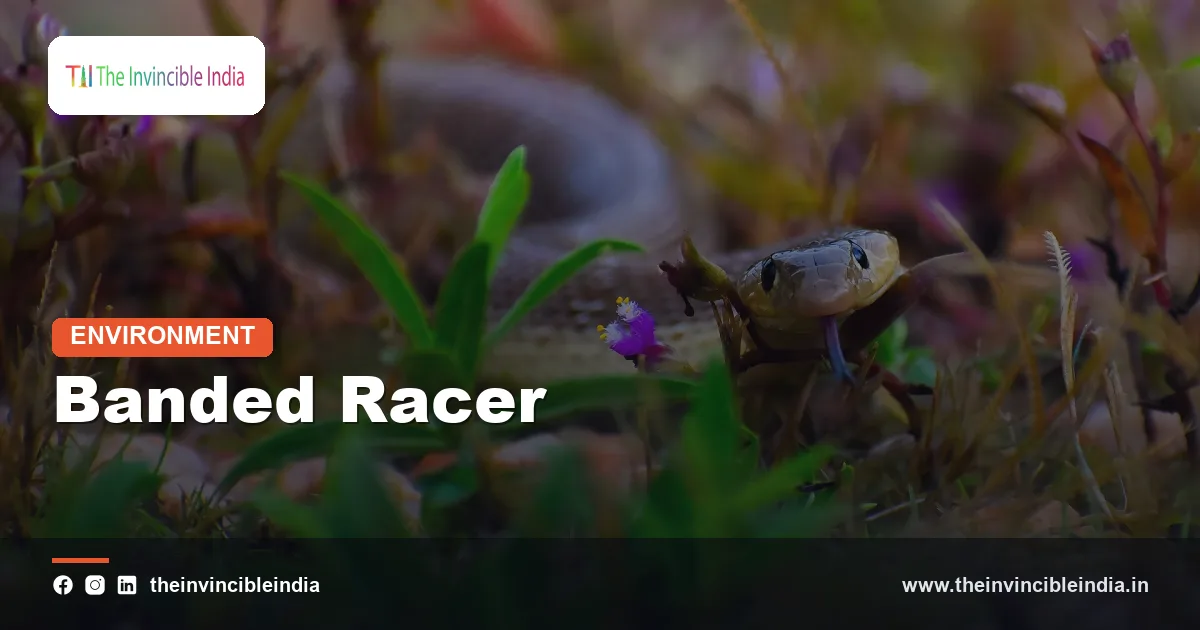
The banded racer (Argyrogena fasciolata) is a slim, fast-moving, non-venomous snake of the Indian plains, scrub and gardens, known for the dark cross-bands on its young body that fade as the snake ages. The banded racer is completely harmless to humans, feeds on lizards, frogs, insects and small rodents, and is frequently killed because its juvenile pattern resembles that of a krait.
Nervous, quick and mostly active during the day, the banded racer is often seen dashing across fields, roads and compound walls. This explainer describes how to identify a banded racer, how its colour changes with age, what it eats, where it lives, how it behaves and why it should be left alone.
| Quick Fact | Detail |
|---|---|
| Common name | Banded racer, also called the Indian banded racer or fasciolated racer |
| Scientific name | Argyrogena fasciolata |
| Family | Colubridae |
| Venom status | Non-venomous and harmless to humans |
| Typical adult length | Roughly 1 to 1.5 metres; slender body |
| Activity | Diurnal; very fast, alert and nervous |
| Main prey | Lizards, frogs, insects, small rodents and occasionally small birds |
| Reproduction | Egg-laying; clutch laid in sheltered sites |
| Range | Widespread in India and parts of the neighbouring Indian subcontinent |
| Habitat | Plains, dry scrub, farmland, rocky areas, gardens and open woodland |
Key Takeaways
- The banded racer (Argyrogena fasciolata) is a non-venomous colubrid with no venom dangerous to people.
- Young banded racers carry bold dark cross-bands that fade with age, so adults often look almost plain brown, olive or grey.
- A banded racer is a day-active, fast-moving hunter that relies on speed and sharp eyesight to catch lizards, frogs and insects.
- The banded racer is nervous and may bite and thrash when cornered, but it bites only in self-defence and the wound is shallow.
- Banded racers are commonly killed in the mistaken belief that they are kraits or other venomous snakes.
- Leaving a banded racer alone benefits farms and gardens, because it controls insects, lizards and small rodents without chemicals.
What is the banded racer?
The banded racer is a slender, non-venomous snake of the family Colubridae, built for speed and found throughout much of India. It belongs to the group commonly called racers, which are lightly built snakes with big eyes and smooth scales that hunt by day.
The species was earlier placed in the genus Coluber and is now classified in the genus Argyrogena. Its English name comes from its pattern of dark bands, which are usually clearest in young snakes. In some regions it is called by local names that refer to its speed or its habit of crossing roads and paths.
Unlike constrictors, the banded racer does not squeeze its prey. It chases and seizes food with its mouth, often swallowing small animals alive.
How can you identify a banded racer?
A banded racer can be identified by its slim body, smooth scales, large eyes with round pupils, a head slightly wider than the neck and a series of dark cross-bands that are strongest on young snakes. The upperparts range from light brown to olive-grey, while the belly is pale, often white or cream.
Main features
- Body: long, slender and lightly built, with a tail that tapers to a fine point.
- Scales: smooth, with a slight sheen.
- Eyes: large and prominent with a rounded pupil, which fits a day-active hunter.
- Head: distinct from the neck, with a slightly pointed snout.
- Pattern: dark bands or blotches on a lighter background in juveniles; faded or absent bands in adults.
Because the pattern changes with age and region, an individual banded racer may look quite different from a photograph in a field guide. People should not try to confirm identity by touching or handling the animal. A photograph taken from a distance and shared with a local snake expert or forest department is much safer.
Why do the bands of a banded racer fade with age?
The bands of a banded racer fade with age because the dark pigment pattern of the juvenile stage gradually blends into the background colour as the snake grows, a change known as ontogenetic colour change. Adults often keep only faint traces of bands near the neck or front of the body.
Zoologists generally think that bold banding helps young snakes by disrupting their outline against stems and grass, which makes them harder for birds and other predators to track while moving. In some cases the pattern may also give a passing resemblance to dangerous snakes, which can deter predators. As the racer grows bigger and faster, it relies less on the pattern and more on speed.
| Life stage | Typical appearance | Common confusion |
|---|---|---|
| Hatchling and juvenile | Clear dark bands on a light brown or grey body | Mistaken for a krait or a wolf snake |
| Sub-adult | Bands begin to blur; background becomes olive or brown | Mistaken for a trinket snake |
| Adult | Mostly plain or faintly banded; slender and fast | Mistaken for a rat snake or a young cobra |
Where does the banded racer live in India?
The banded racer lives in open and semi-open habitats across India, including dry plains, scrub forests, grasslands, farmland, rocky outcrops, gardens and the edges of villages and towns. It prefers warm, dry or semi-arid regions with plenty of cover and open ground for hunting.
The species is widespread in peninsular, central and northern India, and extends to parts of the neighbouring countries of the subcontinent. In built-up areas it uses stone walls, compound hedges, culverts, storerooms and piles of debris for shelter. At night and in the hottest hours the snake retreats into burrows, rock crevices and thick vegetation.
The International Union for Conservation of Nature (IUCN) has treated the species as of Least Concern because of its broad range, although local numbers fall where roads, intensive farming and persecution are heavy.
What does the banded racer eat?
The banded racer eats lizards, frogs, large insects such as grasshoppers, small rodents and occasionally small birds or their eggs. Young racers feed mainly on insects and small lizards, while larger adults take frogs and rodents.
It hunts by sight, moving swiftly through low vegetation with its head raised to spot movement. Once it sees prey, the racer rushes in, grabs it and swallows it. This lively hunting style gives the species its name.
Role in farms and gardens
By eating grasshoppers, crickets, lizards and rodents, the banded racer helps keep crop pests and small animals in check. Its role is modest compared with that of larger rat snakes, but it contributes to ecological balance, particularly in dry scrub and field margins. Farmers who tolerate racers often see fewer insect and rodent problems without needing as many chemical controls.
The banded racer is also food for larger predators such as raptors, mongooses, monitor lizards and bigger snakes, so it forms a link between small prey and larger hunters.
How does the banded racer behave?
The banded racer is a diurnal, alert and highly nervous snake that relies on speed to escape danger. It will usually dash away at the first sign of a human or a predator, flashing across grass, rocks or tarmac.
If cornered, the banded racer may coil, flatten its body, vibrate its tail and strike repeatedly at the threat. It can bite freely when held, which is why handling is discouraged, but the bite has no venom and typically causes only small scratches or punctures. Some individuals also release musk and droppings from the vent when grabbed.
Banded racers are good climbers as well as fast ground runners. They may climb into shrubs, hedges and low branches while hunting or fleeing, and they sometimes shelter in the roof spaces of outbuildings.
How does the banded racer breed?
The banded racer breeds by laying eggs, and the female deposits a clutch in a concealed place such as a rodent burrow, rock crevice, soil crack or leaf litter. The eggs hatch after a period of incubation that depends on temperature, usually timed to coincide with warmer, wetter months when food is plentiful.
Hatchlings emerge fully formed, with striking bands, and are independent from the start. They eat tiny lizards and insects and grow quickly in their first season. Survival is low, because many young are taken by birds, lizards and other snakes.
Is the banded racer venomous or dangerous?
The banded racer is not venomous and is not dangerous to people. It has no venom glands comparable to those of cobras, kraits or vipers, and its bite is a shallow, mechanical wound.
The snake can be dangerous only in the sense that any wild animal may bite when it is hurt. Ordinary first aid for a banded racer bite is to wash the wound with clean water and soap and see a doctor if it is deep, becomes red and swollen, or the person’s tetanus protection is out of date. No antivenom is required.
A person bitten by an unidentified snake must not assume it was a racer. Treat unknown bites as an emergency and reach a hospital with antivenom facilities quickly, keeping the bitten limb still. Do not cut the wound, tie tight bands or try home remedies, and do not kill the snake to prove what it was. A safe photo helps, but doctors rely on symptoms.
How is the banded racer different from a krait or a wolf snake?
A banded racer differs from a krait in being slimmer, faster and brown or olive rather than blue-black, and from a wolf snake by its larger eyes, more elongated body and diurnal habits. Young banded racers have the greatest resemblance to both.
| Feature | Banded racer | Common krait | Common wolf snake |
|---|---|---|---|
| Venom | None | Highly venomous | None |
| Main activity | Daytime | Mostly night | Mostly night |
| Body colour | Brown, olive or grey; bands fade with age | Blue-black with white bands | Brown with pale narrow bands |
| Build | Slender, fast, large eyes | Smooth, cylindrical, small head, small eyes | Flat head, glossy body |
| Escape behaviour | Rapid dash, long runs | Slow by day; may hide head in coils | Quick, squeezes into cracks |
These descriptions are general guidance only. Lighting, age and individual variation can blur the differences, and nobody should come close to a snake in order to inspect it. When in doubt, step back and call someone trained.
Why should the banded racer be left alone?
The banded racer should be left alone because it is harmless, ecologically useful and protected by wildlife law, while attempts to kill or catch it often lead to bites. Native snakes in India fall under the Wild Life (Protection) Act, 1972, so capturing or killing them without authority can be an offence.
Leaving the snake alone also reduces the mistaken killing of true kraits’ look-alikes. When local communities learn to tell harmless snakes apart from dangerous ones, they can concentrate their attention on genuine risks.
What to do if a banded racer is in your garden or home
- Stand back and give the snake an escape route; it will usually leave on its own.
- Keep children and pets away and do not throw objects or use sticks.
- Photograph from a distance if possible, and send the picture to a local rescuer.
- If the snake is inside a room, close the doors to other rooms and call a trained rescuer or the forest department.
- Afterwards, seal gaps, clear debris and reduce insect and rodent attractants.
What are the common myths about the banded racer?
The common myths about the banded racer are that it is a baby krait, that it is poisonous, that it chases people on roads and fields, and that killing it protects a household. Each of these beliefs is wrong, and they are a leading reason why harmless racers die in large numbers.
Myth: the banded racer is a young krait
A young banded racer is not a young krait. The two are different species from different families, and a krait does not turn into a racer or the reverse. A banded racer has large eyes, a slim build and a brown or olive body with bands that blur with age, while a krait is blue-black with white bands and a small, rounded head. The banded racer is also active in daylight, whereas the krait is mostly active at night.
Myth: the banded racer chases people
The banded racer does not chase people. Racers sometimes dart toward a person because the human happens to be standing between the snake and its hiding place, and because the snake moves so quickly that it seems to be attacking. In reality, the animal is trying to reach a burrow, a hedge or a wall crevice. A person who steps aside usually sees the snake pass by without any interest in them.
Myth: a bite from a banded racer is poisonous
A bite from a banded racer is not poisonous or venomous. The snake has rows of small teeth that can leave fine scratches or a few puncture marks, but there is no venom to cause illness. The wound should be washed with clean water and soap, and a doctor should be seen if it is deep or if tetanus protection is uncertain.
Myth: a household is safer after a racer is killed
A household is not safer after a banded racer is killed. The racer was feeding on insects, lizards and small rodents, so its death removes a small natural check on pests. The act of killing also puts a person within striking distance of a frightened animal, and the habit of killing every snake means that venomous species, which are in reality far less common than people believe in any given garden, are also approached at close range. Calling a trained rescuer, or simply letting the snake leave, is the safer course.
Bottom Line
The banded racer is a quick, slender, non-venomous snake whose bold juvenile bands fade as it matures. Its resemblance to dangerous banded snakes has made it a frequent victim of mistaken killing, but the species is harmless and useful. Respecting its space and calling trained help when needed is the best approach.
Frequently Asked Questions
Is the banded racer poisonous or venomous?
No, the banded racer is not venomous and is harmless to humans. It has no venom dangerous to people, and its bite only causes small scratches or punctures. Clean the wound and see a doctor if it becomes painful, swollen or infected.
Why do banded racers lose their bands?
Banded racers lose their bands because the juvenile pattern fades as the snake grows and its colour becomes more uniform. This age-related colour change is normal in many snakes. Adults may keep only faint bands near the neck or front of the body.
What does the banded racer eat?
The banded racer eats lizards, frogs, grasshoppers and other insects, small rodents and sometimes small birds. Young snakes feed mostly on insects and tiny lizards. It hunts by day using speed and sharp eyesight.
Can a banded racer be mistaken for a krait?
Yes, a young banded racer can be mistaken for a krait because both may show bands, but the racer is brown or olive, slimmer and active in daytime. A krait is blue-black with white bands and is usually seen at night. Do not approach to confirm; photograph from a distance and ask an expert.
Does the banded racer bite?
Yes, the banded racer can bite if it is cornered or held, but the bite is not venomous. The snake prefers to flee at high speed and bites only in self-defence. Wash any bite with soap and water and seek medical advice if needed.
Should I kill a banded racer found near my home?
No, a banded racer should not be killed because it is harmless, eats insects, lizards and rodents, and is protected under the Wild Life (Protection) Act, 1972. Most snakebites happen when people try to kill or catch snakes. Give the snake space to leave, or call a trained rescuer if it is indoors.
{“@context”:”https://schema.org”,”@graph”:[{“@type”:”FAQPage”,”mainEntity”:[{“@type”:”Question”,”name”:”Is the banded racer poisonous or venomous?”,”acceptedAnswer”:{“@type”:”Answer”,”text”:”No, the banded racer is not venomous and is harmless to humans. It has no venom dangerous to people, and its bite only causes small scratches or punctures. Clean the wound and see a doctor if it becomes painful, swollen or infected.”}},{“@type”:”Question”,”name”:”Why do banded racers lose their bands?”,”acceptedAnswer”:{“@type”:”Answer”,”text”:”Banded racers lose their bands because the juvenile pattern fades as the snake grows and its colour becomes more uniform. This age-related colour change is normal in many snakes. Adults may keep only faint bands near the neck or front of the body.”}},{“@type”:”Question”,”name”:”What does the banded racer eat?”,”acceptedAnswer”:{“@type”:”Answer”,”text”:”The banded racer eats lizards, frogs, grasshoppers and other insects, small rodents and sometimes small birds. Young snakes feed mostly on insects and tiny lizards. It hunts by day using speed and sharp eyesight.”}},{“@type”:”Question”,”name”:”Can a banded racer be mistaken for a krait?”,”acceptedAnswer”:{“@type”:”Answer”,”text”:”Yes, a young banded racer can be mistaken for a krait because both may show bands, but the racer is brown or olive, slimmer and active in daytime. A krait is blue-black with white bands and is usually seen at night. Do not approach to confirm; photograph from a distance and ask an expert.”}},{“@type”:”Question”,”name”:”Does the banded racer bite?”,”acceptedAnswer”:{“@type”:”Answer”,”text”:”Yes, the banded racer can bite if it is cornered or held, but the bite is not venomous. The snake prefers to flee at high speed and bites only in self-defence. Wash any bite with soap and water and seek medical advice if needed.”}},{“@type”:”Question”,”name”:”Should I kill a banded racer found near my home?”,”acceptedAnswer”:{“@type”:”Answer”,”text”:”No, a banded racer should not be killed because it is harmless, eats insects, lizards and rodents, and is protected under the Wild Life (Protection) Act, 1972. Most snakebites happen when people try to kill or catch snakes. Give the snake space to leave, or call a trained rescuer if it is indoors.”}}]}]}


