


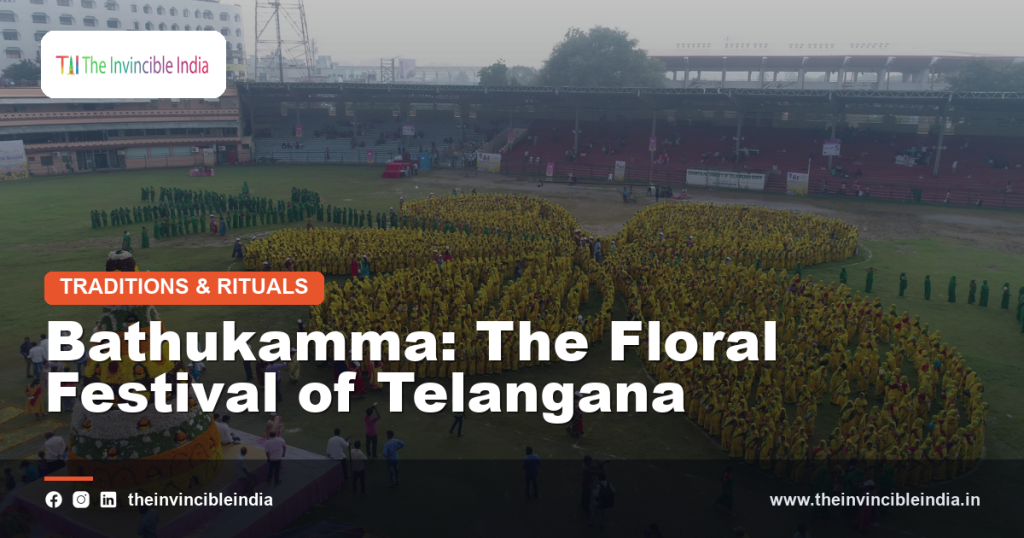
Bathukamma is a distinctive floral festival of Telangana, in which women arrange seasonal flowers into a striking layered form to honour Goddess Gauri, a manifestation of the divine feminine. Celebrated over nine days in the autumn season, the festival combines devotion, folk music and communal dance in a way that has made it one of the most visible symbols of Telangana’s cultural identity. Occurring in a similar seasonal window to Durga Puja, Bathukamma likewise centres on the worship of the goddess, though through a distinctly regional and floral form. This guide traces its meaning, rituals and cultural significance.
Quick Facts
| Detail | Information |
|---|---|
| Also Known As | Telangana’s floral festival |
| Dedicated To | Goddess Gauri |
| Type of Observance | Regional Hindu floral and folk festival |
| General Timing | Nine days in the autumn festival season |
| Key Practices | Flower arrangement, folk songs, dance, immersion |
| Region of Prominence | Telangana |
Meaning and Significance
Bathukamma is celebrated as an expression of gratitude to nature and to the divine feminine, embodied through an arrangement of flowers rather than a sculpted idol. The very name, generally understood to mean “mother goddess, come alive”, reflects the festival’s central idea of honouring the goddess through the fleeting beauty of seasonal blooms.
The festival is deeply woven into the identity of Telangana, celebrated predominantly by women across households, villages and towns. Its blend of devotion, artistry and communal participation has made it not only a religious occasion but also a widely recognised marker of regional culture.
Mythological and Folk Origins
Various folk narratives are associated with the origins of Bathukamma, generally linking the festival to the worship of the goddess as a nurturing, life-giving force connected to the earth and its seasonal abundance. These stories are passed down primarily through oral tradition and song rather than a single fixed scriptural account.
Because the festival’s roots lie substantially in regional folk practice, its exact historical origins are described in general terms rather than tied to a specific date or event. What remains consistent across tellings is the central theme of honouring the goddess as a source of life, fertility and wellbeing.
Bathukamma and the Goddess Gauri
The flower arrangement at the centre of the festival is understood to represent Goddess Gauri, worshipped here in a form closely tied to nature rather than through a conventional idol. This distinctive mode of worship, in which the goddess is honoured through an ephemeral floral creation, sets Bathukamma apart from many other Hindu festivals centred on sculpted images.
The choice of flowers as the medium of worship is often read as symbolic of the transient beauty of life and the natural world, reinforcing the festival’s themes of renewal and gratitude. This floral form of devotion has become one of the most recognisable aspects of goddess worship specific to the Telangana region.
Position in the Autumn Festival Calendar
Bathukamma is observed over nine days in the autumn season, generally coinciding with the period associated with Durga Puja and Navratri elsewhere in India, culminating around Durgashtami, ahead of Dussehra. This placement situates the festival within a broader pan-Indian season of goddess worship, even as its specific form remains distinctly regional.
The nine-day structure allows the celebration to build gradually, with each day carrying its own significance and customary flower arrangement, before reaching its most elaborate expression on the concluding day. This extended timeline is part of what gives the festival its sustained, community-wide character.
Making of the Bathukamma
The Bathukamma itself is constructed by arranging flowers in concentric layers on a flat metal or wooden plate, building upward into a cone-like or stepped shape that can rise to a considerable height. Women take great care in selecting and layering the flowers by colour and type, often working together in courtyards or open community spaces.
This process of assembly is itself treated as an act of devotion, requiring patience and skill developed through years of practice within families and communities. The finished arrangement, vividly coloured and carefully constructed, becomes the focal point of that day’s worship and celebration.
Flowers Traditionally Used
A variety of seasonal flowers native to the region are used in building the Bathukamma, including tangedu, or senna flowers, which hold particular importance and are closely associated with the festival. Other flowers commonly used include marigold, chrysanthemum and various wild blooms gathered from fields and surrounding countryside.
The reliance on locally available, seasonal flowers reflects the festival’s close connection to the agrarian rhythms of rural Telangana. Gathering the flowers is often a communal activity in itself, with families and neighbours collecting blooms together in the days leading up to the festival.
The Nine Days of Celebration
Each of the nine days of Bathukamma carries its own name and is associated with a somewhat different style or theme of flower arrangement, allowing the festival to unfold as a gradually evolving sequence rather than a single repeated ritual. Households and communities build a fresh Bathukamma each evening during this period.
This daily rhythm of preparation, worship and gathering gives the festival a sustained presence in community life across its nine-day span, with anticipation building steadily toward the larger, more elaborate celebrations of the final days.
Songs and Community Singing
Folk songs form an inseparable part of Bathukamma, sung by women as they gather around the flower arrangement each evening. These songs, passed down through generations, touch on themes ranging from devotion and nature to everyday family life and social relationships, giving the festival a rich oral literary tradition.
The songs are typically sung in call-and-response style, with groups of women alternating verses as they circle the Bathukamma. This musical tradition is considered as central to the festival’s identity as the flower arrangement itself, preserving both devotional sentiment and community memory.
Dance Around the Bathukamma
Alongside singing, women perform a circular dance around the Bathukamma, clapping rhythmically and moving in coordinated steps as part of the evening celebration. This dance, often referred to locally as Bathukamma ata, brings a dynamic, participatory dimension to what might otherwise be a purely visual and devotional display.
The combination of song and dance transforms the worship of the flower arrangement into a lively communal event, drawing together women of different ages and backgrounds. This participatory element is frequently cited as one of the most distinctive and joyful features of the festival.
Role of Women and Girls
Bathukamma is observed predominantly by women and girls, who take the lead in every stage of the festival, from gathering flowers and assembling the arrangement to singing and dancing around it each evening. The festival provides a rare, extended occasion for women across generations to gather in shared creative and devotional activity.
Girls are typically introduced to the festival’s customs from a young age, learning the songs, dance steps and flower-arranging techniques from mothers and grandmothers. This intergenerational transmission has helped keep the festival’s traditions vivid and continuous within Telangana households.
Saddula Bathukamma: The Concluding Day
The final and most elaborate day of the festival, known as Saddula Bathukamma, sees the largest and most decorative flower arrangements, along with the most extensive community gatherings. Falling on the day associated with Durgashtami, this concluding celebration draws large numbers of women to public spaces such as tanks, lakes and community grounds.
Special foods and offerings are also prepared on this day, adding a further layer of festivity to the occasion. The scale and energy of Saddula Bathukamma make it the emotional and social high point of the nine-day festival.
Immersion Rituals
At the conclusion of each day’s celebration, and especially on the final day, the flowers that make up the Bathukamma are immersed in a nearby water body, such as a pond, lake or tank, marking the ritual completion of that day’s worship. This act of immersion is treated as a respectful return of the offering to nature.
The immersion is typically accompanied by continued singing and festivity, with women gathering at the water’s edge before dispersing the flowers. This closing ritual reinforces the festival’s broader theme of honouring the natural cycle from which the flowers themselves were drawn.
Bathukamma as a Telangana Cultural Symbol
Beyond its religious dimension, Bathukamma has come to be regarded as a defining cultural symbol of Telangana, closely tied to the region’s identity and heritage. The festival is frequently referenced in discussions of Telangana’s distinct cultural character, alongside its language, cuisine and other regional traditions.
This symbolic status has grown particularly prominent in public life, with the festival serving as an occasion for showcasing Telangana’s folk arts, music and craftsmanship to a wider audience, both within India and among the region’s diaspora communities elsewhere.
Government and Public Celebrations
In recent years, Bathukamma has also been marked through large public celebrations organised with state support, bringing together thousands of women in coordinated performances at prominent venues. These public events complement the more intimate household and neighbourhood observances that remain the festival’s foundation.
Such large-scale celebrations have helped raise the festival’s profile beyond Telangana, drawing media attention and cultural interest from across India. They also provide a platform for preserving and transmitting the festival’s traditional songs and dance forms to younger generations in an organised setting.
Bathukamma Beyond Telangana
Telangana communities living outside the state, including in other parts of India and abroad, continue to observe Bathukamma as a way of maintaining a connection to their cultural roots. Diaspora celebrations often adapt the festival’s format to local circumstances while preserving its core elements of flower arrangement, song and dance.
These observances abroad serve an important role in sustaining a sense of shared identity among Telangana communities living at a distance from home, allowing the festival’s traditions to travel and adapt while remaining recognisably rooted in their regional origin.
Ecological Themes and Sustainability
Bathukamma’s reliance on fresh, biodegradable flowers rather than synthetic materials gives it a naturally sustainable character, with the entire arrangement returning harmlessly to the water body into which it is immersed. This quality has drawn renewed attention in recent years as awareness of ecological concerns around festival celebrations has grown across India.
Environmental groups and local authorities have highlighted Bathukamma as an example of a festival whose traditional practices already align closely with sustainable principles, encouraging continued use of natural flowers and discouraging any drift toward artificial substitutes. This ecological dimension adds a further layer of contemporary relevance to a long-standing seasonal custom.
Bathukamma Today
In contemporary Telangana, Bathukamma continues to be celebrated with the same essential elements of flower arrangement, folk song and communal dance that have long defined it, even as public celebrations have grown in scale and visibility. Social media has also given younger participants new ways to share and document the festival’s colourful traditions.
Despite these changes in scale and setting, the festival’s core spirit, a communal expression of gratitude to nature and the divine feminine through flowers, songs and dance, remains firmly rooted in the households and villages where it has long been practised.
Sources & Further Reading
- Ministry of Culture, Government of India (indiaculture.gov.in).
- Sangeet Natak Akademi (sangeetnatak.gov.in).
Frequently Asked Questions
What is Bathukamma?
Bathukamma is a floral festival of Telangana in which women arrange seasonal flowers into a layered form to honour Goddess Gauri over nine days.
What flowers are used in Bathukamma?
Tangedu, or senna flowers, hold particular importance, alongside marigold, chrysanthemum and various other seasonal blooms gathered locally.
What is Saddula Bathukamma?
Saddula Bathukamma is the concluding and most elaborate day of the festival, marked by the largest flower arrangements and biggest community gatherings.
Who mainly celebrates Bathukamma?
Bathukamma is observed predominantly by women and girls, who lead every stage of the festival from gathering flowers to singing and dancing.
Where is Bathukamma celebrated?
Bathukamma is celebrated primarily in Telangana, with observances also maintained by Telangana communities living elsewhere in India and abroad.