


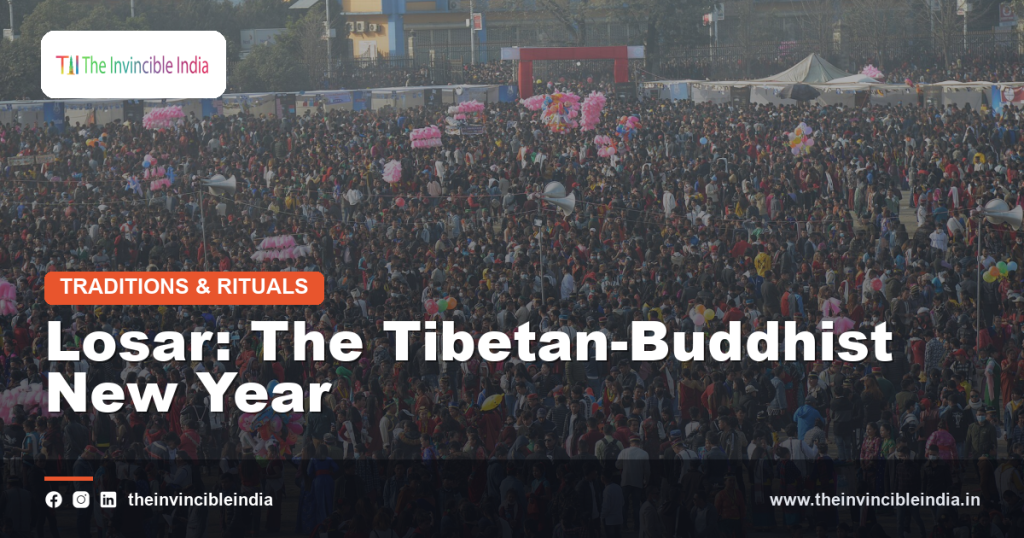
Losar is the New Year festival of Tibetan Buddhist communities, observed with particular vibrancy in the Himalayan regions of India, including Ladakh, Sikkim and parts of Arunachal Pradesh. Rooted in a lunar calendar shared with Tibetan tradition, the festival blends religious ceremony with family reunion, feasting and communal celebration. Much like Makar Sankranti, which marks a seasonal turning point elsewhere in India, Losar signals renewal and a fresh calendrical beginning for the communities that observe it. This guide explores its origins, rituals and the many forms it takes across India’s high-altitude Buddhist regions.
Quick Facts
| Detail | Information |
|---|---|
| Also Known As | Tibetan New Year |
| Observed By | Tibetan Buddhist communities |
| Type of Observance | New Year festival with religious rites |
| General Timing | Based on the Tibetan lunar calendar, typically winter |
| Key Practices | Home cleansing, prayer offerings, feasting, Cham dances |
| Region of Prominence | Ladakh, Sikkim, Arunachal Pradesh, Tibetan exile settlements |
Meaning and Significance
Losar marks the beginning of a new year in the Tibetan lunar calendar and is regarded as a time of renewal, gratitude and the setting of positive intentions. For Tibetan Buddhist communities, the occasion carries both a religious dimension, centred on prayer and the invocation of protective deities, and a social one, built around family reunion and shared meals. It is considered an auspicious moment to leave behind the difficulties of the past year and welcome fresh beginnings.
The festival is observed with a blend of solemn ritual and genuine festivity, reflecting a broader pattern in Buddhist practice where spiritual discipline coexists comfortably with communal joy. This dual character has helped Losar remain a cherished occasion across generations of Himalayan Buddhist communities.
Origins and Historical Background
Losar is understood to have developed from earlier folk New Year observances that predate the arrival of Buddhism in the Tibetan plateau, later absorbing Buddhist ritual elements as the religion spread through the region. Over time, the festival came to incorporate monastic ceremonies alongside its older agrarian and seasonal roots, creating the layered observance familiar today.
As Tibetan Buddhism spread into the Himalayan belt of India, including Ladakh, Sikkim and parts of Arunachal Pradesh, Losar travelled with it, adapting to local custom while retaining its essential structure of cleansing, prayer and celebration. This long process of cultural exchange is part of what gives the festival its rich and varied character today.
Position in the Tibetan Lunar Calendar
Losar follows the Tibetan lunar calendar, a system that combines lunar months with astrological calculations distinct from both the Gregorian and the Hindu lunar calendars. As a result, the festival generally falls in the winter months, though the exact date varies from year to year according to this calendar’s own reckoning.
Because the Tibetan calendar is maintained by monastic institutions and traditional astrologers, the precise timing of Losar in a given year is confirmed through calendars issued by these authorities. This calendrical foundation situates the festival within a distinct cultural and religious framework, separate from the lunar reckonings used elsewhere in India.
Ladakh's Distinct Losar Timing
In Ladakh, Losar is traditionally observed somewhat earlier in the winter season than in many other Tibetan Buddhist regions, a difference rooted in a historical variation in local calendrical reckoning. This distinction is well established in Ladakhi tradition and is generally explained as originating from a shift made to accommodate agricultural and military considerations in earlier centuries.
Despite this difference in timing, the substance of Ladakhi Losar closely mirrors observances elsewhere, featuring the same core elements of home cleansing, prayer and festive gathering. The variation is often cited as an example of how a shared religious calendar can still allow for regionally distinct historical adaptations.
Pre-Losar Cleansing Rituals
In the days leading up to Losar, households undertake a thorough cleaning of their homes, a practice understood as clearing away the misfortunes and negative influences of the outgoing year. Doorways and window frames are often freshly decorated, and altars are cleaned and prepared with new offerings in anticipation of the New Year.
This period of preparation extends beyond the physical home to a broader sense of readiness, with families settling debts and resolving disputes where possible before the New Year begins. The emphasis on starting the year with a clean slate, both literally and figuratively, is a recurring theme across Losar’s preparatory customs.
Gutor and the Expulsion of Negativity
The day before Losar proper is often marked by Gutor, a ritual associated with the symbolic expulsion of negative forces and obstacles from the year that has passed. Monasteries conduct special ceremonies on this day, and households may prepare a special noodle soup as part of the domestic observance connected to this transitional moment.
Gutor is generally understood as a period of purification that prepares both the community and the individual household for the New Year’s arrival. The ritual’s emphasis on releasing accumulated negativity reflects a broader Buddhist theme of impermanence and renewal that runs through the Losar season as a whole.
New Year's Day Observance
On the first day of Losar itself, families rise early to make fresh offerings at their household altars and to greet one another with traditional wishes for the New Year. Visits to monasteries for prayer and blessings are common, with many families making this their first outing of the year.
The day is generally kept quieter and more devotional than the days that follow, with an emphasis on ritual observance before the more social and festive elements of the celebration take over. This structure, moving from solemn beginning to communal celebration, is characteristic of how Losar unfolds across its several days.
Khapse and Festive Foods
Khapse, a fried pastry made from wheat dough and shaped into various decorative forms, is among the most recognisable foods associated with Losar. Households prepare large quantities in advance of the festival, both for family consumption and for offering to guests who visit during the celebration period.
Alongside khapse, festive meals during Losar often include a variety of dishes reflecting the culinary traditions of the Himalayan region, prepared in larger quantities than usual to accommodate visiting relatives and friends. Food preparation itself becomes a communal activity in many households, with family members gathering to make khapse together in the days before the festival.
Chang and Communal Drink
Chang, a traditional barley-based drink, holds a customary place in Losar celebrations, often shared among family and guests as part of New Year greetings and toasts. Its preparation and sharing is treated as a mark of hospitality, extended to visitors as a gesture of goodwill for the year ahead.
The offering of chang is frequently accompanied by traditional songs and well-wishes, reinforcing the festival’s communal spirit. While customs surrounding its use vary between households and regions, chang remains one of the most widely recognised elements of Losar hospitality across Tibetan Buddhist communities in India.
Prayer Flags and Home Decoration
New prayer flags are commonly hoisted on rooftops and in courtyards around Losar, replacing those from the previous year and carrying fresh prayers and blessings into the wind for the months ahead. Homes and monasteries alike are decorated with these colourful flags, along with fresh butter lamps and floral offerings.
The changing of prayer flags is understood as a way of renewing the spiritual atmosphere of a household alongside its physical cleanliness. This visual transformation, with fluttering flags marking the skyline of Himalayan towns and villages, is one of the most visible outward signs that Losar has arrived.
Monastic Cham Dances
Monasteries across Ladakh and other Himalayan regions often stage Cham, a ritual masked dance performed by monks, as part of Losar and related festival periods. The dance depicts figures from Buddhist cosmology and is understood as a means of dispelling negative forces while conveying religious teachings through symbolic movement.
These performances draw large crowds of local residents and visitors, who gather in monastery courtyards to watch the elaborately costumed dancers. Though Cham is also performed at other times of the religious calendar, its association with the New Year season gives it particular resonance during Losar observances.
Role of Monasteries and Lamas
Monasteries serve as central institutions during Losar, hosting special prayer ceremonies, offerings and community gatherings throughout the festival period. Lamas and resident monks conduct rituals intended to invoke blessings and protection for the coming year, both for individual families and for the wider community.
Many families make it a point to visit their local monastery during Losar to receive blessings and to make offerings of butter lamps, incense or food. This close relationship between household observance and monastic ritual reflects the broader structure of Tibetan Buddhist religious life, in which monasteries anchor the spiritual calendar of the surrounding community.
Family Visits and Greetings
The days following New Year’s Day are typically devoted to visiting relatives, friends and neighbours, exchanging greetings and small gifts as part of the festive season. The traditional greeting “Tashi Delek”, conveying wishes of good fortune, is exchanged widely during this period, spoken by children and elders alike.
These visits often involve shared meals and the offering of khapse and chang to guests, reinforcing social bonds within the community. The extended period of visiting, sometimes lasting several days beyond the New Year itself, underscores the importance placed on renewing relationships as part of the Losar season.
Regional Variations in Sikkim and Arunachal Pradesh
Beyond Ladakh, Losar is also observed by Buddhist communities in Sikkim and parts of Arunachal Pradesh, each bringing its own local inflection to the festival. In Sikkim, communities such as the Bhutia observe Losar with practices that reflect both Tibetan Buddhist tradition and the region’s distinct cultural history.
In parts of Arunachal Pradesh, Buddhist communities mark the New Year with their own combination of monastic ritual and local custom, sometimes coinciding with related seasonal festivals specific to the area. These regional variations illustrate how a shared religious calendar can be woven into diverse local cultural fabrics across India’s Himalayan belt.
Losar Among the Tibetan Exile Community
Losar holds particular significance for the Tibetan exile community settled in India, notably in Dharamshala, where the festival is observed with strong attention to preserving cultural and religious continuity. Community celebrations often include prayer gatherings, cultural programmes and traditional performances alongside private household observance.
For many in the exile community, Losar serves as an occasion to reaffirm cultural identity and shared heritage while living away from the Tibetan plateau. This dimension adds a layer of meaning to the festival beyond its religious and seasonal significance, linking it to the broader story of Tibetan community life in India.
Losar Today
In present-day India, Losar continues to be observed with the same essential combination of cleansing rituals, monastic ceremony and family celebration that has long defined it, even as some elements adapt to contemporary circumstances. Younger generations increasingly document and share the festival’s traditions through photography and community events, helping sustain awareness of its customs.
Tourism to Ladakh and other Himalayan regions during the festival period has also grown, bringing wider visibility to Losar’s rituals and performances. Despite these changes, the festival’s core spirit, a time of cleansing, gratitude and renewed connection with family and community, remains firmly intact.
Sources & Further Reading
- Ministry of Culture, Government of India (indiaculture.gov.in).
- Sahitya Akademi.
Frequently Asked Questions
What is Losar?
Losar is the Tibetan-Buddhist New Year, observed with home cleansing, prayer, feasting and monastic rituals across Himalayan Buddhist communities in India.
When is Losar celebrated?
Losar follows the Tibetan lunar calendar and generally falls in winter, though the exact date varies each year and Ladakh traditionally observes it somewhat earlier than other regions.
What foods are associated with Losar?
Khapse, a fried pastry, and chang, a barley-based drink, are among the most recognisable foods and drinks prepared and shared during Losar.
What is Cham dance?
Cham is a ritual masked dance performed by monks at monasteries, depicting figures from Buddhist cosmology and often staged around the Losar season.
Where in India is Losar celebrated?
Losar is observed mainly in Ladakh, Sikkim, parts of Arunachal Pradesh, and among the Tibetan exile community, notably in Dharamshala.