

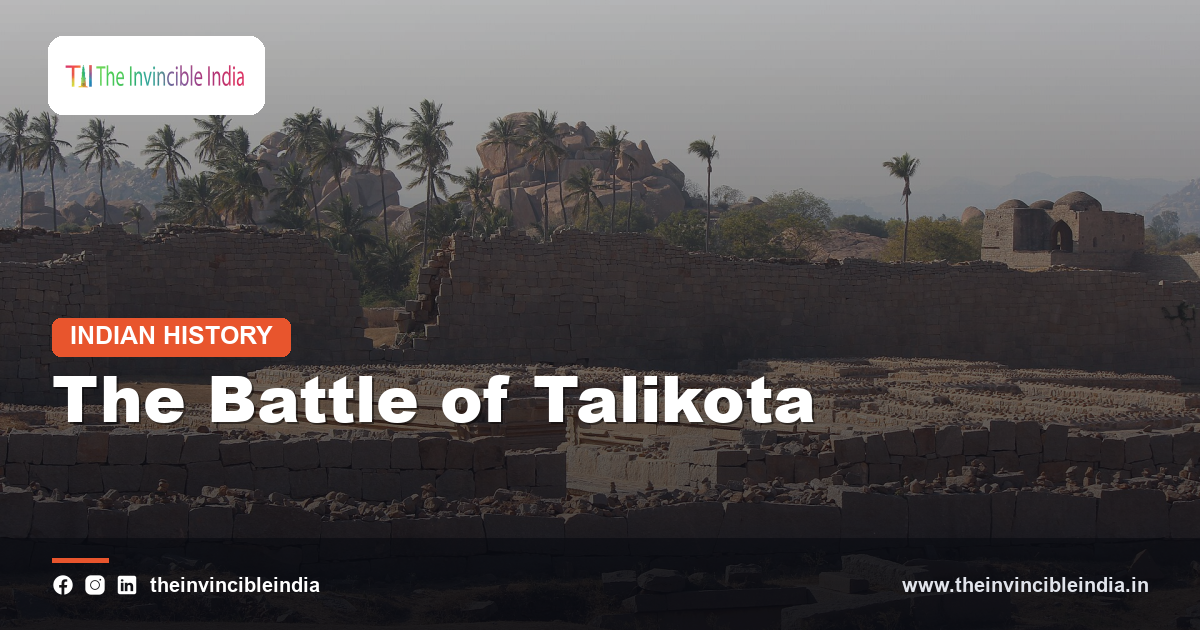
In the mid-16th century, the Deccan plateau of southern India became the site of one of the most consequential battles in the subcontinent’s history, a confrontation that brought a sudden and dramatic end to nearly two centuries of Vijayanagara supremacy. The Vijayanagara Empire, long the dominant power of the south, found itself confronted by an unusual alliance of rival Deccan Sultanates who set aside their own rivalries to challenge the empire’s growing influence. The resulting engagement, fought near the village of Talikota, ended in a catastrophic defeat that led directly to the sack of the magnificent capital city of Hampi. This guide examines the background, course, and lasting consequences of the Battle of Talikota.
Quick Facts
| Detail | Information |
|---|---|
| Also Known As | The Battle of Rakshasi-Tangadi |
| Combatants | The Vijayanagara Empire against an allied confederacy of Deccan Sultanates |
| Approximate Period | Mid-16th century |
| Location | Near the village of Talikota, on the Deccan plateau |
| Outcome | Decisive defeat of Vijayanagara forces and the sack of its capital, Hampi |
| Historical Significance | Marked the beginning of the long decline of the Vijayanagara Empire |
The Vijayanagara Empire Before the Battle
By the middle of the sixteenth century, the Vijayanagara Empire had grown into one of the most powerful and prosperous states in the Indian subcontinent, controlling vast stretches of the Deccan plateau and the far south. Founded some two centuries earlier as a bulwark against expanding sultanates to the north, the empire had grown wealthy through control of fertile agricultural land, flourishing trade networks, and a lucrative trade in diamonds, spices, and textiles. Its capital, Hampi, had developed into a sprawling and magnificent city, admired by foreign travelers for its markets, temples, and royal architecture. Vijayanagara rulers commanded substantial military resources, including large infantry forces, cavalry, and war elephants, and had long maintained an uneasy balance of power with the Muslim sultanates that controlled the Deccan to its north. This combination of wealth, military strength, and political prestige made Vijayanagara the dominant power in southern India on the eve of its greatest military crisis.
The Deccan Sultanates
To the north of Vijayanagara lay the Deccan Sultanates, a cluster of Muslim-ruled states that had emerged from the breakup of an earlier Deccan sultanate and included the kingdoms of Bijapur, Ahmadnagar, Golconda, and Bidar. These sultanates frequently competed and warred among themselves over territory, resources, and prestige, and relations between them and Vijayanagara had long been marked by a shifting pattern of alliances and hostilities. At times, Vijayanagara rulers had allied with one sultanate against another, exploiting divisions among their northern neighbors to protect their own frontiers. This diplomatic maneuvering, while often successful in the short term, also generated lasting resentment among the sultanates, who periodically found themselves on opposing sides of Vijayanagara’s shifting alliances. The fragmented but individually capable Deccan Sultanates thus represented both a source of opportunity and a persistent strategic threat along Vijayanagara’s northern border.
Rising Tensions in the Deccan
In the years leading up to the battle, relations between Vijayanagara and its northern neighbors deteriorated sharply, as perceived slights, territorial disputes, and the assertive foreign policy of the Vijayanagara court alienated sultanates that had previously been divided among themselves. Vijayanagara’s growing confidence, reflected in its willingness to intervene in Deccan affairs and to treat neighboring rulers with what they regarded as condescension, provided the sultanates with a common grievance around which to unite. Diplomatic incidents and border skirmishes added to the growing sense of hostility, gradually eroding the old pattern of divided and competing Deccan states. Sensing an opportunity to curb Vijayanagara’s power once and for all, the rulers of the major sultanates began to set aside their own rivalries in favor of a shared strategic interest. This shift from fragmented competition to coordinated opposition set the stage for one of the most consequential confrontations in the history of the Deccan.
Formation of the Sultanate Confederacy
Recognizing that no single sultanate could match Vijayanagara’s military strength alone, the rulers of Bijapur, Ahmadnagar, Golconda, and Bidar set aside their long-standing rivalries to form a temporary military alliance directed against their common rival. This confederacy represented an unusual degree of cooperation among states that had frequently fought one another, reflecting the seriousness with which they regarded the Vijayanagara threat. Marriage alliances and diplomatic negotiations helped cement the coalition, while shared religious and cultural ties among the sultanates provided an additional basis for unity. The combined military resources of the allied sultanates, including cavalry, artillery, and infantry drawn from across their territories, gave the confederacy a formidable fighting force. This alliance of convenience, forged specifically to confront Vijayanagara, would prove decisive in the battle that followed, demonstrating the strategic advantage of coordinated action over fragmented rivalry.
Prelude to the Battle
As the allied sultanates mobilized their combined forces, the Vijayanagara court, confident in its military strength and past successes, prepared to meet the coalition in open battle rather than adopt a more cautious defensive strategy. Vijayanagara’s regent and de facto ruler at the time commanded the empire’s substantial army, drawing on troops from across its extensive territories to confront the advancing confederacy. Both sides spent considerable effort in the weeks before the engagement gathering supplies, positioning forces, and selecting favorable ground near the northern frontier of Vijayanagara territory. The scale of the forces being assembled on both sides reflected the high stakes of the coming confrontation, which both parties recognized would have far-reaching consequences for the balance of power in the Deccan. This buildup culminated in the armies meeting near the village that would give the battle its name.
The Battlefield Near Talikota
The battle took place on the open plains near the village of Talikota, in a region of the Deccan plateau characterized by relatively flat terrain suited to the maneuvering of large armies. This location, situated along the frontier between Vijayanagara and the northern sultanates, had long served as a contested zone where the two sides’ spheres of influence met. The relatively open ground offered few natural defensive advantages to either side, meaning that the outcome would depend heavily on the discipline, tactics, and coordination of the opposing forces rather than terrain. Some accounts also refer to the battle by an alternate name associated with a nearby locality, reflecting the imprecision common in descriptions of the exact site of many premodern battles. Regardless of the precise location, the flat, open landscape provided an appropriately dramatic stage for what would become one of the most consequential battles in South Indian history.
The Opposing Forces
The armies that met near Talikota were among the largest assembled in the region during this period, with Vijayanagara fielding a vast force of infantry, cavalry, and war elephants drawn from across its extensive territories. The allied sultanates, for their part, brought a combined army that, while perhaps smaller in overall numbers, benefited from more effective artillery and disciplined cavalry units accustomed to coordinated warfare. Vijayanagara’s forces included large numbers of war elephants, which had long been a symbol of the empire’s military might, though their battlefield effectiveness against determined and well-coordinated opponents remained uncertain. The sultanate confederacy, by contrast, made effective use of artillery pieces and cavalry tactics that had been refined through years of warfare among the Deccan states themselves. This contrast in composition and tactics between the two armies would play an important role in shaping the battle’s eventual outcome.
Leadership on Both Sides
On the Vijayanagara side, overall command rested with the empire’s powerful regent, who had effectively guided imperial policy and held real authority behind the throne for some years prior to the battle. His long experience in Vijayanagara’s internal and external affairs had made him a dominant figure at court, though his aggressive approach toward the Deccan sultanates contributed to the very hostility that produced the allied confederacy. On the opposing side, the rulers of the individual sultanates coordinated their forces under a shared strategic plan, drawing on experienced commanders familiar with the region’s terrain and the tactics best suited to countering a large but less cohesive opposing army. This contrast in command structure, a single dominant figure directing Vijayanagara’s forces against a coalition of allied rulers coordinating their combined strength, reflected the broader political dynamics that had brought the two sides to this confrontation.
The Course of the Battle
When the battle began, the Vijayanagara army initially appeared to hold its own against the allied sultanate forces, drawing on its numerical strength and the presence of war elephants to press against the opposing lines. As the fighting intensified, however, the disciplined coordination and effective artillery of the sultanate confederacy began to tell against the less unified Vijayanagara forces. Accounts of the battle describe a moment of crisis when the Vijayanagara regent was killed or captured in the fighting, a development that proved catastrophic for the morale and cohesion of his army. With their commanding figure removed from the field, Vijayanagara’s forces, despite their numbers, began to lose coordination and fall into disarray. This turning point transformed what had begun as a closely fought engagement into a decisive rout of the Vijayanagara army.
The Turning Point
The loss of Vijayanagara’s commanding regent proved to be the decisive turning point of the battle, triggering a collapse in morale and coordination among the empire’s forces at a critical moment in the fighting. Without unified leadership, the various contingents of the Vijayanagara army struggled to maintain their positions against the continued pressure of the allied sultanate forces. Panic reportedly spread through parts of the army, undermining what had until that point been a hard-fought and closely contested engagement. The sultanate confederacy, sensing the shift in momentum, pressed its advantage, driving the disorganized Vijayanagara forces from the field in a broad and decisive rout. This single moment of command failure thus transformed the trajectory of the battle and, with it, the future of the Vijayanagara Empire itself.
Defeat of the Vijayanagara Army
As the Vijayanagara lines broke, soldiers fled the battlefield in large numbers, abandoning equipment, supplies, and the remnants of what had been one of the largest armies assembled in the region. The scale of the defeat left Vijayanagara’s northern frontier effectively undefended, opening the path for the victorious sultanate forces to advance further into imperial territory without significant resistance. Surviving members of the Vijayanagara royal family and court fled southward, seeking safety away from the immediate danger posed by the advancing confederacy. The suddenness and completeness of the defeat stood in sharp contrast to Vijayanagara’s earlier military reputation, underscoring how decisively the loss of central leadership had altered the course of the engagement. This chaotic retreat set the stage for the devastating events that would follow in the empire’s now-undefended capital.
The Sack of Hampi
In the aftermath of the battle, the victorious sultanate armies advanced upon Hampi, the magnificent Vijayanagara capital, which lay largely undefended following the destruction of the empire’s field army. Over an extended period, the city was subjected to extensive plunder and destruction, with temples, palaces, and markets stripped of their wealth and many structures damaged or demolished. The sack of Hampi represented an enormous cultural and material loss, bringing an abrupt end to the city’s status as one of the great urban centers of the medieval world. Descriptions from travelers and later observers convey the scale of the devastation visited upon a city that had, until recently, been renowned for its splendor and prosperity. The destruction of Hampi stands as one of the most dramatic and consequential episodes of urban devastation in medieval Indian history.
Immediate Aftermath
In the immediate aftermath of the defeat, the Vijayanagara court relocated away from the ruined capital, reestablishing itself at other centers as surviving members of the royal family worked to preserve what remained of imperial authority. The empire’s territorial control contracted significantly, with formerly subordinate regional governors and feudatories asserting greater independence in the absence of strong central authority. The victorious sultanates, for their part, did not attempt to permanently occupy Vijayanagara’s core territory, instead withdrawing with their plunder while leaving the weakened empire to manage its own recovery. This period of upheaval marked a fundamental turning point in the political landscape of southern India, as the once-dominant Vijayanagara Empire struggled to adapt to its diminished circumstances. The battle’s aftermath thus reshaped the regional balance of power for generations to come.
Political Consequences for the Deccan
The defeat at Talikota carried lasting political consequences for the entire Deccan and southern India, permanently altering the balance of power that had shaped the region for generations. Vijayanagara, though it continued to exist as a reduced state under successor rulers, never fully recovered its former extent, wealth, or prestige, entering a long period of gradual territorial contraction and political fragmentation. The victorious sultanates, meanwhile, gained territory and plunder from the campaign, though their alliance, formed for this specific purpose, did not endure much beyond the immediate aftermath of their shared victory. Former Vijayanagara feudatories and provincial governors increasingly asserted independent authority, contributing to the fragmentation of what had been a unified imperial structure. This reshaping of regional power set the stage for the political landscape of southern India in the centuries that followed.
Historical Significance
Historians regard the Battle of Talikota as one of the most consequential military engagements in the history of medieval India, marking the effective end of Vijayanagara’s status as the dominant imperial power in the south. The battle demonstrated the potential strategic advantage of coordinated alliance over fragmented rivalry, a lesson not lost on other regional powers observing the outcome. The destruction of Hampi, in particular, has come to symbolize the sudden and dramatic reversal of fortune that could befall even the most powerful medieval states. The battle is also studied as an example of how the loss of central leadership at a critical moment could transform the trajectory of an otherwise evenly matched military engagement. This combination of dramatic reversal and lasting consequence secures Talikota’s place as a pivotal moment in the broader narrative of Indian history.
The Battle of Talikota Today
Today, the ruins of Hampi, largely a product of the destruction that followed the Battle of Talikota, stand as a UNESCO World Heritage Site and one of India’s most significant archaeological landscapes. Visitors and scholars continue to study the site’s temples, palaces, and market streets, gaining insight into the grandeur of the Vijayanagara Empire before its dramatic downfall. The battle itself remains a subject of historical study, examined for what it reveals about the political dynamics of the Deccan and the consequences of leadership failure in military engagements. Heritage authorities work to conserve Hampi’s fragile ruins, balancing preservation with the site’s role as a major destination for tourism and historical education. Through both its ruins and its history, the Battle of Talikota continues to occupy a central place in the story of southern India’s medieval past.
Sources & Further Reading
- Archaeological Survey of India (asi.nic.in).
- Ministry of Culture, Government of India (indiaculture.gov.in).
Frequently Asked Questions
What was the Battle of Talikota?
The Battle of Talikota was a major battle fought in the mid-16th century between the Vijayanagara Empire and an allied confederacy of Deccan Sultanates, resulting in a decisive defeat for Vijayanagara.
Why is the Battle of Talikota significant?
The battle marked the beginning of the long decline of the Vijayanagara Empire and led directly to the destruction of its capital, Hampi, reshaping the balance of power in southern India.
What happened to Hampi after the battle?
In the aftermath of the battle, the victorious sultanate forces sacked and largely destroyed Hampi, bringing an abrupt end to its status as one of the great cities of the medieval world.
Which powers fought in the Battle of Talikota?
The Vijayanagara Empire faced a combined confederacy formed by the Deccan Sultanates of Bijapur, Ahmadnagar, Golconda, and Bidar, who set aside their rivalries to confront their common rival.
What can visitors see at the site associated with the battle today?
The ruins of Hampi, largely a consequence of the sack that followed the battle, survive today as a UNESCO World Heritage Site featuring extensive temple and palace remains.


