

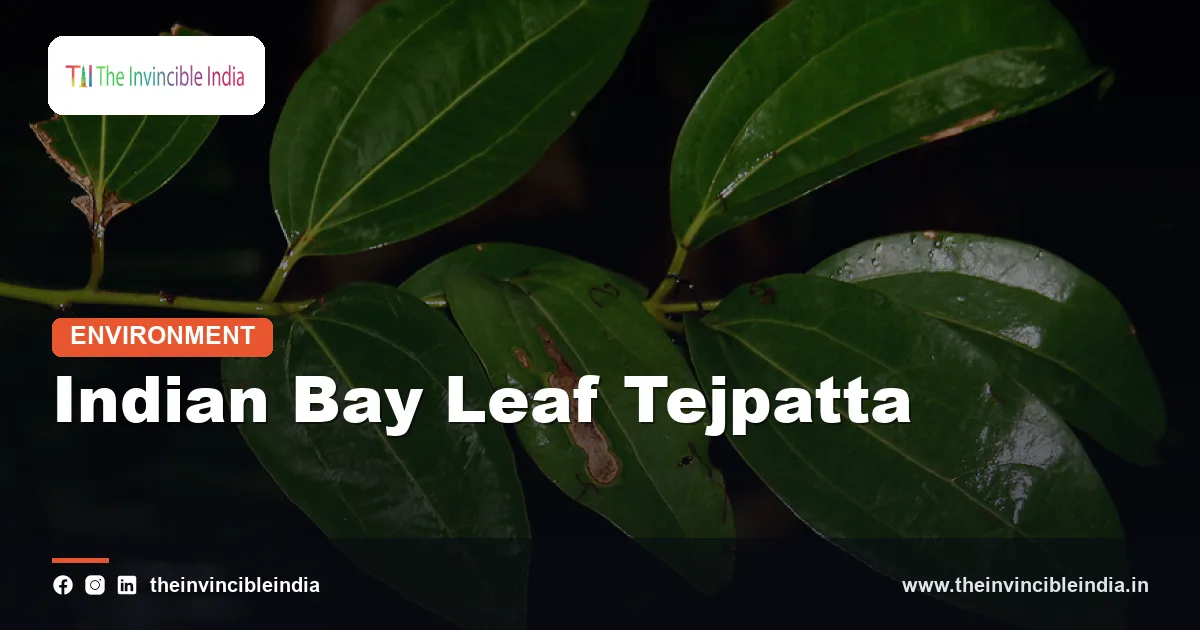
The Indian bay leaf, called tejpatta in Hindi, is the aromatic dried leaf of the evergreen tree Cinnamomum tamala, a member of the cinnamon and laurel family that grows in the Himalayan foothills and north-eastern hills of India. Tejpatta is long, olive-green to brown and marked by three distinct veins running from base to tip, and it is a standard whole spice in Indian rice dishes, curries and masala blends.
Tejpatta is often called bay leaf in English, but it comes from a different tree than the European bay laurel and tastes quite different, with a warm, cinnamon-like note instead of a eucalyptus-like one. This explainer covers the tree, its habitat, how the leaves are gathered and dried, how tejpatta differs from European bay, and how the leaf is used in Indian kitchens.
Quick Facts
| Attribute | Detail |
|---|---|
| Common names | Indian bay leaf, Indian cassia, malabathrum (historical); tejpatta, tejpat or tej patta (Hindi); tamalapatra (Sanskrit); tejpata (Bengali) |
| Scientific name | Cinnamomum tamala |
| Family | Lauraceae, the laurel family |
| Origin | The Indian subcontinent and adjoining Himalayan region, including Nepal, Bhutan and northern Myanmar |
| Where grown in India | Himalayan foothills and the north-east, including Uttarakhand, Himachal Pradesh, Sikkim, Assam, Meghalaya, Arunachal Pradesh and neighbouring hill states |
| Part used | Dried leaf; the bark and leaf oil are used in smaller quantities |
| Harvest season | Leaves are collected from trees or lopped branches mostly in the cooler months, with timing varying by hill region |
| Main products | Whole dried leaf, crushed leaf, leaf oil, bark sold as cassia |
| Notable fact | The leaf has three prominent veins and a flavour closer to cinnamon and clove than to European bay |
Key Takeaways
- Tejpatta is the dried leaf of Cinnamomum tamala, an evergreen tree of the laurel family native to the Himalayan region of the Indian subcontinent.
- The tejpatta leaf has three prominent lengthwise veins, while the European bay leaf has a single central vein with side veins branching from it.
- Tejpatta tastes warm and sweetly spicy, with notes of cinnamon and clove, and is not the same as the milder, eucalyptus-like European bay.
- The tree is a close relative of the cinnamon tree and is sometimes called Indian cassia because its bark resembles cassia bark.
- Indian cooks use one or two whole tejpatta leaves in tempering, rice dishes and gravies and remove the leaf before eating.
- Tejpatta was known in the ancient world as malabathrum, a leaf traded to the Mediterranean, and it appears in Sanskrit as tamalapatra.
What is the tejpatta tree?
The tejpatta tree is Cinnamomum tamala, a medium-sized, evergreen tree of the laurel family that commonly grows 10 to 20 metres tall and is cultivated or collected in the subtropical and temperate hills of northern and north-eastern India. It belongs to the same genus as the cinnamon tree (Cinnamomum verum) and the Chinese cassia, which explains the family resemblance in aroma.
The tree has a spreading crown, thick, slightly rough bark and leaves that are opposite or nearly so, oval to lance-shaped, and glossy above. Young leaves are often tinged reddish or pinkish, and mature leaves turn a deep green. The small yellowish flowers appear in clusters, and the fruit is a dark, small berry. When a fresh leaf is crushed, it gives off a spicy, sweet fragrance.
How can a tejpatta leaf be recognised?
A tejpatta leaf can be recognised by its three prominent veins that run from the base of the blade towards the tip, forming a distinct pattern unlike the single midrib of most other leaves. The leaf is typically 10 to 20 centimetres long, leathery and lance-shaped, and when dried it becomes olive-green to brownish and brittle.
Botanists describe this arrangement as triple-veined, and the same feature is seen in cinnamon leaves, which makes it a useful identification mark in the laurel family. The leaf is stiff, and the dried form has a sweet, warm smell when it is bent or heated, and the aroma deepens during cooking.
Where does the tejpatta tree grow in India?
The tejpatta tree grows in India in the foothills and mid-elevation hills of the Himalaya and the north-east, generally at altitudes from about 900 to 2,500 metres, in states such as Uttarakhand, Himachal Pradesh, Sikkim, Assam, Meghalaya, Arunachal Pradesh, Mizoram and Nagaland. The tree prefers a humid, mild climate, good rainfall and moist, well-drained forest soil, and it does not suit the hot, dry plains.
It is found in forests, forest margins, village groves and agroforestry plots. In several hill communities, the leaves are gathered from trees on private and community land as a supplementary source of income, and dried leaves are sold through local markets to traders. The tree also grows in Nepal and Bhutan, and the leaf is traded across the region. Because much of the supply comes from scattered trees and forest collection, production figures are hard to state precisely.
How is tejpatta harvested and dried?
Tejpatta is harvested by hand by picking mature leaves or by lopping branches and stripping their leaves, and the leaves are then dried in the shade or in gentle sun until brittle. Mature leaves are chosen because they hold more oil, and pruning the branches also helps keep the tree to a manageable height.
- Collecting: Mature leaves are removed from the tree or from lopped branches, usually in the drier and cooler part of the year.
- Cleaning: Damaged, insect-eaten or diseased leaves are sorted out.
- Drying: The leaves are spread out on clean mats or racks in a shady, airy place, or dried briefly in mild sun. Strong, prolonged sun can fade the colour and weaken the aroma.
- Sorting and grading: Whole, clean, olive-brown leaves of good length are separated from broken pieces.
- Packing: Dried leaves are packed in bags or cartons and kept away from moisture.
The drying stage develops the characteristic fragrance, and a properly dried leaf can be kept for many months when stored well.
What is the difference between tejpatta and European bay leaf?
Tejpatta comes from Cinnamomum tamala and tastes of cinnamon and clove, while the European bay leaf comes from Laurus nobilis, a Mediterranean tree, and has a milder, herbal and slightly eucalyptus-like flavour. The two plants belong to the same family, Lauraceae, but to different genera, so they are related only distantly.
| Feature | Tejpatta (Indian bay leaf) | European bay leaf |
|---|---|---|
| Tree | Cinnamomum tamala | Laurus nobilis |
| Native region | Himalayan foothills and north-east India | Mediterranean |
| Veins | Three prominent veins from base to tip | One central vein with side veins |
| Size and shape | Longer, broader and lance-shaped | Shorter, narrower and oval |
| Flavour | Warm, sweet, cinnamon-clove notes | Herbal, floral, slightly eucalyptus-like |
| Typical cuisine | Indian rice dishes, curries, masalas | Soups, stews, stocks, European dishes |
Other leaves are also sold as bay in different countries, including the Indonesian bay leaf from Syzygium polyanthum and the California bay. They differ in flavour, and tejpatta should not be assumed to be interchangeable with them in a recipe.
How is tejpatta used in Indian cooking?
Tejpatta is used in Indian cooking as a whole leaf that is fried in hot oil or ghee at the start of a dish, simmered in gravies and rice, or ground into spice blends. Cooks usually add one or two leaves to the tempering with cinnamon, cardamom, clove and cumin, so that the fat carries the aroma through the dish.
- Pulao and biryani: The leaf is a standard whole spice in the base of these rice dishes.
- Dals and curries: A single leaf adds depth to lentils, vegetable curries and meat gravies.
- Garam masala: In some regional blends, crushed tejpatta is ground along with other spices.
- Tea and kadha: A leaf is sometimes boiled with spiced tea or herbal decoctions.
- Kormas and Mughlai dishes: The leaf supports richer gravies together with mace, cinnamon and clove.
The leaf is tough and is not eaten. It is generally removed from the plate before serving, or the diner leaves it aside, because it can be sharp and unpleasant to chew.
What is the history of tejpatta and malabathrum?
Tejpatta has a long history in the Indian subcontinent, where it appears in Sanskrit texts as tamalapatra and in ancient trade as malabathrum, a fragrant leaf shipped from the east to the Mediterranean world. The Greek and Roman writers who described Indian Ocean trade mention malabathrum as a precious ingredient used in perfumes, ointments and wine.
Scholars generally identify malabathrum with the leaf of Cinnamomum tamala or a closely related tree, although the exact identification of every ancient reference cannot be proved. The name itself is believed to derive from the Sanskrit tamalapatra. The leaf travelled by routes that linked the Himalayan and Gangetic regions with the ports of the Indian coast, and from there overseas.
What else does the tejpatta tree provide?
The tejpatta tree also provides aromatic leaf oil, a bark that is sold as a type of cassia, and timber and fodder in hill farming systems. The bark has a flavour similar to cinnamon but stronger and coarser, and it is sometimes mixed with or sold as cassia in the spice trade.
The essential oil of the leaf contains aromatic compounds such as eugenol, cinnamaldehyde and linalool, in proportions that vary with the tree and its location. It is used in flavouring, fragrance and traditional preparations. In Ayurveda, tamalapatra is used in small doses in formulations for digestion and respiratory ailments, though these uses are traditional and not proven medical treatments.
Why does the tejpatta tree matter to hill communities?
The tejpatta tree matters to hill communities because it gives a regular cash crop from leaves that can be gathered without felling the tree, and it fits easily into mixed hill farming. Households in the Himalayan and north-eastern hills often collect leaves from trees on their own land during the off-season for field crops, which helps spread income through the year.
The tree is also useful for the land itself. Its dense, evergreen canopy shelters the soil on slopes, its leaf litter enriches the ground, and its roots help hold the hillside together. Foresters and agricultural researchers have therefore treated tejpatta as a suitable species for agroforestry in hilly regions. Sustainable harvesting depends on leaving enough foliage on each tree, since removing too many branches can weaken it.
Can a tejpatta tree be grown at home?
A tejpatta tree can be grown in a garden in a mild, humid hill climate, but it is not well suited to hot, dry plains or to a small pot for the long term. Seedlings need a moist, well-drained, fertile soil, partial shade when young and protection from frost and dry winds.
The tree is usually raised from fresh seed, which germinates best soon after the fruit is collected. Growth is moderate, and a tree needs several years before its leaves can be harvested in quantity. In regions outside its natural range, gardeners often buy dried leaves instead, because a young plant gives only a few leaves and takes time to settle.
How should tejpatta be bought and stored?
Tejpatta should be bought as whole, intact, olive-brown leaves with a clear sweet aroma, and stored in an airtight container in a cool, dry place away from sunlight. Properly kept, dried leaves stay fragrant for up to a year, after which the smell weakens noticeably.
- Choose leaves that are long, flat and unbroken, with three clearly visible veins.
- Avoid leaves that are dusty, mouldy, very pale or nearly odourless.
- Rub a leaf gently between the fingers; a fresh sweet aroma indicates good quality.
- Keep the container dry, as damp encourages mould and insect damage.
Bottom Line
Tejpatta is the aromatic leaf of Cinnamomum tamala, a Himalayan relative of the cinnamon tree, and it is among the quiet staples of Indian cooking. Its warm cinnamon-clove flavour sets it apart from European bay, so it is best used in dishes designed for it. Whole leaves from a reliable source, stored dry, give the best aroma in the pot.
Frequently Asked Questions
What is tejpatta in English?
Tejpatta is called Indian bay leaf in English, and it is the dried leaf of the tree Cinnamomum tamala. It belongs to the cinnamon and laurel family. It is sometimes also called Indian cassia leaf or malabathrum.
Is tejpatta the same as bay leaf?
No, tejpatta is not the same as the European bay leaf, even though both are sold as bay leaf. Tejpatta comes from Cinnamomum tamala and has three veins and a cinnamon-clove flavour, while European bay comes from Laurus nobilis and has a single central vein and a milder herbal taste. They can be substituted only roughly.
Where does tejpatta grow in India?
Tejpatta grows in the foothills and mid-elevation hills of the Himalaya and north-east India, in states such as Uttarakhand, Himachal Pradesh, Sikkim, Assam, Meghalaya and Arunachal Pradesh. It prefers a humid, mild climate at altitudes of roughly 900 to 2,500 metres. The tree also grows in Nepal and Bhutan.
Can tejpatta be eaten?
The tejpatta leaf is safe to cook with but is not meant to be eaten, because it is tough and can be sharp to chew. It is added whole to flavour a dish and is taken out or left aside when serving. Swallowing a large piece of dried leaf should be avoided.
How many tejpatta leaves should be used in a dish?
One or two leaves are usually enough for a dish that serves four to six people. The flavour is strong, so too many leaves can make a dish bitter or overpowering. Larger rice and meat preparations may use three or four leaves.
Why does tejpatta have three veins?
Tejpatta has three prominent veins because the tree, Cinnamomum tamala, belongs to the genus Cinnamomum, whose leaves typically show this triple-veined pattern. Cinnamon leaves have the same feature. It is a useful way to tell tejpatta from the single-veined European bay leaf.
{“@context”:”https://schema.org”,”@graph”:[{“@type”:”FAQPage”,”mainEntity”:[{“@type”:”Question”,”name”:”What is tejpatta in English?”,”acceptedAnswer”:{“@type”:”Answer”,”text”:”Tejpatta is called Indian bay leaf in English, and it is the dried leaf of the tree Cinnamomum tamala. It belongs to the cinnamon and laurel family. It is sometimes also called Indian cassia leaf or malabathrum.”}},{“@type”:”Question”,”name”:”Is tejpatta the same as bay leaf?”,”acceptedAnswer”:{“@type”:”Answer”,”text”:”No, tejpatta is not the same as the European bay leaf, even though both are sold as bay leaf. Tejpatta comes from Cinnamomum tamala and has three veins and a cinnamon-clove flavour, while European bay comes from Laurus nobilis and has a single central vein and a milder herbal taste. They can be substituted only roughly.”}},{“@type”:”Question”,”name”:”Where does tejpatta grow in India?”,”acceptedAnswer”:{“@type”:”Answer”,”text”:”Tejpatta grows in the foothills and mid-elevation hills of the Himalaya and north-east India, in states such as Uttarakhand, Himachal Pradesh, Sikkim, Assam, Meghalaya and Arunachal Pradesh. It prefers a humid, mild climate at altitudes of roughly 900 to 2,500 metres. The tree also grows in Nepal and Bhutan.”}},{“@type”:”Question”,”name”:”Can tejpatta be eaten?”,”acceptedAnswer”:{“@type”:”Answer”,”text”:”The tejpatta leaf is safe to cook with but is not meant to be eaten, because it is tough and can be sharp to chew. It is added whole to flavour a dish and is taken out or left aside when serving. Swallowing a large piece of dried leaf should be avoided.”}},{“@type”:”Question”,”name”:”How many tejpatta leaves should be used in a dish?”,”acceptedAnswer”:{“@type”:”Answer”,”text”:”One or two leaves are usually enough for a dish that serves four to six people. The flavour is strong, so too many leaves can make a dish bitter or overpowering. Larger rice and meat preparations may use three or four leaves.”}},{“@type”:”Question”,”name”:”Why does tejpatta have three veins?”,”acceptedAnswer”:{“@type”:”Answer”,”text”:”Tejpatta has three prominent veins because the tree, Cinnamomum tamala, belongs to the genus Cinnamomum, whose leaves typically show this triple-veined pattern. Cinnamon leaves have the same feature. It is a useful way to tell tejpatta from the single-veined European bay leaf.”}}]}]}


