

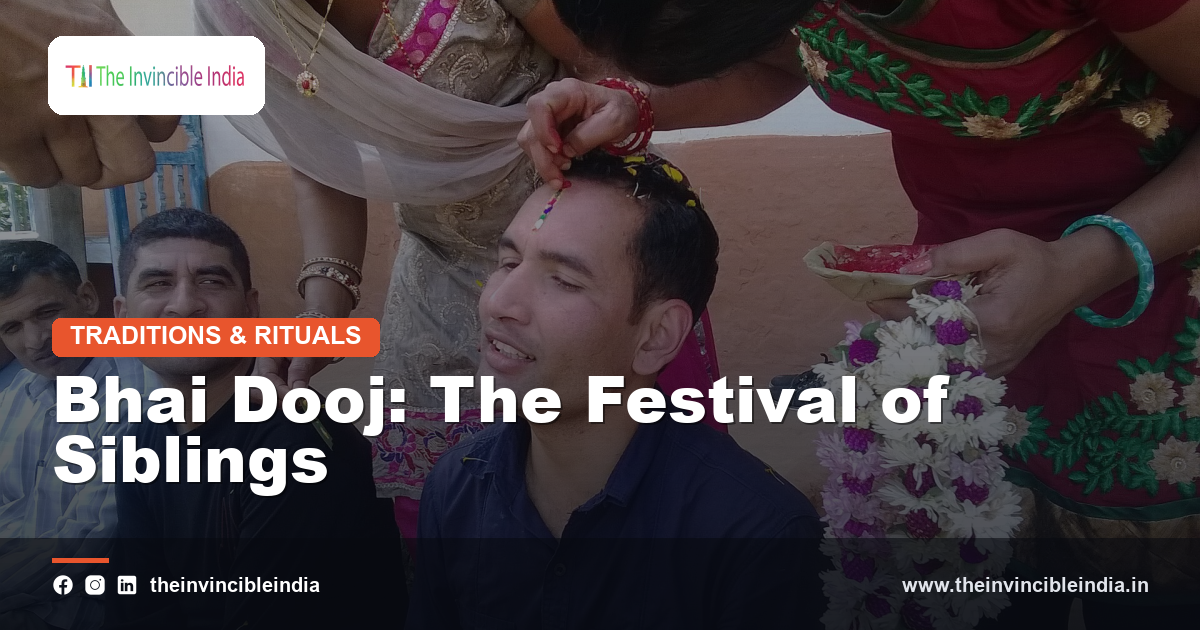
Bhai Dooj is a festival dedicated to the bond between brothers and sisters, observed two days after the main night of Diwali with a ceremony in which sisters apply a tilak on their brothers’ foreheads and pray for their wellbeing. Complementing Raksha Bandhan, which honours the same relationship earlier in the year, Bhai Dooj brings its own distinct rituals and mythological associations rooted in the legend of Yama and Yamuna. Celebrated across much of India under various regional names, the festival continues to be a cherished occasion for family reunion. This guide explores its origins, rituals and regional variations.
Quick Facts
| Detail | Information |
|---|---|
| Also Known As | Bhau Beej, Bhai Tika, Bhai Phota |
| Celebrates | The bond between brothers and sisters |
| Type of Observance | Hindu family festival |
| General Timing | Kartik Shukla Dwitiya, two days after Diwali |
| Key Practices | Tilak ceremony, prayers, gift exchange, family meal |
| Region of Prominence | Observed across India under various regional names |
Meaning and Significance
Bhai Dooj celebrates the enduring bond between brothers and sisters, providing a dedicated occasion within the festival calendar for siblings to reaffirm their affection and mutual care. The festival’s central ritual, in which a sister applies a tilak on her brother’s forehead and prays for his long life, embodies this spirit of protective goodwill.
Falling within the closing days of the Diwali season, Bhai Dooj extends the festival period with a distinctly family-oriented observance, reinforcing the broader emphasis on kinship and togetherness that runs through much of the Diwali festival cycle.
The Legend of Yama and Yamuna
Bhai Dooj is traditionally associated with a story involving Yama, the god of death, and his sister Yamuna, who is said to have welcomed her brother with great affection, applying tilak upon him and offering a festive meal on this day. Yama is said to have been so moved by the gesture that he declared the day auspicious for all brothers and sisters.
This legend gives the festival its alternative name, Yama Dwitiya, and provides its underlying mythological rationale. As with other such narratives, the story is understood as a symbolic teaching about sibling devotion rather than a literal historical account.
Position in the Diwali Festival Cycle
Bhai Dooj falls on Kartik Shukla Dwitiya, the second day of the bright fortnight following Diwali, placing it near the very end of the extended festival period that begins with Dhanteras. This positioning allows it to serve as a fitting, family-centred conclusion to the season.
As with other festivals following the lunar calendar, the exact Gregorian date shifts each year. Its placement at the close of the Diwali cycle gives Bhai Dooj a distinct role, shifting the focus from the broader themes of light and prosperity toward a more intimate celebration of sibling relationships.
Comparison with Raksha Bandhan
Bhai Dooj is often discussed alongside Raksha Bandhan, another major festival celebrating the bond between brothers and sisters, though the two differ in timing, ritual and symbolic emphasis. Raksha Bandhan, observed earlier in the year, centres on the tying of a protective thread, while Bhai Dooj focuses on the tilak ceremony and a shared festive meal.
Rather than duplicating one another, the two festivals are generally seen as complementary occasions, each offering siblings a distinct opportunity across the year to express care and strengthen their relationship through customary ritual.
The Tilak Ceremony
The central ritual of Bhai Dooj involves a sister applying a tilak, typically made with vermilion or sandalwood paste, on her brother’s forehead while offering prayers for his health, prosperity and long life. This act is performed with considerable care, often following a brief invocation or hymn.
The tilak is understood as a mark of protection and blessing, echoing similar symbolic gestures found in other Hindu rituals. Its central place in the Bhai Dooj ceremony reflects the broader importance of such small, personal rites of blessing within Indian family tradition.
Rituals Performed by Sisters
Beyond the tilak itself, sisters typically perform an aarti, waving a lit lamp before their brother as part of the ceremony, and may also tie a sacred thread around his wrist in some regional traditions. These accompanying rituals reinforce the protective and devotional character of the occasion.
Sisters often prepare specially for the day, arranging the ritual items in advance and, in many households, preparing sweets or a full festive meal as part of the celebration. This active role played by sisters throughout the observance underscores their central place in the festival’s structure.
Gifts and Blessings Exchanged
Following the tilak ceremony, brothers customarily offer gifts to their sisters as a token of appreciation and affection, ranging from money and clothing to other personal items depending on family custom and means. In turn, brothers often pledge their support and protection to their sisters for the year ahead.
This exchange of gifts and blessings reflects the reciprocal nature of the sibling bond celebrated on this day, with both parties actively participating in expressions of care rather than the ritual being one-directional.
Special Foods and Family Meals
A festive meal, often prepared by the sister and including the brother’s favourite dishes, forms an important part of Bhai Dooj celebrations in many households. This shared meal provides an occasion for extended family members to gather, reinforcing the festival’s broader emphasis on togetherness.
Sweets play a particularly prominent role in the day’s offerings, exchanged between siblings as part of the closing gestures of the ceremony. The combination of ritual, gift-giving and shared food gives Bhai Dooj a warm, domestic character distinct from more public festival celebrations.
Regional Names: Bhau Beej and Others
Bhai Dooj is known by a variety of regional names across India, reflecting local linguistic and cultural traditions while sharing the same underlying theme of sibling celebration. In Maharashtra and Goa, the festival is commonly called Bhau Beej, while in parts of North India it is referred to as Bhai Dooj or Bhaiya Dooj.
These varied names point to the festival’s widespread observance across linguistic regions, each community adapting the occasion’s core rituals, the tilak, blessings and shared meal, to its own customary vocabulary and local practice.
Bhai Dooj in Maharashtra and Goa
In Maharashtra and Goa, Bhau Beej is observed with rituals closely mirroring those found elsewhere, including the tilak ceremony and exchange of gifts, often coinciding with the celebration of the new year in the Vikram Samvat calendar observed in the region around this time.
This overlapping of the sibling festival with the regional new year adds a further layer of festivity to the occasion in these states, with households marking both the turn of the calendar and the celebration of sibling bonds within the same festive period.
Bhai Dooj in North India
Across North India, Bhai Dooj is observed with the familiar combination of tilak, aarti and festive meal, often marking one of the final gatherings of the extended Diwali season. Families frequently travel to be together for the occasion, particularly where siblings live in different cities.
The festival’s timing at the close of the Diwali period makes it a natural occasion for extended family reunions, with many households treating it as a final, more intimate celebration following the larger, more public festivities of Diwali itself.
Bhai Dooj in Bengal: Bhai Phota
In Bengal, the festival is observed as Bhai Phota, following the same essential structure of tilak, blessing and gift exchange, though with certain distinct regional customs, such as specific ritual chants recited by the sister as part of the ceremony.
Bhai Phota holds a particularly cherished place in Bengali family life, often treated as an occasion for elaborate preparation and celebration comparable in importance to other major festivals in the region’s calendar, reflecting the broader emphasis placed on sibling relationships within Bengali culture.
Symbolism of the Sibling Bond
At its core, Bhai Dooj is understood as a celebration of mutual protection and care between siblings, with the sister’s blessing for her brother’s wellbeing matched by his pledge of support and protection in return. This reciprocal symbolism gives the festival a balanced, two-way character.
The festival’s enduring popularity reflects the broader value placed on sibling relationships within Indian family life, offering a dedicated occasion each year for these bonds to be formally and affectionately acknowledged through shared ritual.
Modern Adaptations for Distant Families
As families increasingly live apart due to work, migration or study, many siblings now observe elements of Bhai Dooj remotely, exchanging blessings and gifts through video calls or courier services when an in-person gathering is not possible. Some sisters send tilak kits by post to brothers living far away.
These adaptations reflect a broader pattern seen across many Indian festivals, in which core rituals are preserved even as their format adjusts to accommodate the realities of contemporary, often geographically dispersed, family life.
Bhai Dooj and the Wider Theme of Family in Indian Festivals
Bhai Dooj fits within a broader pattern in the Indian festival calendar of dedicated occasions honouring specific family relationships, alongside festivals centred on parents, spouses and the wider community. This pattern reflects the significant emphasis placed on familial bonds within Indian cultural and religious life.
Viewed together with festivals such as Raksha Bandhan, Bhai Dooj illustrates how ritual and celebration are used across the calendar to formally mark and strengthen particular relationships, giving structured occasions to sentiments that might otherwise remain unexpressed in daily life.
Brothers Visiting Sisters' Homes
A widely followed custom holds that brothers should travel to their sisters’ homes for the Bhai Dooj ceremony, reversing the more common pattern in which sisters visit their natal families during other festivals. This gesture is understood as a way of honouring the sister’s household and acknowledging her central role in the day’s rituals.
Where distance or circumstance makes such travel difficult, sisters sometimes visit their brothers instead, or the ceremony is conducted wherever the family can gather. Regardless of the exact arrangement, the underlying expectation that the day should be spent together, in person, remains a strong and widely respected part of the tradition.
Bhai Dooj Today
In contemporary India, Bhai Dooj continues to be observed with its familiar combination of tilak, blessings, gift exchange and family meal, even as the format has adapted for siblings living apart. The festival remains a widely anticipated closing occasion of the Diwali season for households across the country.
Despite changes in circumstance and format, the festival’s essential purpose, honouring and reinforcing the bond between brothers and sisters through shared ritual, remains as meaningful today as it has long been within Indian family tradition.
Sources & Further Reading
- Ministry of Culture, Government of India (indiaculture.gov.in).
- Sahitya Akademi.
Frequently Asked Questions
What is Bhai Dooj?
Bhai Dooj is a festival celebrating the bond between brothers and sisters, marked by a tilak ceremony, blessings and a shared festive meal, two days after Diwali.
What is the legend behind Bhai Dooj?
The festival is traditionally linked to the story of Yama and his sister Yamuna, who welcomed him with a tilak and festive meal, leading Yama to declare the day auspicious for siblings.
How is Bhai Dooj different from Raksha Bandhan?
Raksha Bandhan centres on tying a protective thread and is observed earlier in the year, while Bhai Dooj focuses on a tilak ceremony and festive meal near the end of the Diwali season.
What is Bhau Beej?
Bhau Beej is the name used for Bhai Dooj in Maharashtra and Goa, observed with the same core rituals of tilak, blessings and gift exchange.
What is Bhai Phota?
Bhai Phota is the Bengali name for Bhai Dooj, following the same essential structure with certain distinct regional customs and ritual chants.


