

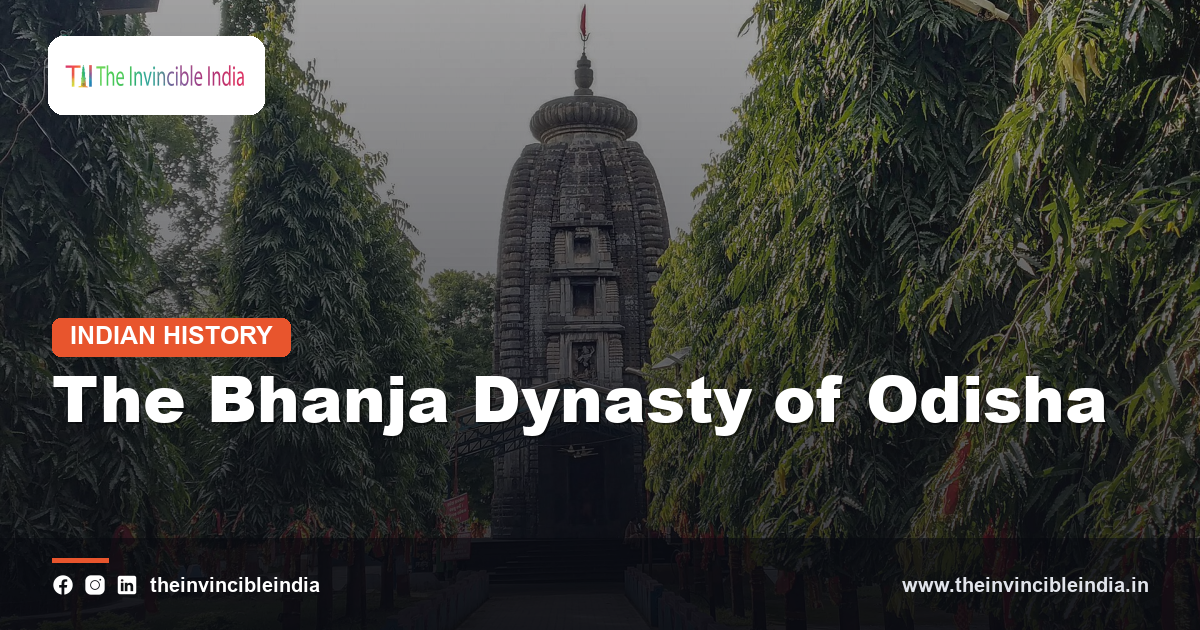
The Bhanja dynasty, also called the Bhanjas of Odisha, was a line of rulers, with several branches, who held power in parts of Odisha and the surrounding country from the early medieval period onward. Known in branches such as the Khinjali and Khijjinga, or Khiching, houses, and continuing in the later ruling families of Mayurbhanj and Keonjhar, the Bhanjas were notable patrons of temple building and of Odia culture. Their heritage includes the temples of Khiching, with its celebrated Kichakeshwari temple, and other monuments that reflect the devotional and artistic life of the region. As a ruling house of the eastern subcontinent, the Bhanjas belong to the rich history of Odisha and the wider medieval world, akin to the southern dynasties described in our guide to the Chola dynasty. Because the dynasty is known chiefly from inscriptions and its branches are complex, this account keeps to general terms where details are uncertain.
Quick answer: The Bhanja dynasty, or Bhanjas of Odisha, was a line of rulers with several branches who held power in parts of Odisha from the early medieval period onward. Known in branches such as the Khinjali and Khijjinga, or Khiching, houses, and continuing in the later families of Mayurbhanj and Keonjhar, the Bhanjas were notable patrons of temple building and Odia culture. Their heritage includes the temples of Khiching, with its celebrated Kichakeshwari temple, and the dynasty is known chiefly from inscriptions.
Key Takeaways
- The Bhanjas were a line of rulers, with several branches, who held power in parts of Odisha from the early medieval period onward.
- Their branches include the Khinjali and Khijjinga, or Khiching, houses.
- The dynasty continued in the later ruling families of Mayurbhanj and Keonjhar.
- The Bhanjas were notable patrons of temple building and Odia culture.
- Khiching, with its celebrated Kichakeshwari temple, is an important centre of Bhanja heritage.
- The dynasty is known chiefly from inscriptions rather than a single continuous chronicle.
Read on for the history, culture, and legacy in detail.
Quick Facts
| Detail | Information |
|---|---|
| Dynasty | Bhanja dynasty (Bhanjas of Odisha) |
| Period | Early medieval period onward, dates debated |
| Region | Parts of Odisha and surrounding country |
| Branches | Khinjali; Khijjinga (Khiching); later Mayurbhanj and Keonjhar |
| Chief Centre | Khiching, site of the Kichakeshwari temple |
| Patronage | Temple building; Odia culture |
| Evidence | Chiefly inscriptions |
| Legacy | Temple heritage of Khiching and the Mayurbhanj region |
Who Were the Bhanjas?
The Bhanjas were a line of rulers, with several branches, who held power in parts of Odisha and the surrounding country from the early medieval period onward. Rather than a single unified dynasty, the Bhanjas comprised a number of related houses and branches who ruled different tracts of the region at various times across a long span of history. They are remembered as notable patrons of temple building and of the culture of Odisha, leaving a rich heritage of shrines and monuments. The dynasty claimed a prestigious lineage, as was common among Indian ruling families, and its name recurs across the branches that shared the Bhanja identity. Known chiefly from inscriptions, the Bhanjas held an important place among the ruling houses of medieval and later Odisha. Their long continuity, through branches that endured into the later princely states, is one of their most striking features. The Bhanjas represent an enduring strand in the history of eastern India.
Where Did the Bhanjas Rule?
The Bhanjas ruled parts of Odisha and the surrounding country in eastern India, a region of fertile plains, forested hills and river valleys with a rich tradition of temple building and culture. Different branches of the Bhanjas were associated with different parts of this region, including the tracts linked with the Khinjali and Khijjinga, or Khiching, houses, and later the Mayurbhanj and Keonjhar areas. The varied geography of Odisha, with its coastal plains and inland hills, shaped the fortunes of these ruling houses. The region’s wealth, its temple culture and its position in eastern India supported a flourishing devotional and artistic life under the Bhanjas. Because the branches ruled different areas at different times, the Bhanja presence was spread across several parts of Odisha. Their territories were generally regional in scale, reflecting their role among the ruling houses of the region. The lands of Odisha were thus the homeland and stage for the long history of the Bhanjas.
What Were the Branches of the Bhanja Dynasty?
The Bhanja dynasty is known in several branches, each associated with a particular region and period, which together make up the complex history of the Bhanjas of Odisha. Among the early branches traditionally identified are the Khinjali Bhanjas and the Khijjinga, or Khiching, Bhanjas, who ruled their respective tracts in the early medieval period. In later centuries the Bhanja identity continued in the ruling families of Mayurbhanj and Keonjhar, which endured into the era of the princely states. These branches were distinct ruling houses who shared the Bhanja name and a claimed common lineage. Because the records are drawn chiefly from inscriptions and the branches are complex, the relationships among them and their precise chronology are uncertain and debated by historians. The existence of multiple branches reflects the way the Bhanja identity was spread among several houses across Odisha. The study of these branches helps map the ruling families of the region over a long span.
Who Were the Khinjali Bhanjas?
The Khinjali Bhanjas were one of the early branches of the Bhanja dynasty, associated with the Khinjali region of Odisha and known chiefly from inscriptions of the early medieval period. As a ruling house of the region, they held their tract of Odisha and are remembered for grants and acts recorded in their epigraphs, which provide much of the evidence for their history. Like the other Bhanja branches, they claimed the prestigious Bhanja lineage and participated in the temple culture and devotional life of the region. Their history, reconstructed from scattered inscriptions, is treated cautiously by historians, who note the gaps and uncertainties in the record. The Khinjali Bhanjas illustrate the character of the Bhanja houses as regional ruling families whose history survives mainly through epigraphy. As one of the early branches, they form part of the complex and layered history of the Bhanjas of Odisha. Their inscriptions remain valuable for the study of the region.
Who Were the Khijjinga Bhanjas?
The Khijjinga Bhanjas, associated with Khijjinga, corresponding to the area of Khiching in Odisha, were another of the early branches of the Bhanja dynasty and are of particular importance for their connection with the celebrated temple heritage of Khiching. As a ruling house of the region, they held their tract and are remembered for their patronage of temple building, above all in connection with the important shrines at Khiching. Their history, like that of the other branches, is reconstructed chiefly from inscriptions and the surviving monuments and is treated with care. The Khijjinga Bhanjas are especially remembered because Khiching became a notable centre of temple art associated with the dynasty. Their patronage links them to one of the richest sites of Bhanja heritage. As an early branch closely tied to the temple culture of the region, the Khijjinga Bhanjas occupy an important place in the history of the dynasty. Their legacy survives in the monuments of Khiching.
What Is Khiching Known For?
Khiching, in the Mayurbhanj region of Odisha, is known as an important centre of temple art and heritage associated with the Bhanja dynasty, above all through its celebrated Kichakeshwari temple. The site preserves temples and monuments that reflect the devotional culture and artistic traditions supported by the Bhanjas, making it one of the notable heritage places of the region. Khiching is remembered as a historic seat connected with the Khijjinga branch of the Bhanjas and as a focus of temple building under the dynasty. The carved stone temples and sculpture of Khiching illustrate the richness of the artistic traditions of medieval Odisha. The site remains an important place of devotion and heritage today. As a centre closely tied to the Bhanjas, Khiching embodies the temple patronage for which the dynasty is remembered. Its monuments stand among the most significant surviving heritage of the Bhanja age in Odisha.
What Is the Kichakeshwari Temple?
The Kichakeshwari temple at Khiching is the most celebrated monument associated with the Bhanja dynasty, a revered temple dedicated to the goddess and a major centre of devotion in the Mayurbhanj region of Odisha. Admired for its carved stone architecture and sculpture in the tradition of medieval Odia temple building, the temple reflects the religious patronage of the Bhanja rulers and the artistic richness of the region. The shrine is revered as an important place of worship and is closely tied to the heritage of Khiching and the Bhanjas. Its remains and its continuing devotion illustrate the enduring religious life of the site. As with other temples, the precise early history of the Kichakeshwari temple is drawn from tradition, inscriptions and archaeology and is treated with care. The temple stands as the enduring emblem of Bhanja temple patronage at Khiching. It remains among the most cherished religious monuments associated with the dynasty in Odisha.
How Did the Bhanjas Patronise Temple Building?
The Bhanjas were notable patrons of temple building, and their support for shrines and temple art forms one of the defining features of the dynasty across its branches. In the tracts they ruled, the Bhanja houses built and endowed temples dedicated to Hindu deities, contributing to the rich temple culture of Odisha. The site of Khiching, with its celebrated Kichakeshwari temple, stands as the most famous expression of this patronage, but the devotional energy of the dynasty is reflected in monuments across the region. Such patronage reinforced the legitimacy and prestige of the rulers and tied their rule to the sacred landscape of Odisha. The temples built under the Bhanjas reflect the artistic traditions and devotional life of medieval eastern India. Through this patronage the dynasty left a lasting mark on the religious and architectural heritage of the region. Temple building remains the most visible and celebrated legacy of the Bhanja dynasty.
What Was Bhanja Temple Art Like?
Bhanja temple art, seen at Khiching and other sites of Odisha, belonged to the rich tradition of eastern Indian temple building, with carved stone shrines, finely sculpted images and the distinctive styles that flourished in the region during the medieval period. The temples associated with the dynasty display stone construction, ornamental carving and images of deities characteristic of Odia temple architecture and sculpture. The art of Khiching in particular is admired for its quality and for its place in the artistic heritage of the region. This art reflects the wealth of the ruling houses, their religious devotion and the skill of the artisans of Odisha. Much of this heritage survives in the temples and in images and fragments preserved at the sites and in collections. The temple art patronised by the Bhanjas forms an important chapter in the artistic heritage of Odisha. It stands as enduring evidence of the devotion and cultural ambition of the dynasty and its branches.
How Did the Bhanjas Support Odia Culture?
The Bhanjas were patrons of the culture of Odisha, and their support for temple building, devotion, learning and the arts contributed to the rich cultural life of the region across their long history. As ruling houses deeply tied to the region, the Bhanja branches fostered the religious and artistic traditions that gave Odisha its distinctive heritage. Their patronage of temples and shrines supported the devotional culture that remains central to the identity of the region. The later Bhanja houses, such as those of Mayurbhanj, continued to play a role in the cultural life of their territories into the modern era. This long engagement with the culture of Odisha connects the dynasty to the broader heritage of eastern India. The support of the Bhanjas for religion and the arts formed part of the wider flourishing of Odia culture. Through such patronage the dynasty left a legacy that continues to shape the cultural heritage of the region.
What Do Inscriptions Tell Us About the Bhanjas?
Inscriptions are the principal source for the history of the Bhanjas, since the dynasty and its branches left no single continuous chronicle. The epigraphs associated with the various Bhanja houses record names, titles, genealogies, grants and events, providing the scattered evidence from which historians reconstruct the outline of the dynasty’s history. Because the records are spread across many branches, regions and centuries, assembling them into a coherent narrative is difficult and leaves many gaps, so the names, dates and relationships of individual rulers are often uncertain. Scholars interpret these inscriptions with care, aware of their limits and of the traditional nature of genealogical claims. The inscriptions, together with the surviving temples and monuments, form the foundation of what can be known about the Bhanjas. The inscriptional record is thus both the basis and the boundary of the study of the dynasty. Through it, historians recover the history of the Bhanja houses of Odisha.
How Did the Bhanja Houses Continue in Later Times?
The Bhanja identity continued in later centuries through ruling families such as those of Mayurbhanj and Keonjhar, which carried the Bhanja name and lineage into the era of the princely states. These later houses ruled their territories in the region of Odisha, maintaining the traditions and heritage associated with the Bhanjas over a long span of history. The state of Mayurbhanj in particular became one of the notable princely states of the region in the modern era, continuing the long story of the Bhanja houses. The continuity of the Bhanja identity across many centuries, from the early medieval branches to the modern princely states, is one of the most striking features of the dynasty. The later houses preserved the cultural and dynastic heritage of the Bhanjas into recent times. As with the earlier branches, their history is studied through records and traditions. The long continuity of the Bhanja houses gives the dynasty an enduring place in the history of Odisha.
How Did Mayurbhanj Join India?
Mayurbhanj, one of the later Bhanja houses and a princely state of the region, became part of independent India in the years following independence in 1947, as the princely states were integrated into the new nation. With the end of British paramountcy, the rulers of the princely states acceded to India, and the territory of Mayurbhanj was merged into the republic and became part of Odisha. This transition brought to a close the era of the Bhanja houses as ruling princes, though the family retained its historical standing and heritage. The integration of the states was part of the great reshaping of the political map of the subcontinent after independence. For the Bhanjas of Mayurbhanj, it marked the end of their long role as a ruling house. The joining of Mayurbhanj to India thus closed the final chapter of the Bhanja dynasty as a ruling family. The region became part of the modern state of Odisha.
Why Are the Bhanjas Significant?
The Bhanjas are significant as one of the enduring ruling houses of Odisha and as notable patrons of temple building and Odia culture across a long span of history. Their branches, from the early medieval Khinjali and Khijjinga houses to the later families of Mayurbhanj and Keonjhar, illustrate the continuity of a dynastic identity over many centuries. Their patronage of temple building, seen above all in the celebrated monuments of Khiching and the Kichakeshwari temple, left a rich architectural and devotional heritage in the region. The dynasty’s history, reconstructed chiefly from inscriptions, offers insight into the ruling houses of medieval and later eastern India. The temples and monuments of the Bhanja age remain among the important heritage of Odisha. For students of Indian history, the Bhanjas offer a vivid example of an enduring regional dynasty. Their significance rests on this combination of long continuity, temple patronage and contribution to the culture of Odisha.
The Bhanja Dynasty Today
The Bhanja dynasty is remembered today chiefly through the temple heritage of Khiching, above all the revered Kichakeshwari temple, and through the broader cultural heritage of the Mayurbhanj region and Odisha. The temples and monuments associated with the dynasty draw visitors, pilgrims and admirers of history and architecture, standing as enduring symbols of the dynasty’s devotion and artistry. The region retains the temple traditions, culture and heritage shaped by the Bhanjas over their long history. Scholars continue to study the inscriptions and monuments of the Bhanja houses to refine the understanding of the dynasty and its place in the history of Odisha. For readers of Indian history, the Bhanjas offer a striking example of an enduring regional dynasty and its rich temple heritage. Their legacy endures in the carved stone temples of Khiching, in the heritage of the Mayurbhanj region, and in the cultural life of Odisha.
Sources & Further Reading
- Archaeological Survey of India (asi.nic.in).
- Ministry of Culture, Government of India (indiaculture.gov.in).
- Department of Tourism, Government of Odisha (odishatourism.gov.in).
Frequently Asked Questions
Who were the Bhanjas of Odisha?
The Bhanjas were a line of rulers, with several branches, who held power in parts of Odisha from the early medieval period onward. They are remembered as notable patrons of temple building and Odia culture, and the dynasty is known chiefly from inscriptions.
What were the branches of the Bhanja dynasty?
The Bhanja dynasty is known in several branches, including the early Khinjali and Khijjinga, or Khiching, houses, and the later ruling families of Mayurbhanj and Keonjhar. The relationships among these branches are complex and are reconstructed cautiously by historians.
What is Khiching known for?
Khiching, in the Mayurbhanj region of Odisha, is known as an important centre of temple art associated with the Bhanja dynasty, above all through its celebrated Kichakeshwari temple. The site preserves temples and sculpture that reflect the devotional culture supported by the Bhanjas.
What is the Kichakeshwari temple?
The Kichakeshwari temple at Khiching is the most celebrated monument associated with the Bhanja dynasty, a revered temple dedicated to the goddess in the Mayurbhanj region of Odisha. It is admired for its carved stone architecture in the tradition of medieval Odia temple building.
How do we know about the Bhanjas?
The Bhanjas are known chiefly from inscriptions, since the dynasty and its branches left no single continuous chronicle. Together with the surviving temples and monuments, these inscriptions form the foundation of what can be known, though many details remain uncertain.
What happened to the Bhanja houses?
The Bhanja identity continued through later ruling families such as Mayurbhanj and Keonjhar, which endured into the era of the princely states. Mayurbhanj became part of independent India after 1947 and was merged into the modern state of Odisha.


