

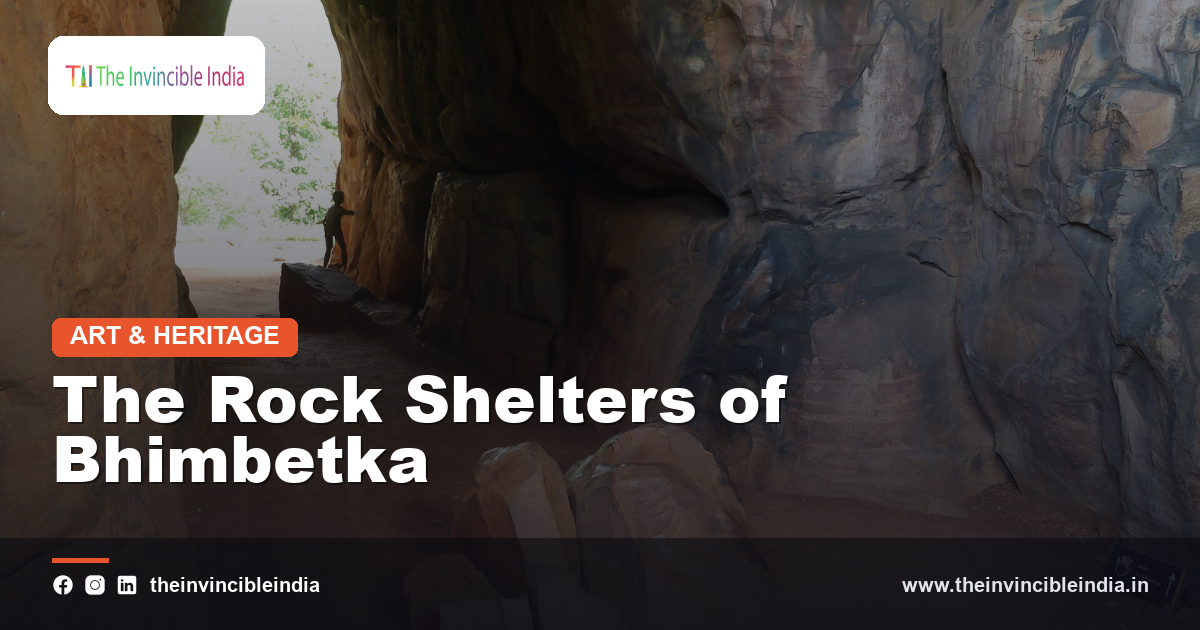
The rock shelters of Bhimbetka, set among sandstone outcrops near Bhopal in Madhya Pradesh, form one of the most important prehistoric sites in South Asia, sheltering paintings that record thousands of years of human presence in the region. Layers of imagery accumulated over successive periods depict hunting scenes, animals, and communal life, offering rare visual testimony to the world of early inhabitants long before the written record. Recognized as a UNESCO World Heritage Site alongside other landmarks central to India’s UNESCO World Heritage Sites, Bhimbetka continues to be studied as a key reference point for understanding prehistoric art and settlement across the Indian subcontinent.
Quick Facts
| Detail | Information |
|---|---|
| Location | Near Bhopal, Madhya Pradesh |
| Type | Prehistoric rock shelters and cave art |
| Setting | Sandstone outcrops in the Vindhya hill range |
| Famous for | Layered prehistoric rock paintings |
| Time span | Spans prehistoric through later historic periods |
| Recognition | UNESCO World Heritage Site |
A Prehistoric Landscape Near Bhopal
The Bhimbetka rock shelters lie within a forested landscape of sandstone hills on the edge of the Vindhya range, not far from the modern city of Bhopal. The area’s rugged terrain, dotted with natural rock overhangs and caves, provided sheltered spaces that early human communities found suitable for habitation over an extended span of time.
This setting, combining natural shelter with access to surrounding forests and water sources, made the region attractive to successive groups of inhabitants across many millennia, leaving behind a dense concentration of rock shelters bearing traces of sustained human activity.
Discovery of Bhimbetka
Bhimbetka came to wider scholarly attention in the mid-twentieth century, when researchers surveying the region identified the rock shelters and recognized the significance of the paintings preserved within them. This discovery prompted subsequent archaeological investigation into the site’s shelters and their painted surfaces.
Following this initial identification, systematic study of the site expanded considerably, revealing the scale and density of rock shelters in the surrounding hills and establishing Bhimbetka as one of the most significant concentrations of prehistoric art known in India.
Geological Setting
The rock shelters are formed within massive sandstone outcrops shaped over long geological periods by weathering and erosion, producing the natural overhangs and cave-like spaces that early inhabitants used for shelter. The distinctive rounded and layered rock formations give the landscape its characteristic appearance.
This geological character not only created suitable habitation spaces but also provided durable rock surfaces capable of preserving painted imagery over exceptionally long periods, contributing directly to the survival of the site’s artistic record into the present day.
Evidence of Early Human Habitation
Archaeological investigation at Bhimbetka has uncovered evidence of prolonged human habitation within the rock shelters, including stone tools and other traces of daily activity associated with early hunter-gatherer communities. Such findings indicate that the shelters served as functional living spaces rather than purely ceremonial sites.
This evidence positions Bhimbetka as an important location for understanding the lifeways of early inhabitants of the Indian subcontinent, offering insight into how communities adapted to and made use of the natural rock landscape over successive periods of occupation.
The Rock Paintings
The paintings found within Bhimbetka’s shelters constitute one of the richest collections of prehistoric rock art in India, rendered directly onto the natural stone surfaces using pigments derived from locally available minerals and organic materials. The images range from simple linear figures to more complex compositions.
These paintings, layered across the walls of numerous shelters, represent the cumulative artistic output of generations of inhabitants, making the site an invaluable visual archive of changing artistic styles and cultural practices across an extended span of prehistoric and early historic time.
Themes and Subjects of the Art
The subjects depicted in Bhimbetka’s paintings include scenes of hunting, groups of animals, and figures engaged in what appear to be communal or ceremonial activities such as dancing. These themes reflect the everyday concerns and experiences of the communities who created them.
Animals depicted include a range of wild species recognizable from the surrounding landscape, rendered with varying degrees of stylization across different periods. Together, these subjects offer a vivid, if impressionistic, window into the concerns and activities that shaped early human life in the region.
Pigments and Painting Techniques
The paintings at Bhimbetka were created using natural pigments, including mineral-derived colors such as red and white, applied directly to the rock surface. These materials, sourced from the immediate environment, reflect the resourcefulness of early artists working without access to manufactured paints or tools.
The durability of these natural pigments, combined with the sheltering effect of the overhanging rock, has allowed many images to survive for an extraordinarily long time, providing modern researchers with a rare direct link to the artistic practices of early human communities.
Chronological Layers of Art
Bhimbetka’s rock art is understood to span multiple periods, with successive generations of inhabitants adding new imagery to shelters already bearing older paintings. This layering has resulted in complex overlapping compositions that researchers study to distinguish different stylistic phases and periods of activity.
The presence of these chronological layers makes Bhimbetka particularly valuable for tracing the evolution of artistic style and subject matter over an extended timeframe, offering a continuous, if fragmented, record of changing artistic and cultural expression at the site.
Everyday Life Reflected in the Shelters
Beyond the paintings themselves, the physical arrangement of the rock shelters offers clues about the daily lives of their inhabitants, including how spaces may have been used for shelter, food preparation, and communal activity. Such details help researchers reconstruct broader patterns of prehistoric settlement.
This combination of artistic and habitational evidence allows Bhimbetka to serve as more than a gallery of ancient images, functioning instead as a comprehensive site for studying the practical and cultural dimensions of early human life in central India.
Notable Shelters
Among the numerous rock shelters that make up the Bhimbetka complex, several are particularly noted for the density and quality of their painted imagery, containing extensive compositions that illustrate the range of subjects and styles found across the site. These shelters are often highlighted in scholarly discussions of the site.
The variation between shelters, in terms of both content and preservation, allows researchers to compare different examples of prehistoric artistic practice within a single, geographically concentrated site, enriching the overall understanding of the region’s rock art traditions.
Continuity With Nearby Communities
The Bhimbetka region has long been home to local and tribal communities whose traditional ways of life bear some resemblance to elements depicted in the ancient paintings, offering researchers useful comparative context when interpreting the site’s imagery. This continuity is treated carefully and generally, without overstating direct links.
Such connections underscore the deep and continuous human relationship with this landscape, spanning from the prehistoric artists who painted the shelters to the communities who continue to inhabit the surrounding region today.
Archaeological Excavations
Systematic archaeological excavation at Bhimbetka has uncovered stone tools, hearths, and other material evidence within several rock shelters, supplementing the pictorial record with tangible artifacts of daily life. These findings have been essential in establishing the broader chronological framework for the site’s occupation.
Ongoing research continues to refine understanding of how the site was used across different periods, with excavation work carried out carefully to preserve both the physical deposits and the painted surfaces that make Bhimbetka such a significant archaeological resource.
UNESCO World Heritage Recognition
In recognition of its outstanding value for understanding early human life and artistic expression, Bhimbetka has been designated a UNESCO World Heritage Site. This status acknowledges the site’s significance not only within India but as part of the broader global record of prehistoric human activity.
World Heritage recognition has helped focus conservation attention and scholarly resources on the site, supporting continued research and protective measures aimed at preserving its fragile rock art for future study and appreciation.
Comparisons With Other Prehistoric Art Sites
Bhimbetka is often discussed alongside other significant concentrations of prehistoric rock art found in various parts of the world, each offering its own regional record of early human artistic expression. Such comparisons help situate Bhimbetka within a broader global context of prehistoric creativity.
While each site reflects its own local environment and cultural development, these comparative discussions highlight shared human impulses toward visual representation, reinforcing Bhimbetka’s importance as a major contribution to the worldwide understanding of prehistoric art.
Conservation Challenges
Preserving Bhimbetka’s rock paintings presents significant challenges, as the pigments and rock surfaces remain vulnerable to weathering, humidity, and the effects of visitor traffic. Conservation efforts focus on monitoring environmental conditions and limiting physical contact with painted surfaces to slow further deterioration.
These ongoing preservation measures are essential to ensuring that the site’s irreplaceable paintings, some of which survive only faintly, remain available for study and appreciation, given that damage to such ancient pigment-based art cannot be reversed or repaired.
Visiting Bhimbetka Today
Visitors to Bhimbetka follow marked pathways connecting a selection of the site’s most significant rock shelters, allowing access to view painted panels while minimizing disturbance to the wider archaeological landscape. Interpretive signage generally accompanies the more prominent shelters.
The experience of walking among the ancient rock shelters, set within a quiet forested landscape, offers visitors a rare and direct encounter with the artistic legacy of prehistoric communities, making Bhimbetka a compelling destination for those interested in early human history.
Interpreting Prehistoric Imagery
Interpreting the imagery preserved at Bhimbetka requires considerable caution, since the meaning intended by its original artists cannot be recovered with certainty and must instead be inferred through careful comparison with other archaeological evidence and broadly established scholarly method. Researchers generally avoid overly specific claims about the exact purpose or narrative content of individual paintings.
Instead, scholars tend to focus on identifying recurring themes, stylistic groupings, and general patterns of change over time, treating the paintings as a valuable but incomplete record of prehistoric life rather than a fully decipherable text. This careful, evidence-based approach has shaped the broader academic understanding of Bhimbetka, ensuring that interpretations of the site remain grounded in what the physical and painted record can reasonably support rather than speculative narrative reconstruction.
Interdisciplinary collaboration between archaeologists, art historians, and specialists in pigment analysis has further strengthened this cautious approach, allowing new findings to be cross-checked against multiple lines of evidence before being incorporated into the wider scholarly narrative surrounding the site’s long and layered occupation.
Bhimbetka Today
The rock shelters of Bhimbetka continue to stand as one of the most important records of prehistoric life and artistic expression found anywhere in India, their layered paintings offering a rare direct window into the world of early human communities across an immense span of time.
As a UNESCO World Heritage Site, Bhimbetka remains a focus of ongoing research and conservation, ensuring that its fragile paintings continue to inform scholarly understanding and public appreciation of India’s deep prehistoric heritage for generations to come.
Sources & Further Reading
- Archaeological Survey of India (asi.nic.in).
- Ministry of Culture, Government of India (indiaculture.gov.in).
Frequently Asked Questions
Where are the Bhimbetka rock shelters located?
The Bhimbetka rock shelters are located among sandstone hills near the city of Bhopal in Madhya Pradesh, India.
What is Bhimbetka best known for?
Bhimbetka is best known for its extensive collection of prehistoric rock paintings depicting hunting scenes, animals, and communal activities.
How old are the paintings at Bhimbetka?
The paintings span multiple periods, with successive layers added over a very long span of prehistoric and later historic time.
What materials were used to create the paintings?
Artists used natural pigments, including mineral-derived colors such as red and white, applied directly to the rock surfaces.
Is Bhimbetka a UNESCO World Heritage Site?
Yes, Bhimbetka has been designated a UNESCO World Heritage Site in recognition of its significance for understanding prehistoric human life and art.


