

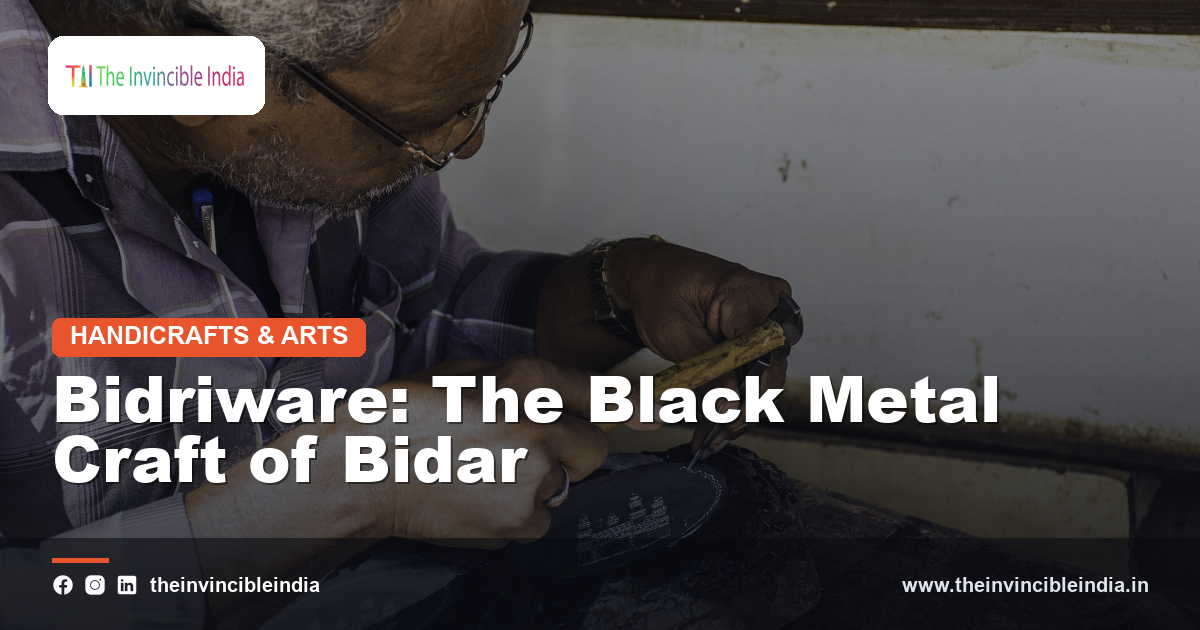
Bidriware is one of India’s most striking metal crafts, celebrated for its dramatic contrast of gleaming silver inlaid into a deep, matte black metal. Named after the city of Bidar, where it originated and still flourishes, the craft produces vases, boxes, bowls, hookah bases and ornaments in which delicate silver designs shine against a jet-black background. The distinctive black colour comes from a special treatment involving a soil found only at Bidar, a secret that gives the craft its unique character. Persian in origin and rich in history, Bidriware is one of the most refined of India’s handicraft traditions. This guide explores its origins, its materials, its famous black finish, its inlay work, its making and its living tradition.
Quick Facts
| Detail | Information |
|---|---|
| Type | Inlaid metal handicraft |
| Region | Bidar, Karnataka |
| Materials | A blackened zinc alloy inlaid with silver |
| Signature effect | Bright silver designs against a deep matte black |
| Secret | The black finish uses a special soil from Bidar |
| Recognition | Protected by a Geographical Indication (GI) tag |
A Dramatic Metal Craft
Bidriware is among the most visually striking of India’s metal crafts, prized for the bold and elegant contrast between its bright silver inlay and its deep, matte black surface. Objects such as vases, boxes, bowls and ornaments are transformed into works of art in which delicate silver patterns gleam against a jet-black ground, creating an effect of great richness and refinement. This dramatic contrast is the hallmark of the craft and the source of its beauty. Combining fine metalwork with a unique blackening process found nowhere else, Bidriware is one of the most distinctive and admired handicraft traditions of India, treasured for its elegance and craftsmanship.
The City of Bidar
Bidriware takes its name from Bidar, a historic city in the northern part of Karnataka, which has been the home of the craft for centuries. Bidar was once an important centre of power and culture, and it was here, under the patronage of its rulers, that the craft developed and flourished. The city remains the heart of the tradition, and the craft is inseparable from its name and its heritage. Crucially, the special soil that gives Bidriware its unique black colour is found within the old fort of Bidar, tying the craft even more closely to the city and making Bidar essential to its very making.
Persian Origins
The Bidriware tradition has its roots in Persian metalwork, brought to the Deccan region of India centuries ago and developed at Bidar under the patronage of its rulers. The art of inlaying metal with silver, and the aesthetic of the designs, reflect this Persian heritage, which fused with local skill to create the distinctive craft. Over time, Bidriware developed its own character and became a celebrated Indian art, prized at courts and among the wealthy for its beauty and refinement. This blending of Persian influence with Indian craftsmanship, nurtured at Bidar, produced one of the most elegant of India’s metal traditions, an art of foreign origin made wholly its own.
The Special Alloy
The body of a Bidriware object is made from a metal alloy composed mainly of zinc, with a small proportion of copper. This alloy is chosen because it can be blackened deeply and permanently by the special treatment at the heart of the craft, providing the dark ground against which the silver inlay shines. The alloy is cast into the desired shapes using moulds, forming the basic vessels and objects that will then be worked. The choice and casting of this particular alloy is the essential first stage of the craft, for it is this metal, and its ability to take the deep black finish, that makes the characteristic Bidriware effect possible.
Casting the Object
The making of a Bidriware object begins with casting the basic form from the zinc alloy. A mould is prepared, often using a mixture that includes soil, and the molten alloy is poured in to create the rough shape of the vase, box, bowl or other object. Once cast and cooled, the object is removed from the mould and its surface is smoothed and shaped by filing and polishing, readying it for the next stages. This casting and finishing produce the plain metal object that will then be engraved, inlaid with silver and finally blackened. The careful casting of a well-formed object is the foundation on which the fine decorative work is built.
Engraving the Design
Before the silver can be inlaid, the design must be engraved into the surface of the metal object. The artisan first coats the object temporarily so that the pattern can be drawn onto it, then carefully engraves the design into the metal with fine tools, cutting grooves and channels that will hold the silver. This engraving demands great skill and precision, for the beauty of the finished piece depends on the accuracy and delicacy of the cut design. The engraved pattern is the framework of the whole decoration, and the artisan’s mastery of this stage, cutting the fine lines and shapes into the hard metal, is central to the quality of the finished Bidriware.
Inlaying the Silver
The heart of Bidriware is the inlay of silver into the engraved design, the stage that gives the craft its characteristic gleaming patterns. Fine silver, in the form of thin wire or sheet, is carefully hammered and pressed into the engraved grooves and channels, filling the cut design with silver so that it sits flush with the surface. This painstaking work requires great skill and patience, as the silver must be fitted precisely into every line and shape of the pattern. Once inlaid and smoothed, the silver forms the intricate designs that will shine against the black ground. This delicate inlay work is the most skilled and important stage of the craft.
The Secret of the Black
The most famous secret of Bidriware is the process that gives it its deep, permanent black colour, a process that depends on a special soil found within the old fort of Bidar. After the silver has been inlaid, the object is treated with a paste made from this particular soil, mixed with other ingredients. Through a chemical reaction, this treatment blackens the zinc alloy deeply and permanently while leaving the inlaid silver untouched and bright. The result is the dramatic contrast of gleaming silver against jet-black metal that defines the craft. This unique blackening, dependent on the soil of Bidar itself, is the crowning secret of Bidriware and the source of its distinctive beauty.
The Soil of Bidar
One of the most fascinating aspects of Bidriware is that its characteristic black finish cannot be achieved without a special soil taken from the old fort of Bidar. This soil, believed to have particular properties owing to its long shelter from sun and rain, is essential to the blackening process, and it is said that the same effect cannot be reproduced using soil from elsewhere. This remarkable dependence on a local material ties the craft inseparably to the city of Bidar and gives it a unique, almost magical quality. It is one of the reasons the craft has remained centred on Bidar and could not simply be transplanted elsewhere.
Motifs and Designs
Bidriware is decorated with elegant designs reflecting its Persian heritage and Indian setting. Floral and foliate patterns, creepers, geometric designs and arabesques are common, along with motifs such as the poppy flower and other traditional forms. These designs, inlaid in silver, are arranged with care to suit the shape of each object, from the flowing patterns on a vase to the borders and panels on a box. The graceful, intricate designs, gleaming silver against black, give Bidriware its refined and decorative beauty. The vocabulary of motifs, developed over centuries, connects the craft to its Persian roots while expressing the artistry of its Indian makers.
The Range of Objects
Bidriware has traditionally been made in a range of objects, both decorative and functional. Historically, the craft produced hookah bases, vases, bowls, plates, boxes, ornamental containers and other items for the courts and the wealthy. Today it continues to be made in vases, boxes, bowls, jewellery, decorative plates and a variety of ornamental and gift items, all bearing the characteristic silver-on-black designs. This range allows the craft to appeal to different tastes and uses while keeping its distinctive style. The adaptation of the tradition to objects suited to modern tastes has helped it endure, and Bidriware pieces are prized as elegant decorative objects and gifts.
The Artisans
Bidriware is the work of highly skilled artisans in Bidar, who master the several demanding stages of the craft, from casting and engraving to the delicate silver inlay and the final blackening. The tradition has been sustained by communities of craftspeople, often within families, who carry the specialised knowledge across generations. Creating fine Bidriware requires patience, precision and artistry, especially in the intricate inlay work, and this expertise is the foundation of the craft. The dedication of these artisans, and the passing on of their skills and the closely held knowledge of the process, is essential to the survival and quality of the Bidriware tradition.
Recognition and a GI Tag
Bidriware is celebrated as one of the finest metal crafts of India, admired for its dramatic beauty and refined craftsmanship. To protect the tradition and the artisans, Bidriware has been granted a Geographical Indication (GI) tag, which recognises it as a product distinctive to Bidar and helps safeguard its authenticity against imitation. The craft is also supported through crafts promotion and a market for Bidriware objects as decorative pieces and gifts within India and abroad. This recognition and protection help sustain the tradition and the livelihoods of the artisan community, and affirm the value of Bidriware as a treasured part of India’s craft heritage.
Bidriware Today
Today Bidriware continues as a living craft in Bidar, its dramatic silver-on-black objects prized as elegant decorative pieces and gifts across India and around the world. The artisans continue to make the ware by the traditional methods, including the unique blackening with the soil of Bidar, while adapting the range of objects to modern tastes. Efforts through GI protection and crafts support work to safeguard the tradition and the artisans against imitation and decline. In its striking contrast of gleaming silver and deep black, its fine inlay work and its unique blackening secret, Bidriware remains one of the most distinctive and admired metal crafts of India.
Sources & Further Reading
- Ministry of Culture, Government of India, on the metal craft traditions of India (indiaculture.gov.in).
- Geographical Indications Registry, Government of India, on the GI status of Bidriware (ipindia.gov.in).
- Development Commissioner (Handicrafts), Ministry of Textiles, on traditional Indian handicrafts.
Frequently Asked Questions
What is Bidriware?
Bidriware is a striking metal craft from Bidar in Karnataka, in which silver is inlaid into a blackened zinc alloy to create objects such as vases, boxes and ornaments with bright silver designs against a deep matte black background.
Why is Bidriware black?
Bidriware gets its deep, permanent black colour from a special treatment using a soil found within the old fort of Bidar. After the silver is inlaid, a paste made from this soil blackens the zinc alloy while leaving the silver bright, creating the characteristic contrast.
What is Bidriware made of?
Bidriware objects are made from an alloy composed mainly of zinc with a little copper, chosen because it can be blackened deeply and permanently. Fine silver is then inlaid into the engraved designs to create the gleaming patterns.
Where does Bidriware come from?
Bidriware comes from Bidar, a historic city in northern Karnataka, where the craft developed under royal patronage from Persian origins. The special soil essential to its black finish is found within the old fort of Bidar.
Is Bidriware protected by a GI tag?
Yes. Bidriware has been granted a Geographical Indication (GI) tag, which recognises it as a product distinctive to Bidar and helps protect its authenticity and the interests of its artisans against imitation.


