

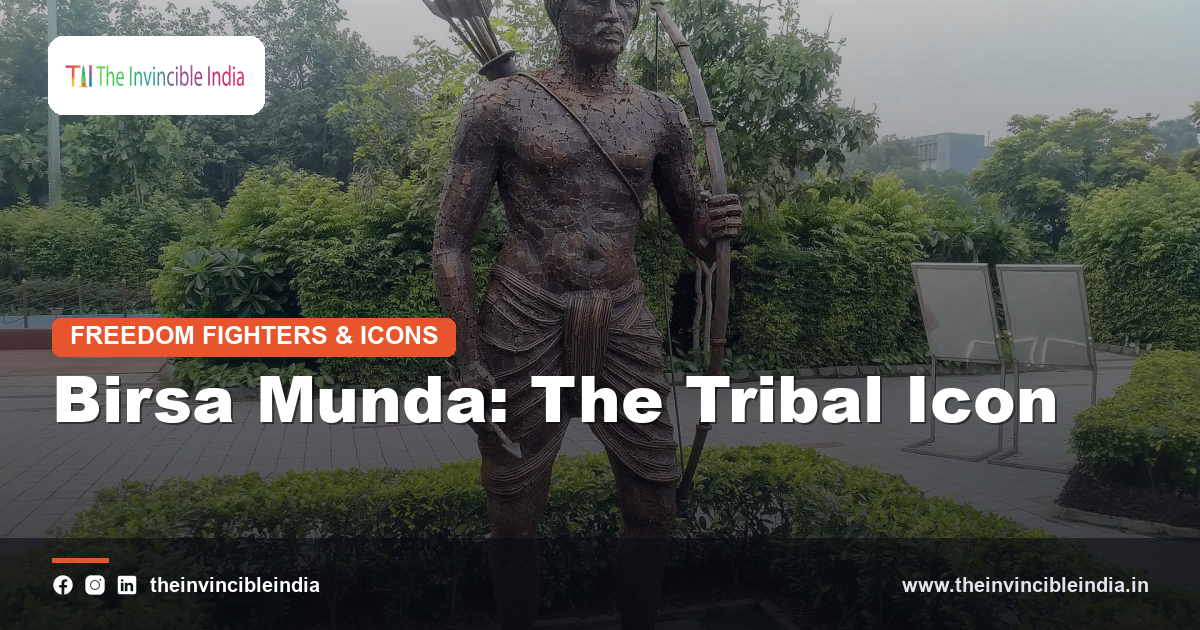
Birsa Munda stands as one of the most revered figures among India’s freedom fighters, a young leader from the Munda tribal community of the Chhotanagpur plateau whose brief but remarkable life combined religious reform with determined resistance to colonial and exploitative land practices. Emerging in the closing years of the nineteenth century, he rallied tribal communities of the region into the movement remembered as the Ulgulan, or the Great Tumult, challenging the alliance of colonial administration and outside landlords that had eroded traditional tribal rights over land and forest. Though his life was cut tragically short, his memory has grown steadily into a powerful symbol of tribal identity and self-respect across India. This guide traces his life, his movement, and his enduring legacy.
Quick Facts
| Detail | Information |
|---|---|
| Known as | Dharti Aba (Father of the Earth) |
| Community | Munda tribe, Chhotanagpur plateau |
| Movement led | The Ulgulan (Great Tumult) |
| Focus | Land rights, forest access and religious reform |
| Region | Present-day Jharkhand |
| Legacy | National symbol of tribal identity and resistance |
A Tribal Icon of the Chhotanagpur Plateau
Birsa Munda occupies a unique place in India’s history as a young tribal leader whose short life left an extraordinarily lasting impact on the collective memory of the Chhotanagpur plateau and beyond. Born into the Munda community, he grew up amid the profound social and economic changes that colonial rule and the arrival of outside landlords had brought to the region’s tribal societies. Rather than accept these changes passively, Birsa emerged as a figure capable of articulating tribal grievances and mobilising communities toward organised resistance. His legacy today extends well beyond the specific events of his movement, having become a broader symbol of tribal pride and self-determination across the country. As a tribal icon, Birsa Munda’s story continues to resonate powerfully.
Early Life Among the Munda Community
Birsa Munda was born in the late nineteenth century into a Munda family of modest means in the Chhotanagpur region, an area whose tribal population had long practised its own systems of communal land use. His early years were shaped by the gradual erosion of these traditional systems as colonial administration and non-tribal landlords extended their control over land that had previously belonged collectively to tribal communities. Growing up amid these tensions gave the young Birsa an early awareness of the injustices faced by his people. This upbringing, rooted in a community increasingly under economic pressure, laid the foundation for the leadership role he would later assume.
Education and Exposure to Wider Influences
Birsa Munda received some formal education in his youth, including time spent in mission schools that exposed him to new religious and social ideas circulating in the region. This exposure broadened his outlook beyond the immediate concerns of his village, bringing him into contact with wider currents of religious reform and social change affecting tribal society at the time. While these experiences shaped his thinking, Birsa retained a strong connection to Munda tradition and belief, which he would later draw upon extensively in his own teachings. This combination of external exposure and rootedness in tribal culture gave Birsa a distinctive perspective that shaped his later leadership.
Land Alienation and Tribal Grievance
A central grievance driving the movement that Birsa Munda would come to lead was the alienation of tribal land, as traditional communal landholding systems gave way under colonial administration to arrangements that favoured outside landlords and moneylenders. Munda cultivators increasingly found themselves reduced to tenants or labourers on land their ancestors had once held collectively, a change that struck at the heart of tribal social and economic life. Forced labour demands and restrictions on forest use added further layers of hardship to an already difficult situation. This widespread sense of land alienation and economic injustice provided the essential context for the movement Birsa would soon lead.
Emergence as a Religious and Social Reformer
Before becoming a political leader, Birsa Munda first emerged as a religious and social reformer, preaching a message that combined elements of Munda tradition with new ethical and spiritual teachings aimed at reforming tribal society from within. He encouraged his followers to abandon certain customs he considered harmful while urging a renewed sense of communal discipline and self-respect. This religious message, often referred to by followers as the Birsait faith, gave his movement a powerful spiritual dimension that reinforced its social and political appeal. Birsa’s emergence as a religious reformer laid important groundwork for the wider movement of resistance that would follow.
The Call to Resistance
As Birsa Munda’s following grew, his message increasingly turned toward direct resistance against the colonial administration and the landlords who had benefited from the alienation of tribal land. He called upon Munda and other tribal communities to reclaim their traditional rights and to resist the structures that had dispossessed them, framing this resistance in terms that resonated deeply with tribal identity and belief. This call to resistance transformed a religious and social reform movement into a more overtly political and confrontational one. The shift marked the beginning of the phase of Birsa’s leadership that would culminate in open uprising.
The Ulgulan: The Great Tumult
The movement led by Birsa Munda came to be known as the Ulgulan, a term meaning great tumult or uprising, referring to the coordinated resistance mounted by Munda communities against colonial authority and exploitative land arrangements in the late 1890s. The Ulgulan involved organised actions against symbols of colonial and landlord authority across the Chhotanagpur region, reflecting the scale of grievance that Birsa had succeeded in mobilising. This movement stands as one of the most significant tribal uprisings of the colonial period, notable both for its scale and for the depth of popular support it commanded. The Ulgulan remains the defining episode of Birsa Munda’s life and leadership.
Organisation and Popular Support
The strength of the Ulgulan lay significantly in the organisational network that Birsa Munda had built through his earlier work as a religious and social reformer, which gave him a base of committed followers across numerous villages of the Chhotanagpur plateau. This network allowed the movement to coordinate action across a wide area despite the absence of modern communication or transport. The depth of popular support Birsa commanded reflected the genuine resonance of his message among a population that had endured years of land alienation and economic hardship. This broad-based organisation and support gave the Ulgulan a scale and cohesion that alarmed the colonial administration considerably.
The Colonial Response
The colonial administration responded to the Ulgulan with a substantial deployment of police and military force, treating the movement as a serious threat to its authority over the Chhotanagpur region. Efforts to suppress the uprising involved both direct confrontation with Birsa’s followers and measures aimed at breaking up the network of support he had built across the region’s villages. The scale of this response reflected the seriousness with which colonial authorities viewed the challenge posed by an organised tribal uprising. This determined colonial effort at suppression eventually succeeded in containing the immediate uprising, though its underlying grievances remained unresolved for years afterward.
Capture and Imprisonment
Birsa Munda was eventually captured by colonial authorities as the campaign to suppress the Ulgulan intensified, bringing an end to his direct leadership of the movement in the field. His capture was a significant blow to the uprising, though the underlying grievances that had driven Munda communities to resistance did not disappear with his imprisonment. Accounts of this period describe the continuing loyalty of his followers even after his capture, a testament to the depth of the movement he had built. His imprisonment marked the beginning of the final and tragically brief chapter of his life.
Death at a Young Age
Birsa Munda died in custody at a remarkably young age, a loss that was felt deeply among the tribal communities of the Chhotanagpur plateau who had come to regard him as both a spiritual and political leader. His early death, following a life devoted entirely to the cause of tribal dignity and rights, only deepened the reverence in which he was held by his followers and by later generations. The circumstances of his death, occurring while still a very young man, have contributed to the almost legendary status he holds in tribal memory. This early death remains one of the most poignant aspects of Birsa Munda’s extraordinary story.
Legacy for Land and Forest Rights
The Ulgulan led by Birsa Munda contributed to a growing colonial recognition of the need to address tribal grievances over land, eventually influencing administrative measures intended to provide some protection for tribal landholding in the Chhotanagpur region. While these measures came only gradually and imperfectly addressed the underlying injustices, the movement’s impact on land and forest policy debates in the region is widely acknowledged by historians. This legacy for land and forest rights connects Birsa Munda’s short life to longer-term struggles over tribal land that have continued in various forms into the present day. His movement remains a foundational reference point in the history of tribal rights in India.
Symbol of Tribal Identity and Pride
Beyond the specific events of the Ulgulan, Birsa Munda has grown into a broader symbol of tribal identity and pride across India, representing the dignity, resilience and cultural distinctiveness of tribal communities in the face of historical marginalisation. His image and story are invoked widely in contexts concerned with tribal welfare, cultural recognition and social justice, reflecting a legacy that has expanded well beyond the historical specifics of his own movement. This role as a symbol of tribal identity has grown steadily over the decades since his death, cementing his place in the national consciousness. Birsa Munda’s symbolic significance today extends far beyond the borders of the Chhotanagpur plateau.
National Recognition and Commemoration
Birsa Munda’s contribution to India’s history has received significant national recognition, with his birth anniversary observed as a day honouring tribal pride and heritage across the country. Statues, institutions, and public spaces bearing his name can be found not only in Jharkhand but across India, reflecting the national scale of the reverence in which he is held. This level of commemoration places Birsa Munda among the most widely honoured tribal leaders in the country’s history. Such national recognition and commemoration ensure that his story reaches audiences far beyond the region where his movement originally took place.
Memorials in Jharkhand and Beyond
Across Jharkhand, the region most closely associated with his life and movement, Birsa Munda is honoured through numerous memorials, museums and public institutions that preserve and present his story to new generations. These sites serve as important centres of remembrance, drawing visitors interested in learning about the Ulgulan and the broader history of tribal resistance in the region. Similar tributes exist in other parts of the country, reflecting the geographic spread of his legacy well beyond his native Chhotanagpur. These memorials in Jharkhand and beyond ensure that Birsa Munda’s story remains accessible and vivid for those who seek to understand it.
Birsa Munda Today
Today Birsa Munda is remembered as one of the most significant tribal leaders in Indian history, honoured both for his specific leadership of the Ulgulan movement and for his broader role as a symbol of tribal dignity and resistance. His story continues to be taught in schools, commemorated in public life, and invoked in ongoing conversations about tribal rights and recognition across India. He is remembered particularly for the rare combination of religious reform and political resistance that characterised his brief but consequential life. As Dharti Aba, father of the earth, Birsa Munda endures as one of India’s most cherished tribal icons.
Sources & Further Reading
- Ministry of Tribal Affairs, Government of India, on tribal history and leaders (tribal.nic.in).
- Ministry of Culture, Government of India, on regional freedom movements (indiaculture.gov.in).
Frequently Asked Questions
Who was Birsa Munda?
Birsa Munda was a young tribal leader of the Munda community from the Chhotanagpur plateau who led the Ulgulan movement, combining religious reform with resistance to colonial land and forest policies that had dispossessed tribal communities.
What was the Ulgulan movement?
The Ulgulan, or Great Tumult, was a tribal uprising led by Birsa Munda in the late 1890s against colonial authority and exploitative land arrangements affecting the Munda and other tribal communities of the Chhotanagpur region.
Why is Birsa Munda called Dharti Aba?
Birsa Munda is honoured with the title Dharti Aba, meaning father of the earth, reflecting the deep reverence tribal communities hold for his leadership and his defence of their traditional connection to the land.
How is Birsa Munda remembered today?
Birsa Munda is remembered through memorials, museums and national commemorations, and his birth anniversary is observed as a day honouring tribal pride and heritage across India.
What is Birsa Mundas broader legacy?
Beyond the Ulgulan movement itself, Birsa Munda has become a lasting national symbol of tribal identity, dignity and resistance, invoked widely in discussions of tribal rights and cultural recognition.


