

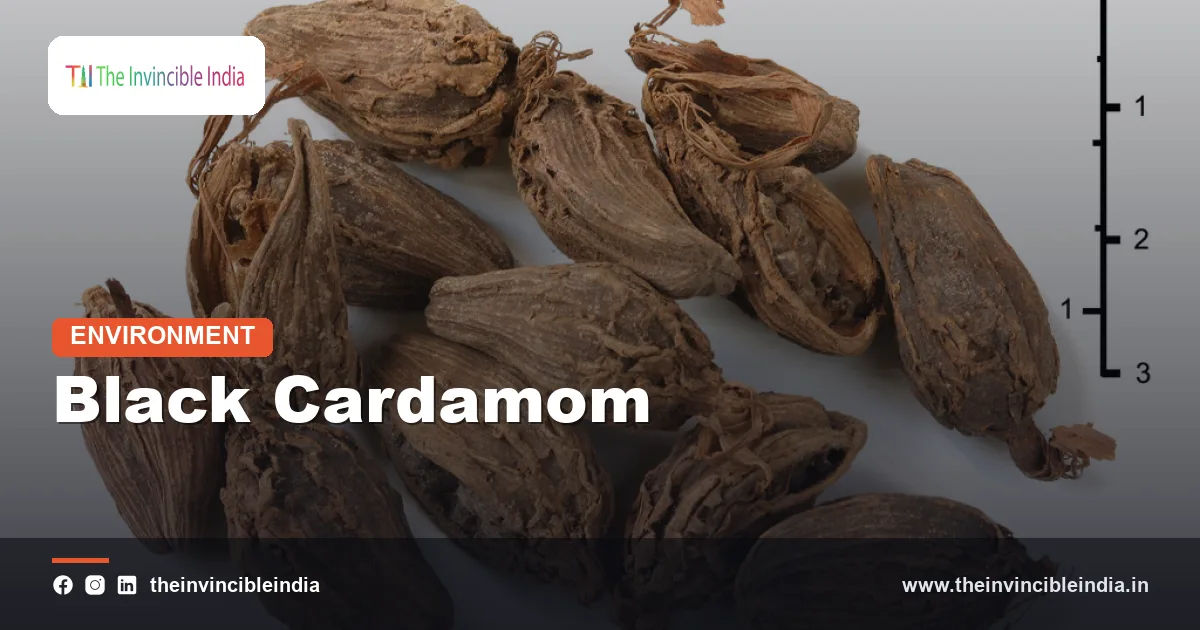
The spice called black cardamom is the large, dark brown, smoky-smelling seed pod of the perennial herb Amomum subulatum, a ginger-family plant that grows in the shaded hill forests of the eastern Himalaya and is known in Hindi and Urdu as badi elaichi. India, along with Nepal and Bhutan, is one of the main producers of this spice, and most of the Indian crop comes from Sikkim and the Darjeeling hills of West Bengal.
The pods are harvested in autumn, dried over a wood fire in a kiln called a bhatti, and sold whole for use in rice dishes, meat curries and garam masala blends. This explainer describes the plant, how it is grown and dried, how it differs from green cardamom, and why it matters to Himalayan farming communities.
Quick Facts
| Common names | Black cardamom, large cardamom, badi elaichi, Nepal cardamom |
|---|---|
| Scientific name | Amomum subulatum |
| Family | Zingiberaceae (the ginger family) |
| Where grown in India | Sikkim, the Darjeeling hills of West Bengal, and parts of Arunachal Pradesh and other north-eastern hill areas |
| Typical altitude | Roughly 800 to 2,000 metres above sea level, in humid shaded slopes |
| Season | Pods ripen and are harvested mainly from September to November |
| Part used | The dried, seed-filled capsule (pod) |
| Uses | Savoury rice dishes, meat curries, garam masala, spiced teas and traditional remedies |
Key Takeaways
- Black cardamom (Amomum subulatum) is a ginger-family herb whose large dried capsules are the spice known as badi elaichi.
- Black cardamom is a different plant from green cardamom, which is Elettaria cardamomum and is grown mainly in southern India.
- The smoky aroma of black cardamom comes largely from drying the harvested pods over a wood fire in a traditional kiln.
- Sikkim and the Darjeeling hills are the heartland of Indian black cardamom cultivation, usually under the shade of alder trees.
- Black cardamom is used whole in savoury dishes such as biryani and pulao, and is rarely used in sweet preparations.
- Black cardamom farms depend on humid mountain slopes, so they are sensitive to plant diseases, landslides and changing rainfall.
What is black cardamom?
Black cardamom is a spice made from the dried fruit capsules of Amomum subulatum, a tall leafy herb of the Zingiberaceae family. Each capsule is about two to three centimetres long, oval, deeply wrinkled and dark reddish-brown to almost black, and it holds dozens of small, sticky, aromatic seeds packed in three compartments.
The spice is also called large cardamom, greater cardamom, Nepal cardamom and, in Indian kitchens, badi elaichi, where “badi” means big. Its flavour is intense, resinous and smoky, with a cooling camphor-like note that experienced cooks describe as menthol-like. That character comes from aromatic oils in the seeds, one of which is cineole, and from the smoke absorbed during drying.
Unlike many spices that are ground before sale, black cardamom is traditionally sold and used as a whole pod. Cooks crack it lightly or drop it in intact, let it flavour the oil or the cooking liquid, and usually remove it before serving because the pod itself is tough and bitter to chew.
How is black cardamom different from green cardamom?
Black cardamom differs from green cardamom in being a different species, a different size, a different flavour and a different growing region. Green cardamom, called choti elaichi or “small cardamom”, is Elettaria cardamomum, a plant of the Western Ghats in Kerala, Karnataka and Tamil Nadu, while black cardamom comes from Amomum subulatum in the eastern Himalaya.
The two spices share a family and a common name but they are not interchangeable. Green cardamom has a sweet, floral, lemony fragrance and is used in tea, desserts and rice puddings. Black cardamom is earthy and smoky and belongs mostly to savoury food. Substituting one for the other changes a dish noticeably.
| Feature | Black cardamom | Green cardamom |
|---|---|---|
| Scientific name | Amomum subulatum | Elettaria cardamomum |
| Hindi name | Badi elaichi | Choti elaichi |
| Pod size and colour | Large, wrinkled, dark brown | Small, smooth, pale green |
| Main Indian region | Sikkim and Darjeeling hills | Kerala, Karnataka, Tamil Nadu |
| Drying method | Smoked over wood fire in a kiln | Dried in sun or heated chambers |
| Flavour | Smoky, resinous, camphor-like | Sweet, floral, citrusy |
| Typical use | Biryani, pulao, curries, garam masala | Tea, sweets, desserts, rice dishes |
Where is black cardamom grown in India?
Black cardamom is grown in India mainly in the state of Sikkim, which is generally regarded as the largest producing state, and in the Darjeeling and Kalimpong hills of West Bengal. Smaller plantings exist in parts of Arunachal Pradesh and other hill districts of the north-east, where the climate and terrain are similar.
The spice thrives in the outer and middle Himalayan zone. This belt receives heavy rainfall, stays humid through much of the year, and has steep, well-drained, forested slopes with deep leafy soils. Outside India, Nepal and Bhutan are the other principal producers, and the three countries together supply most of the black cardamom traded in the world.
Within Sikkim, farming is typically done by small households that grow the crop on their own mountain land rather than on large estates. A farm is often a narrow terraced plot or a cleared forest slope near a stream, because the plant needs constant moisture at its roots but does not tolerate standing water.
What does the black cardamom plant look like?
The black cardamom plant is a clump-forming perennial herb that sends up leafy shoots, called pseudostems, about one to two metres tall from an underground rhizome. The long, lance-shaped leaves are glossy green and arranged in two rows along each shoot, which gives a clump a lush, tropical appearance even on a cold Himalayan hillside.
The flowers do not appear on the leafy shoots. Instead, short spikes arise at ground level directly from the rhizome, so the flowers and later the fruits sit close to the soil, partly hidden under leaf litter. Each spike carries pale, yellowish flowers that are pollinated by insects, chiefly bees. After pollination, the spike develops into a cluster of rounded capsules that turn from green to a reddish-brown as they mature.
Because the plant spreads underground, a single clump slowly widens into a thicket. Farmers divide older clumps and replant sections as new suckers, which keeps the planting productive and is the most common way of establishing new fields.
How is black cardamom cultivated?
Black cardamom is cultivated by planting rhizome suckers or seedlings in humid, shaded, sloping forest land, usually beneath a canopy of trees that filters the sunlight. The crop is a long-term perennial, so a well-managed plantation can remain productive for many years after the first yield.
Shade and the role of alder
The plant is a shade lover and burns in strong direct sun. In Sikkim and the Darjeeling hills the traditional shade tree is the Nepal alder (Alnus nepalensis), a fast-growing Himalayan species. Alder roots host nitrogen-fixing bacteria, so the trees add fertility to the soil, and their leaves form a rich mulch. This agroforestry arrangement lets farmers earn from the spice while keeping a tree canopy on steep slopes.
Planting and care
- Planting is usually done at the start of the rainy season, when the soil is moist and cuttings establish quickly.
- Suckers with a healthy rhizome and shoots are planted in pits at wide spacing, so clumps have room to spread.
- Weeding is done by hand, and old, dried or diseased shoots are removed to let air and light reach the clump.
- Water is supplied largely by natural rainfall and by small channels and streams drawn across the plot.
The plant begins to bear a meaningful crop after a few years of growth. Yields rise as the clump matures, then decline with age and disease, at which point farmers replant with healthy suckers.
How is black cardamom harvested and dried?
Black cardamom is harvested by hand in autumn, usually from September to November, by cutting the whole fruit spike when the capsules are mature but still firm, and it is then dried slowly in a kiln over a wood fire. The timing matters because capsules left too long on the plant split open and lose their seeds, while capsules cut too early dry poorly and smell weak.
After picking, farmers separate the capsules from the spike and clean off soil. The traditional drying structure is the bhatti, a kiln or hearth in which the pods are spread on trays or racks above a smouldering wood fire. The pods are dried over several days, and heat and smoke together drive off moisture and fix the colour and aroma.
The smoke gives the spice its characteristic flavour. If the drying is too hot, the capsules can crack, scorch or lose oil, and if it is too smoky or uneven, the pods may taste harsh. Improved dryers, which use controlled heat with better airflow, have been promoted by research and spice institutions to produce a cleaner, more uniform product, though many traditional farmers still prefer the classic smoky bhatti flavour.
Once dry, the pods are graded by size and colour, cleaned and packed. Large, plump, dark pods with a strong aroma generally fetch better prices than small or broken ones.
What does black cardamom taste like and how is it used?
Black cardamom tastes smoky, earthy and resinous with a cool, camphor-like edge, and it is used mainly in savoury dishes where its depth stands up to meat, rice and lentils. A single pod is usually enough to flavour a dish for several people.
Common culinary uses include:
- Whole pods dropped into biryani, pulao and other layered rice dishes.
- Slow-cooked meat curries, nihari and rich gravies, where the pod infuses the fat and liquid.
- Garam masala and other ground spice blends, in which the seeds are used with cloves, cinnamon and pepper.
- Lentil dishes and dal tadka, where a pod is added to the hot tempering oil.
- Spiced tea and kadha in some households, in small quantities.
The spice is also used in traditional home remedies for digestion and throat comfort, and its seeds are sometimes chewed as a breath freshener. Such uses are part of cultural practice rather than proven medicine. Black cardamom is also used in the cooking of neighbouring countries, including China, where related pods are used in braised dishes, though some of those pods come from other Amomum species.
What are the main cultivars of black cardamom?
The main cultivars of black cardamom grown in Sikkim and the Darjeeling hills are named by farmers according to plant form and the altitude where each one performs best. Names vary a little from one valley to another, but several are widely recognised in the region.
| Cultivar | General notes |
|---|---|
| Ramsey | A traditional cultivar suited to higher altitudes and cooler conditions |
| Sawney | A widely grown type valued for its vigour and adaptability |
| Golsey | A cultivar with rounder capsules, found in many farms |
| Varlangey | A cultivar known for good yield in suitable zones |
| Seremna | A type grown in mid-altitude areas and noted for tolerance to some stresses |
Research institutions and the Spices Board of India have worked on selecting disease-tolerant and high-yielding planting material, because the choice of cultivar affects both survival and income. Farmers generally choose the cultivar by altitude, rainfall and local experience.
What threatens black cardamom farming?
Black cardamom farming is threatened chiefly by plant diseases, ageing plantations, shifting weather patterns and the physical risks of mountain slopes. Several of these problems feed into one another, which makes the crop harder to protect than its simple appearance suggests.
- Viral diseases: Two viral diseases known locally as chirke and foorkey have caused serious losses. Chirke produces pale streaks on the leaves and stunted growth, and foorkey makes the plant produce many small, bushy shoots with few capsules. Both spread through infected planting material and insect vectors.
- Fungal problems: Wet conditions encourage blights and rots on leaves and capsules.
- Old plantations: Many clumps are decades old and produce less, but replanting takes years before the next good crop.
- Climate variability: The plant likes steady humidity. Prolonged dry spells, heavy cloudbursts and warming at lower altitudes can lower yields.
- Landslides and terrain: Steep slopes are prone to soil movement during intense rain, which damages farms and drying structures.
Planting disease-free suckers, rotating out infected clumps promptly and maintaining the shade tree cover are the usual defences. Extension work by the Spices Board and agricultural institutions concentrates on these practices.
Why does black cardamom matter to Himalayan communities?
Black cardamom matters to Himalayan communities because it is one of the few high-value cash crops that grows well on steep, shaded mountain land, giving small farming households a dependable income. Because the spice is light, dry and non-perishable, it can be carried from remote villages to markets and stored until prices improve.
The crop also fits a forest-friendly style of farming. The plants grow under native or planted trees, so cultivation does not require clearing all vegetation, and the alder shade helps hold the soil on slopes. In this way the spice supports both livelihoods and a measure of forest cover in a fragile ecosystem.
India exports a share of its black cardamom to other countries, and the spice is traded through regional markets in the hills before reaching major cities. Prices change from year to year with crop size, quality and demand, which makes marketing support and storage facilities important for growers.
Bottom Line
Black cardamom is the smoky, camphor-scented pod of Amomum subulatum, grown under tree shade on humid Himalayan slopes, mainly in Sikkim and the Darjeeling hills. It is a separate spice from green cardamom, and its distinctive flavour depends as much on kiln drying as on the plant itself.
Frequently Asked Questions
What is black cardamom called in Hindi?
Black cardamom is called badi elaichi in Hindi, meaning “big cardamom”. It is also known as large cardamom or Nepal cardamom in trade. The name distinguishes it from choti elaichi, the small green cardamom.
Is black cardamom the same as green cardamom?
No, black cardamom is not the same as green cardamom. Black cardamom comes from Amomum subulatum and is grown in the eastern Himalaya, while green cardamom comes from Elettaria cardamomum and is grown mainly in southern India. They differ in size, flavour and typical use.
Where is black cardamom grown in India?
Black cardamom is grown in India mainly in Sikkim and the Darjeeling hills of West Bengal. Some cultivation also occurs in Arunachal Pradesh and other parts of the north-east. Nepal and Bhutan are the other major producing countries.
Why does black cardamom taste smoky?
Black cardamom tastes smoky because the harvested pods are dried over a wood fire in a traditional kiln called a bhatti. The smoke is absorbed into the capsule during several days of drying. This gives the spice its distinctive aroma alongside its natural camphor-like oils.
How do you use black cardamom in cooking?
Black cardamom is used whole in savoury dishes such as biryani, pulao, meat curries and dal. A cook usually cracks the pod lightly and adds it to hot oil or cooking liquid, then removes it before serving. The seeds are also ground into garam masala.
When is black cardamom harvested?
Black cardamom is harvested mainly in autumn, from about September to November, depending on altitude. Farmers cut the fruit spikes when the capsules are mature but still firm. The pods are then dried promptly to preserve their aroma and prevent splitting.
{“@context”:”https://schema.org”,”@graph”:[{“@type”:”FAQPage”,”mainEntity”:[{“@type”:”Question”,”name”:”What is black cardamom called in Hindi?”,”acceptedAnswer”:{“@type”:”Answer”,”text”:”Black cardamom is called badi elaichi in Hindi, meaning “big cardamom”. It is also known as large cardamom or Nepal cardamom in trade. The name distinguishes it from choti elaichi, the small green cardamom.”}},{“@type”:”Question”,”name”:”Is black cardamom the same as green cardamom?”,”acceptedAnswer”:{“@type”:”Answer”,”text”:”No, black cardamom is not the same as green cardamom. Black cardamom comes from Amomum subulatum and is grown in the eastern Himalaya, while green cardamom comes from Elettaria cardamomum and is grown mainly in southern India. They differ in size, flavour and typical use.”}},{“@type”:”Question”,”name”:”Where is black cardamom grown in India?”,”acceptedAnswer”:{“@type”:”Answer”,”text”:”Black cardamom is grown in India mainly in Sikkim and the Darjeeling hills of West Bengal. Some cultivation also occurs in Arunachal Pradesh and other parts of the north-east. Nepal and Bhutan are the other major producing countries.”}},{“@type”:”Question”,”name”:”Why does black cardamom taste smoky?”,”acceptedAnswer”:{“@type”:”Answer”,”text”:”Black cardamom tastes smoky because the harvested pods are dried over a wood fire in a traditional kiln called a bhatti. The smoke is absorbed into the capsule during several days of drying. This gives the spice its distinctive aroma alongside its natural camphor-like oils.”}},{“@type”:”Question”,”name”:”How do you use black cardamom in cooking?”,”acceptedAnswer”:{“@type”:”Answer”,”text”:”Black cardamom is used whole in savoury dishes such as biryani, pulao, meat curries and dal. A cook usually cracks the pod lightly and adds it to hot oil or cooking liquid, then removes it before serving. The seeds are also ground into garam masala.”}},{“@type”:”Question”,”name”:”When is black cardamom harvested?”,”acceptedAnswer”:{“@type”:”Answer”,”text”:”Black cardamom is harvested mainly in autumn, from about September to November, depending on altitude. Farmers cut the fruit spikes when the capsules are mature but still firm. The pods are then dried promptly to preserve their aroma and prevent splitting.”}}]}]}


