

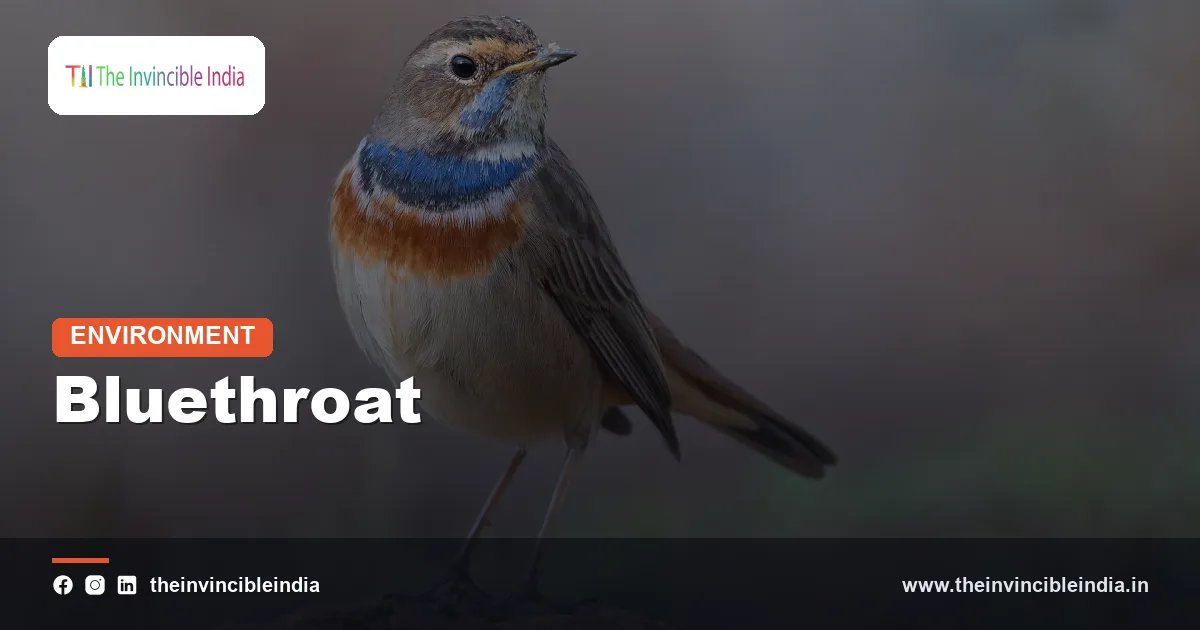
The bluethroat (Luscinia svecica) is a small, long-legged songbird of the Old World flycatcher family that breeds across northern Eurasia and spends the winter in the Indian subcontinent, where it skulks in reed beds, wet fields and thickets and is admired for the blue-and-chestnut bib of the adult male. In India the bird is a regular but easily overlooked winter visitor, because it spends most of its time on the ground in dense cover.
For bird watchers, the first glimpse of a bluethroat running across a muddy path and cocking its rust-edged tail is a highlight of the cold season. This article explains how to identify the bluethroat, where it winters in India, what it eats, how it migrates and breeds and what its presence says about the health of wetlands.
Quick Facts
| Common name | Bluethroat |
|---|---|
| Scientific name | Luscinia svecica |
| Family | Muscicapidae (Old World flycatchers and chats) |
| Size | About 14 cm, a little smaller than a sparrow, with long legs |
| Range in India | Widespread winter visitor to the plains and lower hills, especially in the north and west, and in suitable wetlands elsewhere |
| Habitat | Reed beds, marsh edges, wet fields, sugarcane and crop margins, scrub near water |
| Diet | Insects, spiders, worms and other small invertebrates; some seeds and berries |
| Breeding season | Summer, mainly on northern Eurasian tundra, scrub and wet thickets |
| Conservation status | Least Concern on the IUCN Red List; wild birds are protected under the Wildlife (Protection) Act, 1972 |
Key Takeaways
- The bluethroat is a small, ground-dwelling robin-like bird whose adult male shows a blue throat and upper breast with a chestnut or white central spot in the breeding season.
- The bluethroat is a winter visitor to India, arriving from northern breeding grounds in autumn and leaving in spring.
- The bluethroat has a pale eyebrow stripe and rusty-orange patches at the base of its tail, which are visible when the bird flicks or fans its tail.
- The bluethroat lives in dense low vegetation near water, such as reed beds, marsh edges, wet fields and crop margins, and feeds mainly on the ground.
- The bluethroat eats mostly insects and other small invertebrates, which it picks while hopping or running across mud and leaf litter.
- The IUCN classifies the bluethroat as Least Concern because of its very large global range and population.
What is the bluethroat?
The bluethroat is a small passerine bird in the same family as robins, chats and nightingales, noted for the iridescent blue bib of the breeding male. Its genus name, Luscinia, is shared with the nightingales, and the species is closely related to several other robin-like Eurasian birds that are strong singers and skilled skulkers.
The bird has a huge breeding range that reaches from Scandinavia across Siberia to Alaska and also includes parts of Central Asia. Within this range several subspecies are recognised. They differ in the colour of the central spot on the bib, which may be red-chestnut in some populations and white in others, and in subtle differences of size and tone.
Almost all bluethroats seen in India are winter visitors that have flown long distances from their northern breeding grounds. They then spend roughly half the year in the subcontinent, feeding in damp habitats, before returning north to nest.
How can you identify a bluethroat?
A bluethroat is identified by its slim, upright build, brown upperparts, a clear pale eyebrow stripe, a dark moustache-like line and, most distinctly, the rusty-orange patches at the sides of the tail base. The male in good plumage has a blue throat, while winter birds in India often show only a partial or faded bib.
The adult male
In full breeding plumage, the adult male has a bright blue throat and upper breast, bordered by a narrow black band and a chestnut band below. A central spot on the throat, which is red-chestnut or white depending on the subspecies, gives the bird its “spotted” look. By the time the birds reach India in winter, the colours are often partly hidden by pale feather tips, so many males look duller.
The female and young
The female has a pale throat, bordered by a necklace of dark spots, and may show a faint trace of blue in some individuals. Young birds in autumn are mostly brown with buff streaks and spots, and they may be identified by the pale eyebrow and the tell-tale rufous tail base.
Quick field marks
- A slim, upright shape and long legs that suit a ground-dwelling life.
- A bold pale supercilium (eyebrow) above the eye.
- Rusty-orange patches on either side of the tail base, visible when the tail is raised or flicked.
- A quick run-and-stop movement across open ground, with the tail often cocked.
Where does the bluethroat live in India?
The bluethroat lives in India in winter, mainly in the plains and the lower hills, where it favours reed beds, marsh edges, wet fields and thick, low scrub close to water. It is reported from many states, from the north and north-west to the east and the peninsula, though numbers vary from place to place.
The species is most frequently found around freshwater wetlands, lakes, village ponds, canals and irrigation channels, where tall grass and reeds provide cover and the soil stays damp. It also visits cultivated land such as sugarcane, wheat and mustard fields, especially when these are close to water or have thick edges.
Because the bird keeps close to the ground and slips into cover when disturbed, it is easily missed. A common way to locate it is to walk quietly along a muddy path next to a reed bed and watch for a small bird that dashes across the open and stops, flicking its tail.
The bluethroat often shares its winter habitat with other wetland-edge birds such as warblers, pipits and wagtails. It tends to be a solitary forager, although several birds may occupy the same stretch of marsh without much interaction.
When does the bluethroat arrive and leave?
The bluethroat arrives in India from about September or October and departs around March or April, spending roughly five to six months in the subcontinent. The timing varies with the weather, the location and the subspecies involved.
The birds migrate mostly at night, and they follow broad routes from Central Asia and Siberia across mountain ranges and plains. Some pass over high Himalayan ridges, an impressive journey for such a small bird. On reaching the plains they settle quickly, find a damp patch with cover and remain there for the winter.
Many bluethroats return to the same wintering site year after year. This site fidelity means that a pond edge, a marsh or a patch of cultivation that holds a bluethroat one winter may well hold one again the next.
In spring, the males begin to moult into more colourful plumage, and in some birds a hint of the breeding bib can be seen before departure. By April most have left, and the wetlands become quiet again until autumn.
| Month range | What the bluethroat is doing |
|---|---|
| September to October | Arrives in India after migrating at night |
| November to February | Settles in reed beds, wet fields and thickets; feeds on the ground |
| March to April | Moults, builds condition and departs north |
| May to July | Breeds on northern Eurasian breeding grounds |
What does the bluethroat eat?
The bluethroat eats mainly small invertebrates, including beetles, flies, ants, caterpillars, spiders, earthworms and other soft-bodied creatures found on or near the ground. In autumn and winter, the bird also takes some small seeds and berries.
The feeding style is typical of ground-dwelling robins. The bird runs a short way, stops, tilts its head to look and listen, and then pecks at the surface or turns over litter. It may also probe soft mud at the edge of water, where it finds small creatures that have gathered in the damp.
The bird is active mostly in the early morning and in the evening, and often stays hidden in the middle of the day. When alarmed, it dives into the nearest cover and may run through the base of reeds for some distance before it emerges again.
As an insect-eater, the bluethroat helps to control populations of small invertebrates in wetlands and fields. Its presence is also a sign that the habitat still supports a rich supply of insects and has enough cover to protect small birds.
How does the bluethroat sing and call?
The bluethroat produces a varied, melodious song, rich in mimicked and clear notes, mostly sung on the breeding grounds, while in India it is usually heard giving a short, hard “tack” or a soft whistle as a call. The song of the male is delivered from a prominent perch and may include imitations of other birds.
In winter the species is much quieter, and it is the sharp call notes that betray its presence in a reed bed or thicket. Some birds give a quiet, subdued version of the song in late winter, as breeding time approaches.
Because the bird is shy and remains in cover, listening for the call is often the best way to find it. Observers who learn this call can locate bluethroats in places where they could otherwise pass unnoticed.
How does the bluethroat breed?
The bluethroat breeds in summer in northern Eurasia, building a cup nest on or near the ground in a hidden spot among thick vegetation, and laying a clutch of greenish, finely speckled eggs. In India the species is mainly a non-breeding visitor, though some sources report breeding in the high northern margins of the region.
On the breeding grounds, the male performs a display flight and sings from a perch to defend his territory. The nest is made of grasses, moss and fine roots and is often tucked beneath a tussock, in a bank or at the base of a shrub. The female does most of the incubation, and both parents feed the chicks with insects.
Because the nesting areas are far from India, bird watchers in the country rarely see nests. Their experience of the bird is of a quiet, solitary winter visitor, a very different picture from the singing, displaying bird of the northern summer.
Is the bluethroat threatened?
The bluethroat is not globally threatened, and the International Union for Conservation of Nature (IUCN) lists it as Least Concern because of its very large range and large population. In India, wild birds are covered by the Wildlife (Protection) Act, 1972.
The bird does, however, depend on wetland edges and dense low vegetation in winter, and these habitats face pressure in many parts of the country. Drainage of marshes, clearing of reed beds, overgrazing, pollution of water bodies and heavy use of pesticides on field margins can reduce both cover and insect food.
Protecting village ponds, retaining patches of tall grass and reeds, and managing wetlands with care help to maintain suitable winter habitat. Migratory birds such as the bluethroat also remind conservationists that protection must extend across regions and countries, since the birds depend on places thousands of kilometres apart.
Bottom Line
The bluethroat is a small, elusive winter visitor with a beautiful throat and a lively ground-running habit. It is common enough to be found in many Indian wetlands and fields, and each sighting is a reminder of the long migrations that link India’s marshes with the distant north.
Frequently Asked Questions
What is a bluethroat?
A bluethroat is a small, long-legged songbird of the Old World flycatcher family. The breeding male has a blue throat and upper breast with a chestnut or white central spot, while winter birds in India often look browner and duller.
Is the bluethroat found in India?
Yes, the bluethroat is found in India as a winter visitor. It arrives from September or October, stays in wetlands, wet fields and thickets across the plains and lower hills, and leaves around March or April.
How can I identify a bluethroat?
A bluethroat can be identified by its brown upperparts, pale eyebrow stripe and the rusty-orange patches at the base of the tail. Males may also show some blue on the throat, and the bird often runs along the ground with its tail cocked.
What does the bluethroat eat?
The bluethroat eats mostly insects, spiders, worms and other small invertebrates found on the ground. In winter it also takes small seeds and berries, and it often feeds along muddy edges of water.
Where does the bluethroat breed?
The bluethroat breeds in summer across northern Eurasia, from Scandinavia and Siberia to Alaska, in scrub, tundra and wet thickets. Its nest is a cup of grass and moss placed on or near the ground.
Is the bluethroat endangered?
No, the bluethroat is not endangered, and the IUCN lists it as Least Concern. Its range and population are very large, although loss of wetlands and reed beds can reduce suitable winter habitat locally in India.
{“@context”:”https://schema.org”,”@graph”:[{“@type”:”FAQPage”,”mainEntity”:[{“@type”:”Question”,”name”:”What is a bluethroat?”,”acceptedAnswer”:{“@type”:”Answer”,”text”:”A bluethroat is a small, long-legged songbird of the Old World flycatcher family. The breeding male has a blue throat and upper breast with a chestnut or white central spot, while winter birds in India often look browner and duller.”}},{“@type”:”Question”,”name”:”Is the bluethroat found in India?”,”acceptedAnswer”:{“@type”:”Answer”,”text”:”Yes, the bluethroat is found in India as a winter visitor. It arrives from September or October, stays in wetlands, wet fields and thickets across the plains and lower hills, and leaves around March or April.”}},{“@type”:”Question”,”name”:”How can I identify a bluethroat?”,”acceptedAnswer”:{“@type”:”Answer”,”text”:”A bluethroat can be identified by its brown upperparts, pale eyebrow stripe and the rusty-orange patches at the base of the tail. Males may also show some blue on the throat, and the bird often runs along the ground with its tail cocked.”}},{“@type”:”Question”,”name”:”What does the bluethroat eat?”,”acceptedAnswer”:{“@type”:”Answer”,”text”:”The bluethroat eats mostly insects, spiders, worms and other small invertebrates found on the ground. In winter it also takes small seeds and berries, and it often feeds along muddy edges of water.”}},{“@type”:”Question”,”name”:”Where does the bluethroat breed?”,”acceptedAnswer”:{“@type”:”Answer”,”text”:”The bluethroat breeds in summer across northern Eurasia, from Scandinavia and Siberia to Alaska, in scrub, tundra and wet thickets. Its nest is a cup of grass and moss placed on or near the ground.”}},{“@type”:”Question”,”name”:”Is the bluethroat endangered?”,”acceptedAnswer”:{“@type”:”Answer”,”text”:”No, the bluethroat is not endangered, and the IUCN lists it as Least Concern. Its range and population are very large, although loss of wetlands and reed beds can reduce suitable winter habitat locally in India.”}}]}]}


