

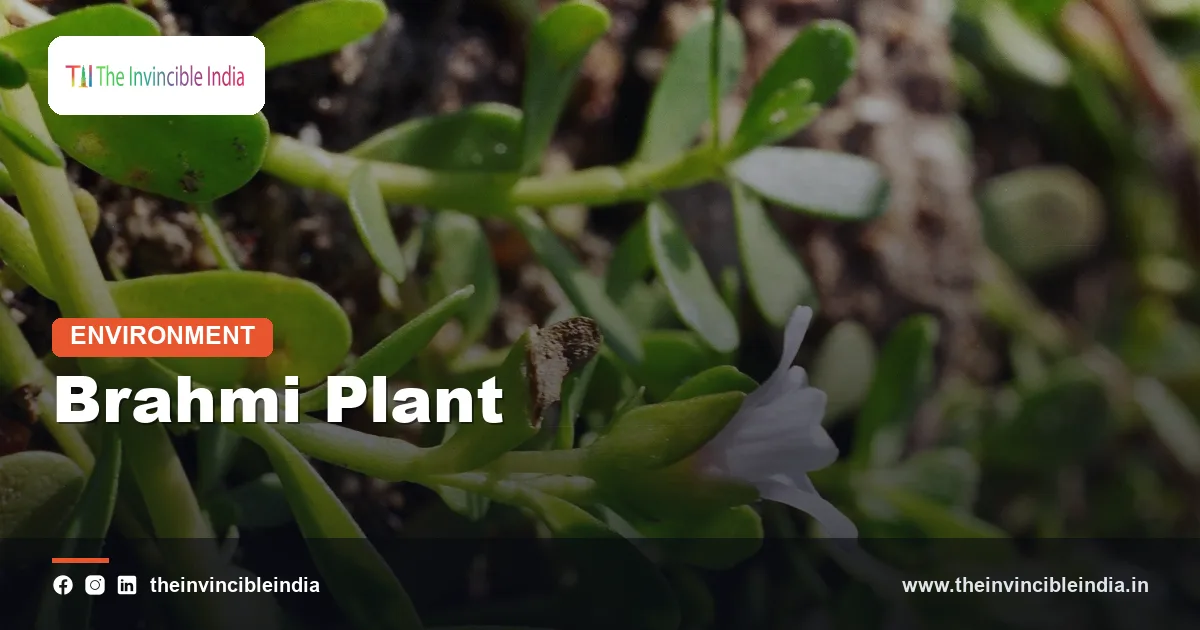
The herb known as brahmi (Bacopa monnieri) is a small, creeping, succulent marsh plant of India that Ayurveda has traditionally used as a tonic for the mind, memory and nervous system. Brahmi grows in wet soils, along the edges of ponds, streams and paddy fields, and is recognised by its fleshy, oval leaves and tiny pale flowers.
This article explains what brahmi is, how to identify it, where it grows in India, what it contains, how it has been used in traditional medicine and how it is cultivated. The medicinal uses described here are traditional in nature and are not proven medical claims.
Quick Facts
| Botanical name | Bacopa monnieri (also written Bacopa monniera) |
|---|---|
| Family | Plantaginaceae (earlier placed in Scrophulariaceae) |
| Common names | Brahmi, Neer Brahmi, Jalanimba, water hyssop, herb of grace |
| Part used | Whole aerial herb: leaves, soft stems and, at times, the entire plant |
| Where grown in India | Wet and marshy ground across the plains and lower hills; cultivated in parts of Uttar Pradesh, Uttarakhand, Tamil Nadu, Kerala, Karnataka, Andhra Pradesh and West Bengal |
| Active compounds | Bacosides (triterpenoid saponins), alkaloids such as brahmine and herpestine, flavonoids and sterols |
| Traditional uses | Classified in Ayurveda as a medhya rasayana, a rejuvenative for the intellect, used for memory, concentration, nervous calm and as a general tonic |
| Cultivation | Perennial creeping herb propagated from stem cuttings; needs constant moisture, warmth and sunlight |
Key Takeaways
- Brahmi is the common name in India for Bacopa monnieri, a creeping, water-loving perennial herb of the family Plantaginaceae.
- Ayurveda classes brahmi among the medhya rasayana, the group of herbs traditionally associated with the intellect, memory and mental clarity.
- The main active constituents of brahmi are the bacosides, a family of triterpenoid saponins found in the leaves and stems.
- The name brahmi is also used in some regions for a different plant, Centella asiatica, so the botanical name should be checked before buying or using any product.
- Brahmi is propagated mainly from stem cuttings and thrives in standing or slowly moving fresh water and saturated soil.
- The traditional uses of brahmi are not established medical treatments, and a qualified Ayurvedic practitioner or doctor should be consulted before taking it.
What is brahmi?
Brahmi is the widely used Indian name for Bacopa monnieri, a low-growing, creeping herb of wetlands that has been valued in Ayurveda for many centuries. The plant is a perennial, which means it lives for several years, and it spreads along the ground by rooting at the nodes of its stems.
In classical Sanskrit literature the herb is associated with Brahma, the creator, and with brahman, the universal consciousness, which is the commonly cited origin of the name. The association reflects the reputation of the plant as an aid to learning, reflection and clarity of mind. Other Sanskrit names include Saraswati, linked to the goddess of knowledge, and Jalanimba or Nirbrahmi, which point to its life in water.
Brahmi is also called water hyssop and herb of grace in English. It is a plant of the tropics and subtropics, and it occurs naturally in wetlands of Asia, Africa, Australia and the Americas, although the Indian subcontinent is regarded as its traditional home in Ayurvedic practice.
What does the brahmi plant look like?
The brahmi plant is a prostrate, softly fleshy herb with slender, branching stems that creep over wet ground and root at each node. The stems are often green to pale purple and may grow to about thirty centimetres or more in length, forming a dense mat in favourable conditions.
The leaves are small, oblong to spoon-shaped, thick and juicy, and grow in opposite pairs along the stem. They have a smooth edge and are dotted with tiny glands that can be seen when the leaf is held to the light. The succulent feel of the leaf helps the plant store water and gives it a distinctive appearance among marsh vegetation.
The flowers are small and solitary, borne in the angles between leaf and stem. They are usually white or pale mauve with faint purple veins and have four or five petals. After flowering the plant forms tiny oval capsules that hold very small seeds. The bitter taste and mild, slightly earthy smell of the crushed leaves are further identifying features.
Where does brahmi grow in India?
Brahmi grows wild across India in wet and marshy places, from the plains to lower mountain slopes, wherever the soil stays saturated for much of the year. It is typically found beside ponds, tanks, canals, streams, ditches and in the margins of rice fields.
The herb is reported from the Gangetic plains, the Himalayan foothills, the eastern states, the Deccan and the Western and Eastern Ghats, and it is commonly seen in coastal and low-lying districts where humidity is high. Because the plant needs constant moisture, it tends to disappear from places where wetlands are drained, polluted or filled in.
Commercial cultivation has developed in several states, including Uttar Pradesh, Uttarakhand, Tamil Nadu, Kerala, Karnataka, Andhra Pradesh and West Bengal, to meet demand from herbal and Ayurvedic manufacturers. Cultivated brahmi helps reduce the pressure on wild populations, which have historically been collected from wetlands in large quantities.
Is brahmi the same as Centella asiatica?
No, brahmi in the strict botanical sense refers to Bacopa monnieri, while Centella asiatica is a different plant that is also called brahmi in some regions and is known in Sanskrit as mandukaparni. The two belong to different plant families and look quite different when examined closely.
The confusion is old and has historical roots. In parts of northern and eastern India, markets and households have long used the name brahmi for Centella asiatica, whereas in the south and in many classical texts brahmi usually means Bacopa. Centella asiatica, sometimes called gotu kola or Indian pennywort, is a creeping herb with rounded, kidney-shaped leaves, belongs to the family Apiaceae and contains different compounds called asiaticosides.
| Feature | Bacopa monnieri | Centella asiatica |
|---|---|---|
| Family | Plantaginaceae | Apiaceae |
| Leaf shape | Small, thick, oblong or spoon-shaped, succulent | Rounded or kidney-shaped, thin, with long stalks |
| Flowers | Solitary, white or pale mauve, four to five petals | Small clusters, pinkish-red, close to the ground |
| Main compounds | Bacosides | Asiaticosides, madecassoside |
| Common Sanskrit name | Brahmi, Jalanimba | Mandukaparni |
Anyone buying a brahmi product should look for the botanical name on the label to know which plant is actually inside.
What compounds does brahmi contain?
Brahmi contains bacosides, a group of triterpenoid saponins that are regarded as its principal active constituents. Bacoside A and bacoside B are among the best-known members of this group and are often used as marker compounds to describe the quality of brahmi extracts.
The plant also contains alkaloids, including brahmine and herpestine, along with flavonoids, sterols, saponins and other phytochemicals that have been identified through laboratory analysis. Chemical studies have been carried out on the plant since the twentieth century, and research continues on how these substances behave in the body.
The concentration of bacosides varies with the place of growth, the season, the part of the plant and the method of drying and extraction. This natural variation is one reason that products from different makers can differ, and it is why standardised extracts are often sold with a stated percentage of bacosides.
How has brahmi been used in traditional medicine?
Brahmi has been used in Ayurveda as a medhya rasayana, a herb traditionally taken to support memory, learning, concentration and calmness of mind. Classical Ayurvedic texts, including the Charaka Samhita and the Sushruta Samhita, mention the herb, and it appears in many compound formulations.
Traditional uses described in Ayurvedic literature include:
- Support for memory, attention and study, particularly for students and for older people.
- Calming the mind in conditions that Ayurveda describes as agitation or restlessness.
- Use as a general rejuvenative tonic for the nervous system.
- Application as a hair and scalp oil, a very common household use in India.
- Use in preparations for cough, throat complaints and digestive discomfort in folk medicine.
These are traditional practices. Modern scientific studies on Bacopa monnieri exist, mainly small trials and laboratory work, but the evidence is limited and mixed, and brahmi is not an approved treatment for any disease. Readers should treat the traditional uses as cultural and historical information rather than medical advice.
In what forms is brahmi taken?
Brahmi is available in several traditional and modern forms, including fresh juice, dried powder, medicated ghee, syrup, oil, capsules and tablets. The preparation chosen usually depends on whether it is meant for internal use or for application to the scalp and body.
- Churna (powder): dried leaves ground fine, traditionally mixed with honey, ghee or warm water.
- Ghrita: a medicated ghee in which the herb is cooked, such as the classical Brahmi Ghrita.
- Taila (oil): herb-infused oil, often with coconut or sesame oil, used for head massage.
- Syrup and tonic: sweetened liquid preparations common in Indian pharmacies.
- Extract capsules and tablets: standardised products found in modern herbal supplement markets.
Dosage varies between products and individuals, and it should come from the label and a qualified practitioner rather than from general articles.
How is brahmi cultivated?
Brahmi is cultivated as a perennial herb propagated mainly through stem cuttings planted in moist or waterlogged soil, and it grows best in warm, humid conditions with plenty of sunlight. Seeds exist but are tiny and not commonly used on farms.
Farmers generally prepare a field that can hold water, level it, and plant rooted stem pieces a short distance apart. Soil that is rich in organic matter, clayey or loamy and slightly acidic to neutral suits the crop. The plant spreads quickly and can cover the ground within a few months.
The first harvest is typically possible within three to four months, when the plant has made dense growth, and the top growth can be cut several times a year as it regrows. Harvested herb is washed and shade-dried or sun-dried before it is sold to processors. Because brahmi is sensitive to dry soil and cold, it is grown mostly in the warmer, wetter parts of India.
Is brahmi safe, and who should be careful?
Brahmi is traditionally regarded as a gentle herb, but it is not free of side effects, and reported effects include nausea, stomach cramps, loose stools and dry mouth. Anyone who has a medical condition should speak to a doctor before using it.
People who take prescription medicines for thyroid conditions, anxiety, epilepsy or other chronic illnesses, and those taking sedatives, should seek professional advice because herbs may interact with drugs. Pregnant and breastfeeding women, children and people due for surgery should also take medical guidance before using any brahmi preparation. Products should be bought from reputable makers, since adulteration and mislabelling of herbal products can occur.
This article offers general information only. Please consult a qualified Ayurvedic practitioner or a doctor before using brahmi for any health purpose.
Why does brahmi matter to India?
Brahmi matters to India as a long-standing medicinal plant of Ayurveda, a staple of household remedies and a crop that supports herbal industries and rural livelihoods. It is among the better-known herbs in the Indian materia medica and appears widely in classical formulations and branded products.
The plant also has ecological value. As a wetland species, brahmi grows where water is clean and available, and its presence is often a sign of a healthy marsh margin. The loss of wetlands to drainage, construction and pollution threatens the wild habitat of the herb, which is one reason cultivation and wetland conservation both receive attention.
The popularity of brahmi has also pushed it into global supplement markets, where demand for standardised extracts has grown. For India, a country with a vast tradition of plant-based medicine, brahmi is a good example of a humble marsh herb with both cultural meaning and commercial relevance.
Brahmi also plays a part in daily cultural life. Many Indian families give brahmi oil for head massage to children and older relatives, and fresh leaves are sometimes added to chutneys and drinks in regional kitchens. Such household use is long-standing, and it keeps knowledge of the plant alive even where modern medicines are easily available.
Bottom Line
Brahmi, or Bacopa monnieri, is a small, succulent, water-loving herb that Ayurveda has long used as a tonic for memory and the nervous system. Its traditional reputation is strong, but scientific evidence remains limited, so it should be used only on professional advice.
Frequently Asked Questions
What is brahmi used for in Ayurveda?
Brahmi is used in Ayurveda traditionally as a medhya rasayana, a herb meant to support memory, concentration and calm of mind. It is also used as a general nervine tonic and in hair oils. These are traditional uses and not proven medical claims.
Is brahmi the same as Bacopa monnieri?
Yes, in most classical and scientific contexts brahmi means Bacopa monnieri. However, in some parts of India the name is also applied to Centella asiatica, a different plant, so the botanical name on the label should be checked.
Where does brahmi grow?
Brahmi grows in wet, marshy places across India, including pond edges, streams, canals and paddy field margins. It is cultivated commercially in states such as Uttar Pradesh, Uttarakhand, Tamil Nadu, Kerala, Karnataka and West Bengal. The plant needs constantly moist soil and warm weather.
What are the active compounds in brahmi?
The main active compounds in brahmi are the bacosides, which are triterpenoid saponins. The plant also contains alkaloids such as brahmine and herpestine, along with flavonoids and sterols. Bacoside content varies with growing conditions and processing.
Does brahmi have side effects?
Brahmi can cause side effects in some people, such as nausea, stomach cramps, loose stools and dry mouth. It may also interact with certain medicines, such as those for thyroid conditions or sedatives. A doctor or qualified Ayurvedic practitioner should be consulted before use.
How is brahmi grown?
Brahmi is grown as a perennial herb from stem cuttings planted in moist or waterlogged soil in a warm, sunny location. The first harvest is usually possible after about three to four months, and the plant can be cut repeatedly as it regrows. The harvested herb is dried before sale.
{“@context”:”https://schema.org”,”@graph”:[{“@type”:”FAQPage”,”mainEntity”:[{“@type”:”Question”,”name”:”What is brahmi used for in Ayurveda?”,”acceptedAnswer”:{“@type”:”Answer”,”text”:”Brahmi is used in Ayurveda traditionally as a medhya rasayana, a herb meant to support memory, concentration and calm of mind. It is also used as a general nervine tonic and in hair oils. These are traditional uses and not proven medical claims.”}},{“@type”:”Question”,”name”:”Is brahmi the same as Bacopa monnieri?”,”acceptedAnswer”:{“@type”:”Answer”,”text”:”Yes, in most classical and scientific contexts brahmi means Bacopa monnieri. However, in some parts of India the name is also applied to Centella asiatica, a different plant, so the botanical name on the label should be checked.”}},{“@type”:”Question”,”name”:”Where does brahmi grow?”,”acceptedAnswer”:{“@type”:”Answer”,”text”:”Brahmi grows in wet, marshy places across India, including pond edges, streams, canals and paddy field margins. It is cultivated commercially in states such as Uttar Pradesh, Uttarakhand, Tamil Nadu, Kerala, Karnataka and West Bengal. The plant needs constantly moist soil and warm weather.”}},{“@type”:”Question”,”name”:”What are the active compounds in brahmi?”,”acceptedAnswer”:{“@type”:”Answer”,”text”:”The main active compounds in brahmi are the bacosides, which are triterpenoid saponins. The plant also contains alkaloids such as brahmine and herpestine, along with flavonoids and sterols. Bacoside content varies with growing conditions and processing.”}},{“@type”:”Question”,”name”:”Does brahmi have side effects?”,”acceptedAnswer”:{“@type”:”Answer”,”text”:”Brahmi can cause side effects in some people, such as nausea, stomach cramps, loose stools and dry mouth. It may also interact with certain medicines, such as those for thyroid conditions or sedatives. A doctor or qualified Ayurvedic practitioner should be consulted before use.”}},{“@type”:”Question”,”name”:”How is brahmi grown?”,”acceptedAnswer”:{“@type”:”Answer”,”text”:”Brahmi is grown as a perennial herb from stem cuttings planted in moist or waterlogged soil in a warm, sunny location. The first harvest is usually possible after about three to four months, and the plant can be cut repeatedly as it regrows. The harvested herb is dried before sale.”}}]}]}


