

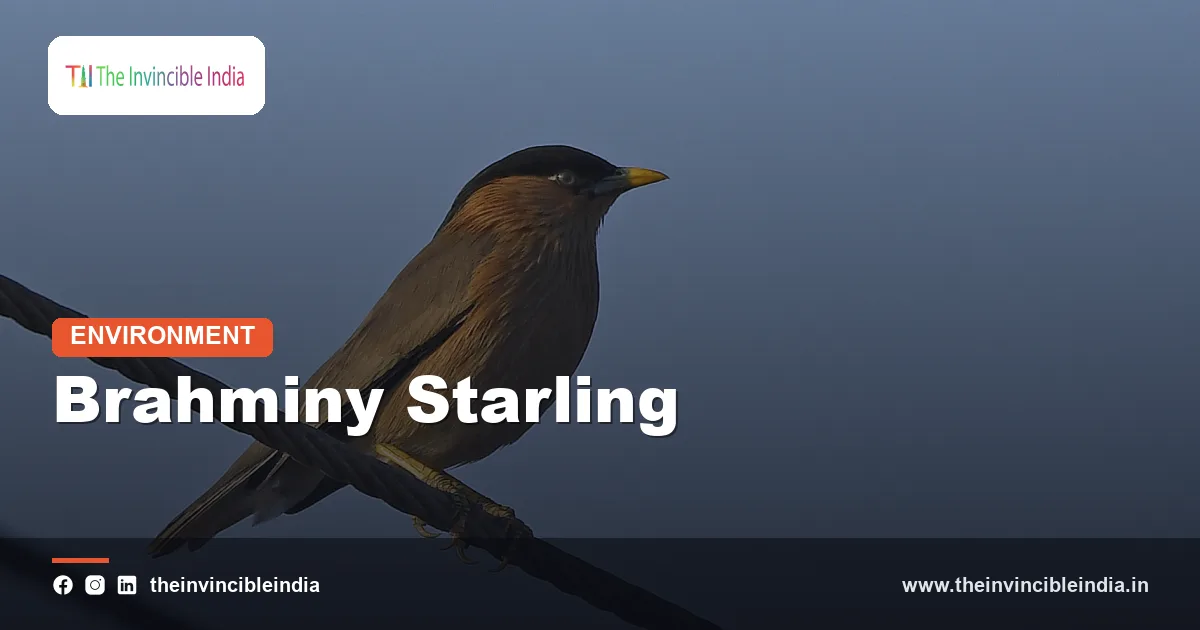
The brahminy starling (Sturnia pagodarum), also called the brahminy myna, is a handsome, medium-sized starling of the Indian subcontinent, easily recognised by its glossy black cap with a drooping crest, warm orange-buff underparts and grey back, and it is a bird of open country, scrub, gardens and light woodland across much of India. It is a lively, sociable species with a pleasant, whistling song, a taste for fruit, nectar and insects, and a tendency to wander in flocks in search of fruiting and flowering trees.
Many people mistake the brahminy starling for a type of myna because of its common name, though it is a starling in the same family, Sturnidae. This explainer sets out how to identify the brahminy starling, where it lives in India, what it eats, how it sings and breeds, and how it differs from other starlings and mynas. Population figures are not stated precisely, since they change from region to region and year to year.
| Quick Facts: Brahminy Starling | |
|---|---|
| Scientific name | Sturnia pagodarum (formerly placed in Sturnus and Temenuchus) |
| Family | Sturnidae (starlings and mynas) |
| Common names | Brahminy starling, brahminy myna, brahminy mynah, pagoda starling |
| Typical length | About 19 to 21 cm |
| Plumage | Glossy black cap with long drooping crest; grey back; warm orange-buff or rufous underparts and nape |
| Bill | Yellowish with a bluish base |
| Range | Widespread across the Indian subcontinent, including India, Sri Lanka, Nepal, Pakistan and Bangladesh |
| Habitat | Open country, scrub, gardens, orchards and light deciduous woodland |
| Conservation status | Least Concern on the IUCN Red List |
Key Takeaways
- The brahminy starling is a medium-sized starling with a glossy black cap, a drooping crest, grey upperparts and orange-buff underparts.
- The brahminy starling, also known as the brahminy myna, is native to the Indian subcontinent and is found across most of India in open country and scrub.
- The brahminy starling eats fruit, flower nectar and insects, and it often visits flowering trees such as silk cotton and coral tree.
- The brahminy starling has a pleasant song of whistles, warbles and chattering notes, and it is a lively, social bird.
- The brahminy starling nests in holes in trees, walls and buildings and usually lays three to five pale blue eggs.
- The brahminy starling is classed as Least Concern by the IUCN because it is widespread and adaptable.
What is the brahminy starling?
The brahminy starling is a songbird in the starling family Sturnidae that lives across the Indian subcontinent, and it is known for its two-tone colouring of black crest and orange-buff body. Although many Indians call it the brahminy myna, it is more precisely a starling, and the “myna” in its name is a popular label for starling relatives with strong voices.
The scientific name Sturnia pagodarum records the bird’s classification history. It was once placed in the genus Sturnus with the European starling, later in Temenuchus, and in more recent classifications in Sturnia, with a small group of Asian starlings. The species name pagodarum is often linked to “pagoda”, which in older English usage referred to Indian temples, where the bird was sometimes seen. The exact origin of the common name “brahminy” is less certain, but it likely refers to the bird’s neat, clean-looking plumage and its presence around temple groves and villages.
The brahminy starling is a resident and local migrant: many birds stay in the same region, but flocks make seasonal movements in response to fruiting trees, rain and food.
How do you identify a brahminy starling?
A brahminy starling can be identified by its glossy black cap with a loose, drooping crest, a pale grey back, warm orange-buff underparts and nape, and a yellowish bill with a blue base. In flight, the bird shows a dark tail with white tips and dark wings with a glossy sheen.
Field marks to look for:
- Cap and crest: glossy black or bluish-black, with long, narrow feathers drooping over the nape.
- Back and wings: pale grey on the back, with darker wing feathers.
- Underparts and nape: a warm orange-buff or rufous wash that varies in intensity across individuals.
- Bill: yellowish, with a pale blue base.
- Eye: pale or whitish, giving a bright expression.
- Tail: dark, with a white band on the tip.
The sexes look similar, though the male may be slightly brighter. Juveniles are duller, with a greyer crown and less obvious crest. The overall impression is of a neat, pale starling that looks quite different from the dark, heavy mynas.
Where does the brahminy starling live in India?
The brahminy starling lives across most of peninsular and northern India, from the plains to low hills, favouring open country with scattered trees, scrub, orchards, gardens and light deciduous woodland. It is also found in neighbouring Sri Lanka, Nepal, Pakistan and Bangladesh, with seasonal movements that can make it appear and disappear locally.
Typical habitats include:
- Open scrub and dry deciduous woodland with flowering and fruiting trees.
- Gardens, parks, avenues and temple groves in towns and villages.
- Orchards and plantations where fruit is available.
- Farmland edges, hedgerows and field boundaries with tall trees.
- Rocky outcrops and ruins that offer nest holes.
The brahminy starling is less common in dense evergreen forest and in the wettest regions, such as parts of the Western Ghats and the north-east. It tends to be more abundant in drier and more open areas, where it can feed on fruit and nectar from scattered trees.
What does the brahminy starling eat?
The brahminy starling eats fruit, flower nectar and insects, with fruit and nectar especially important when trees are in fruit or flower. Like other starlings, the brahminy starling is an omnivore that switches between plant and animal food depending on what is available.
Foods commonly recorded include:
- Fruit: figs, berries, mulberries, ripe papaya and other soft fruit from wild and cultivated trees.
- Nectar: blossoms of silk cotton (Bombax), coral tree (Erythrina) and other flowering trees.
- Insects: grasshoppers, caterpillars, beetles and termites, taken from the ground or from foliage.
- Other items: occasional seeds, grain and household scraps.
When feeding on flowers, brahminy starlings can act as pollinators because pollen sticks to their bills and face. When feeding on fruit, they swallow seeds and drop them elsewhere, which helps disperse trees across open country.
What does the brahminy starling sound like?
The brahminy starling has a pleasant, varied song made of whistles, warbles, trills and chattering notes, and it is regarded as one of the better singers among Indian starlings. The song is often delivered from a treetop perch, especially in the breeding season.
Features of the brahminy starling’s voice include:
- A series of clear whistles mixed with soft chuckles and rattles.
- Short, sharp contact calls given by foraging flocks to keep together.
- Harsh alarm notes when predators or humans approach a nest.
- Occasional mimicry of other birds and environmental sounds, as in many starlings.
Birds are often heard before they are seen, as flocks chatter while feeding in flowering trees. The song is softer and more melodious than the loud, harsh calls of the common myna.
How does the brahminy starling breed?
The brahminy starling breeds in holes in trees, walls, buildings and rock crevices, and the pair usually lays three to five pale blue eggs in a loosely made nest of grass, straw and feathers. Timing varies across India, and breeding often takes place in the warmer months before and during the rains.
Main points of its breeding:
- Nest site: tree hollows, holes in masonry, gaps under eaves and sometimes old woodpecker or barbet holes.
- Nest material: grass, rags, roots and feathers, loosely arranged.
- Eggs: plain pale blue, usually three to five.
- Incubation: by both parents, for around two weeks.
- Chicks: fed on insects and fruit, and fledge after roughly three weeks.
Because the brahminy starling relies on cavities, the loss of old trees can limit breeding in some places. In towns, nests in building crevices are common, and conflicts with other cavity nesters can occur.
Why do brahminy starlings wander in flocks?
Brahminy starlings wander in flocks because the trees they depend on fruit and flower at different times and in different places, so the birds move across the landscape to follow these food sources. This nomadic pattern means the species can be abundant in an area for a few weeks and then disappear.
The reasons and patterns of movement can be summarised as follows:
| Cue | Likely movement |
|---|---|
| Flowering of nectar trees such as silk cotton and coral tree | Flocks gather and feed on blossoms for days or weeks |
| Ripening of figs and wild berries | Birds move to fruiting trees, often alongside other fruit-eaters |
| Onset of monsoon | Local shifts as insects increase and nesting begins |
| Dry-season stress | Birds move toward gardens, irrigated land and water |
| Breeding season | Pairs settle near nest holes and defend small territories |
Outside the breeding season, brahminy starlings join large flocks that may include other starlings and mynas. They often roost together in trees and bamboo clumps, calling loudly at dusk.
How is the brahminy starling different from mynas and other starlings?
The brahminy starling differs from mynas and other Indian starlings in its black crest, grey back and orange-buff underparts, and in its smaller size and slimmer build. The common myna is brown with a yellow eye patch, the jungle myna is dark grey with a forehead tuft, and the bank myna is bluish-grey with an orange eye patch.
In practice, the easiest way to avoid confusion is to look at the colour of the belly and the crown: a pale, buff-orange body with a dark crested cap is a brahminy starling. Other starlings in India, such as the rosy starling and the spotted-winged starling, differ by seasonal plumage, distribution and pattern.
Is the brahminy starling threatened?
The brahminy starling is not threatened and is rated Least Concern by the IUCN because it has a large range, a flexible diet and an ability to live near people. Local declines may happen when old trees and orchards are removed, when cavity nest sites are lost, or when birds are trapped for the cage-bird trade.
Conservation points include:
- Protecting native flowering and fruiting trees, which supply nectar and fruit through the year.
- Retaining dead and hollow branches where safe, as they provide nest cavities.
- Avoiding trapping of wild birds, which is restricted under Indian wildlife law; readers should check current provisions of the Wildlife (Protection) Act, 1972.
- Planting a mix of native trees in gardens and campuses so that food is available at different times.
Bottom Line
The brahminy starling is a neat, crested starling with a black cap and orange-buff body that moves across India’s open country in search of fruit, nectar and insects. It is a widespread and cheerful singer, and planting native flowering trees is one of the best ways to keep it in towns and fields.
Frequently Asked Questions
Is the brahminy starling the same as the brahminy myna?
Yes, the brahminy starling and the brahminy myna are the same bird, Sturnia pagodarum. It is technically a starling, but “myna” is a popular name for such birds in India. Both names are widely used in field guides and local speech.
What does a brahminy starling look like?
A brahminy starling has a glossy black cap with a drooping crest, a pale grey back and warm orange-buff underparts and nape. Its bill is yellowish with a bluish base, and its eyes are pale. In flight, it shows a dark tail with white tips.
Where is the brahminy starling found in India?
The brahminy starling is found across most of peninsular and northern India in open country, scrub, gardens, orchards and light woodland. It is less common in dense evergreen forest and the wettest hill regions. It also occurs in Sri Lanka, Nepal, Pakistan and Bangladesh.
What does the brahminy starling eat?
The brahminy starling eats fruit, flower nectar and insects. It often visits flowering trees such as silk cotton and coral tree and fruiting trees such as figs. By feeding on nectar and fruit, it can help pollinate flowers and spread seeds.
Does the brahminy starling sing?
Yes, the brahminy starling has a pleasant song of whistles, warbles and chattering notes. It often sings from a treetop, especially in the breeding season. Its voice is softer and more melodious than that of the common myna.
Is the brahminy starling endangered?
No, the brahminy starling is not endangered and is rated Least Concern by the IUCN. It is widespread and adaptable, though local numbers can fall when old trees are cut or when birds are trapped. Protecting native flowering trees and nest cavities helps the species.
{“@context”:”https://schema.org”,”@graph”:[{“@type”:”FAQPage”,”mainEntity”:[{“@type”:”Question”,”name”:”Is the brahminy starling the same as the brahminy myna?”,”acceptedAnswer”:{“@type”:”Answer”,”text”:”Yes, the brahminy starling and the brahminy myna are the same bird, Sturnia pagodarum. It is technically a starling, but “myna” is a popular name for such birds in India. Both names are widely used in field guides and local speech.”}},{“@type”:”Question”,”name”:”What does a brahminy starling look like?”,”acceptedAnswer”:{“@type”:”Answer”,”text”:”A brahminy starling has a glossy black cap with a drooping crest, a pale grey back and warm orange-buff underparts and nape. Its bill is yellowish with a bluish base, and its eyes are pale. In flight, it shows a dark tail with white tips.”}},{“@type”:”Question”,”name”:”Where is the brahminy starling found in India?”,”acceptedAnswer”:{“@type”:”Answer”,”text”:”The brahminy starling is found across most of peninsular and northern India in open country, scrub, gardens, orchards and light woodland. It is less common in dense evergreen forest and the wettest hill regions. It also occurs in Sri Lanka, Nepal, Pakistan and Bangladesh.”}},{“@type”:”Question”,”name”:”What does the brahminy starling eat?”,”acceptedAnswer”:{“@type”:”Answer”,”text”:”The brahminy starling eats fruit, flower nectar and insects. It often visits flowering trees such as silk cotton and coral tree and fruiting trees such as figs. By feeding on nectar and fruit, it can help pollinate flowers and spread seeds.”}},{“@type”:”Question”,”name”:”Does the brahminy starling sing?”,”acceptedAnswer”:{“@type”:”Answer”,”text”:”Yes, the brahminy starling has a pleasant song of whistles, warbles and chattering notes. It often sings from a treetop, especially in the breeding season. Its voice is softer and more melodious than that of the common myna.”}},{“@type”:”Question”,”name”:”Is the brahminy starling endangered?”,”acceptedAnswer”:{“@type”:”Answer”,”text”:”No, the brahminy starling is not endangered and is rated Least Concern by the IUCN. It is widespread and adaptable, though local numbers can fall when old trees are cut or when birds are trapped. Protecting native flowering trees and nest cavities helps the species.”}}]}]}


