

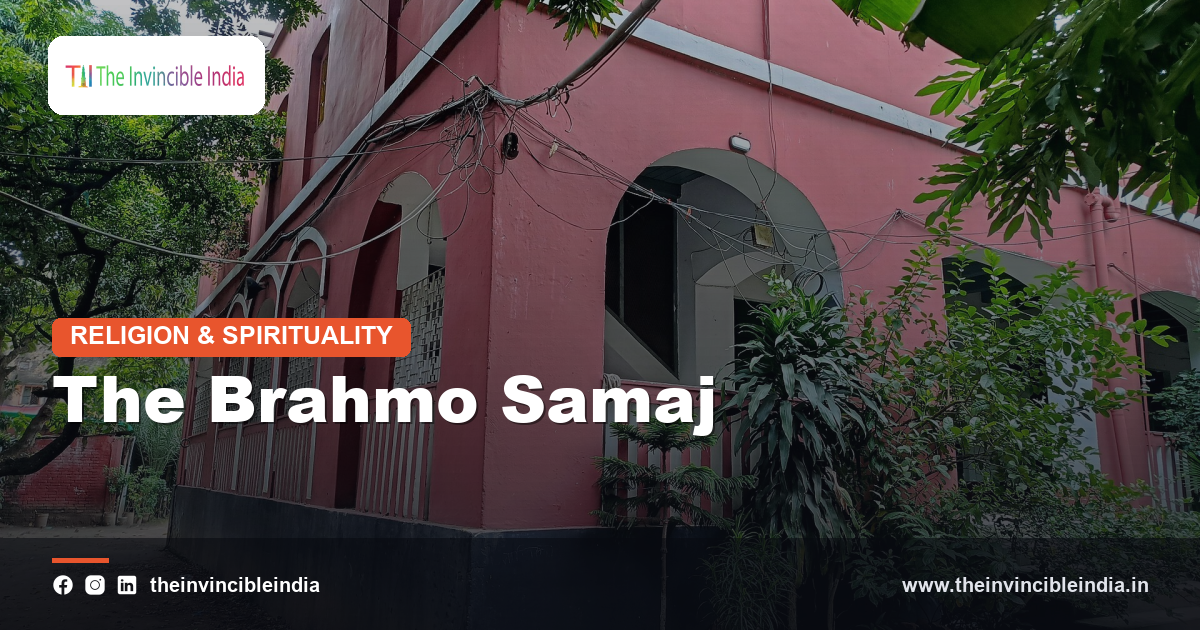
The Brahmo Samaj occupies a distinctive place in the story of religious reform in colonial India, emerging in early nineteenth-century Bengal as an attempt to establish a monotheistic form of worship rooted in reason and the ethical core of Indian tradition. It developed during a period of intense intellectual exchange between Indian scholars and European ideas, producing a movement that drew selectively from classical Hindu philosophy, including currents within Vedanta, while also engaging with universalist religious thought. Associated closely with its founding figure and later reformers who reshaped its direction, the Brahmo Samaj became a center of debate on idolatry, caste, and the status of women. This overview surveys its founding, beliefs, offshoots, and continuing legacy.
Quick Facts
| Detail | Information |
|---|---|
| Movement type | Hindu monotheistic reform movement |
| Founded | 1828 (Brahmo Sabha), Calcutta |
| Founding figure | Raja Ram Mohan Roy |
| Later leaders | Debendranath Tagore, Keshab Chandra Sen |
| Core belief | One formless, universal God |
| Notable campaigns | Anti-sati, women’s education |
Origins in Bengal
The Brahmo Samaj arose in early nineteenth-century Bengal, a region that had become a center of intellectual exchange between traditional Indian scholarship and ideas arriving through colonial institutions, trade, and education. Calcutta in particular had emerged as a hub where Sanskrit learning, Persian and Islamic scholarship, and European thought circulated alongside one another, creating fertile ground for new religious and social movements. Educated Bengalis of the period were engaging closely with questions about the nature of God, the authority of scripture, and the social customs then practiced in the name of religion. It was within this environment that a small circle of reform-minded thinkers began meeting to discuss the possibility of a purified, monotheistic form of worship drawn from what they considered the most universal and rational elements of Hindu philosophy. Their discussions laid the intellectual groundwork for what would become one of colonial India’s most influential religious reform movements.
Raja Ram Mohan Roy
Raja Ram Mohan Roy, widely remembered as a founding figure of modern Indian reform, is closely associated with the intellectual origins of the Brahmo Samaj. A scholar fluent in several classical and modern languages, he studied Hindu philosophical texts, Islamic theology, and Christian scripture, drawing on this broad learning to argue for a monotheistic understanding of God consistent with the Upanishads. He was an outspoken critic of practices he considered social rather than truly religious in origin, including the custom of sati, and he campaigned publicly for its abolition. Roy also engaged extensively with contemporary debates on education, journalism, and law, reflecting a broader commitment to reasoned public discourse. His efforts to found an institution for monotheistic worship, grounded in classical Hindu texts yet open to universal ethical ideas, provided the foundation on which the Brahmo Samaj would later be formally organized and expanded by successive leaders.
Founding of the Brahmo Sabha
The formal organization that would grow into the Brahmo Samaj began as the Brahmo Sabha, established in Calcutta in the 1820s as a society for monotheistic worship and philosophical discussion. Its early meetings combined the recitation of Upanishadic texts with hymns and sermons emphasizing the unity and formlessness of God, deliberately avoiding image worship and elaborate ritual. Membership was initially small and drawn largely from Calcutta’s educated elite, but the society’s ideas circulated more widely through publications and public debate. Over subsequent decades, the organization was renamed and reorganized several times as new leaders took up its direction, eventually becoming known as the Brahmo Samaj. Despite these organizational changes, the core commitment to monotheism, ethical living, and reasoned engagement with scripture remained constant, giving the movement a continuous identity even as its leadership and specific practices evolved across the nineteenth century.
Core Beliefs: Monotheism and Reason
At the heart of Brahmo Samaj teaching lies a firm commitment to monotheism, the belief in a single, formless, and universal God accessible to reason and reflection rather than through image or elaborate ritual. This conception drew on classical Hindu philosophical texts, particularly the Upanishads, which Brahmo thinkers read as affirming an abstract, unified divine reality beneath the diversity of popular worship. Alongside this theological position, the movement placed strong emphasis on reason as a guide to religious truth, encouraging members to question inherited custom rather than accept it uncritically. Ethical conduct, understood as service to others and personal moral discipline, was treated as inseparable from genuine devotion. This combination of rational inquiry, scriptural study, and ethical seriousness gave the Brahmo Samaj an intellectual character that appealed particularly to the educated middle classes of colonial Bengal, distinguishing it from movements organized primarily around devotional or ritual practice.
Rejection of Idolatry
Like several other reform movements of its era, the Brahmo Samaj rejected the worship of images as inconsistent with its understanding of a formless, universal God. Its founders argued that the classical Upanishadic texts pointed toward an abstract divine principle rather than the specific deities and icons central to much popular Hindu worship, and they saw the movement’s task as recovering this more austere theological vision. Brahmo services accordingly centered on prayer, the singing of devotional hymns composed for the movement, and the reading and exposition of scripture, rather than ritual offerings to images. This stance placed the Brahmo Samaj in occasional tension with more traditional currents of Hindu practice, generating public debate about the proper interpretation of Hindu scripture and custom. Members of the movement generally presented their position not as a rejection of Hindu tradition but as a return to what they considered its most philosophically refined and universal expression.
Debendranath Tagore and Renewal
Following its early years, the Brahmo Samaj found renewed direction under Debendranath Tagore, a leader who reorganized the movement and gave it more systematic theological and institutional form. Tagore, a serious student of the Upanishads, worked to establish a clearer doctrinal basis for Brahmo worship and helped formalize its practices, including regular congregational services and a structured order of worship. Under his leadership the movement also developed clearer organizational structures, including a formal creed and codes of conduct for members. Tagore’s own family became closely associated with Brahmo intellectual and cultural life for generations, contributing to literature, education, and social reform in Bengal. His stewardship is generally credited with stabilizing the Brahmo Samaj after its founding period and equipping it with the institutional foundations that allowed the movement to expand its membership and influence across Bengali society in the mid-nineteenth century.
Keshab Chandra Sen and Reform
A later and more dynamic chapter in Brahmo Samaj history is associated with Keshab Chandra Sen, whose energetic leadership brought new momentum and, eventually, significant controversy to the movement. Sen expanded the Samaj’s social reform activities, pressing further on issues such as intercaste marriage, the treatment of women, and engagement with other religious traditions, including elements of Christian ethical thought that he sought to incorporate into a broader universalist vision. His approach was more overtly missionary and reform-oriented than that of his predecessors, and it drew both enthusiastic followers and sharp critics within the movement. Sen’s leadership ultimately contributed to organizational tensions that led to a formal division within the Brahmo Samaj later in the century. Despite these disputes, his period of leadership is remembered for its energetic public advocacy of social reform and its role in extending Brahmo influence well beyond Calcutta’s original founding circle.
Split into Adi and Sadharan Brahmo Samaj
Disagreements over leadership style, doctrine, and the pace of social reform eventually led to a formal split within the Brahmo Samaj during the latter half of the nineteenth century. Those who favored the more traditional, Tagore-associated approach continued under the name Adi Brahmo Samaj, emphasizing continuity with earlier Upanishadic-based teaching and more gradual reform. A separate body, the Sadharan Brahmo Samaj, formed around leaders who sought more democratic governance within the organization and a stronger, more consistent commitment to social causes such as women’s education and intercaste marriage. This division illustrated the broader tensions common to reform movements navigating questions of authority, doctrine, and the proper pace of social change. Despite the split, both branches continued to share the movement’s foundational commitment to monotheism and rational religion, and Brahmo institutions descended from each branch have continued to operate in Bengal and elsewhere into the present day.
Social Reform: Sati and Widow Remarriage
Brahmo Samaj leaders were prominent voices in the campaign against sati, the practice of widow immolation, which Raja Ram Mohan Roy and his associates argued had no firm basis in scripture and represented a grave injustice to women. Their sustained public advocacy, combined with petitions and appeals to colonial authorities, contributed to the climate that led to the practice being formally prohibited by law in the early nineteenth century. Brahmo reformers also took up the related cause of widow remarriage, arguing that social customs preventing widows from remarrying inflicted unnecessary hardship and were likewise not required by authentic religious teaching. These campaigns positioned the Brahmo Samaj at the forefront of a broader movement to improve the social and legal status of women in colonial India. The movement’s willingness to challenge deeply entrenched customs on these issues remains one of its most widely recognized historical contributions.
Advocacy for Women's Education
Education for women formed a consistent thread throughout Brahmo Samaj activity, reflecting the movement’s broader conviction that reasoned religion required an educated, informed community of both men and women. Brahmo families were often among the earliest in Bengal to provide formal schooling to their daughters, and Brahmo leaders supported the establishment of schools and, later, colleges intended specifically for girls and women. Members of the movement also wrote and spoke publicly in favor of expanding educational opportunities for women more broadly across Bengali society, treating access to learning as a matter of basic dignity rather than a privilege reserved for men. This emphasis contributed to a wider culture of female literacy and intellectual engagement within reform-minded circles in colonial Bengal. The Brahmo Samaj’s advocacy in this area is often cited alongside its campaigns against sati and for widow remarriage as part of a coherent program of reform centered on women’s welfare.
Caste and Social Equality
The Brahmo Samaj also engaged with questions of caste, generally favoring a more inclusive social order than that prescribed by traditional hereditary distinctions. Its congregations were open to worshippers regardless of caste background, and later Brahmo leaders actively promoted intercaste marriage as an expression of the movement’s commitment to human equality grounded in shared reason and moral capacity rather than birth. This stance sometimes placed the Samaj in tension with more conservative sections of Hindu society, and debates over intercaste marriage were among the issues that contributed to internal disagreements within the movement itself. Nonetheless, the Brahmo Samaj’s public position in favor of reducing caste-based exclusion aligned it with other contemporary reform movements pursuing similar goals through different theological routes. Its members’ involvement in professional, educational, and civic life across caste lines further reflected this broader commitment to a more open and merit-based social order.
Brahmo Worship and the Prayer Hall
Brahmo worship takes place in a prayer hall, generally referred to as a mandir, which is deliberately designed without images or icons in keeping with the movement’s monotheistic theology. Services typically include the singing of Brahmo hymns composed over the movement’s history, recitation of passages from the Upanishads and other texts, and sermons or addresses on ethical and spiritual themes delivered by a designated minister or leader. The atmosphere of a Brahmo service is often described as contemplative and orderly, with congregational participation centered on shared prayer and reflection rather than ritual offering. Some Brahmo congregations follow a structured liturgical calendar with particular observances marking the founding of the movement or the memory of its principal leaders. This form of worship, simple in structure yet intellectually serious in content, reflects the broader Brahmo emphasis on reasoned, universal religion accessible without reliance on priestly ritual or image veneration.
Influence on the Bengal Renaissance
The Brahmo Samaj is closely associated with what is often called the Bengal Renaissance, a broader flowering of literary, intellectual, and social activity in nineteenth-century Bengal. Brahmo thinkers contributed significantly to debates on education, journalism, science, and social reform that characterized this period, and many prominent Bengali intellectuals, writers, and reformers were connected to the movement either as members or through family ties. The exchange of ideas between Brahmo circles and other reform-minded groups helped generate a broader climate of critical inquiry into religious custom, social practice, and political organization. This intellectual ferment extended well beyond strictly religious questions, touching Bengali literature, the visual arts, and emerging professional and civic institutions. The Brahmo Samaj’s role within this wider Renaissance illustrates how a religious reform movement could become deeply intertwined with a region’s broader cultural and intellectual transformation during a period of significant social change.
Literature, Arts, and Brahmo Thought
Brahmo Samaj circles produced or influenced a considerable body of literature, music, and public writing during the nineteenth and early twentieth centuries. Devotional hymns composed for Brahmo worship added a distinctive genre to Bengali religious music, while members of prominent Brahmo families contributed extensively to poetry, prose, and essays engaging with religious, social, and philosophical themes. This literary activity often carried forward the movement’s characteristic blend of ethical seriousness, rational inquiry, and openness to universal religious ideas, reaching audiences well beyond the Samaj’s formal membership. Educational institutions associated with the Brahmo Samaj also served as settings where these literary and artistic currents were nurtured and transmitted to younger generations. The cultural output associated with the movement helped ensure that its religious and social ideas circulated widely within Bengali society, influencing debates on education, gender, and social reform long after the founding generation of Brahmo leaders had passed.
Spread Beyond Bengal
Although the Brahmo Samaj originated in Calcutta and remained most closely associated with Bengal, its ideas and organizational model spread to other parts of India during the nineteenth century. Brahmo-inspired societies and congregations were established in cities across northern and western India, often through the efforts of individuals who had encountered the movement’s teaching while studying or working in Bengal. These branches adapted Brahmo worship and organizational practice to local circumstances while maintaining the core commitment to monotheism and social reform. The movement’s emphasis on rational religion and social change also influenced other reform organizations that developed independently in different regions, contributing to a broader nineteenth-century climate of religious and social reassessment across India. While never becoming a mass movement on the scale of some other religious traditions, the Brahmo Samaj’s geographic spread reflected the wide resonance of its central ideas among educated reform-minded communities throughout colonial India.
Legacy in Modern Hindu Thought
The Brahmo Samaj is widely regarded by historians as one of the most consequential religious reform movements of colonial India, shaping subsequent debates on monotheism, ritual, and social reform well beyond its own formal membership. Its early campaigns against sati and for widow remarriage contributed to the broader legal and social changes of the nineteenth century, while its advocacy for women’s education helped establish precedents that later reform movements built upon. The movement’s insistence on reasoned engagement with scripture also influenced later Hindu reform organizations, even those that developed different theological positions of their own. Prominent individuals associated with Brahmo circles went on to shape modern Indian literature, education, and public life more broadly, extending the movement’s influence far beyond its congregations. This legacy is commonly cited in accounts of how internal reform movements contributed to the broader modernization of religious and social thought in nineteenth-century India.
Brahmo Samaj Today
Today the Brahmo Samaj continues as a smaller but still active religious community, with congregations, both Adi and Sadharan in origin, maintaining prayer halls and observing Brahmo forms of worship in Kolkata and a number of other cities in India and abroad. Its membership is considerably smaller than in its nineteenth-century heyday, but its historical significance continues to be studied and acknowledged in accounts of Indian religious and social reform. Institutions with historical Brahmo connections, including schools and cultural organizations, continue to operate, carrying forward aspects of the movement’s educational and cultural legacy. Scholars and members of the public continue to engage with Brahmo Samaj history as a key episode in the story of how Indian religious communities responded to the intellectual and social pressures of the colonial period. As a living tradition, the contemporary Brahmo Samaj preserves the founding emphasis on monotheistic worship, reasoned inquiry, and ethical living first articulated by its nineteenth-century founders.
Sources & Further Reading
- Ministry of Culture, Government of India (indiaculture.gov.in).
- Sahitya Akademi (sahitya-akademi.gov.in).
Frequently Asked Questions
What is the Brahmo Samaj?
The Brahmo Samaj is a monotheistic Hindu reform movement founded in nineteenth-century Bengal that emphasizes belief in one formless God, reasoned engagement with scripture, and social reform.
Who founded the Brahmo Samaj?
The movement’s intellectual foundations are associated with Raja Ram Mohan Roy, and it was later organized and expanded by leaders including Debendranath Tagore and Keshab Chandra Sen.
What did the Brahmo Samaj believe about idol worship?
The Brahmo Samaj rejected image worship, teaching that God is formless and universal, and centered its worship on prayer, hymns, and scriptural reading instead.
What social reforms did the Brahmo Samaj support?
The movement campaigned against sati, supported widow remarriage, promoted women’s education, and favored reducing caste-based social restrictions, including support for intercaste marriage.
Why did the Brahmo Samaj split into different branches?
Disagreements over leadership and the pace of reform led to a division in the nineteenth century, producing the Adi Brahmo Samaj and the Sadharan Brahmo Samaj, which both continue to exist today.


