

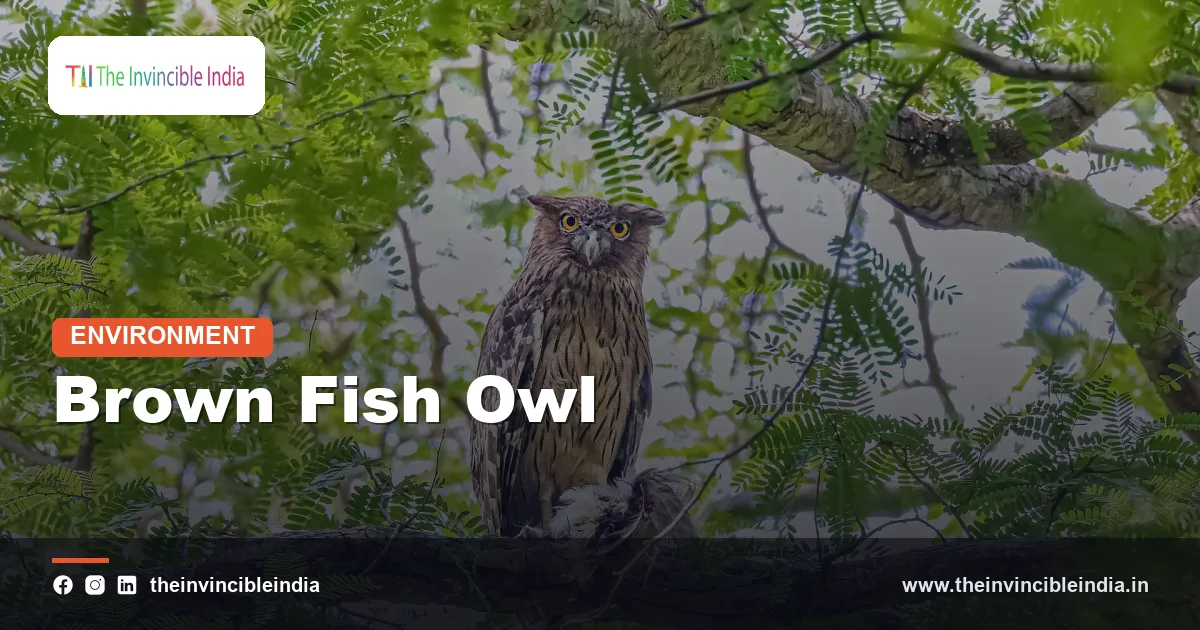
The brown fish owl is a large, ear-tufted owl (Ketupa zeylonensis) that hunts fish, crabs and frogs along rivers, streams, lakes and village tanks across India, mostly at dusk and through the night. It is one of the biggest owls of the Indian plains and foothills, recognised by its golden-yellow eyes, its streaked buff underparts and its deep, booming hoots that carry along the water.
Unlike most owls, the brown fish owl is a specialist of the waterside, with bare legs and rough-soled feet built for gripping slippery prey. This guide explains how to identify the bird, where it lives, how it fishes, how it breeds and why its quiet riverside habitat matters.
| Common name | Brown fish owl |
|---|---|
| Scientific name | Ketupa zeylonensis |
| Family | Strigidae (typical owls) |
| Size | About 48 to 57 cm long; large with prominent ear tufts |
| Range in India | Most of the country, in the plains, foothills and hills; scarcer in dry western regions |
| Habitat | Wooded rivers, streams, lakes, ponds, canals, irrigation tanks and mangroves |
| Diet | Fish, crabs and frogs, plus rodents, birds, bats and large insects |
| Breeding | Nests in tree hollows, old raptor nests and rock ledges; usually 1 to 2 eggs in the dry season |
| Conservation status | Least Concern (IUCN); protected under the Wildlife (Protection) Act, 1972 |
Key Takeaways
- The brown fish owl (Ketupa zeylonensis) is a large Indian owl that specialises in catching fish, crabs and frogs from rivers, streams and ponds.
- The brown fish owl has bare, unfeathered lower legs and spiny soles on its toes, which help it hold slippery prey.
- The brown fish owl roosts by day in dense trees near water and hunts mainly at dusk, at night and around dawn.
- The brown fish owl gives a deep, booming hoot, often performed as a duet between a male and female.
- The brown fish owl is widespread in India and rated Least Concern, but it depends on healthy waterside trees and clean fish-bearing water.
- The brown fish owl is protected under the Wildlife (Protection) Act, 1972, like all owls in India.
What is the brown fish owl?
The brown fish owl is a large species of owl in the family Strigidae, the group that contains most of the world’s typical owls, and it is adapted to hunting around water. It belongs to the genus Ketupa, the fish owls, which also includes the tawny fish owl, the buffy fish owl and the Blakiston’s fish owl of northeast Asia.
Older books place the bird in the genus Bubo with the eagle-owls, and its large size and ear tufts do give it an eagle-owl look. Like other owls, the brown fish owl has forward-facing eyes, a facial disc that funnels sound to its ears and a hooked bill for tearing prey.
In many parts of India the bird has local names that echo its call. It is most often noticed because of its voice, as the bird is rarely seen during the day.
How can you identify a brown fish owl?
A brown fish owl can be identified by its large size, its prominent tufts of feathers on either side of the head, its bright golden-yellow eyes and its brown upperparts finely marked with buff, over buffy underparts with dark streaks. Its feathered face looks rather flat, and the tufts are held more widely apart than in some other large owls.
Useful field marks include:
- Ear tufts: Long, upright feather tufts, usually angled slightly outward from the head.
- Yellow eyes: Large golden-yellow irises that stand out from the brown face.
- White throat patch: A pale whitish patch on the throat that shows when the bird calls.
- Streaked underparts: Dark vertical streaks on a warm buff chest and belly, without the fine crossbars seen on some other owls.
- Bare lower legs: The legs below the “knee” are unfeathered, which sets the fish owls apart from most other large owls.
The bird looks bulky and upright when perched. In flight it has broad, rounded wings and a fairly short tail, and it often looks heavier and slower than a hawk or a smaller owl.
Where does the brown fish owl live in India?
The brown fish owl lives across most of India, from the foothills of the Himalaya to the southern peninsula and the Western Ghats, wherever it can find water with trees nearby. It is less common in the driest western regions and in open treeless areas, because it needs shady roosts as well as fishing waters.
Typical habitats are:
- Wooded rivers and forest streams, especially with large overhanging trees.
- Lakes, ponds, village tanks and reservoirs fringed with mango, banyan, tamarind or bamboo.
- Irrigation canals, paddy-field channels and marshy edges.
- Mangroves, estuaries and coastal creeks in some regions.
Outside India the brown fish owl ranges through Sri Lanka, Nepal, Bangladesh, Myanmar and parts of Southeast Asia, and its range extends westward through Pakistan and Iran toward the Middle East. It generally occurs from sea level to about 1,500 metres in the hills of India.
How does the brown fish owl hunt?
The brown fish owl hunts by perching quietly on a branch, rock or bank overlooking the water and then swooping down to seize a fish or crab in its talons. It may also wade in shallows and snatch prey from the surface or the water’s edge.
Special adaptations help it succeed:
- Rough toe pads: The undersides of the toes are covered in tiny spikes called spicules, which give a firm grip on wet fish.
- Bare legs: Without feathers on the lower leg, the bird does not get its plumage soaked when it plunges into water.
- Strong talons: Long, curved claws hold prey too heavy or too slippery for the bill alone.
- Night vision and hearing: Large eyes and sensitive ears help the bird find movement at low light and ripples in the water.
- Less silent flight: Fish owls are generally described as having less specialised silent-flight plumage than owls that hunt rodents on dry land, since their aquatic prey is less likely to be alerted by wing noise.
The owl often carries prey to a favourite perch to eat. Larger fish may be torn into pieces, while crabs and frogs are swallowed whole or in parts. Indigestible material such as scales and shells is later coughed up in compact pellets.
What does the brown fish owl eat?
The brown fish owl eats mostly fish, crabs and frogs, though it is an opportunist that also takes rodents, small birds, bats, snakes, lizards and large insects such as beetles. Its diet changes with local conditions and with the seasons.
The main prey groups are:
- Fish: Small to medium freshwater fish, especially those that come to shallows at night, are a staple.
- Crabs and crayfish: Freshwater crabs are a favourite where they are common.
- Frogs and toads: Amphibians are frequently taken around ponds and paddy fields, especially in the monsoon.
- Small mammals and birds: Rats, mice and sometimes roosting birds supplement the diet away from water.
- Insects: Large water beetles, locusts and other insects are caught on or above the ground.
The brown fish owl therefore plays a role as a top predator of small waterside animals. It helps control rodents and amphibians, and its presence generally suggests that a stretch of water still supports a reasonable range of prey.
What does the brown fish owl sound like?
The brown fish owl produces a deep, resonant, booming hoot that is repeated at intervals and can be heard far across water on calm nights. Pairs often call in a duet, with the male and female hooting at slightly different pitches.
The calls are usually given at dusk and at night, and they serve several purposes:
- Advertising the territory to neighbouring pairs.
- Keeping contact between the male and female.
- Strengthening the pair bond before and during the breeding season.
Besides hooting, the owl makes harsher, wheezy or hissing sounds when disturbed, and the young give raspy begging calls. Because the bird is difficult to see in dense riverside trees, many observers first locate it by ear.
How does the brown fish owl breed?
The brown fish owl breeds mainly in the dry season, laying one or two eggs in a large tree hollow, a ledge on a cliff or bank, or the abandoned nest of a big bird such as an eagle or a vulture. It builds little or no nest of its own.
Other features of its breeding cycle are:
- Timing: In much of India nesting takes place from about November to April, though the dates vary with region and rainfall.
- Clutch: The eggs are white and nearly round, as in most owls.
- Incubation: The female incubates the eggs for roughly a month, while the male brings food.
- Chick care: The young are fed by both parents and leave the nest after several weeks, though they may stay near it for a long time and keep begging.
- Site fidelity: Pairs often return to the same stretch of river or pond and sometimes the same nest site year after year.
Because nest trees need to be large and old, the removal of mature trees along waterways can reduce the number of suitable sites, even where there is enough fish to feed the birds.
Why does the brown fish owl matter?
The brown fish owl matters because, as a predator at the top of the waterside food web, it signals the health of rivers, tanks and wooded streams, and because it controls populations of rodents and other small animals. Its presence shows that mature trees and healthy prey still exist beside the water.
The bird has a cultural dimension too. Across South Asia, owls are tied up with omens and folk beliefs, some of them positive and many of them negative. These beliefs can lead to harassment or killing of owls, so public education is an important part of owl conservation. Under the Wildlife (Protection) Act, 1972, owls are protected and it is illegal to capture, kill or trade them.
What threats does the brown fish owl face?
The brown fish owl is not considered globally threatened, but it is affected locally by loss of riverside trees, water pollution, overfishing, drainage of wetlands and persecution caused by superstition. Its overall rating is Least Concern because it is widely distributed and adaptable.
The main pressures include:
- Habitat loss: Felling of big roost and nest trees, and conversion of wetland edges for building and farming.
- Pollution: Industrial and agricultural runoff reduces fish and crab populations and can pass toxins up the food chain.
- Electrocution and collisions: Owls flying at night can hit wires and vehicles.
- Trapping and killing: Illegal capture for superstitious practices and the wildlife trade still occurs in some regions.
- Disturbance: Loud noise, lighting and activity near roosts and nests can drive the birds away.
Protecting old waterside trees, keeping rivers and tanks clean and spreading awareness about owls are among the most effective ways of conserving the species.
How does the brown fish owl compare with other large Indian owls?
The brown fish owl differs from other large Indian owls mainly in its waterside habitat, its bare legs and its fish diet. The table below compares it with two other large owls of the subcontinent.
| Owl | Habitat | Main prey | Distinguishing feature |
|---|---|---|---|
| Brown fish owl | Rivers, ponds and wooded streams | Fish, crabs and frogs | Ear tufts, yellow eyes, bare lower legs |
| Indian eagle-owl | Rocky hills, scrub and ravines | Rodents, birds and reptiles | Orange eyes and feathered legs |
| Mottled wood owl | Groves, old trees and village woods | Rodents, birds and insects | No ear tufts and dark eyes |
The brown fish owl is therefore the owl most closely tied to water. Where it shares ground with the Indian eagle-owl, the two usually use different parts of the landscape.
How can you see a brown fish owl?
The best way to see a brown fish owl is to look for its daytime roost in dense, shady trees beside a river or pond, or to wait at dusk near a quiet stretch of water where its hoots are heard. It often roosts on a thick, leafy branch against a trunk, and may be given away by mobbing crows.
Some tips for watching responsibly are:
- Search large mango, banyan, tamarind and bamboo clumps near water in the daytime.
- Listen for deep hoots at dusk, then scan nearby branches with a torch used sparingly and with a red filter if possible.
- Use binoculars rather than approaching closely, because disturbed owls may abandon roosts and nests.
- Avoid flash photography, and never use recorded calls to lure the bird during breeding season.
Wooded river corridors in the Western Ghats, central India and the Gangetic plains are among the best places to find the species, though it can turn up wherever mature trees and fish-bearing water coexist.
Bottom Line
The brown fish owl is a large, booming night hunter of Indian rivers and ponds that depends on old trees and living waters. Keeping waterside trees standing, rivers clean and owls free from persecution will help it remain a familiar presence for years to come.
Frequently Asked Questions
What is a brown fish owl?
A brown fish owl is a large, ear-tufted owl of the species Ketupa zeylonensis that hunts fish, crabs and frogs along Indian rivers, lakes and streams. It has golden-yellow eyes, buff streaked underparts and a deep booming call.
Where do brown fish owls live in India?
Brown fish owls live across most of India near water with trees, including wooded rivers, ponds, tanks, canals and mangroves. They are found from the Himalayan foothills to the southern peninsula, but are scarcer in very dry regions.
What does a brown fish owl eat?
A brown fish owl eats mainly fish, crabs and frogs. It also takes rodents, small birds, bats, reptiles and large insects when the opportunity arises.
Is the brown fish owl nocturnal?
The brown fish owl is mainly nocturnal and crepuscular, hunting at dusk, at night and around dawn. It spends the day roosting quietly in dense trees close to water.
How do you tell a brown fish owl from other owls?
A brown fish owl is distinguished by its ear tufts, golden-yellow eyes, streaked buff underparts and bare lower legs. Its waterside habitat and deep booming call also help separate it from forest and eagle owls.
Is the brown fish owl protected in India?
The brown fish owl is protected under the Wildlife (Protection) Act, 1972, which makes it illegal to hunt, capture or trade owls. The IUCN lists the species as Least Concern because it is widespread, but local populations still depend on healthy waterside trees and clean water.
{“@context”:”https://schema.org”,”@graph”:[{“@type”:”FAQPage”,”mainEntity”:[{“@type”:”Question”,”name”:”What is a brown fish owl?”,”acceptedAnswer”:{“@type”:”Answer”,”text”:”A brown fish owl is a large, ear-tufted owl of the species Ketupa zeylonensis that hunts fish, crabs and frogs along Indian rivers, lakes and streams. It has golden-yellow eyes, buff streaked underparts and a deep booming call.”}},{“@type”:”Question”,”name”:”Where do brown fish owls live in India?”,”acceptedAnswer”:{“@type”:”Answer”,”text”:”Brown fish owls live across most of India near water with trees, including wooded rivers, ponds, tanks, canals and mangroves. They are found from the Himalayan foothills to the southern peninsula, but are scarcer in very dry regions.”}},{“@type”:”Question”,”name”:”What does a brown fish owl eat?”,”acceptedAnswer”:{“@type”:”Answer”,”text”:”A brown fish owl eats mainly fish, crabs and frogs. It also takes rodents, small birds, bats, reptiles and large insects when the opportunity arises.”}},{“@type”:”Question”,”name”:”Is the brown fish owl nocturnal?”,”acceptedAnswer”:{“@type”:”Answer”,”text”:”The brown fish owl is mainly nocturnal and crepuscular, hunting at dusk, at night and around dawn. It spends the day roosting quietly in dense trees close to water.”}},{“@type”:”Question”,”name”:”How do you tell a brown fish owl from other owls?”,”acceptedAnswer”:{“@type”:”Answer”,”text”:”A brown fish owl is distinguished by its ear tufts, golden-yellow eyes, streaked buff underparts and bare lower legs. Its waterside habitat and deep booming call also help separate it from forest and eagle owls.”}},{“@type”:”Question”,”name”:”Is the brown fish owl protected in India?”,”acceptedAnswer”:{“@type”:”Answer”,”text”:”The brown fish owl is protected under the Wildlife (Protection) Act, 1972, which makes it illegal to hunt, capture or trade owls. The IUCN lists the species as Least Concern because it is widespread, but local populations still depend on healthy waterside trees and clean water.”}}]}]}


