

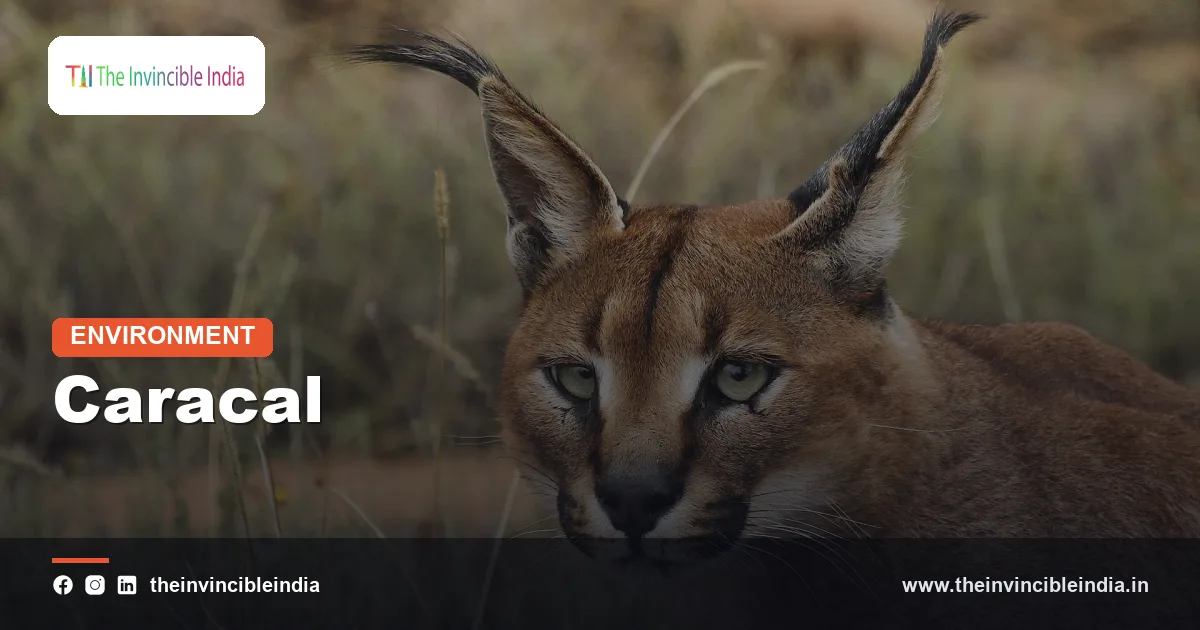
Caracal conservation in India is the effort to protect the caracal (Caracal caracal), a medium-sized wild cat with long black ear tufts that survives in small, scattered populations in the dry scrub and semi-arid landscapes of western and central India. The caracal is now among the country’s rarest and least-studied mammals, with the population thought to be limited to perhaps a few hundred animals at most, and possibly fewer.
Known historically as the “siyah gosh” (Persian for “black ear”), the caracal was once kept and trained by Indian rulers for hunting. Today it is protected under Schedule I of the Wildlife (Protection) Act, 1972, but habitat loss, road accidents and a lack of reliable survey data make its long-term survival uncertain. This explainer sets out what the animal is, where it lives and what is being done for it.
| Scientific name | Caracal caracal (Asian subspecies: Caracal caracal schmitzi) |
|---|---|
| Local and historical names | Siyah gosh, syah gosh (Persian “black ear”), desert lynx |
| Type of animal | Medium-sized wild cat |
| Body weight | Roughly 8 to 18 kilograms |
| Main Indian habitat | Dry scrub, grassland, semi-arid and rocky terrain in Rajasthan, Gujarat and Madhya Pradesh |
| Indian protection status | Schedule I, Wildlife (Protection) Act, 1972 |
| Global status | Least Concern (IUCN), but much rarer in Asia than in Africa |
| International trade | Asian populations in CITES Appendix I; African populations in Appendix II |
| Estimated Indian population | Not precisely known; possibly a few hundred or fewer |
Key Takeaways
- The caracal is a medium-sized wild cat with distinctive black ear tufts, and its Persian-origin name “siyah gosh” means “black ear”.
- In India, the caracal survives mainly in dry, open landscapes of Rajasthan, Gujarat and Madhya Pradesh, and the total population is believed to be small, possibly only a few hundred animals.
- The caracal is listed under Schedule I of the Wildlife (Protection) Act, 1972, which gives it the highest level of legal protection in India.
- Mughal and earlier Indian rulers trained caracals to hunt hares, birds and small antelope, which is why the species features in historical records and paintings.
- The main threats to the caracal in India are habitat loss, road accidents, retaliatory killing, a shrinking prey base and a lack of systematic population surveys.
- Global numbers of the caracal are healthy in Africa, so the species is rated Least Concern worldwide, yet the Asian populations are small, isolated and poorly documented.
What is the caracal?
The caracal is a medium-sized, lean wild cat that is known for its tall, tufted black ears, a plain sandy or reddish coat and exceptional leaping ability. The species stands roughly 40 to 50 centimetres at the shoulder and has long legs, a short tail and a compact, muscular body.
The ear tufts can be around 4 to 5 centimetres long, and their function is still debated. Scientists suggest that they help with signalling between individuals or with the position of the ears while hunting. The word “caracal” is believed to come from the Turkish “karakulak”, meaning “black ear”, which is why the Persian-derived name “siyah gosh” carries the same meaning.
Caracals are sometimes called desert lynx, although they are not true lynxes. They belong to the cat family (Felidae) and are most closely related to the African golden cat and the serval. Adult caracals can leap about three metres into the air to snatch birds from flight, a feat for which they are famous.
Where do caracals live in India?
Caracals in India live mainly in the arid and semi-arid regions of western and central India, including parts of Rajasthan, Gujarat and Madhya Pradesh. They prefer dry scrub forest, rocky hills, open grassland and thorny woodland with enough cover for resting and hunting.
In Rajasthan, caracals have been recorded in areas such as Ranthambore National Park and surrounding forests, the Aravalli hills and desert-edge scrublands. In Gujarat, the Kutch region and its dry scrub and grasslands are known caracal habitat. In Madhya Pradesh, small populations are reported from dry forests and rocky tracts, particularly in the north and west of the state.
Historically, the caracal’s range in India extended across a wider band of the north-west, centre and parts of the Deccan, and into Punjab, Haryana and Uttar Pradesh. Over the past century, this range has shrunk and fragmented, and many records are now from isolated pockets.
- Rajasthan: Ranthambore and surrounding forests, parts of the Aravallis and dry scrub areas.
- Gujarat: Kutch and scrub-grassland regions.
- Madhya Pradesh: dry forests and rocky scrub, including parts of the Chambal and Bundelkhand regions.
Why is the caracal called “siyah gosh”?
The caracal is called “siyah gosh” because the Persian words mean “black ear”, referring to the cat’s black ear tufts and the dark backs of its ears. The name was used by the Persian-speaking courts of Mughal India and entered local languages, where it appears in several spellings such as “syahgosh” or “sia-gosh”.
The English word “caracal” is thought to come from the Turkish “karakulak”, which has the same meaning as the Persian name. The cat has also been described in older English-language books as the “Persian lynx”, which reflects the way it was first documented in south-west Asia.
What is the Mughal history of the caracal?
The Mughal history of the caracal is that Mughal emperors and nobles kept the cat as a hunting animal, much as they kept cheetahs, and used it to catch hares, game birds and small antelope. This practice, known as caracal coursing, is recorded in chronicles and miniature paintings of the Mughal period and in the accounts of European travellers.
Trained caracals were sometimes released into flocks of pigeons or cranes, and spectators watched how many birds the cat could knock down in a single leap. Such displays were also known in Persia and other parts of West and Central Asia, from where the practice and the name probably travelled.
This history is often cited because it shows the animal was once common enough to be captured and trained. The same hunting culture, together with later colonial-era hunting and the clearing of scrubland, contributed to the long decline in numbers.
How many caracals are left in India?
No one knows exactly how many caracals are left in India, but the population is generally believed to be small, with estimates ranging from perhaps a few dozen to a few hundred animals. The cat is shy, nocturnal and spread thinly across a large region, which makes it hard to count.
Earlier assessments reported only a few dozen animals, and some regional surveys have recorded far more than previously expected through camera traps. However, there has been no systematic nationwide survey of the species, and experts caution that any single number is uncertain. Many consider the caracal to be among the most threatened mammals in India, alongside the Great Indian Bustard and the Gangetic dolphin.
The Ministry of Environment, Forest and Climate Change (MoEFCC) and the National Board for Wildlife (NBWL) have identified the caracal among species that need focused recovery attention, which has raised its profile in conservation planning.
What are the main threats to caracals in India?
The main threats to caracals in India are the loss and degradation of dry scrub and grassland habitat, road accidents, retaliatory killing and the decline of small prey. Because caracals live at low densities, even a modest number of deaths can threaten a local population.
- Habitat loss: scrublands and grasslands have often been classed as “wastelands” and converted to farms, mines, industry and wind or solar installations.
- Road and rail mortality: highways and roads cutting through dry forests and scrub kill animals that move at night.
- Retaliatory killing: caracals may take poultry or small livestock, leading to snares, traps and poisoning by villagers.
- Prey decline: overgrazing, hunting and habitat loss reduce hares, rodents, birds and small antelope.
- Stray dogs and conflict: free-ranging dogs and human settlement edges compete with and threaten the cats.
- Poor data: lack of surveys and monitoring makes it hard to plan protection for the species.
What does the caracal eat and how does it hunt?
The caracal eats mainly small mammals and birds, including hares, rodents, gerbils, ground-nesting birds and occasionally young antelope or small livestock. It is a solitary, mostly nocturnal hunter that relies on stealth, hearing and a short, explosive sprint or leap to capture prey.
Caracals are able to kill prey larger than themselves, such as young chinkara or blackbuck fawns, although they mostly choose smaller animals. They often cover their kills with vegetation and sometimes carry them into trees or rocky ledges, as leopards do. Females give birth to one to four kittens after a gestation of about two and a half months, and the young stay with the mother for many months.
What laws protect the caracal in India?
The caracal is protected in India as a Schedule I species under the Wildlife (Protection) Act, 1972, which prohibits hunting and trade and provides the strongest penalties under the Act. This is the same schedule that covers tigers, elephants and leopards.
At the international level, the Asian populations of the caracal are listed on Appendix I of the Convention on International Trade in Endangered Species of Wild Fauna and Flora (CITES), which bans commercial international trade. African populations fall under CITES Appendix II. The International Union for Conservation of Nature (IUCN) rates the species as Least Concern globally, but regional assessments treat Asian populations as more vulnerable.
Protected areas such as Ranthambore National Park and the Kutch desert sanctuaries offer habitat protection, but much of the caracal’s range lies outside protected areas, on revenue and village lands where legal protection is harder to enforce.
What is being done to conserve the caracal?
Conservation of the caracal in India currently rests on legal protection, camera-trap surveys, habitat management in protected areas and growing recovery planning by government bodies and research institutions. The Wildlife Institute of India (WII), state forest departments and conservation groups have documented the species and begun to plan for it.
Recovery planning under the MoEFCC includes the caracal among a list of species that need targeted attention, and state forest departments in Rajasthan, Gujarat and Madhya Pradesh have recorded the cat during camera-trap exercises. Researchers have also called for better data, such as genetic studies and landscape-wide surveys, to understand population size and connectivity.
Priority actions suggested by conservation experts
- Run systematic camera-trap and genetic surveys to estimate the population.
- Protect and restore dry scrub and grassland, and stop treating these habitats as wasteland.
- Build wildlife-friendly road crossings and signage on busy stretches through caracal habitat.
- Compensate livestock losses promptly to reduce retaliation.
- Reduce free-ranging dog numbers near protected areas.
- Raise awareness among local communities and forest staff about the species.
How does the Indian caracal compare with other small wild cats?
| Species | Typical habitat in India | Distinctive feature |
|---|---|---|
| Caracal | Dry scrub, grassland, rocky terrain in the west and centre | Long black ear tufts, plain sandy coat |
| Jungle cat | Wetlands, grassland and scrub across much of India | Plain brown-grey coat, no ear tufts |
| Desert cat | Desert and semi-arid areas of Rajasthan and Gujarat | Pale sandy coat with faint markings |
| Rusty-spotted cat | Forests and grasslands in peninsular India and Sri Lanka | One of the smallest cats, with rusty spots |
| Leopard cat | Forests of the Himalaya, Northeast and Western Ghats | Spotted coat similar to a small leopard |
Bottom Line
Caracal conservation in India matters because the cat is a rare, highly adapted predator of dry landscapes that conservation planning has long overlooked. Protecting scrub and grassland, gathering better population data and reducing road and conflict deaths are the most important steps. The caracal’s survival will depend on valuing the arid “wastelands” where it lives.
Frequently Asked Questions
What is a caracal?
A caracal is a medium-sized wild cat with a plain sandy coat, long legs and tall black ear tufts. It weighs roughly 8 to 18 kilograms and is known for leaping about three metres to catch birds. In India it lives in dry scrub and grassland areas of Rajasthan, Gujarat and Madhya Pradesh.
What does “siyah gosh” mean?
“Siyah gosh” is a Persian term meaning “black ear”, and it is the traditional name for the caracal. The name refers to the cat’s black ear tufts. It was used in Mughal India, where the animal was kept and trained for hunting.
How many caracals are there in India?
The exact number of caracals in India is not known, but the population is considered small, possibly a few hundred animals at most. The cat is nocturnal and shy, and there has been no systematic national survey. Estimates therefore vary and should be treated with caution.
Where is the caracal found in India?
The caracal is found mainly in dry and semi-arid parts of Rajasthan, Gujarat and Madhya Pradesh. Known areas include Ranthambore and surrounding forests in Rajasthan and the Kutch region of Gujarat. Its historical range was larger but has shrunk and become fragmented.
Is the caracal protected by law in India?
Yes, the caracal is protected as a Schedule I species under the Wildlife (Protection) Act, 1972, which gives it the highest legal protection. Hunting and trade are prohibited, and violations carry strict penalties. Internationally, Asian caracals are listed under CITES Appendix I, which bans commercial trade.
What are the biggest threats to the caracal?
The biggest threats to the caracal in India are habitat loss, road accidents, retaliatory killing and declining prey. Dry scrubland is often converted to farms, mines and energy projects because it is wrongly seen as wasteland. Poor survey data also makes it harder to plan protection.
{“@context”:”https://schema.org”,”@graph”:[{“@type”:”FAQPage”,”mainEntity”:[{“@type”:”Question”,”name”:”What is a caracal?”,”acceptedAnswer”:{“@type”:”Answer”,”text”:”A caracal is a medium-sized wild cat with a plain sandy coat, long legs and tall black ear tufts. It weighs roughly 8 to 18 kilograms and is known for leaping about three metres to catch birds. In India it lives in dry scrub and grassland areas of Rajasthan, Gujarat and Madhya Pradesh.”}},{“@type”:”Question”,”name”:”What does “siyah gosh” mean?”,”acceptedAnswer”:{“@type”:”Answer”,”text”:””Siyah gosh” is a Persian term meaning “black ear”, and it is the traditional name for the caracal. The name refers to the cat’s black ear tufts. It was used in Mughal India, where the animal was kept and trained for hunting.”}},{“@type”:”Question”,”name”:”How many caracals are there in India?”,”acceptedAnswer”:{“@type”:”Answer”,”text”:”The exact number of caracals in India is not known, but the population is considered small, possibly a few hundred animals at most. The cat is nocturnal and shy, and there has been no systematic national survey. Estimates therefore vary and should be treated with caution.”}},{“@type”:”Question”,”name”:”Where is the caracal found in India?”,”acceptedAnswer”:{“@type”:”Answer”,”text”:”The caracal is found mainly in dry and semi-arid parts of Rajasthan, Gujarat and Madhya Pradesh. Known areas include Ranthambore and surrounding forests in Rajasthan and the Kutch region of Gujarat. Its historical range was larger but has shrunk and become fragmented.”}},{“@type”:”Question”,”name”:”Is the caracal protected by law in India?”,”acceptedAnswer”:{“@type”:”Answer”,”text”:”Yes, the caracal is protected as a Schedule I species under the Wildlife (Protection) Act, 1972, which gives it the highest legal protection. Hunting and trade are prohibited, and violations carry strict penalties. Internationally, Asian caracals are listed under CITES Appendix I, which bans commercial trade.”}},{“@type”:”Question”,”name”:”What are the biggest threats to the caracal?”,”acceptedAnswer”:{“@type”:”Answer”,”text”:”The biggest threats to the caracal in India are habitat loss, road accidents, retaliatory killing and declining prey. Dry scrubland is often converted to farms, mines and energy projects because it is wrongly seen as wasteland. Poor survey data also makes it harder to plan protection.”}}]}]}


