

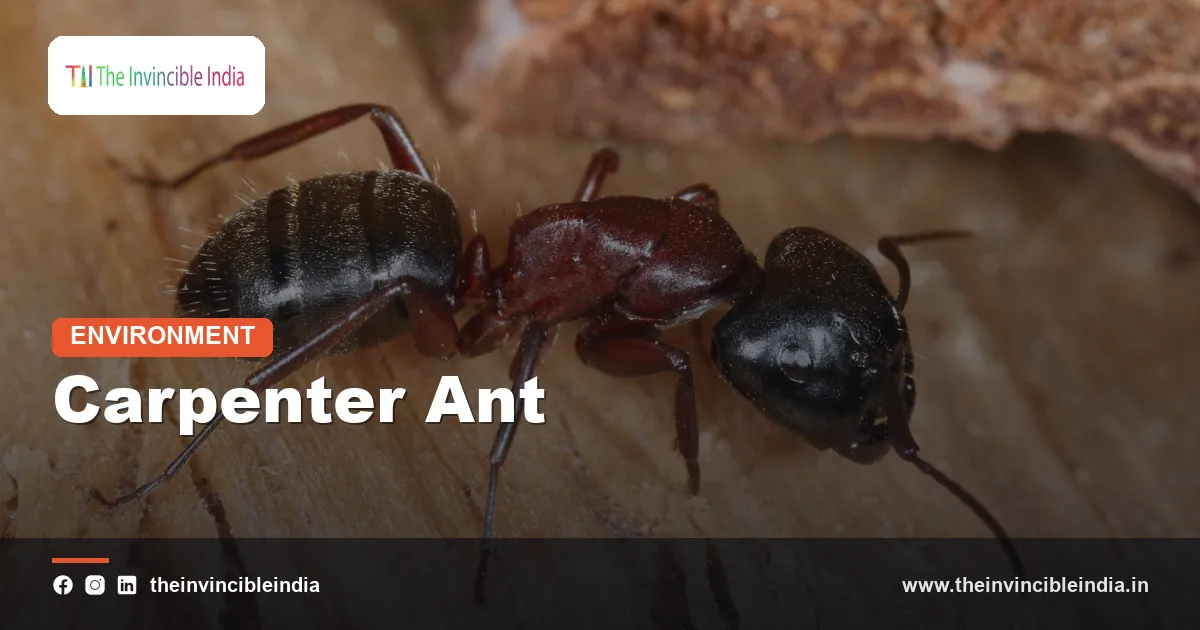
A carpenter ant is a large ant of the genus Camponotus that excavates its nest in damp or decaying wood, tree hollows and soil, and that does not eat the wood it removes. Found in gardens, forests, plantations and homes across India, the carpenter ant is a big, dark, slow-moving forager that follows regular trails and feeds on sugary secretions, nectar and other insects.
Because it is large and often seen inside houses, the carpenter ant is frequently mistaken for a termite and blamed for timber damage that is caused by moisture or by termites. This article explains what a carpenter ant is, how it nests and feeds, how its colony is organised, how it differs from a termite, whether it bites or stings, and when it needs to be controlled.
Quick Facts
| Common name | Carpenter ant (Indian species include the black carpenter ant, Camponotus compressus, and the golden-backed carpenter ant, Camponotus sericeus) |
|---|---|
| Scientific classification | Order Hymenoptera; family Formicidae (ants); subfamily Formicinae; genus Camponotus |
| Size | Workers vary from about 6 mm to well over 1 cm, with the largest workers (majors) reaching about 1.5 cm; queens are larger still |
| Habitat in India | Forests, plantations, gardens, tree trunks, fallen logs, damp timber and wall cavities, from the plains to the hills |
| Diet | Honeydew from aphids and scale insects, plant nectar, fruit juices, sugary foods and small insects; wood is not eaten |
| Life cycle | Complete metamorphosis: egg, larva, pupa, adult; colonies grow slowly and may take several years to mature |
| Ecological role | Omnivorous forager, plant-sap and honeydew consumer, and decomposer of damp wood |
| Notable features | Smooth, evenly rounded upper profile of the thorax, a single node at the waist, workers of different sizes, no sting but a bite and a spray of formic acid |
Key Takeaways
- The carpenter ant belongs to the genus Camponotus of the subfamily Formicinae, a very large genus with well over a thousand species worldwide.
- A carpenter ant excavates galleries in damp or decayed wood to make a nest, but it does not eat wood and gets its food from honeydew, nectar and other insects.
- A carpenter ant colony contains workers of different sizes, called polymorphic workers, along with one or more queens and seasonal winged reproductives.
- The carpenter ant has no functional sting but can bite with strong jaws and spray formic acid into the wound.
- A carpenter ant differs from a termite in having a narrow waist, elbowed antennae, a hard dark body and wings of unequal length.
- Carpenter ant nests in a building usually indicate a moisture problem, so the lasting solution is to repair leaks and dry out the timber.
What is a carpenter ant?
A carpenter ant is a member of the large ant genus Camponotus, in the family Formicidae, and is distinguished from other ants by its large size, its smooth rounded thorax and its habit of nesting in wood. The word carpenter refers to the way it carves out tunnels, not to any use of wood as food.
The genus Camponotus is one of the biggest groups of ants, with well over a thousand species described worldwide, found on every continent apart from the polar regions. It belongs to the subfamily Formicinae, the formic-acid-spraying ants, which also includes the weaver ants and the honeypot ants. In India, several species occur, and the commonest are the Indian black carpenter ant, Camponotus compressus, and the golden-backed carpenter ant, Camponotus sericeus.
The workers are black, brown or reddish-brown, and some have a golden sheen on the abdomen from fine hairs. They are slower and more deliberate than many small garden ants and are often seen walking in single file along walls, branches and pipes, mostly after dark.
How can you identify a carpenter ant?
A carpenter ant can be identified by its large size, its single node between the thorax and abdomen, its evenly rounded thorax when viewed from the side and a circle of fine hairs at the tip of its abdomen. These features distinguish it from many other large ants.
- Size: workers are noticeably larger than common house ants, and a single nest has workers of several sizes.
- Waist: one node, or a small raised segment, separates the thorax from the abdomen.
- Thorax: the upper outline is smooth and gently arched, without spines or bumps.
- Antennae: elbowed, with a long first segment.
- Abdomen tip: a rounded opening, ringed with hairs, through which the ant sprays formic acid.
- Colour: black, brown or reddish, sometimes with a golden or silvery sheen.
The winged reproductives, which appear during the mating season, are larger still and have long wings. They can be mistaken for termite swarmers, but the narrow waist and the unequal wings give them away.
Where does a carpenter ant build its nest?
A carpenter ant builds its nest in wood that is damp, rotting or hollow, as well as in soil, under stones and in other sheltered cavities. The main nest, or parent colony, is often in a rotting tree trunk or log, and smaller satellite nests may be built in nearby buildings.
Natural sites include dead branches, tree stumps, hollow trunks, fallen logs, bamboo clumps and the roots of old trees. In and around houses, the ants favour timber that has become wet from leaks, such as window frames, door frames, roof beams, wooden sinks, damp skirting and wall cavities. They may also use hollow spaces behind panels, in insulation and under floors.
The ants chew the wood into thin tunnels, called galleries, which run along the softer layers and between the harder grain. The walls of the galleries are smooth, as if sanded, which is a useful clue. The waste, which includes wood shavings and the remains of insects, is pushed out of small openings as a fine, sawdust-like material called frass.
Why the ant does not eat the wood
The carpenter ant carves wood only to create space. It cannot digest cellulose as termites do, so the shavings are simply cast out. This is the key difference between carpenter ant damage and termite damage: the carpenter ant galleries are clean and smooth, while termite galleries are packed with soil and often contain mud-lined walls.
What does a carpenter ant eat?
A carpenter ant eats sugary liquids and small animals: honeydew from aphids and scale insects, nectar from flowers, juices from ripe fruit, sweet household foods and the bodies of other insects. It is an omnivore with a strong preference for sweet foods.
Much of its food comes from honeydew, the sugary liquid excreted by sap-sucking insects. The ants tend aphids, mealybugs and scale insects on trees and shrubs, stroking them to stimulate honeydew production and sometimes defending them from predators. This is an example of mutualism, a relationship in which both partners benefit. The ants also visit extrafloral nectaries, which are small nectar-producing glands on leaves and stems.
- Honeydew from aphids, mealybugs, scale insects and leafhoppers.
- Nectar from flowers and from glands on leaves and stems.
- Ripe or fallen fruit.
- Small insects, including dead or dying ones.
- Sweet and fatty human foods, such as sugar, jaggery, honey, syrups and cooked food.
Foraging ants carry food back to the nest in their crops, a stretchable stomach used as a food store, and share it with nestmates by regurgitation. This sharing, called trophallaxis, spreads food, and chemical signals, through the whole colony.
How is a carpenter ant colony organised?
A carpenter ant colony is organised around one or more queens, with the daughters working as workers of different sizes and the males and new queens appearing only in the breeding season. The colony is a family, and its members cooperate in feeding, nest building and defence.
The workers are polymorphic: the smaller minors do most of the foraging and brood care, the medium workers handle tasks such as tending aphids, and the large majors, with big heads and powerful jaws, defend the nest and sometimes help with excavation. All the workers are female and sterile in the ordinary course of events.
Founding a colony
New colonies begin with a mating flight, when winged males and females leave the nest, usually after rain in warm, humid weather. After mating, the males die and the young queen sheds her wings, looks for a sheltered cavity in wood or soil and seals herself in. She lays the first eggs and rears the first small workers on her own body reserves, and later the workers take over foraging and feeding.
Growth is slow. A carpenter ant colony may take several years before it has enough workers to produce winged reproductives, and an established colony may have thousands of workers. Large colonies often split their activity between a main nest and several satellite nests, which are linked by trails.
How does a carpenter ant develop?
A carpenter ant develops by complete metamorphosis in four stages: egg, larva, pupa and adult. The queen lays small oval eggs, which hatch into legless, grub-like larvae, and the workers feed them with regurgitated food.
The larvae grow, and in many cases spin a thin silk cocoon, before turning into pupae, which look like pale adults with folded legs. Finally, the pupae emerge as adult ants. The time from egg to adult varies with temperature and food, and in the warmth of the Indian plains it may take roughly a couple of months.
| Stage | Appearance | Main care |
|---|---|---|
| Egg | Tiny, oval, whitish | Tended and moved by workers |
| Larva | Legless, white, grub-like | Fed with liquid food by workers |
| Pupa | Pale, with folded legs and antennae | Kept in the brood chambers |
| Adult | Worker, queen or male, in dark colours | Forage, build and breed according to role |
Does a carpenter ant bite or sting?
A carpenter ant can bite but cannot sting, because members of its subfamily have lost the functional stinger. When threatened, the ant seizes the skin with its strong jaws and may spray formic acid from the tip of its abdomen, which causes a brief sting-like burning.
The bite of a carpenter ant is not dangerous to most people. It may cause redness, a short burning sensation and slight swelling, which settle within hours. Washing the area with soap and water, and applying a cold compress, is usually enough. A person who develops wide swelling, breathing difficulty or other signs of an allergic reaction should seek medical help promptly.
Carpenter ants do not seek out people. They bite mainly when handled or when the nest is disturbed. A carpenter ant also does not spread disease in the way flies or cockroaches may, although like any foraging insect it can contaminate food it walks on.
How is a carpenter ant different from a termite?
A carpenter ant is different from a termite in its body shape, antennae, wings, colour and feeding: the carpenter ant has a narrow waist, elbowed antennae and a hard dark body, and does not eat wood, while the termite has a broad waist, straight antennae and a soft pale body, and feeds on cellulose.
| Feature | Carpenter ant | Termite |
|---|---|---|
| Waist | Narrow and pinched | Broad |
| Antennae | Elbowed | Straight and beaded |
| Wings of swarmers | Front wings longer than hind wings | All four wings of equal length |
| Body | Hard, dark, glossy | Soft, pale, often translucent |
| Does it eat wood? | No, it only removes it to make a nest | Yes, it digests the cellulose |
| Galleries | Clean, smooth and free of soil | Rough and packed with soil or mud |
| Waste | Coarse frass with insect parts | Pellets or mud |
| Wood preference | Damp or decaying wood | Sound or damp wood, depending on species |
These differences matter for treatment. A carpenter ant is primarily a moisture-related nuisance, whereas a termite attacks the wood itself and may do far more structural damage. The two can occur together, as both are attracted to moist timber.
Is the carpenter ant a pest?
The carpenter ant is a pest mainly in and around buildings, where its nests can weaken damp timber, and where the foraging workers may contaminate food. Its damage is usually slower and more localised than that of termites, and it is mostly confined to wood that is already wet or rotten.
Signs of a carpenter ant problem include large black ants wandering indoors at night, small piles of coarse frass beneath wooden surfaces, a faint rustling sound inside the walls and the presence of winged ants in the house. Outdoors, the ants may attract aphids to garden plants, because they protect and farm them for honeydew.
In a natural setting, the carpenter ant is not considered a pest at all. It helps to break down dead wood, spreads some seeds, preys on other insects and feeds many animals, including birds, lizards, spiders and frogs.
How can a carpenter ant be controlled and kept away from the house?
A carpenter ant can be controlled and kept away by correcting moisture problems, repairing and sealing wood, trimming vegetation away from the house and removing the nest and food sources. Because the ants nest in damp timber, making the wood dry is the most important and long-lasting step.
- Fix leaking roofs, pipes and taps, and ventilate areas where damp collects.
- Replace or repair rotting timber and seal cracks and gaps around windows, doors and pipes.
- Trim tree branches and creepers that touch the walls, and store firewood and cartons away from the house.
- Keep sweet and cooked food covered, and clean up spills quickly.
- Follow trails at night to find the nest; destroying a satellite nest does not remove the parent colony, which may be outdoors.
- Use baits or professional treatments where needed, and avoid spraying only the visible workers, which does not affect the queen.
Because the parent colony is often in a tree or log some distance from the house, a durable solution may require finding the main nest. If the infestation is heavy, a trained pest control professional should be called.
What role does the carpenter ant play in nature?
The carpenter ant plays several roles in nature: it recycles dead wood, preys on small insects, spreads some seeds and forms partnerships with sap-sucking insects. In forests and gardens, it is part of the network of insects that process dead plant matter.
By hollowing out rotting wood, it helps fungi and other decomposers reach deeper layers, speeding the return of nutrients to the soil. Its association with aphids and scale insects shapes insect communities on trees. The ants themselves are prey for woodpeckers, barbets, lizards, frogs and spiders.
In tropical forests elsewhere in the world, carpenter ants are known to be infected by a parasitic fungus, Ophiocordyceps, which alters their behaviour and kills them. This is a reminder that even large, dominant insects are part of complex food webs involving parasites and microbes.
Bottom Line
The carpenter ant is a large, dark, wood-nesting ant of the genus Camponotus that excavates damp wood but does not eat it. It is easy to confuse with a termite, yet it differs in its waist, antennae, wings and diet, and the best way to deal with it in a house is to remove the moisture that attracts it.
Frequently Asked Questions
What is a carpenter ant?
A carpenter ant is a large ant of the genus Camponotus that digs its nest in damp or decaying wood but does not eat the wood. It feeds on honeydew, nectar and small insects. Several species occur in India, including Camponotus compressus.
Does a carpenter ant eat wood?
A carpenter ant does not eat wood. It chews the wood only to make tunnels for its nest, and pushes the shavings out as frass. Its food consists of honeydew, nectar, fruit juices, sweet foods and other insects.
How is a carpenter ant different from a termite?
A carpenter ant differs from a termite in having a narrow waist, elbowed antennae, a hard dark body and wings of unequal length. A termite has a broad waist, straight antennae, a soft pale body and four equal wings. The termite also eats wood, which the carpenter ant does not.
Can a carpenter ant bite or sting?
A carpenter ant can bite with its strong jaws but cannot sting, as it has lost the functional stinger. It may spray formic acid on the bite, which causes brief burning. The bite is usually mild, although a person with an allergic reaction should seek medical advice.
Why are there carpenter ants in my house?
Carpenter ants enter a house mainly because of damp or decaying wood, which they use for nesting, and because of accessible food, especially sweet items. They may also be foraging from a main nest in a nearby tree or log. Fixing leaks and sealing entry points reduces the problem.
How can I get rid of carpenter ants?
Carpenter ants can be removed by fixing moisture problems, repairing damp wood, sealing cracks, trimming vegetation and covering food, together with baits or professional treatment where needed. The key step is to locate and treat the nest, since killing only the visible workers does not remove the queen. A heavy infestation is best handled by a trained professional.
{“@context”:”https://schema.org”,”@graph”:[{“@type”:”FAQPage”,”mainEntity”:[{“@type”:”Question”,”name”:”What is a carpenter ant?”,”acceptedAnswer”:{“@type”:”Answer”,”text”:”A carpenter ant is a large ant of the genus Camponotus that digs its nest in damp or decaying wood but does not eat the wood. It feeds on honeydew, nectar and small insects. Several species occur in India, including Camponotus compressus.”}},{“@type”:”Question”,”name”:”Does a carpenter ant eat wood?”,”acceptedAnswer”:{“@type”:”Answer”,”text”:”A carpenter ant does not eat wood. It chews the wood only to make tunnels for its nest, and pushes the shavings out as frass. Its food consists of honeydew, nectar, fruit juices, sweet foods and other insects.”}},{“@type”:”Question”,”name”:”How is a carpenter ant different from a termite?”,”acceptedAnswer”:{“@type”:”Answer”,”text”:”A carpenter ant differs from a termite in having a narrow waist, elbowed antennae, a hard dark body and wings of unequal length. A termite has a broad waist, straight antennae, a soft pale body and four equal wings. The termite also eats wood, which the carpenter ant does not.”}},{“@type”:”Question”,”name”:”Can a carpenter ant bite or sting?”,”acceptedAnswer”:{“@type”:”Answer”,”text”:”A carpenter ant can bite with its strong jaws but cannot sting, as it has lost the functional stinger. It may spray formic acid on the bite, which causes brief burning. The bite is usually mild, although a person with an allergic reaction should seek medical advice.”}},{“@type”:”Question”,”name”:”Why are there carpenter ants in my house?”,”acceptedAnswer”:{“@type”:”Answer”,”text”:”Carpenter ants enter a house mainly because of damp or decaying wood, which they use for nesting, and because of accessible food, especially sweet items. They may also be foraging from a main nest in a nearby tree or log. Fixing leaks and sealing entry points reduces the problem.”}},{“@type”:”Question”,”name”:”How can I get rid of carpenter ants?”,”acceptedAnswer”:{“@type”:”Answer”,”text”:”Carpenter ants can be removed by fixing moisture problems, repairing damp wood, sealing cracks, trimming vegetation and covering food, together with baits or professional treatment where needed. The key step is to locate and treat the nest, since killing only the visible workers does not remove the queen. A heavy infestation is best handled by a trained professional.”}}]}]}


