

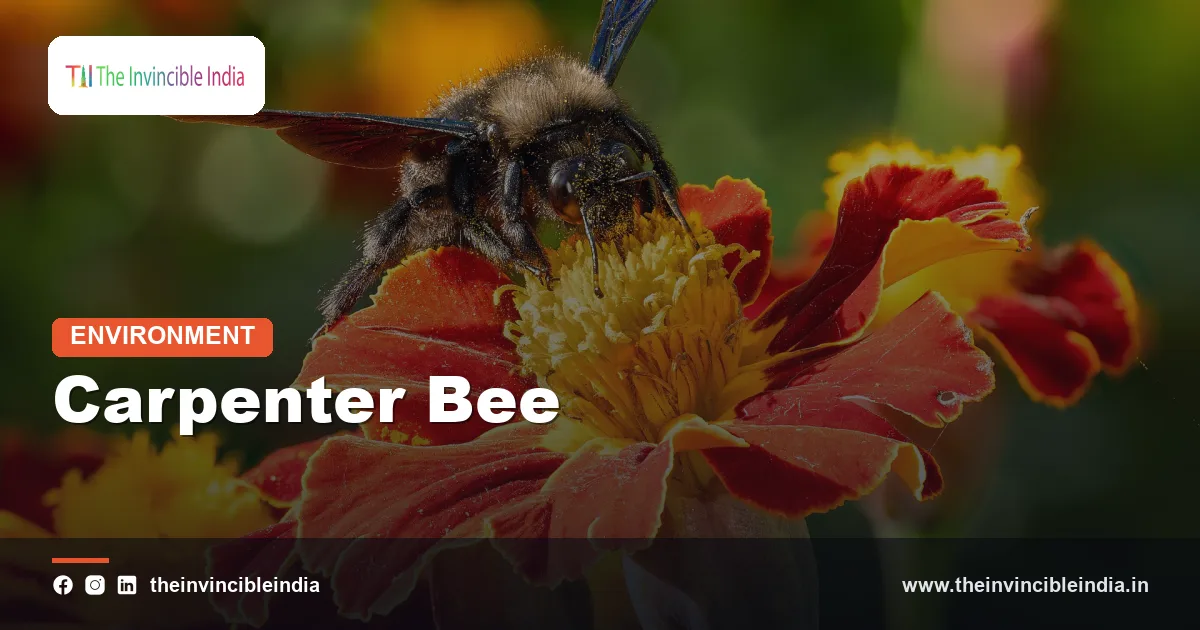
The carpenter bee is a large, shiny black bee of the genus Xylocopa that bores round tunnels into dead wood or bamboo to build its nest, and in India it is the big, loudly buzzing “bhanwra” often seen hovering around flowers and wooden beams. The carpenter bee is harmless to people in practice, does not form a swarm, and is a valuable pollinator, especially of flowers that need a vigorous shake to release their pollen.
Many Indians notice carpenter bees because of their size, their deep drone and the neat holes and fine sawdust they leave on old wooden doors, rafters and bamboo poles. This explainer covers what the carpenter bee is, how it differs from honey bees and bumblebees, how it nests, whether it stings, why it is useful, and what to do if it takes an interest in the woodwork of a house. Last updated: 23 October 2026.
| Quick Facts | Details |
|---|---|
| Common name | Carpenter bee; often called bhanwra in Hindi for large black bees |
| Genus and family | Xylocopa, in the bee family Apidae (subfamily Xylocopinae) |
| Number of species | Around 500 species worldwide; several species recorded across India |
| Appearance | Large, stout, glossy black body, often with a metallic blue or violet sheen on the wings |
| Typical size | Commonly about 2 to 3 centimetres long, among the largest bees in India |
| Nesting | Tunnels bored into dead wood, bamboo or dry stems; mostly solitary |
| Diet | Nectar and pollen from flowers; larvae fed pollen and nectar loaf |
| Key ecological role | Pollinator, including buzz pollination of tomato, brinjal and passion fruit |
| Danger to people | Low; males cannot sting and females sting only if grabbed or crushed |
Key Takeaways
- The carpenter bee (genus Xylocopa) is a large, shiny black bee that nests by boring tunnels in dead wood and bamboo rather than building a hive.
- Carpenter bees are usually solitary, with each female digging and provisioning her own nest, and they do not produce honey.
- Male carpenter bees have no stinger, and females sting only when handled or threatened, which makes the carpenter bee one of the least dangerous large bees.
- Carpenter bees perform buzz pollination, vibrating flowers to release pollen that honey bees cannot easily collect, which benefits crops such as tomato, brinjal and passion fruit.
- Carpenter bees chew wood to make a nest but do not eat it, so the damage is cosmetic or minor unless the same wood is reused for many years.
- Carpenter bees are harmless and beneficial, and in most cases the best response is to live with them or simply protect exposed wood with paint or varnish.
What is a carpenter bee?
A carpenter bee is a large bee of the genus Xylocopa that digs nesting tunnels in wood, bamboo or hard plant stems; the name comes from this habit of “carpentry” rather than from any use of wood as food. Xylocopa is a worldwide group of roughly 500 species found in warm regions on every inhabited continent except the coldest parts.
In India, carpenter bees are most often noticed as big, blue-black, glossy insects that fly with a deep, slow drone. Their wings often shine violet or bluish in sunlight, and the body is stout with a smooth, shiny abdomen. Several Xylocopa species occur across the country, including forms commonly recorded as Xylocopa latipes, Xylocopa fenestrata and Xylocopa aestuans, and they range from the plains to the foothills.
Because the bee is large and black, people sometimes mistake it for a hornet or for a “black bumblebee”. It is neither. It is a true bee that feeds only on flowers, and its behaviour is far more peaceful than its appearance suggests.
How can you identify a carpenter bee in India?
You can identify a carpenter bee by its large size, its shiny, nearly hairless black abdomen, its violet-blue wing sheen and its habit of hovering near wood or flowers. It is noticeably bigger and glossier than a honey bee.
- Size: usually around 2 to 3 centimetres long, with a thick, rounded body.
- Abdomen: smooth, bare and shiny black, unlike the fuzzy abdomen of a bumblebee.
- Wings: dark, often with a purple, blue or coppery iridescence.
- Behaviour: hovers in place, darts after other insects, and visits large or deep flowers.
- Signs of nesting: a neat round hole in dry wood about as wide as a finger, with coarse yellowish sawdust below.
- Males and females: in many species males are lighter or more golden on the face or body and are more often seen hovering, while females are darker and do the digging.
The sound is a good clue. Carpenter bees produce a lower-pitched, more resonant hum than honey bees, and a visit to a flowering shrub often announces itself well before the bee is seen.
How is a carpenter bee different from a honey bee or bumblebee?
A carpenter bee differs from a honey bee and a bumblebee mainly in its shiny, bare abdomen, its mostly solitary nesting in wood, and its lack of a honey-producing colony. Honey bees and bumblebees live in social colonies, while the carpenter bee mostly lives alone.
| Feature | Carpenter bee | Honey bee | Bumblebee |
|---|---|---|---|
| Genus | Xylocopa | Apis | Bombus |
| Body | Large, glossy and nearly bare abdomen | Smaller, brownish and fuzzy-banded | Large, round, densely hairy |
| Nesting | Tunnel in dead wood or bamboo | Wax combs in cavities or open combs | Small nests in ground burrows or hollows |
| Social life | Mostly solitary, some loose family groups | Highly social colony | Small annual colony |
| Honey | None stored for humans | Yes, in quantity | Small stores only |
| Where common in India | Plains, towns, forests, foothills | Nearly everywhere | Mainly cooler hill regions |
Bumblebees are mostly an animal of the cooler Himalayan regions and other hills, so a big, shiny black bee in a plains town or city is almost certainly a carpenter bee.
How does a carpenter bee build its nest?
A carpenter bee builds its nest by chewing a circular entrance hole into dry, soft or weathered wood or bamboo, then tunnelling along the grain to make a gallery divided into separate chambers. The female does this alone, using her strong jaws.
The entrance hole is typically a neat circle, a little over a centimetre across, and it often runs inward and then turns to follow the grain of the wood. Along the tunnel the female builds a row of brood cells. In each cell she places a ball of pollen mixed with nectar, lays one egg on it and seals the cell with a partition made of chewed wood pulp.
The egg hatches into a legless grub that feeds on the pollen loaf, grows, pupates and emerges as an adult after several weeks. Young adults often stay in the nest for a time and may feed one another before leaving. Nests are frequently reused and extended by later generations, which is why a favourite beam may collect several holes over the years.
Natural nesting sites include dead tree branches, dry bamboo and the flower stalks of plants such as agave. In towns, carpenter bees turn to unpainted wooden eaves, old doors, window frames, rafters and bamboo scaffolding because soft, dry, untreated wood is the easiest to excavate.
Do carpenter bees sting or bite?
Carpenter bees rarely sting; males cannot sting at all, and females sting only if they are caught, pinched or pressed against skin. In everyday encounters they are among the more docile large insects.
Male carpenter bees are the ones that often seem aggressive. They hover near the nest, dart at passing insects and even buzz close to a person’s head to chase away rivals. This is territorial display, not an attack, and because males have no stinger they are physically unable to hurt anyone.
Females do have a stinger, but they are busy foraging and nest-building and have no colony of honey to defend, so they have little reason to use it. A sting is possible if one is handled bare-handed or trapped in clothing, and as with any insect sting, anyone known to be allergic should seek medical help. The bee’s mandibles are used for wood, not for biting people.
Why is the carpenter bee important for pollination?
The carpenter bee is important for pollination because it is large, strong and able to perform buzz pollination, shaking pollen loose from flowers that hold it tightly in tube-like anthers. Many crops and wild plants depend on this skill.
In buzz pollination, also called sonication, the bee grips the flower and vibrates its flight muscles at a high frequency without moving its wings. The vibration shakes pollen out of the anthers. Honey bees cannot do this effectively, but carpenter bees and bumblebees can.
Plants that benefit include tomato, brinjal (eggplant), passion fruit and many wild shrubs and trees in the pea and cassia families. In passion fruit orchards in particular, carpenter bees are considered key pollinators, and growers in some regions place nesting logs or bamboo to attract them.
Carpenter bees also visit large flowers that smaller bees struggle with, and they forage in conditions that deter other bees, such as early mornings and cooler or overcast weather. Because they live alone and travel widely, they help carry pollen between scattered plants in gardens, scrub and forest edges.
What do carpenter bees eat?
Carpenter bees eat nectar for energy and pollen for protein, and their larvae are fed a mixture of pollen and nectar prepared by the mother. They do not eat wood and they do not make honey that people harvest.
Adults visit a wide range of flowers, including legumes, gourds, mallows, hibiscus-type flowers, cassia, and garden plants such as lantana and basil. Sometimes a carpenter bee cuts a small hole in the base of a deep flower to reach the nectar without entering the bloom, a habit known as nectar robbing. In such cases the flower may not be pollinated, but on balance the bee still contributes far more to pollination than it takes.
What is the life cycle of a carpenter bee?
The life cycle of a carpenter bee has four stages, egg, larva, pupa and adult, and the whole development inside the nest takes roughly a few months depending on temperature. Adults can live for more than a year, which is unusually long for a bee.
- Egg: laid on a ball of pollen and nectar inside a sealed brood cell.
- Larva: a white, legless grub that feeds on the stored pollen loaf.
- Pupa: the stage in which the body is rebuilt into the adult form.
- Adult: emerges, feeds, mates and, in females, starts new tunnels or reuses old ones.
In India, activity is highest in warm months and during the flowering seasons, and adults may shelter inside old nest tunnels in cold or dry spells. Some species show simple cooperation, with a few related females sharing one entrance while one guards the nest, but each female typically provisions her own cells.
Do carpenter bees damage wooden houses and furniture?
Carpenter bees can leave holes and dust in exposed wood, but they eat no wood and usually cause only minor damage, unlike termites, which actually consume timber. The tunnels are limited in number and length unless the same beam is used for many years.
Repeated reuse is where trouble can build up. When many generations tunnel into the same softwood rafter or bamboo post, galleries may weaken it over time, and woodpeckers sometimes tear into nests to feed on the grubs, causing more visible damage. Most homeowners, however, notice only a few neat round holes and a sprinkling of sawdust.
It is worth knowing the difference between the pests. Termites leave mud tubes and hollow the wood from within, while powderpost beetles leave tiny pinholes with fine flour-like dust. Carpenter bee holes are larger and perfectly round, and the insect making them is a large, noisy bee, not a small, hidden one.
How can you keep carpenter bees away from wood without harming them?
You can keep carpenter bees away from wood by painting, varnishing or sealing exposed surfaces and filling old holes once the bees have left, since the bees prefer bare, untreated, weathered wood. Prevention is more effective and kinder than spraying.
- Paint or varnish exposed wooden eaves, beams, door frames and fences, because bees avoid treated surfaces.
- Choose harder or well-seasoned timber for outdoor structures where possible.
- Fill unused holes with putty or wood filler only after confirming the bee is gone, usually in the evening or in the off-season.
- Offer an alternative by leaving an old log, dead branch or bamboo pole in a corner of the garden as a nesting site.
- Avoid swatting or crushing the bees, since this is the situation most likely to provoke a defensive sting.
Heavy chemical spraying is unnecessary and counterproductive, because it harms other pollinators and wildlife along with the bee. For a persistent problem in a valuable timber structure, a pest-control professional can advise on measures that target only the nest.
Are carpenter bees declining and how can people help them?
Carpenter bees are not known to be in broad decline in India, but they face the same pressures as other pollinators, including habitat loss, pesticide exposure and the removal of dead wood from gardens and farms. Small actions can sustain local populations.
Because the carpenter bee depends on dead wood for nesting, tidy-minded removal of every old stump or dry stem reduces its options. Leaving some deadwood, planting flowers that bloom across the year and reducing insecticide use all help. Planting a mix of flowering shrubs, legumes, herbs and trees gives these bees a steady food supply.
Schools, farms and gardens can also teach people to recognise the bee. A pollinator that looks fearsome but is actually gentle makes a good example of how appearance can mislead, and a better understanding encourages tolerance rather than fear.
Bottom Line
The carpenter bee is a large, shiny, mostly solitary bee that nests in dead wood and bamboo, feeds only on nectar and pollen, and pollinates crops and wild plants with its buzzing technique. It is far less dangerous than it looks, males cannot sting at all, and protecting wood with paint or varnish is usually enough to keep a house from becoming a nesting site.
Frequently Asked Questions
Is the carpenter bee dangerous to humans?
No, the carpenter bee is not dangerous to humans in normal circumstances. Males have no stinger, and females sting only if they are handled or trapped. The loud, hovering males can look threatening but are harmless.
Do carpenter bees eat wood?
No, carpenter bees do not eat wood; they chew it only to make tunnels for nesting. They feed on nectar and pollen from flowers, and the sawdust seen under nest holes is simply the waste from their tunnelling. This is the key difference between carpenter bees and termites.
What is a carpenter bee called in Hindi?
The large black carpenter bee is commonly called bhanwra in Hindi, a word also used loosely for other large black bees. Regional languages have their own names, and many people use the English name. The same word can refer to more than one kind of bee, so the context matters.
How is a carpenter bee different from a bumblebee?
A carpenter bee has a smooth, shiny, nearly hairless black abdomen, while a bumblebee has a round, densely furry body with coloured bands. Carpenter bees nest in tunnels bored into wood, while bumblebees live in small colonies in the ground or hollows. Bumblebees are mainly found in cooler hill regions of India.
Why do carpenter bees make holes in my house?
Carpenter bees make holes in houses because exposed, dry and untreated wood is easy to excavate for a nest. A single female tunnels a round entrance and a gallery for her eggs. Painting or varnishing the wood is the simplest way to discourage nesting.
Are carpenter bees good for the garden and farms?
Yes, carpenter bees are good for gardens and farms because they are strong pollinators. They use buzz pollination to release pollen from flowers like tomato, brinjal and passion fruit, which many other bees cannot do. Leaving a little dead wood or bamboo for nesting helps keep them around.
{“@context”:”https://schema.org”,”@graph”:[{“@type”:”FAQPage”,”mainEntity”:[{“@type”:”Question”,”name”:”Is the carpenter bee dangerous to humans?”,”acceptedAnswer”:{“@type”:”Answer”,”text”:”No, the carpenter bee is not dangerous to humans in normal circumstances. Males have no stinger, and females sting only if they are handled or trapped. The loud, hovering males can look threatening but are harmless.”}},{“@type”:”Question”,”name”:”Do carpenter bees eat wood?”,”acceptedAnswer”:{“@type”:”Answer”,”text”:”No, carpenter bees do not eat wood; they chew it only to make tunnels for nesting. They feed on nectar and pollen from flowers, and the sawdust seen under nest holes is simply the waste from their tunnelling. This is the key difference between carpenter bees and termites.”}},{“@type”:”Question”,”name”:”What is a carpenter bee called in Hindi?”,”acceptedAnswer”:{“@type”:”Answer”,”text”:”The large black carpenter bee is commonly called bhanwra in Hindi, a word also used loosely for other large black bees. Regional languages have their own names, and many people use the English name. The same word can refer to more than one kind of bee, so the context matters.”}},{“@type”:”Question”,”name”:”How is a carpenter bee different from a bumblebee?”,”acceptedAnswer”:{“@type”:”Answer”,”text”:”A carpenter bee has a smooth, shiny, nearly hairless black abdomen, while a bumblebee has a round, densely furry body with coloured bands. Carpenter bees nest in tunnels bored into wood, while bumblebees live in small colonies in the ground or hollows. Bumblebees are mainly found in cooler hill regions of India.”}},{“@type”:”Question”,”name”:”Why do carpenter bees make holes in my house?”,”acceptedAnswer”:{“@type”:”Answer”,”text”:”Carpenter bees make holes in houses because exposed, dry and untreated wood is easy to excavate for a nest. A single female tunnels a round entrance and a gallery for her eggs. Painting or varnishing the wood is the simplest way to discourage nesting.”}},{“@type”:”Question”,”name”:”Are carpenter bees good for the garden and farms?”,”acceptedAnswer”:{“@type”:”Answer”,”text”:”Yes, carpenter bees are good for gardens and farms because they are strong pollinators. They use buzz pollination to release pollen from flowers like tomato, brinjal and passion fruit, which many other bees cannot do. Leaving a little dead wood or bamboo for nesting helps keep them around.”}}]}]}


