

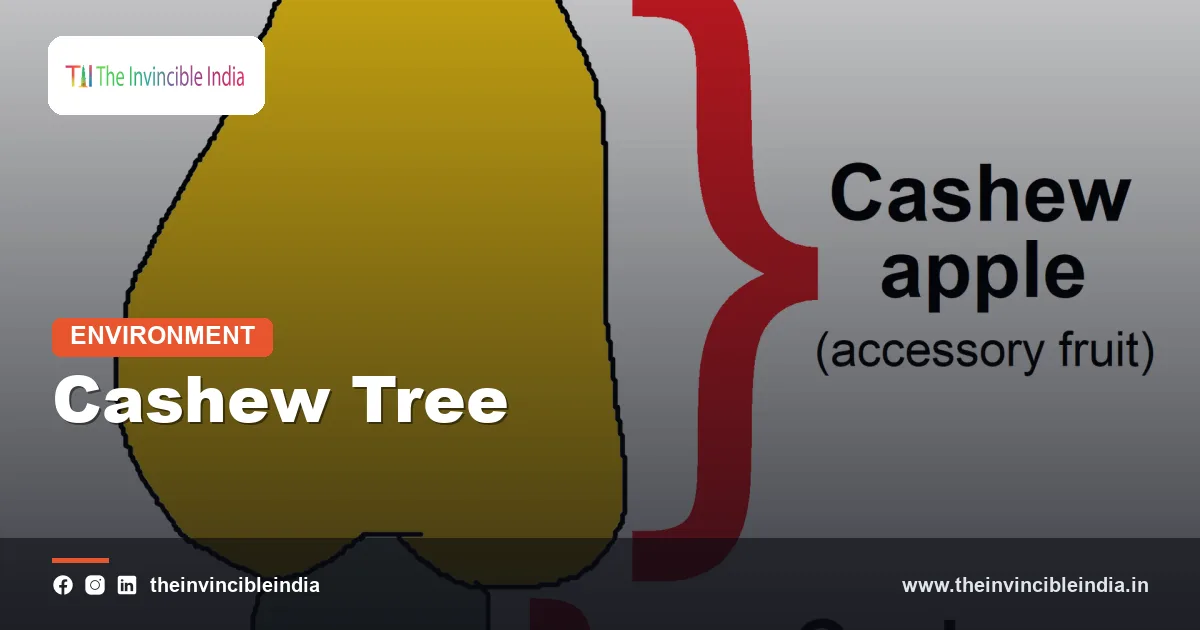
The cashew tree is an evergreen tropical tree (Anacardium occidentale) that bears the cashew nut, a kidney-shaped seed hanging from the end of a swollen, fleshy, juicy stalk known as the cashew apple. In India, the cashew tree is grown mainly along the coast, from the Konkan and Goa down through Karnataka and Kerala and across to Odisha and Andhra Pradesh, and it supports a large processing industry.
The tree is not native to India. It arrived from Brazil with Portuguese traders in the sixteenth century and spread so successfully that India became one of the world’s major cashew growers, processors and consumers. This article explains what the cashew tree is, why the cashew apple and the nut are different things, where the tree grows in India, how raw nuts become the kernels sold in shops, and why handling cashew shells needs care.
| Attribute | Detail |
|---|---|
| Scientific name | Anacardium occidentale |
| Family | Anacardiaceae (the sumac or mango family) |
| Native region | Northeastern Brazil; introduced to India by the Portuguese in the 1500s |
| Where grown in India | Maharashtra (Konkan), Goa, Karnataka, Kerala, Andhra Pradesh, Odisha, Tamil Nadu, West Bengal and Chhattisgarh |
| Season | Flowers mainly from November to February; nuts are harvested roughly from February to May |
| Parts used | Kernel (the nut), cashew apple, shell oil and wood |
| Products and uses | Edible kernels, cashew apple juice and the Goan spirit feni, cashew nut shell liquid (CNSL), shell cake |
| Importance | A major coastal cash crop and the base of a large processing and export industry |
Key Takeaways
- The cashew tree, Anacardium occidentale, belongs to the same plant family (Anacardiaceae) as the mango and the poison ivy group.
- The cashew nut is the true fruit of the cashew tree, while the fleshy cashew apple above it is an enlarged stalk, botanically a false fruit.
- Portuguese traders brought the cashew tree from Brazil to the Goa region in the sixteenth century, partly to control soil erosion on the coast.
- The shell of a raw cashew contains a caustic oil, cashew nut shell liquid (CNSL), which can burn skin, so raw cashews are never eaten unprocessed.
- Feni, a spirit distilled from cashew apples, carries a Geographical Indication (GI) tag as a traditional Goan drink.
- Cashew kernels are graded by size and whiteness, with grades such as W-320, W-240 and W-180 indicating whole white kernels and the approximate number per pound.
What is the cashew tree?
The cashew tree is a spreading, evergreen tropical tree that usually grows 8 to 12 metres tall and bears clusters of small pinkish flowers followed by the cashew apple and nut. Its leaves are glossy, leathery and oval, and its crown is broad and low-branched, often forming a dense dome that gives good shade.
The cashew tree belongs to Anacardiaceae, a family that also includes the mango, pistachio and sumac. Members of the family often contain resinous or irritating compounds, which explains why cashew shells are hazardous to handle. The generic name Anacardium is generally linked to the heart-like shape of the fruit’s stalk end, and the common name cashew comes from a Portuguese word derived from an indigenous Brazilian term.
The tree is hardy. It tolerates poor, sandy or laterite soil, some drought and coastal winds, and it can fruit on land where many other crops struggle. That toughness is a key reason it spread across so much of India’s coastline and into wastelands and hill slopes.
Is the cashew a nut or a fruit?
The cashew is a seed, and the part people call the nut is the true fruit of the cashew tree, while the fleshy cashew apple is an accessory fruit formed from the swollen flower stalk. The kidney-shaped nut hangs below the apple, outside it, which is unusual among fruits.
Botanically, the nut is a drupe containing a single seed, the kernel. The shell around the kernel has three layers, and the middle layer is honeycombed with the caustic oil. The apple, by contrast, is soft, juicy, thin-skinned and usually red, yellow or orange, with a distinctive sweet and astringent taste.
Cooks and traders treat the cashew as a tree nut, and in the kitchen the kernel is used like other nuts. Culinary and botanical language differ in many foods, and the cashew is a clear example of that gap.
How did the cashew tree reach India?
The cashew tree reached India from Brazil through Portuguese traders, who introduced it to the Goa region in the sixteenth century. It was initially planted to hold soil on coastal slopes and to provide fruit, and only later became a significant commercial crop.
From Goa, the tree spread along the western coast through the Konkan and into Karnataka and Kerala, and later across to the eastern coast. Farmers learned to value both the apple and the nut. By the twentieth century cashew processing had become a major industry, and Kerala, especially around Kollam, grew into a well-known centre for shelling and kernel processing.
Government agencies and research institutions helped the crop spread. The Indian Council of Agricultural Research runs a dedicated cashew research directorate at Puttur in Karnataka, and agricultural universities in Maharashtra, Kerala and other states have developed improved varieties. Forest departments in several states also planted cashew on wastelands and coastal sands.
Where is the cashew tree grown in India?
The cashew tree is grown mainly in the coastal and peninsular states of India, including Maharashtra, Andhra Pradesh, Odisha, Kerala, Karnataka, Goa and Tamil Nadu, with smaller areas in West Bengal and Chhattisgarh. The crop thrives in warm, humid regions with a pronounced dry season.
- Konkan and Goa: hillsides and laterite plateaus across Sindhudurg, Ratnagiri and Goa are covered with cashew orchards, and the apple is used for feni.
- Karnataka coast: districts such as Dakshina Kannada and Uttara Kannada grow cashew along the Western Ghats foothills.
- Kerala: cashew is grown in the northern districts, while Kollam in the south is historically the processing hub.
- Andhra Pradesh and Odisha: large plantations on the eastern coast and uplands, often planted by state corporations and farmers on sandy and laterite soils.
- Tamil Nadu: mainly in the coastal and Cuddalore belt.
India is one of the leading cashew-producing countries and also one of the largest processors. Domestic production does not meet the needs of its processing industry, so India imports a large quantity of raw cashew nuts, mostly from African countries, to be shelled and processed in Indian factories. Exact production and import figures change each year, so current numbers should be taken from the Cashew Export Promotion Council of India or government sources.
What climate and soil does the cashew tree need?
The cashew tree needs a warm tropical climate with temperatures roughly between 20 and 35 degrees Celsius, a distinct dry spell for flowering and moderate annual rainfall. It grows well from sea level to a few hundred metres, and does best on well-drained sandy, red or laterite soils.
Cashew does poorly in waterlogged ground or where frost occurs. Heavy rain during flowering washes away pollen and promotes fungal diseases, so a dry, sunny winter is important. Mist and cloud during flowering can reduce fruit set.
The tree’s deep taproot and wide-spreading lateral roots let it tap moisture in poor ground. Farmers value it as a crop for marginal land, where it also protects against erosion by binding soil and shedding leaves that build organic matter.
How does the cashew tree grow and bear fruit?
A cashew tree grown from a grafted seedling usually begins to bear fruit in about three years and reaches full production by around ten years, and then continues yielding for decades. Seedling trees take longer and vary more in quality, so commercial orchards now favour grafted or selected varieties.
The tree carries both male and hermaphrodite flowers on the same panicle. Pollination is done mainly by insects, including bees, flies and ants. After fertilisation, the nut forms first as a small green kidney-shaped fruit, and the stalk above it swells over the next two months into the apple. The nut matures to grey-green and the apple turns yellow or red.
When the nut is ripe, both fall to the ground. Farmers collect the fallen fruit, separate the nut from the apple by twisting or cutting, and spread the nuts in the sun to dry. Sun drying reduces moisture so that the raw nuts can be stored for months before processing.
What is the cashew apple and how is it used?
The cashew apple is the juicy, fibrous, pear-shaped stalk that sits above the cashew nut, and it is eaten fresh, juiced, preserved or fermented, though it spoils within a day or two after picking. It is rich in vitamin C, with a sharp, sweet-astringent flavour that some find puckering.
Most cashew apples in India go unused in many regions, because the nut is the economic product and the apple is perishable and hard to transport. In Goa and parts of the Konkan, however, the apple is an important local resource.
- Feni: the apple’s juice is fermented and distilled to make cashew feni, a traditional Goan liquor that holds a Geographical Indication tag. It is usually distilled twice, sometimes in traditional clay pots.
- Juice, syrup and jam: the astringency is reduced by steaming or treating the apple, and the juice is made into drinks, jams and candied fruit.
- Curries and pickles: in coastal households, the apple can be cooked in vegetable dishes or pickled.
- Animal feed: pressed apple residue is occasionally used for fodder.
Research on cashew apple products has been going on for years, and food technologists argue that better collection and processing could add income for orchard owners.
How is a raw cashew turned into the nut we eat?
A raw cashew is turned into an edible kernel by drying, heating to soften the shell, cutting the shell open, drying again, peeling off the thin brown skin and grading the kernels by size and colour. The process removes the caustic shell oil and has to be done carefully because the oil harms skin.
- Drying and storage: raw nuts are sun dried and stored until processing begins.
- Heating: nuts are steamed or roasted so the shell becomes brittle and the oil drains or loosens. Modern factories commonly use steam, while older methods used open roasting or oil baths.
- Shelling: the nuts are cut open by hand-operated or mechanical shellers. In India, shelling has long been largely manual and has employed many women workers.
- Drying and peeling: the kernels are dried in an oven to loosen the thin brown testa, which is then peeled off by hand or machine.
- Grading and packing: kernels are sorted by size, shape and colour and packed, often in vacuum or carbon-dioxide-flushed tins to preserve freshness.
The Indian trade uses a grading code in which W stands for white whole kernels and the number gives the approximate count per pound. W-180 and W-210 are larger, premium kernels, W-320 is the most common general-purpose grade, and smaller grades such as W-450 are sold at lower prices. Broken pieces, called splits or butts, are sold for confectionery and cooking.
Why are raw cashew shells dangerous?
Raw cashew shells are dangerous because the honeycomb layer inside contains cashew nut shell liquid (CNSL), a caustic oil rich in anacardic acid and cardol that causes blisters and skin irritation in contact. This is the reason raw cashews are never sold in their shells like peanuts.
The same chemistry connects the cashew to its relatives. Poison ivy and poison sumac also belong to the plant family Anacardiaceae, and their rash-causing oil, urushiol, is chemically similar to the compounds in CNSL. Workers in traditional shelling units used to suffer skin damage, which is why gloves, ash and better equipment became important.
CNSL is not waste. It is a valuable industrial material used in brake linings, paints, varnishes, resins and insulating coatings, and it is a recognised by-product of the cashew industry. After the oil is drawn out, the remaining shell cake can be burnt as fuel in the factory’s furnaces.
What are the uses and health value of cashew?
Cashew kernels are eaten raw, roasted, salted or ground and are used in Indian sweets, curries, gravies and snacks, while the apple, shell oil and wood serve other purposes. Kernels are energy dense and contain fat, protein, minerals such as magnesium, copper and zinc, and small amounts of fibre.
- Sweets and snacks: kaju katli, a diamond-shaped cashew sweet, is among India’s most familiar festive mithai.
- Gravies: a paste of soaked cashews thickens and enriches many north Indian curries such as korma and shahi dishes.
- Dairy-free uses: blended cashews are used to make plant-based milks and creams.
- Industrial uses: CNSL is used in friction linings, coatings and resins.
- Wood and gum: cashew wood is used as fuel, and the tree exudes a gum that can be used as an adhesive.
Cashew is a tree nut, so it can trigger allergies in sensitive people. As with all calorie-dense snacks, moderation matters. Anyone with a nut allergy or a medical condition should follow the advice of a doctor.
What are the challenges facing the cashew industry?
The main challenges facing India’s cashew industry are low orchard productivity, dependence on imported raw nuts, ageing plantations, climate-related risks such as unseasonal rain and pests, and the need for better working conditions in processing. Many orchards are old seedling trees that yield less than modern grafted varieties.
The tea mosquito bug is a well-known pest of cashew in India, damaging young shoots, flowers and nuts. Stem and root borer attacks can kill trees. Rain during flowering can sharply reduce the crop, as can extreme heat.
The industry has also been working on mechanisation, better shelling equipment and safer workplaces, as well as on fair pricing for farmers and use of the cashew apple. Replanting with high-yielding varieties, better pruning and pest management, and better use of by-products are the paths most often suggested for raising returns.
Bottom Line
The cashew tree turned a Brazilian import into a coastal Indian livelihood, giving the country a nut, a fruit, a spirit and an industrial oil from a single hardy tree. Its future rests on renewing old orchards, protecting yields from pests and weather, and making use of everything the tree gives.
Frequently Asked Questions
Is the cashew a fruit or a nut?
The cashew nut is botanically the true fruit of the cashew tree, a single-seeded drupe, while the fleshy cashew apple above it is an accessory fruit formed from the swollen stalk. In cooking, the kernel is treated as a tree nut. The nut hangs outside the apple, which is unusual among fruits.
Where is the cashew tree grown in India?
The cashew tree is grown mainly along India’s coastline, in states such as Maharashtra, Andhra Pradesh, Odisha, Kerala, Karnataka, Goa and Tamil Nadu. The Konkan and Goa belt is famous for cashew orchards and for feni. Kerala, particularly the Kollam area, is a long-standing centre of cashew processing.
Who brought the cashew tree to India?
Portuguese traders brought the cashew tree to India from Brazil in the sixteenth century, planting it first in the Goa region. They used it partly to hold soil on coastal slopes. It later spread along the west and east coasts and became a major commercial crop.
Why can’t we eat raw cashews in the shell?
Cashew shells contain cashew nut shell liquid, a caustic oil that can blister skin and irritate the mouth. The shell must be heated and cut open with care, and the kernel peeled, before it is safe to eat. What are sold as raw cashews in shops have already been shelled and processed to remove this oil.
What is feni made from?
Feni is a traditional Goan spirit made from the fermented and distilled juice of the cashew apple, though a coconut-sap version also exists in Goa. The cashew version has a Geographical Indication tag. The apples are crushed, the juice fermented and the liquor distilled, traditionally twice.
What do W-320 and W-240 mean on cashew packs?
W-320 and W-240 are trade grades for whole white cashew kernels, where W stands for white and the number is roughly the count of kernels in a pound. A lower number means larger kernels, so W-240 kernels are bigger and usually costlier than W-320. W-320 is the most widely traded grade.
{“@context”:”https://schema.org”,”@graph”:[{“@type”:”FAQPage”,”mainEntity”:[{“@type”:”Question”,”name”:”Is the cashew a fruit or a nut?”,”acceptedAnswer”:{“@type”:”Answer”,”text”:”The cashew nut is botanically the true fruit of the cashew tree, a single-seeded drupe, while the fleshy cashew apple above it is an accessory fruit formed from the swollen stalk. In cooking, the kernel is treated as a tree nut. The nut hangs outside the apple, which is unusual among fruits.”}},{“@type”:”Question”,”name”:”Where is the cashew tree grown in India?”,”acceptedAnswer”:{“@type”:”Answer”,”text”:”The cashew tree is grown mainly along India’s coastline, in states such as Maharashtra, Andhra Pradesh, Odisha, Kerala, Karnataka, Goa and Tamil Nadu. The Konkan and Goa belt is famous for cashew orchards and for feni. Kerala, particularly the Kollam area, is a long-standing centre of cashew processing.”}},{“@type”:”Question”,”name”:”Who brought the cashew tree to India?”,”acceptedAnswer”:{“@type”:”Answer”,”text”:”Portuguese traders brought the cashew tree to India from Brazil in the sixteenth century, planting it first in the Goa region. They used it partly to hold soil on coastal slopes. It later spread along the west and east coasts and became a major commercial crop.”}},{“@type”:”Question”,”name”:”Why can’t we eat raw cashews in the shell?”,”acceptedAnswer”:{“@type”:”Answer”,”text”:”Cashew shells contain cashew nut shell liquid, a caustic oil that can blister skin and irritate the mouth. The shell must be heated and cut open with care, and the kernel peeled, before it is safe to eat. What are sold as raw cashews in shops have already been shelled and processed to remove this oil.”}},{“@type”:”Question”,”name”:”What is feni made from?”,”acceptedAnswer”:{“@type”:”Answer”,”text”:”Feni is a traditional Goan spirit made from the fermented and distilled juice of the cashew apple, though a coconut-sap version also exists in Goa. The cashew version has a Geographical Indication tag. The apples are crushed, the juice fermented and the liquor distilled, traditionally twice.”}},{“@type”:”Question”,”name”:”What do W-320 and W-240 mean on cashew packs?”,”acceptedAnswer”:{“@type”:”Answer”,”text”:”W-320 and W-240 are trade grades for whole white cashew kernels, where W stands for white and the number is roughly the count of kernels in a pound. A lower number means larger kernels, so W-240 kernels are bigger and usually costlier than W-320. W-320 is the most widely traded grade.”}}]}]}


