

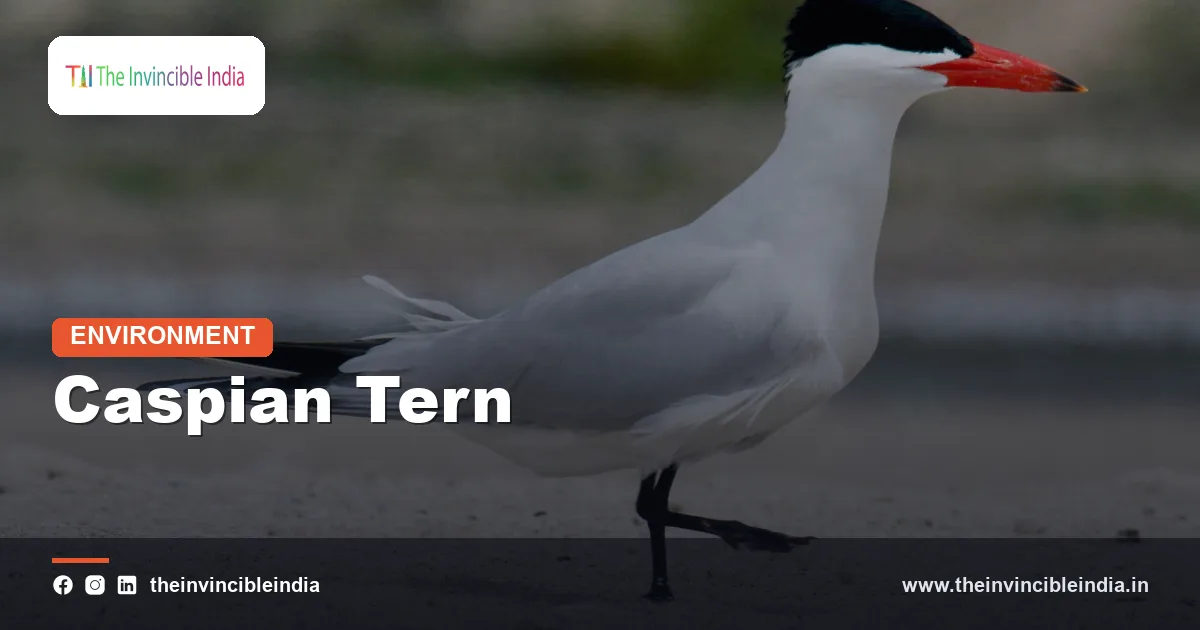
The Caspian tern (Hydroprogne caspia) is the largest tern in the world, a gull-sized white-and-grey waterbird with a black cap, a heavy red-orange bill and a habit of plunge-diving for fish, and it can be seen along Indian coasts, estuaries, rivers and large reservoirs. Because it is so big and so distinctive, the Caspian tern is often the easiest tern to pick out from a mixed flock of waterbirds on a mudflat or sandbar.
This article explains what the Caspian tern is, how to identify it, where it occurs in India, what it eats and how it hunts, how it breeds and how it differs from similar terns and gulls. It also looks at the bird’s global range, its conservation status and the best ways to watch it.
| Common name | Caspian tern |
|---|---|
| Scientific name | Hydroprogne caspia (the only species in its genus) |
| Family | Laridae (gulls, terns and skimmers, with terns often placed in the subfamily Sterninae) |
| Size | About 47 to 54 cm long, with a wingspan of roughly 130 to 145 cm |
| Range in India | Coasts, estuaries, lagoons, large rivers and big lakes and reservoirs; mostly non-breeding visitors, with local breeding |
| Habitat | Sandy and muddy shores, sandbars, tidal creeks, saltpans, reservoirs and open fresh or brackish water |
| Diet | Mainly fish caught by plunge-diving; occasionally crustaceans and eggs or chicks of other birds |
| Breeding | Nests in colonies on bare islands, sandbars and beaches, laying a few eggs in a shallow scrape |
| Conservation status | Least Concern on the IUCN Red List, with a very large global range |
Key Takeaways
- The Caspian tern is the largest tern in the world, roughly the size of a large gull, with a wingspan of well over a metre.
- An adult Caspian tern has a thick red-orange bill with a dark tip, a black cap, pale grey upperparts and black legs.
- The Caspian tern feeds almost entirely on fish, which it catches by hovering and plunge-diving into the water head first.
- The Caspian tern occurs on Indian coasts, estuaries, large rivers and reservoirs, and most birds seen in India are non-breeding visitors.
- The Caspian tern gives a deep, harsh, croaking call that is quite unlike the high-pitched notes of smaller terns.
- The Caspian tern is classified as Least Concern because it breeds on every continent except Antarctica and South America, though local colonies can be disturbed.
What is the Caspian tern?
The Caspian tern is a large waterbird in the gull and tern family, Laridae, and it is the biggest of all the terns. It belongs to the genus Hydroprogne, a name that combines Greek words for water and a swallow, and it is the sole species in that genus.
Terns are slender, long-winged seabirds that hunt mainly by diving for fish. Most terns are small and elegant, but the Caspian tern is heavy and broad-winged, with a large head and a thick bill. In flight its wingbeats are slower and more gull-like than those of smaller terns. The species name “caspia” refers to the Caspian Sea, from where the bird was first described, although the species ranges far beyond that region.
The Caspian tern is found across a very large part of the world, including Eurasia, Africa, Australasia and North America. This wide distribution is one reason why the bird can be seen in many different habitats, from sea coasts to inland lakes.
How do you identify a Caspian tern?
A Caspian tern can be identified by its very large size, a thick red-orange bill with a dark tip, a black cap, pale grey back and wings, white underparts and black legs. When it flies, the dark underside of the outer wing tips contrasts with the otherwise pale wings and helps to separate it from gulls and smaller terns.
The main field marks are as follows.
- Bill: massive, straight and bright red to orange-red, usually with a dusky tip. No other tern in India has such a heavy, brightly coloured bill.
- Cap: solid black in the breeding season; in other months it becomes streaked with white, so the bird looks white-faced with a dark smudge behind the eye.
- Upperparts: pale silvery grey.
- Underparts: clean white.
- Tail: short and only slightly forked, much less deeply cut than the tails of many other terns.
- Legs: black and fairly short.
- Underwing: a dark band along the outer primary feathers, visible from below.
Males and females look alike. Juveniles have a paler orange or yellowish bill, scaly brown markings on the back and a more mottled head. The size of the bird is often the first clue, because beside a gull-billed tern or a common tern a Caspian tern looks like a different class of bird.
Where is the Caspian tern found in India?
The Caspian tern is found in India along the coast, in estuaries and creeks, around saltpans and lagoons, and on large rivers, lakes and reservoirs inland. Most records are of non-breeding birds that arrive in the cooler months, although small numbers are present at other times of year.
It tends to be seen resting on sandbars, mudflats and the shores of large water bodies, often at some distance from people, or flying low over the water searching for fish. Coastal states with extensive tidal flats, such as Gujarat, Maharashtra, Goa, Kerala, Tamil Nadu, Andhra Pradesh, Odisha and West Bengal, offer many opportunities to see it, and large inland reservoirs and river stretches can also hold individual birds.
A Caspian tern often associates with other waterbirds. It may be seen on the same sandbar as gulls, other terns, waders and pelicans, standing slightly apart because of its size. Because it is a wide-ranging flier, the same bird may appear on a river one day and on the coast the next.
What does the Caspian tern eat and how does it hunt?
The Caspian tern eats mainly fish, which it catches by flying over the water, spotting prey from a height and plunging head first into the surface. It occasionally also takes crustaceans, large insects and, in colonies, the eggs and chicks of other birds.
The hunting method is distinctive. The bird flies slowly with its head and bill pointed downwards, often 5 to 15 metres above the water, and pauses to hover when it sees a fish. It then folds its wings and dives, usually going fully or partly under the surface, before bursting back out with a fish held crosswise in its bill. Compared with small terns, which dive with quick, light movements, the Caspian tern makes bigger and heavier plunges.
The prey is mostly small to medium surface-dwelling fish, in sizes that the bird can swallow or carry in its large bill. Foraging birds favour calm, clear and shallow water such as lagoons, creeks and the edges of reservoirs. In breeding colonies, adults carry fish back to the nest to feed their chicks, and may fly several kilometres each way to do so.
Because the Caspian tern is a visual hunter, turbid or heavily polluted water can reduce its success. This makes its presence a minor indicator of reasonably clear water with healthy fish populations.
What does the Caspian tern sound like?
The Caspian tern has a deep, harsh, rasping call, often written as “kraah” or “kaaw”, that is much lower and louder than the high-pitched calls of smaller terns. Birds give this call in flight, when disturbed and around colonies, and the sound often reveals the species before it is seen.
Calls help individuals keep in contact when feeding along a coast or river. In breeding colonies, adult birds use a range of croaks and cackles to defend nest sites, to greet partners and to find chicks. Young birds beg with a high, plaintive whistling call and follow their parents in the air for weeks after fledging, which is an unusual behaviour among terns.
How does the Caspian tern breed?
The Caspian tern breeds in colonies on bare ground, usually on islands, sandbars, shingle banks, beaches or similar open sites, where each pair makes a shallow scrape in sand or soil and lays a small clutch of eggs. Nesting on islands and sandbars helps to protect the eggs from land predators, although flooding and human disturbance remain risks.
The main points of its breeding biology are summarised below.
- Colony: dense groups of nesting pairs, often mixed with other terns and gulls.
- Nest: a simple depression in the ground, sometimes lined with shells, pebbles or bits of debris.
- Eggs: usually two or three, pale and spotted, incubated by both parents for a few weeks.
- Chicks: downy, mobile and fed by both parents, they leave the nest early and gather in groups called crèches.
- Fledging: young birds fly after about a month but depend on their parents for food for a long time afterwards.
In India, Caspian terns are mainly regarded as non-breeding visitors, although breeding has been recorded in a small number of places with undisturbed sandbars and islands. Most of the large breeding colonies of the species are in other parts of the world, in regions of Asia, Europe, Africa, North America and Australia.
How is the Caspian tern different from other terns and gulls?
The Caspian tern differs from other terns mainly in its much larger size and its massive red-orange bill, and it differs from gulls in its black cap, slender build and habit of plunge-diving. A comparison with some similar birds seen in India makes the contrast clear.
| Bird | Approximate length | Bill | Notable features |
|---|---|---|---|
| Caspian tern | 47 to 54 cm | Heavy, red-orange with dark tip | Largest tern, black cap, short tail with small fork, dark underside of wing tips |
| Greater crested (swift) tern | About 46 to 49 cm | Long, curved, yellow | Shaggy black crest, grey upperparts, deeply forked tail |
| Gull-billed tern | About 35 to 38 cm | Short, thick, black | Hawks over fields and marshes, does not usually dive |
| River tern | About 38 to 43 cm | Yellow, slightly drooping | Deeply forked tail, found on rivers and lakes |
| Pallas’s gull | About 57 to 61 cm | Yellow with a dark band near the tip | Gull shape, much larger, rounded tail, walks on the shore |
The simplest rule is that a tern with a big, bright red bill and a size close to a gull’s is almost certainly a Caspian tern. Terns with yellow or black bills are other species.
Is the Caspian tern threatened?
The Caspian tern is not threatened at the global level, and the IUCN lists it as Least Concern because it has an enormous range and a large total population. Individual colonies can nevertheless suffer from habitat loss and disturbance.
Threats to Caspian terns and their colonies include the following.
- Disturbance of nesting islands and sandbars by people, boats, vehicles and dogs.
- Loss of coastal and wetland habitat to construction, reclamation and port development.
- Pollution of coastal and inland waters, including oil, plastic and chemicals.
- Entanglement in fishing nets and lines.
- Predation of eggs and chicks by introduced animals in some regions.
Protecting undisturbed sandbars and islands, along with clean coastal and inland waters, supports the species and a large number of other waterbirds that share its habitat.
How can you watch Caspian terns?
The best way to watch a Caspian tern is to visit a coastal lagoon, estuary or large reservoir and scan sandbars and shallow water with binoculars or a telescope. Early morning and late afternoon give good light and often more feeding activity.
These simple practices improve the chances of a good sighting.
- Search the edges of mixed flocks of gulls and terns, where the large size makes the bird stand out.
- Listen for the low croaking call, especially when birds fly overhead.
- Watch open water for slow, low flight followed by a hover and a dive.
- Keep a safe distance from resting and nesting groups, because repeated flushing wastes energy.
- Note the bill colour and cap pattern in photographs, since these help confirm the species and the season.
Bottom Line
The Caspian tern is a large, powerful and unmistakable waterbird that can be seen on Indian coasts, rivers and reservoirs. With its heavy red bill, black cap and plunge-diving hunting style, it is one of the easiest terns to learn and a useful indicator of clean, undisturbed water.
Frequently Asked Questions
Why is the Caspian tern so large?
The Caspian tern is large because it has evolved to catch and carry fish bigger than those taken by small terns. It is the largest tern in the world, about the size of a gull, and its thick bill is suited to grasping larger prey.
How do I identify a Caspian tern in India?
A Caspian tern is identified by its large size, thick red-orange bill with a dark tip, black cap, pale grey back and black legs. In flight, the dark outer wing tips seen from below are a useful clue.
Where can I see Caspian terns in India?
Caspian terns can be seen on sandbars, mudflats, estuaries, lagoons and creeks along the coast, and on large rivers, lakes and reservoirs inland. Most records are of non-breeding birds present in the cooler months.
What does the Caspian tern eat?
The Caspian tern eats mainly fish, which it catches by hovering over the water and plunge-diving. It sometimes takes crustaceans or large insects, and in colonies may eat the eggs or chicks of other birds.
Does the Caspian tern breed in India?
The Caspian tern breeds only locally in India, and most birds seen in the country are non-breeding visitors. Where it does nest, it lays eggs in a shallow scrape on bare sandbars or islands, usually in colonies.
Is the Caspian tern endangered?
No, the Caspian tern is listed as Least Concern by the IUCN because it has a very large range and population. However, nesting colonies can be harmed by disturbance, habitat loss and pollution.
{“@context”:”https://schema.org”,”@graph”:[{“@type”:”FAQPage”,”mainEntity”:[{“@type”:”Question”,”name”:”Why is the Caspian tern so large?”,”acceptedAnswer”:{“@type”:”Answer”,”text”:”The Caspian tern is large because it has evolved to catch and carry fish bigger than those taken by small terns. It is the largest tern in the world, about the size of a gull, and its thick bill is suited to grasping larger prey.”}},{“@type”:”Question”,”name”:”How do I identify a Caspian tern in India?”,”acceptedAnswer”:{“@type”:”Answer”,”text”:”A Caspian tern is identified by its large size, thick red-orange bill with a dark tip, black cap, pale grey back and black legs. In flight, the dark outer wing tips seen from below are a useful clue.”}},{“@type”:”Question”,”name”:”Where can I see Caspian terns in India?”,”acceptedAnswer”:{“@type”:”Answer”,”text”:”Caspian terns can be seen on sandbars, mudflats, estuaries, lagoons and creeks along the coast, and on large rivers, lakes and reservoirs inland. Most records are of non-breeding birds present in the cooler months.”}},{“@type”:”Question”,”name”:”What does the Caspian tern eat?”,”acceptedAnswer”:{“@type”:”Answer”,”text”:”The Caspian tern eats mainly fish, which it catches by hovering over the water and plunge-diving. It sometimes takes crustaceans or large insects, and in colonies may eat the eggs or chicks of other birds.”}},{“@type”:”Question”,”name”:”Does the Caspian tern breed in India?”,”acceptedAnswer”:{“@type”:”Answer”,”text”:”The Caspian tern breeds only locally in India, and most birds seen in the country are non-breeding visitors. Where it does nest, it lays eggs in a shallow scrape on bare sandbars or islands, usually in colonies.”}},{“@type”:”Question”,”name”:”Is the Caspian tern endangered?”,”acceptedAnswer”:{“@type”:”Answer”,”text”:”No, the Caspian tern is listed as Least Concern by the IUCN because it has a very large range and population. However, nesting colonies can be harmed by disturbance, habitat loss and pollution.”}}]}]}


