

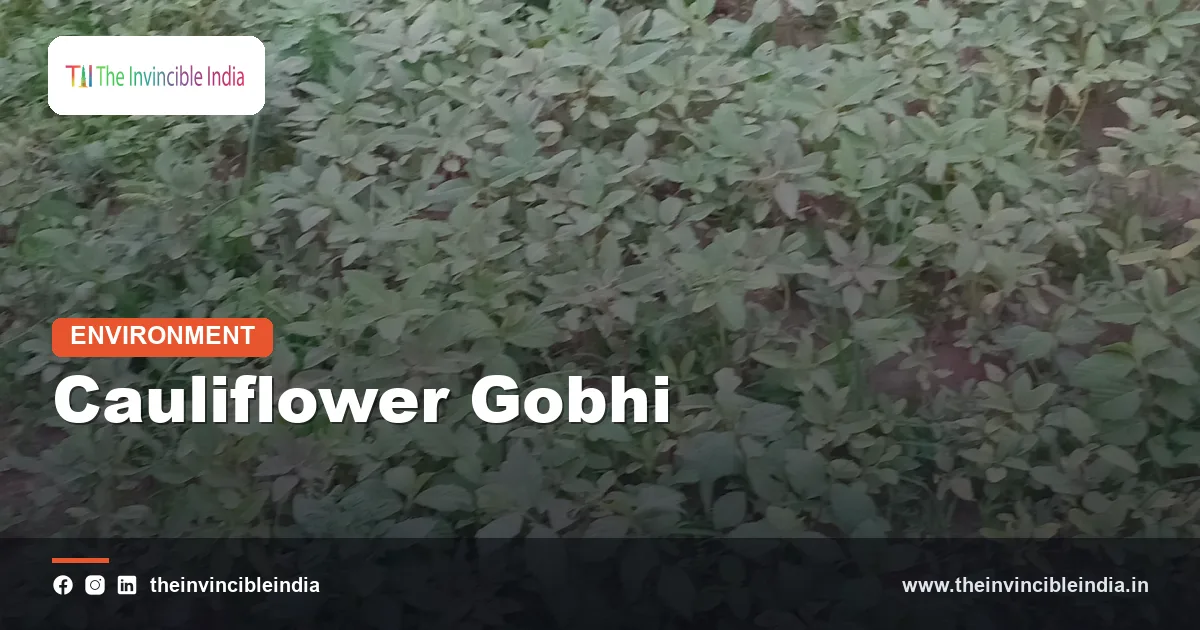
The cauliflower (Brassica oleracea var. botrytis), called gobhi in Hindi, is a cool-season vegetable of the mustard family, Brassicaceae, grown for its compact, white, edible flower head known as the curd. Cauliflower is a cultivated form of wild cabbage and a close cousin of cabbage, broccoli, kale and kohlrabi, and India is among the largest producers in the world, second only to China by most estimates. The vegetable is cooked in homes across the country, especially in the winter months.
This explainer sets out what cauliflower is, how the curd forms, which types are grown in India, where and when the crop is cultivated, which disorders and pests affect it, and how it is used in food. The facts given are stable botanical and agricultural points, and production figures are stated only as approximate, qualified ranges.
| Quick Facts: Cauliflower | |
|---|---|
| Common names | Cauliflower; gobhi or phool gobhi (Hindi) |
| Scientific name | Brassica oleracea var. botrytis |
| Family | Brassicaceae (mustard or cabbage family) |
| Origin | Developed from wild cabbage in the eastern Mediterranean region, with early selection in the Middle East and Europe |
| Where grown in India | Bihar, Uttar Pradesh, West Bengal, Odisha, Haryana, Madhya Pradesh, Gujarat and Assam, among others |
| Season | Mainly a winter crop in the plains; early and late types extend supply from late summer to spring |
| Part used | The curd, an immature flower head, along with tender leaves in some dishes |
| Importance | One of India’s leading cole crops and a staple winter vegetable in households and markets |
Key Takeaways
- The cauliflower, Brassica oleracea var. botrytis, is a cultivated variety of wild cabbage whose edible part is an immature flower head called the curd.
- Cauliflower belongs to the same species as cabbage, broccoli, kale, kohlrabi and Brussels sprouts, which were all selected from the wild cabbage by farmers over many centuries.
- Cauliflower is generally said to have been introduced to India in 1822 at the Saharanpur botanical garden by a British superintendent, and it has since become one of the most widely grown winter vegetables.
- India grows several maturity groups of cauliflower, from early tropical types to late snowball types, so that the vegetable is available over many months.
- Common cauliflower disorders include buttoning, riceyness, blindness and browning, and they are often linked to temperature stress or to shortages of nutrients such as boron.
- Cauliflower provides vitamin C, vitamin K, folate and dietary fibre, and it is cooked in dishes such as aloo gobhi, gobhi paratha and gobhi Manchurian.
What Is Cauliflower?
Cauliflower is a biennial plant of the cabbage family that is grown as an annual vegetable for its dense, white to cream-coloured curd, which is a cluster of tightly packed, undeveloped flower buds on thickened stalks. The name comes from Latin words meaning cabbage flower, and the Hindi name phool gobhi has a similar sense of a flowering cabbage.
The plant has a short thick stem and a rosette of broad, wavy blue-green leaves with a prominent pale midrib. In the centre, the curd forms as the growing point stops producing normal leaves and instead produces a mass of flower primordia that stay in an arrested state. If the head is left in the field for too long it elongates, loosens and eventually opens into small yellow four-petalled flowers, typical of the mustard family.
The curd is what people eat, and the quality of cauliflower depends on how firm, compact and white the curd is. Leaves that wrap around the head protect it from sunlight, which would otherwise turn it yellowish or tinge it with colour. In some varieties the outer leaves curl naturally over the curd, a trait called self-blanching.
How Is Cauliflower Related to Cabbage and Broccoli?
Cauliflower is related to cabbage and broccoli because all three are cultivated groups of the same species, Brassica oleracea, which humans selected over many centuries for different plant parts. Cabbage was selected for its large terminal leaf bud, kale for its leaves, kohlrabi for its swollen stem, Brussels sprouts for its side buds, and broccoli and cauliflower for their flower structures.
The wild ancestor is a leafy, salt-tolerant plant of coastal cliffs in southern and western Europe. Early cultivators chose plants with larger, tastier parts, and different selections diverged into the vegetables seen today. Cauliflower is the result of selecting for a mutation that arrests flower development and creates a thick, edible mass of buds.
| Vegetable | Group name | Part eaten |
|---|---|---|
| Cabbage | capitata | Large terminal leaf head |
| Cauliflower | botrytis | Compact, arrested flower head (curd) |
| Broccoli | italica | Green flower buds and stalk |
| Kohlrabi | gongylodes | Swollen stem |
| Kale | acephala | Loose leaves |
| Brussels sprouts | gemmifera | Small side buds |
When and How Did Cauliflower Reach India?
Cauliflower reached India in the early nineteenth century, and it is generally said to have been introduced in 1822 by a British botanist, Dr Jemson, who was the superintendent of the botanical garden at Saharanpur. The seeds came from England, and the plant was first grown in northern India before spreading to other regions.
Early cultivation in India used temperate European types that needed cold weather and so were limited to the hills and the cool plains. Over time, Indian breeders and farmers selected types that could form curds at higher temperatures, which led to the early tropical groups that are planted in late summer. These adaptations made it possible to extend the season far beyond the original winter window.
Today, research centres such as the Indian Agricultural Research Institute (IARI) in New Delhi, state agricultural universities and private seed companies develop improved varieties and hybrids. The IARI has released well-known cauliflower lines with names such as Pusa Snowball, Pusa Shubhra and Pusa Deepali, and hybrid seed has become common among commercial growers.
What Are the Types of Cauliflower Grown in India?
The cauliflower types grown in India are divided into groups according to the temperature at which they form curds, namely early or tropical types, mid-season types and late or snowball types. Each group has a different sowing and harvest window, and farmers choose according to the local climate.
- Early or Indian type: Tolerates higher temperatures, sown in about May to July and harvested in about September to November. Curds are often less compact and slightly yellowish.
- Mid-season type: Sown around August to September, harvested in the cooler months of about November to December, with moderate temperature needs.
- Late or snowball type: Needs cooler weather for good curd formation, sown around September to October and harvested from December to February or later. These types give very compact, pure white curds.
Beyond the common white forms, cauliflower also comes in orange, purple and green varieties, and the conical, spiralled Romanesco form. Coloured types owe their hues to natural pigments and are grown on a small scale for specialist markets.
Where Is Cauliflower Grown in India?
Cauliflower is grown in many Indian states, with Bihar, Uttar Pradesh, West Bengal, Odisha, Haryana, Madhya Pradesh, Gujarat and Assam among the main producers in most years. The crop is concentrated in the Indo-Gangetic plains and the eastern states, where the winters are cool and irrigation is available.
The hills of Himachal Pradesh, Jammu and Kashmir and Uttarakhand produce off-season cauliflower in summer, when the plains are too hot, so the vegetable reaches city markets almost year-round. Production figures change with area and weather, but India harvests several million tonnes of cauliflower in a typical year, and the vegetable sits among the top vegetable crops in the country by volume.
Most of the crop is sold fresh in local markets and mandis. Small amounts are processed, frozen or pickled, and cauliflower is also exported in modest quantities, mainly to nearby countries and the Gulf.
How Is Cauliflower Cultivated?
Cauliflower is cultivated by raising seedlings in a nursery for about four to five weeks and then transplanting them to well-prepared, fertile, well-drained fields, where they are irrigated and fed until the curds are ready, about two to three months later. Loam and sandy loam soils rich in organic matter and with a near-neutral reaction are the best for it.
Climate and temperature
Cauliflower is sensitive to temperature at the time of curd initiation. Snowball types need roughly 15 to 20 degrees Celsius, while tropical types tolerate warmer conditions of about 25 degrees Celsius or a little higher. If the temperature is wrong for the type, the plants may fail to form a proper curd.
Nursery, transplanting and care
Seeds are sown in raised nursery beds, and the seedlings are transplanted at suitable spacing. Cauliflower is a heavy feeder and needs balanced nitrogen, phosphorus and potassium, plus micronutrients such as boron and molybdenum. Regular, even irrigation and weed control are essential, and mulching can help in dry areas.
Blanching and harvest
For types that do not self-blanch, growers tie the outer leaves over the developing curd a week or so before harvest to shield it from sun. The curd is cut when it is compact, firm and of marketable size, before the surface becomes loose or ricey. A few wrapper leaves are left on to protect the head during transport.
What Disorders and Pests Affect Cauliflower?
Cauliflower is affected by physiological disorders such as buttoning, riceyness, blindness and browning, and by pests and diseases such as the diamondback moth, aphids, black rot, downy mildew and clubroot. Many disorders arise from temperature stress, wrong variety choice or nutrient shortage rather than from infection.
Physiological disorders
- Buttoning: Formation of tiny curds on small plants, often caused by stress, old seedlings or a variety that does not suit the temperature.
- Riceyness: A grainy, velvety look on the curd surface caused by high temperature or over-maturity.
- Blindness: Failure of the growing point to form a head, sometimes due to damage to the growing tip.
- Browning and hollow stem: Brown patches on the curd and a hollow stem, commonly linked to boron deficiency.
- Whiptail: Narrow, twisted leaves associated with molybdenum deficiency in acidic soils.
Pests and diseases
The diamondback moth caterpillar chews leaves and curds and has developed resistance to many insecticides in some areas. Aphids suck sap and spread virus. Black rot, caused by the bacterium Xanthomonas campestris, produces V-shaped yellow patches on leaf edges, and downy mildew appears in cool, damp weather. Clubroot, caused by a soil organism, deforms the roots and is controlled by crop rotation and liming acidic soils.
Integrated pest management is recommended for these problems, and it includes using healthy seedlings, clean fields, crop rotation with non-brassica crops, pheromone traps, biological controls and carefully timed sprays. Following the label and the pre-harvest interval keeps residues within safe limits.
How Is Cauliflower Used in Food and What Does It Provide?
Cauliflower is used as a cooked vegetable in curries, dry sabzis, parathas, pulaos, soups, pickles and snacks, and it provides vitamin C, vitamin K, folate, dietary fibre and small amounts of minerals with few calories. It absorbs spices well, which is why it suits so many Indian preparations.
Familiar dishes include aloo gobhi, a dry preparation with potato, gobhi paratha stuffed with spiced grated curd, gobhi masala, gobhi pakora and the Indo-Chinese gobhi Manchurian. In some regions it is pickled with mustard oil and spices or added to mixed vegetable preparations. The tender inner leaves and the stalk are also edible and are sometimes cooked together with the curd.
Cauliflower contains sulphur-based compounds called glucosinolates, which give the vegetable and its relatives their characteristic smell when overcooked. Cooking briefly retains more of the vitamin C, and steaming, sautéing or roasting generally keeps better texture than prolonged boiling. In recent years cauliflower has also been used as a substitute for rice or flour in grated or ground form.
Why Does Cauliflower Matter to Indian Agriculture?
Cauliflower matters to Indian agriculture because it is a high-value winter vegetable that gives farmers good returns from small land holdings and supplies a large urban market. A short cropping cycle of about two to four months allows farmers to fit it in a rotation with rice, wheat or maize.
The crop also has risks. Seed cost for hybrids is high, the curd is perishable, and prices fall sharply during peak winter arrivals when many farmers harvest at the same time. Weather matters a great deal, because early heat or untimely rain can damage curds, and the vegetable has to reach the market soon after harvest.
Improvements in seed, protected nursery raising, drip irrigation and post-harvest handling are helping farmers improve quality and reduce losses. Public research on heat-tolerant varieties and on stable curd formation is expected to extend the cultivation area and the supply season.
Bottom Line
Cauliflower is a cultivated form of wild cabbage whose edible curd makes it one of the most popular winter vegetables in India. Its success as a crop depends on matching the right type to the right season and temperature, and on managing nutrients and pests carefully. From aloo gobhi to gobhi paratha, it is woven into everyday Indian cooking.
Frequently Asked Questions
What is cauliflower?
Cauliflower is a vegetable of the mustard family, grown for its compact white head called the curd. The curd is an immature flower cluster. In Hindi the vegetable is called gobhi or phool gobhi.
Is cauliflower the same as broccoli?
Cauliflower and broccoli are not the same, but they are close relatives within the species Brassica oleracea. Cauliflower produces a dense white head of arrested flower buds, whereas broccoli produces green flower buds on thick stalks. They can be cooked in similar ways.
Which states grow the most cauliflower in India?
Bihar, Uttar Pradesh, West Bengal, Odisha and Haryana are among the leading cauliflower-growing states, with Madhya Pradesh, Gujarat and Assam also contributing. Rankings vary from year to year. The hill states supply off-season cauliflower in summer.
When is cauliflower grown in India?
Cauliflower is mainly a winter crop in the Indian plains, with harvests between about November and February. Early tropical types are sown in summer and harvested in autumn, extending the supply. Late snowball types are harvested in the coldest months.
Why does cauliflower sometimes have small or loose heads?
Small or loose heads are usually caused by temperature stress, an unsuitable variety, old seedlings, nutrient shortages or late harvesting. Disorders like buttoning and riceyness are common examples. Choosing the right type for the season and giving balanced nutrition helps prevent them.
How was cauliflower introduced to India?
Cauliflower is generally said to have been introduced to India in 1822 at the Saharanpur botanical garden by its British superintendent, Dr Jemson. The seeds came from Europe. Since then Indian breeders have developed types suited to local conditions.
{“@context”:”https://schema.org”,”@graph”:[{“@type”:”FAQPage”,”mainEntity”:[{“@type”:”Question”,”name”:”What is cauliflower?”,”acceptedAnswer”:{“@type”:”Answer”,”text”:”Cauliflower is a vegetable of the mustard family, grown for its compact white head called the curd. The curd is an immature flower cluster. In Hindi the vegetable is called gobhi or phool gobhi.”}},{“@type”:”Question”,”name”:”Is cauliflower the same as broccoli?”,”acceptedAnswer”:{“@type”:”Answer”,”text”:”Cauliflower and broccoli are not the same, but they are close relatives within the species Brassica oleracea. Cauliflower produces a dense white head of arrested flower buds, whereas broccoli produces green flower buds on thick stalks. They can be cooked in similar ways.”}},{“@type”:”Question”,”name”:”Which states grow the most cauliflower in India?”,”acceptedAnswer”:{“@type”:”Answer”,”text”:”Bihar, Uttar Pradesh, West Bengal, Odisha and Haryana are among the leading cauliflower-growing states, with Madhya Pradesh, Gujarat and Assam also contributing. Rankings vary from year to year. The hill states supply off-season cauliflower in summer.”}},{“@type”:”Question”,”name”:”When is cauliflower grown in India?”,”acceptedAnswer”:{“@type”:”Answer”,”text”:”Cauliflower is mainly a winter crop in the Indian plains, with harvests between about November and February. Early tropical types are sown in summer and harvested in autumn, extending the supply. Late snowball types are harvested in the coldest months.”}},{“@type”:”Question”,”name”:”Why does cauliflower sometimes have small or loose heads?”,”acceptedAnswer”:{“@type”:”Answer”,”text”:”Small or loose heads are usually caused by temperature stress, an unsuitable variety, old seedlings, nutrient shortages or late harvesting. Disorders like buttoning and riceyness are common examples. Choosing the right type for the season and giving balanced nutrition helps prevent them.”}},{“@type”:”Question”,”name”:”How was cauliflower introduced to India?”,”acceptedAnswer”:{“@type”:”Answer”,”text”:”Cauliflower is generally said to have been introduced to India in 1822 at the Saharanpur botanical garden by its British superintendent, Dr Jemson. The seeds came from Europe. Since then Indian breeders have developed types suited to local conditions.”}}]}]}


