

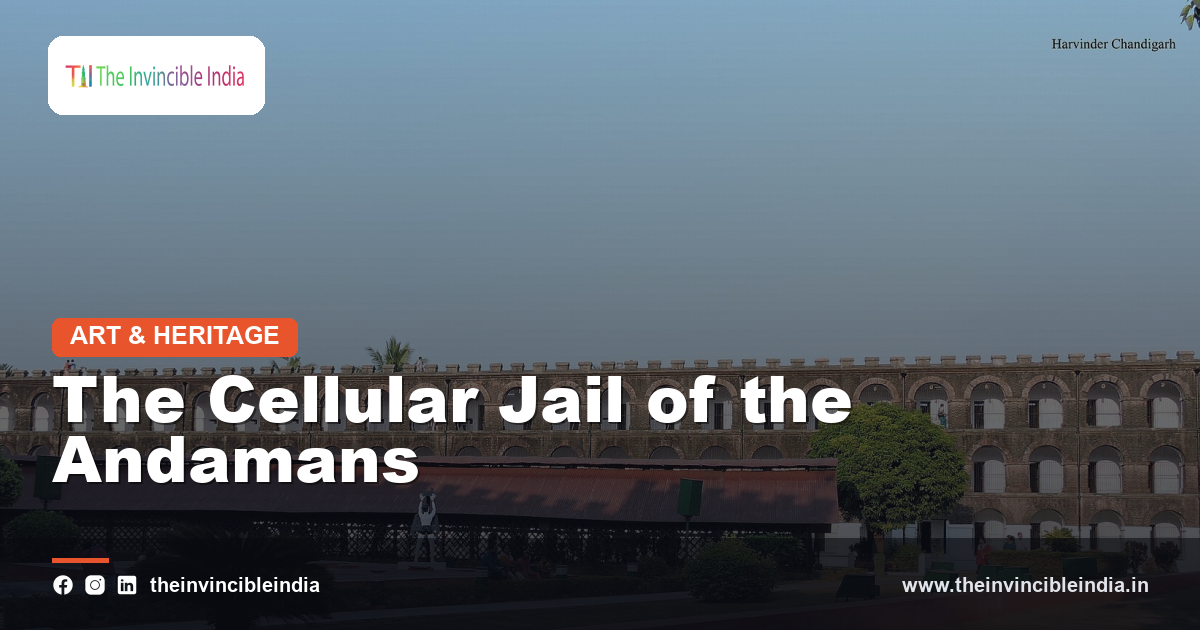
The Cellular Jail at Port Blair in the Andaman and Nicobar Islands is one of the most solemn monuments of modern Indian history. Built by the British colonial government as a prison for convicts and political prisoners, it was designed so that each inmate was held in a separate cell, a plan that gave the building its name. Banishment to the islands across the open sea came to be known as Kala Pani, the black water, a phrase that carried deep dread in the popular imagination. Today the red brick complex is preserved as a national memorial, and it stands alongside other great forts and fortified places of India as a structure whose walls hold powerful memories of struggle, endurance and eventual freedom.
Quick Facts
| Detail | Information |
|---|---|
| Location | Port Blair, Andaman and Nicobar Islands |
| Type | Colonial-era prison, now a national memorial |
| Popular name | Kala Pani |
| Design | Radiating wings around a central watchtower |
| Material | Red brick |
| Present role | Memorial museum with an evening light and sound programme |
A Prison Above the Bay
The Cellular Jail occupies a commanding position on the coast of Port Blair, overlooking the waters of the Bay of Bengal. Its imposing red brick wings and tall central tower dominate the shoreline and can be seen from a considerable distance.
The setting was chosen with deliberate purpose, since the isolation of the islands made escape extremely difficult. The sea itself served as the most powerful wall of the prison. Today the same setting, with its sweeping views and quiet harbour, gives the memorial a contemplative character that contrasts sharply with the harsh purpose for which the building was first constructed.
The Meaning of Kala Pani
The phrase Kala Pani, meaning black water, referred to the dark and dangerous sea that separated the mainland from distant places of exile. In traditional belief, crossing the ocean could carry social and religious consequences, which made the idea of transportation across it especially terrifying.
Over time the term became closely associated with the Andaman penal settlement and with the Cellular Jail in particular. It came to symbolise permanent separation from home, family and community. The phrase survives in language, literature and film as a reminder of how deeply the experience of colonial exile was felt, and it remains central to the memory of the site.
The Penal Settlement in the Andamans
The British colonial authorities established a penal settlement in the Andaman Islands in the nineteenth century, sending convicts from across the Indian mainland to live and labour in the remote territory. The settlement was used to hold criminals as well as those regarded as a threat to colonial rule.
Convicts were put to work clearing forest, building roads and constructing settlements, often under difficult conditions in a tropical and unfamiliar environment. The settlement therefore played a significant role in the development of Port Blair, even as it caused great suffering. The islands thus became closely tied to the history of colonial punishment and to the memory of those who passed through it.
Construction of the Cellular Jail
The Cellular Jail was built in the late nineteenth and early twentieth centuries as a more secure and disciplined facility within the penal settlement. Much of the labour and the bricks used in its building came from within the settlement itself, with convicts taking part in its construction.
The jail was intended to replace earlier and more scattered arrangements with a single purpose-built prison that could hold large numbers under close supervision. Its completion marked a new stage in colonial penal policy in the islands. The building thus stands as a record of both administrative ambition and the human labour that raised it, often by those who would later be confined within its walls.
The Radial Design and Central Tower
The prison was planned with a series of wings radiating outward from a central tower, like the spokes of a wheel. This arrangement followed ideas about prison design that favoured constant observation of inmates from a single point.
Each wing was several storeys high, and the cells opened onto corridors that faced the central tower, allowing guards to monitor movement with ease. The design also ensured that cell doors faced away from each other, so that prisoners could not communicate across the building. The plan reveals how architecture was used as an instrument of control, turning geometry itself into a method of discipline and isolation.
Solitary Cells and Isolation
The defining feature of the prison was its system of individual cells, intended to keep each prisoner in isolation. The cells were small and sparsely furnished, with narrow openings for light and air placed high on the walls.
Isolation was meant to break the spirit of resistance and to prevent political prisoners from organising or sharing ideas. In practice, many inmates found ways to maintain contact through coded signals and small acts of solidarity. The cells survive today as powerful evidence of the experience of confinement, and visitors who stand inside them often gain a direct and sobering understanding of what it meant to live in silence and separation.
Daily Life and Forced Labour
Prisoners at the Cellular Jail faced a strict regime that included hard physical labour, limited food and harsh discipline. Tasks such as extracting oil, clearing land and other heavy work were imposed as part of the penal routine.
Punishments for disobedience could be severe, and health conditions were often poor in the humid island climate. Accounts left by former prisoners describe the physical and psychological toll of this existence. These testimonies form an important part of the historical record, and they help explain why the jail became a lasting symbol of colonial cruelty. Remembering daily life in the prison is an essential part of understanding the monument.
Political Prisoners and the Freedom Movement
Many participants in India’s struggle for independence were sent to the Cellular Jail, including revolutionaries and activists from different regions of the country. Their imprisonment in the Andamans was meant to remove them from public life and to discourage others from following their example.
Instead, the jail became a place where political commitment was tested and, in many cases, strengthened. The shared experience of confinement created bonds between prisoners from diverse backgrounds and linguistic communities. The Cellular Jail is therefore remembered not only as a place of suffering but also as a place where the broader ideals of the freedom movement were kept alive under extraordinary pressure.
Notable Figures Linked to the Jail
Several well known figures from the independence movement are associated with the Cellular Jail, among them Vinayak Damodar Savarkar, Barindra Kumar Ghose and Batukeshwar Dutt. Their names are widely commemorated in the memorial and in the national memory of the freedom struggle.
Many other prisoners, whose names are less widely known, endured the same conditions and made comparable sacrifices. The memorial honours them collectively as well as individually, recognising that the history of the jail is a story of many people. By remembering both the famous and the unnamed, the site reflects the breadth of the movement that eventually led to independence.
Protest, Hunger Strikes and Resistance
Prisoners did not accept their treatment passively. Over the years they organised protests against harsh conditions, including hunger strikes undertaken to demand better treatment and the recognition of political prisoners.
These acts of resistance drew attention beyond the islands and contributed to growing public concern on the mainland about conditions in the Andaman jail. Pressure from political leaders and the public eventually led to changes in the treatment of political prisoners and their return from the islands. The history of protest at the Cellular Jail shows how organised moral resistance could challenge even a system built on isolation and strict discipline.
The Second World War and Its Aftermath
During the Second World War the Andaman Islands came under Japanese occupation, a period that brought further hardship to the local population and altered the history of the prison. The jail itself was used during this time, and the islands were closely linked to wider wartime events in Asia.
After the war and the end of colonial rule, the penal settlement was wound down. Some of the original wings were damaged or demolished in the following decades, and the complex was reduced from its full extent. Only part of the original structure survives, which makes the preserved wings all the more precious as evidence of a dark chapter of history.
From Prison to National Memorial
After independence, the surviving portion of the Cellular Jail was recognised as a place of national importance and was developed as a memorial to the freedom fighters held there. It was formally dedicated as a national memorial in the later twentieth century.
The transformation from a place of punishment to a place of commemoration reflects a deliberate choice to honour those who suffered within its walls. The preserved wings, the central tower and the exhibits now serve to educate visitors about the colonial period. This change of purpose gives the site a meaning that is both historical and moral, turning painful memory into public understanding.
The Surviving Wings and Museum
A portion of the original wings still stands, along with the central tower, and visitors can walk along the corridors and enter some of the cells. A museum within the complex displays photographs, documents and objects that describe the history of the penal settlement and the lives of prisoners.
Memorial plaques and a gallery of freedom fighters honour those associated with the jail. The red brick structure, with its repeated arches and long corridors, retains a stark and powerful atmosphere. The museum and the surviving architecture together give visitors a clear and moving introduction to the history of the site and the human stories bound up with it.
Light and Sound Programme
In the evenings the memorial hosts a light and sound programme that narrates the story of the jail and the freedom struggle within the open courtyard. Using narration, music and illumination of the building itself, the show recounts the experiences of the prisoners.
The programme is designed to help visitors from different backgrounds understand the history in an accessible and emotional way. Standing in the courtyard as the story unfolds against the walls of the prison creates a strong sense of presence and connection. The performance has become one of the most memorable parts of a visit and a significant means of keeping the memory of the jail alive.
Nearby Historic Sites in Port Blair
The Cellular Jail is one part of a wider historic landscape in the Andaman Islands. Nearby islands such as Ross Island, once the administrative headquarters of the colonial settlement, preserve ruins of buildings from the period.
Together these sites allow visitors to trace the full story of colonial administration in the islands, from governance to confinement. They also show the transformation of the territory over time. For those exploring the heritage of the region, the jail forms the emotional heart of a larger historical circuit. Visiting these sites together provides a fuller picture of how the islands were shaped by the colonial experience.
Architecture, Memory and Heritage Value
Although it is not a temple or palace, the Cellular Jail is a significant work of colonial-era architecture, valued for its planning, its scale and its historical associations. It is also an example of heritage that preserves difficult memories rather than celebrating beauty alone.
Monuments of this kind are important because they remind societies of the costs of past injustices and the courage of those who resisted them. The jail is frequently discussed alongside other places of memory across the country, including sites listed in the guide to UNESCO World Heritage Sites of India. Its heritage value lies in its capacity to teach through the preservation of lived history.
The Cellular Jail Today
Today the Cellular Jail is among the most visited and most respected sites in the Andaman and Nicobar Islands. It receives travellers, students and families who come to learn about the freedom struggle and to pay their respects to those who were imprisoned there.
The memorial is maintained with the aim of preserving both the physical structure and the stories it holds. For many visitors, the experience is deeply moving, a reminder of the price paid for independence and of the importance of freedom. The Cellular Jail endures as a place where history is not merely recorded but felt, and where the memory of sacrifice continues to inspire respect and reflection.
Sources & Further Reading
- Archaeological Survey of India (asi.nic.in).
- Ministry of Culture, Government of India (indiaculture.gov.in).
Frequently Asked Questions
Why is the Cellular Jail called Kala Pani?
Kala Pani means black water and referred to the feared sea crossing to the Andaman Islands. The term became associated with the penal settlement and the jail as a symbol of exile and separation from home.
Why is it called the Cellular Jail?
The prison was designed with individual cells so that each inmate could be kept in isolation. The system of separate cells, arranged along corridors radiating from a central tower, gave the building its name.
Who were some of the freedom fighters held at the jail?
Figures such as Vinayak Damodar Savarkar, Barindra Kumar Ghose and Batukeshwar Dutt are among those associated with the Cellular Jail. Many other political prisoners from across India were also confined there.
What can visitors see at the Cellular Jail today?
Visitors can walk through the surviving wings, see the central tower and enter some of the cells, and they can explore a museum with exhibits on the penal settlement. An evening light and sound programme narrates the history of the jail.
Is the Cellular Jail a national memorial?
Yes, the surviving portion of the prison has been preserved as a national memorial dedicated to the freedom fighters who were held there. It serves both as a heritage site and an educational museum.


