

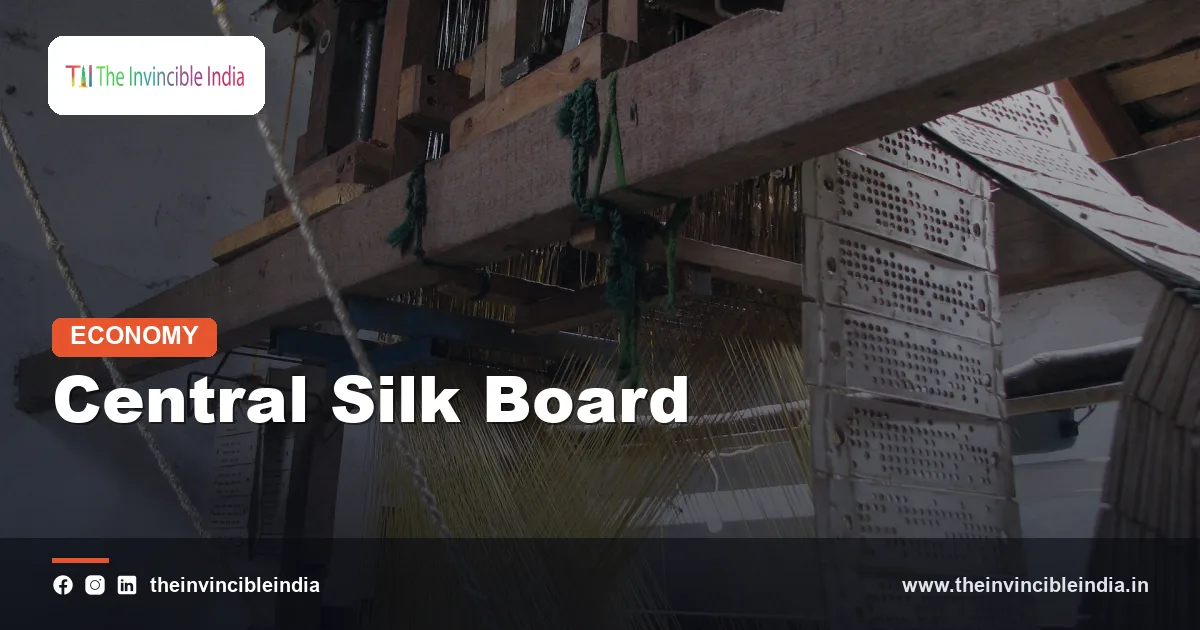
The Central Silk Board (CSB) is the statutory body, set up under the Central Silk Board Act, 1948, that develops sericulture and the silk industry in India under the Ministry of Textiles, Government of India. India is the world’s second-largest producer of silk after China, and the Central Silk Board is the national agency that guides research, seed supply, rearer support and quality marking for the sector.
This explainer covers what the Central Silk Board is, how it is organised, the four silk varieties India produces, its research institutes, the Silk Mark label and the help it gives to farmers and weavers. Numbers are approximate and dated, because production and employment figures change from year to year. Last updated: 20 October 2026.
| Attribute | Detail |
|---|---|
| Full name | Central Silk Board (CSB) |
| Established | Under the Central Silk Board Act, 1948 (constituted in the late 1940s) |
| Type | Statutory body of the Government of India |
| Administrative ministry | Ministry of Textiles |
| Headquarters | Bengaluru, Karnataka |
| Mandate | Development of sericulture and the silk industry: research, seed, extension, quality and trade support |
| Silk varieties covered | Mulberry, tasar, eri and muga |
| Quality label | Silk Mark, run through the Silk Mark Organisation of India (SMOI) |
| India’s global position | Second-largest silk producer in the world, and the only country producing all four commercial silk types |
Key Takeaways
- The Central Silk Board is a statutory body created under the Central Silk Board Act, 1948, and it functions under the Ministry of Textiles with its headquarters in Bengaluru.
- India is the second-largest producer of silk in the world, behind China, and the Central Silk Board coordinates the national effort to develop that production.
- India is the only country that produces all four commercial silk types: mulberry, tasar, eri and muga.
- Muga silk, a golden-coloured silk, is produced only in Assam and neighbouring parts of the Northeast and has been given Geographical Indication (GI) protection.
- The Central Silk Board runs research and training institutes for mulberry, tasar, and muga and eri silk, and supports silkworm seed production for rearers.
- The Silk Mark label, introduced by the Central Silk Board, certifies that a product is made of pure natural silk.
What is the Central Silk Board and what does it do?
The Central Silk Board is the national statutory body responsible for the planned development of sericulture, the practice of raising silkworms to produce silk, and of the silk industry in India. It advises the government, runs research, supports farmers and promotes domestic and export trade in silk.
The Board’s work covers the whole chain, from planting mulberry and other host plants to rearing silkworms, reeling cocoons into raw silk, weaving and marketing. It finances research, supplies disease-free silkworm seed, trains rearers, collects statistics and implements government schemes for the sector. The Board operates through a network of seed organisations, research stations, training centres and regional offices spread over the sericulture-producing states.
When and why was the Central Silk Board established?
The Central Silk Board was established under an Act of Parliament in 1948 to organise and promote the silk industry, which was scattered, small-scale and vulnerable to disease and competition. The Central Silk Board Act, 1948, gave the new body the power to guide research, regulate the quality of seed, and advise the government on matters such as duties and trade.
In the years after independence, sericulture was viewed as a labour-intensive rural industry that could generate income in dry and hilly areas where other crops were difficult. A national board offered a single place to plan research and extension. Over time the Board expanded its role, and silk became one of the textile-sector areas that receive targeted central schemes.
How is the Central Silk Board organised?
The Central Silk Board is governed by a Chairperson and a board of members who represent the central government, Parliament, state governments, and the silk industry and trade. A Member Secretary heads the executive wing and manages the organisation’s day-to-day work from Bengaluru.
The technical work is split among specialised units:
- Research and training institutes: central institutes dedicated to particular silk types and to silk technology.
- Silkworm seed organisations: units that produce and distribute basic seed to state seed farms and private grainages.
- Regional and extension offices: local offices that deliver training and schemes to rearers.
- Silk Mark Organisation of India: a society formed by the Board to protect consumers from imitation silk.
What are the four varieties of silk produced in India?
India produces four commercial varieties of silk: mulberry, tasar, eri and muga. They differ by the species of silkworm, the plants on which the worms feed, the region where they are reared, and the look and feel of the fabric.
| Variety | Silkworm feeds on | Main regions | Character |
|---|---|---|---|
| Mulberry | Mulberry leaves (Bombyx mori) | Karnataka, Andhra Pradesh, Tamil Nadu, West Bengal, Jammu and Kashmir | Smooth, fine, lustrous; accounts for the largest share of India’s raw silk |
| Tasar | Wild forest trees such as arjun and asan | Jharkhand, Chhattisgarh, Odisha and parts of other central and eastern states | Coarse, earthy, golden-brown; often called wild silk |
| Eri | Castor and some other plants | Assam and other states of the Northeast | Soft, warm and durable; sometimes called “peace silk” because the moth can emerge before the cocoon is spun |
| Muga | Som and soalu leaves | Assam | Natural golden sheen that grows more lustrous with washing; GI-protected |
Mulberry silk is by far the largest category and is estimated to supply the majority of the country’s raw silk. The other three are known as non-mulberry or vanya silks, and they are important for tribal and rural communities in the east and Northeast.
Which are the research institutes under the Central Silk Board?
The Central Silk Board runs several research and training institutes that focus on specific silk types and on technology. These institutes develop new silkworm breeds, improve host plants, study diseases and train scientists and extension workers.
- Central Sericultural Research and Training Institute (CSR&TI), Mysuru: works on mulberry sericulture, with a sister institute at Berhampore, West Bengal.
- Central Tasar Research and Training Institute (CTR&TI), Ranchi: covers tasar silk and its host plants.
- Central Muga Eri Research and Training Institute (CMER&TI), Lahdoigarh, Jorhat, Assam: handles the muga and eri varieties.
- Central Silk Technological Research Institute (CSTRI), Bengaluru: focuses on reeling, weaving, processing and testing technology.
- Central Sericulture Germplasm Resources Centre (CSGRC), Hosur: conserves mulberry and silkworm genetic resources.
Locations and the exact list of institutes can change with reorganisation, so readers should confirm details with the Board’s official publications.
What is the Silk Mark and how does it protect buyers?
The Silk Mark is a quality label that certifies a product as made of pure natural silk, and it is administered by the Silk Mark Organisation of India (SMOI), a society set up by the Central Silk Board in the early 2000s. The label helps buyers distinguish genuine silk from synthetic blends sold as silk.
The Silk Mark Organisation registers manufacturers, wholesalers and retailers who agree to deal in pure silk and who use the Silk Mark tag, usually a hologram label, on their goods. Random testing is carried out to check compliance, and violators can lose their membership. The label covers all four silk types. For consumers, the Silk Mark is a practical guide, but it complements rather than replaces checks such as asking for bills and inspecting the weave.
How does the Central Silk Board support rearers and weavers?
The Central Silk Board supports rearers and weavers through schemes that provide planting material, silkworm seed, rearing equipment, training and market linkages. Its principal vehicle in recent years has been the Silk Samagra scheme, an umbrella programme of the Ministry of Textiles that bundles several earlier activities.
The types of support include:
- Seed and planting material: supply of disease-free layings and improved mulberry varieties.
- Infrastructure: help with rearing houses, reeling units and cocoon markets.
- Training: short courses for rearers, reelers and weavers on better practices and new machines.
- Technology: promotion of improved reeling machines and eco-friendly processing.
- Market support: exhibitions, buyer-seller meets and brand promotion for Indian silk.
Specific scheme names, funding levels and eligibility conditions are revised from time to time, so applicants should consult current official guidelines.
Why does sericulture matter to India’s rural economy?
Sericulture matters because it is a labour-intensive rural activity that gives income to a large number of families, many of them small farmers, tribal households and women, with relatively little land. Official statements have put employment in the sector at several million people.
A small plot of mulberry can support a household with a steady cycle of rearing, as cocoons can be produced several times a year. Silk also earns foreign exchange through exports of silk fabrics, made-ups and yarn. India’s internal demand for silk, driven partly by weddings and festivals, is large, and the country has traditionally imported raw silk to supplement domestic supply, notably from China. Reducing that import dependence is a stated aim of Central Silk Board programmes.
Where in India is silk produced?
Silk in India is produced mainly in Karnataka, Andhra Pradesh, Tamil Nadu and West Bengal for mulberry silk, in Jharkhand, Chhattisgarh and Odisha for tasar silk, and in Assam and the Northeast for eri and muga silk. Karnataka is generally the leading state for mulberry silk, and its cocoon markets, such as the one at Ramanagara, are well known.
Weaving centres have their own famous styles. Kanchipuram in Tamil Nadu, Banaras in Uttar Pradesh, Mysuru in Karnataka, Bhagalpur in Bihar, Pochampally in Telangana and the weaving clusters of Assam are among the best-known. Many of these products have Geographical Indication status, which protects their regional identity. The Central Silk Board’s raw-silk and seed support underpins much of this weaving trade.
What challenges does the Indian silk industry face?
The Indian silk industry faces competition from cheaper imported silk and synthetics, silkworm diseases, climate pressure, and fragmented rearing and reeling. The Central Silk Board addresses these through research on hardy breeds, quality seed and better technology.
- Imported yarn: lower-cost Chinese raw silk competes with domestic production.
- Disease and climate: heat, humidity and disease outbreaks can sharply reduce cocoon yield.
- Quality gaps: inconsistent yarn quality limits Indian silk in high-end export markets.
- Labour and scale: small holdings and manual reeling keep productivity lower than in leading producers.
- Imitation products: synthetic fabric sold as silk harms genuine producers, which the Silk Mark aims to counter.
How is silk made, from cocoon to cloth?
Silk is made by raising silkworms on a suitable host plant, harvesting the cocoons they spin, unwinding each cocoon into a continuous filament, and then twisting and weaving that filament into fabric. The Central Silk Board’s programmes touch each stage of this chain.
- Plantation: farmers grow mulberry, or tend host trees such as arjun and asan for tasar, castor for eri, and som and soalu for muga.
- Silkworm rearing: eggs, called layings or seed, are hatched under controlled conditions, and the larvae are fed leaves for roughly three to four weeks before they spin cocoons.
- Cocoon harvesting: mature cocoons are collected and sold in cocoon markets, where price depends on quality and weight.
- Stifling: in conventional silk production, the pupae inside the cocoons are killed by heat so the filament is not broken when the moth emerges. Eri silk differs because the moth is allowed to leave, and the open cocoon is spun like cotton.
- Reeling: the continuous filament of a cocoon, which can be hundreds of metres long, is unwound, and several strands are combined into raw silk yarn.
- Throwing, dyeing and weaving: the yarn is twisted, dyed and woven on handlooms or power looms into sarees, dress material, furnishing fabric and other goods.
Quality at the early stages affects everything later. Healthy seed, clean rearing houses and well-timed harvesting give a cocoon that reels well, while diseased or poorly handled cocoons produce weak and uneven yarn. For this reason the Central Silk Board spends considerable effort on seed certification, rearing-house hygiene and training in disease control. It also promotes automatic and semi-automatic reeling machines that give a more uniform yarn than traditional charkha reeling, with the aim of lifting the share of high-grade Indian silk used in export fabrics.
Because each stage often happens in a different village or town, the sector depends on cocoon markets, reeling clusters and weaving centres working well together. The Board’s market-linkage and cluster support is meant to shorten that chain so that rearers receive a fairer price.
Bottom Line
The Central Silk Board is the Ministry of Textiles body that holds together India’s silk sector, from research and seed to quality labelling and farmer support. India’s rare ability to produce all four silk varieties, and its position as the second-largest producer in the world, depend in large part on the work this Bengaluru-based Board coordinates.
Frequently Asked Questions
What is the Central Silk Board?
The Central Silk Board is a statutory body under the Ministry of Textiles that develops sericulture and the silk industry in India. It was created under the Central Silk Board Act, 1948, and is headquartered in Bengaluru. It runs research institutes, supports silkworm seed supply and implements government schemes for silk rearers and weavers.
Which are the four types of silk produced in India?
The four types of silk produced in India are mulberry, tasar, eri and muga. Mulberry is the largest in volume, while tasar, eri and muga are non-mulberry or vanya silks mostly produced in the eastern and northeastern states. India is the only country that produces all four commercial varieties.
Which country produces the most silk, and where does India rank?
China produces the most silk in the world, and India ranks second. India’s silk output is spread across mulberry and non-mulberry varieties, and the country also consumes a very large share of its own production. The Central Silk Board works to raise domestic output and reduce import dependence.
What is the Silk Mark?
The Silk Mark is a quality label that certifies a product as pure natural silk. It was introduced by the Central Silk Board and is managed by the Silk Mark Organisation of India. Registered sellers attach a Silk Mark tag to genuine silk products, which helps consumers avoid synthetic imitations.
What is muga silk and where is it produced?
Muga silk is a naturally golden silk produced by the muga silkworm, which feeds on som and soalu leaves, and it is produced in Assam. The fabric is valued for its sheen and durability and has Geographical Indication protection. The Central Muga Eri Research and Training Institute at Jorhat supports research on muga and eri silk.
How does the Central Silk Board help silk farmers?
The Central Silk Board helps silk farmers by providing improved planting material, disease-free silkworm seed, training, equipment support and market linkages. Much of this assistance is delivered through the Silk Samagra scheme of the Ministry of Textiles. Scheme details and eligibility change over time, so farmers should check current official guidelines.
{“@context”:”https://schema.org”,”@graph”:[{“@type”:”FAQPage”,”mainEntity”:[{“@type”:”Question”,”name”:”What is the Central Silk Board?”,”acceptedAnswer”:{“@type”:”Answer”,”text”:”The Central Silk Board is a statutory body under the Ministry of Textiles that develops sericulture and the silk industry in India. It was created under the Central Silk Board Act, 1948, and is headquartered in Bengaluru. It runs research institutes, supports silkworm seed supply and implements government schemes for silk rearers and weavers.”}},{“@type”:”Question”,”name”:”Which are the four types of silk produced in India?”,”acceptedAnswer”:{“@type”:”Answer”,”text”:”The four types of silk produced in India are mulberry, tasar, eri and muga. Mulberry is the largest in volume, while tasar, eri and muga are non-mulberry or vanya silks mostly produced in the eastern and northeastern states. India is the only country that produces all four commercial varieties.”}},{“@type”:”Question”,”name”:”Which country produces the most silk, and where does India rank?”,”acceptedAnswer”:{“@type”:”Answer”,”text”:”China produces the most silk in the world, and India ranks second. India’s silk output is spread across mulberry and non-mulberry varieties, and the country also consumes a very large share of its own production. The Central Silk Board works to raise domestic output and reduce import dependence.”}},{“@type”:”Question”,”name”:”What is the Silk Mark?”,”acceptedAnswer”:{“@type”:”Answer”,”text”:”The Silk Mark is a quality label that certifies a product as pure natural silk. It was introduced by the Central Silk Board and is managed by the Silk Mark Organisation of India. Registered sellers attach a Silk Mark tag to genuine silk products, which helps consumers avoid synthetic imitations.”}},{“@type”:”Question”,”name”:”What is muga silk and where is it produced?”,”acceptedAnswer”:{“@type”:”Answer”,”text”:”Muga silk is a naturally golden silk produced by the muga silkworm, which feeds on som and soalu leaves, and it is produced in Assam. The fabric is valued for its sheen and durability and has Geographical Indication protection. The Central Muga Eri Research and Training Institute at Jorhat supports research on muga and eri silk.”}},{“@type”:”Question”,”name”:”How does the Central Silk Board help silk farmers?”,”acceptedAnswer”:{“@type”:”Answer”,”text”:”The Central Silk Board helps silk farmers by providing improved planting material, disease-free silkworm seed, training, equipment support and market linkages. Much of this assistance is delivered through the Silk Samagra scheme of the Ministry of Textiles. Scheme details and eligibility change over time, so farmers should check current official guidelines.”}}]}]}


