

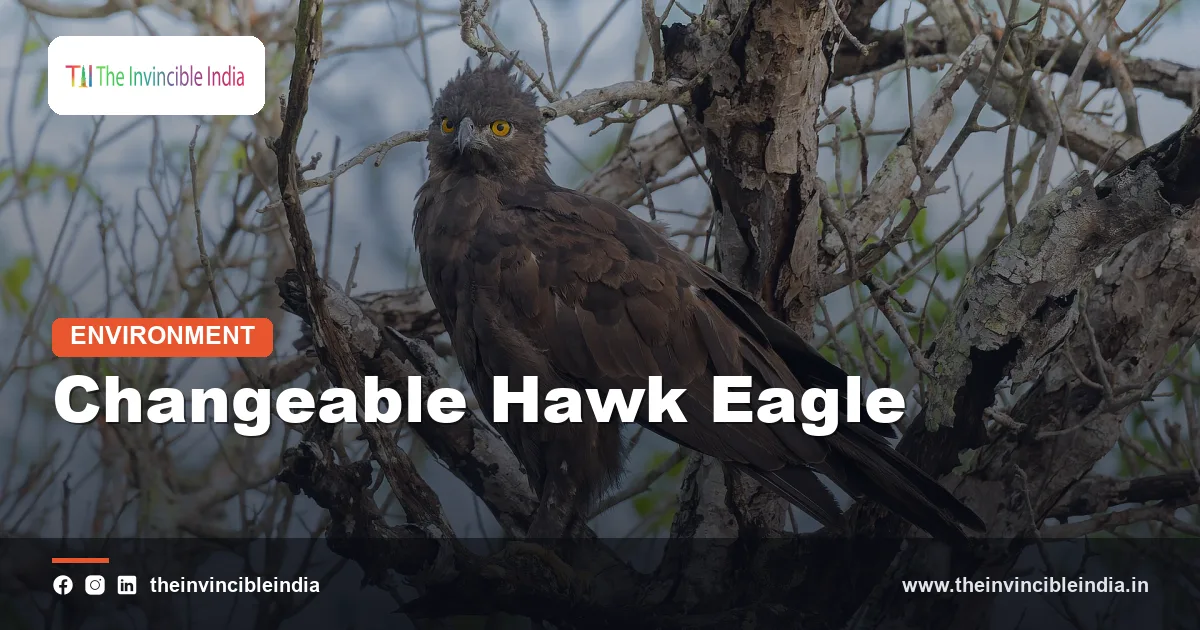
The changeable hawk eagle (Nisaetus cirrhatus) is a powerful, medium-large forest eagle of the family Accipitridae that is found in Indian woodlands and is known for the wide variation in its plumage, from pale, streaked birds to almost uniformly dark ones. It is a crested, broad-winged raptor that hunts birds, small mammals and reptiles from perches and from short, fast flights through and above the trees.
The changeable hawk eagle is also called the crested hawk-eagle in many Indian field guides, because Indian birds often carry a prominent crest. This article explains how the bird looks, why it is called “changeable”, where it lives in India, what it hunts, how it calls and breeds, and how it differs from other hawk-eagles.
| Quick Facts: Changeable Hawk Eagle | |
|---|---|
| Common name | Changeable hawk eagle (also called crested hawk-eagle) |
| Scientific name | Nisaetus cirrhatus (formerly placed in the genus Spizaetus) |
| Family | Accipitridae (hawks, eagles, kites and relatives) |
| Size | About 60 to 72 cm in length, with a wingspan of roughly 110 to 140 cm |
| Range and habitat in India | Forests and wooded country of the peninsula, the Himalayan foothills and the north-east, from plains to mid elevations |
| Diet | Birds such as junglefowl and pigeons, small mammals, lizards and snakes |
| Breeding and movement | Resident; builds a large stick nest in a tall tree and usually lays a single egg |
| Conservation status | Least Concern on the IUCN Red List; protected under the Wildlife (Protection) Act, 1972 |
Key Takeaways
- The changeable hawk eagle is a resident forest raptor of the family Accipitridae that occurs in wooded parts of India and is named for its variable plumage.
- A changeable hawk eagle has short, rounded wings and a long tail, a body shape that lets it manoeuvre between tree trunks and branches.
- The changeable hawk eagle hunts a wide range of prey, including junglefowl, pigeons, squirrels, hares, lizards and snakes.
- Both pale and dark colour forms of the changeable hawk eagle exist, and crest length differs between regions.
- The changeable hawk eagle usually raises a single chick at a time in a bulky stick nest built high in a large tree.
- The changeable hawk eagle is classed as Least Concern globally, but it depends on tall trees and intact forest, so logging and forest fragmentation are its main local threats.
What is the changeable hawk eagle?
The changeable hawk eagle is a forest-dwelling eagle in the genus Nisaetus, a group of crested hawk-eagles found across South and Southeast Asia. The scientific name is Nisaetus cirrhatus, and older books often use Spizaetus cirrhatus. The word cirrhatus means “crested” or “curled”, which refers to the head feathers.
The bird is strong and agile. It combines the compact proportions of a hawk with the power of an eagle, which is why it is called a hawk-eagle. Adults weigh roughly between 1 and 2 kg, with females larger than males. The short wings and long, rounded tail are ideal for fast, twisting flight in woodland, in contrast to the long, narrow wings of soaring eagles that hunt over open plains.
In India the changeable hawk eagle is not a bird of cities. It belongs to forests, forest edges, plantations with large trees and well-wooded hills, and it is most often noticed when it soars above the canopy on bright mornings or calls loudly.
Why is it called the changeable hawk eagle?
The changeable hawk eagle is called “changeable” because its plumage varies so much between individuals, age groups and regions that early naturalists thought they were looking at different species. Some birds are pale with heavy streaking on the chest, while others are dark brown or blackish all over.
The variation has several sources:
- Colour morphs: Dark-morph birds exist beside pale-morph birds, particularly in the Himalayan and north-eastern parts of the range.
- Age: Young birds are usually paler on the head and underparts than adults, and their plumage changes over several years.
- Regional forms: Birds of the Indian peninsula often have a long, narrow crest, while birds from other regions have a short crest or almost none. Scientists recognise several regional forms (subspecies), and some experts have discussed whether certain forms deserve separate species status.
Because of these changes, a changeable hawk eagle is best identified by its shape, behaviour and calls as well as by colour.
How can you identify a changeable hawk eagle?
A changeable hawk eagle is identified by its crest, its heavy build, its short rounded wings, its long barred tail and, in pale birds, a streaked chest and barred belly. The bird looks large and thickset when perched, and the crest, if present, may be held upright or flattened.
Pale-morph birds
A typical pale adult of the peninsular form is brown above, with a long dark crest that is often tipped with white. The throat is whitish with a dark central line, the chest is streaked with brown, and the belly and legs are barred in brown and white. The tail is greyish brown with several dark bands. The legs are fully feathered down to the toes.
Dark-morph birds
Dark-morph birds are chocolate brown to blackish across the body. They may show paler flight feathers from below. They are less common than pale birds in much of India and are more often reported from northern and eastern forests.
In flight
In flight, the bird shows broad, rounded wings, a long tail and dark bars along the flight feathers. When soaring, the wings are held flat or in a slight V. The bird often circles above the forest canopy in the morning and early afternoon.
Where is the changeable hawk eagle found in India?
The changeable hawk eagle is found in the forests of peninsular India, the Western Ghats, the Eastern Ghats, central Indian forests, the Himalayan foothills and the north-east. It prefers broadleaf forest and forest edges, and it also uses well-wooded country and plantations that retain tall trees.
The bird is a resident, which means that it does not make long seasonal migrations. Individuals and pairs hold territories, and a pair may stay in the same stretch of forest for years. Some altitudinal movement can occur in hill regions, with birds moving short distances up or down a slope with the seasons.
The species occurs more widely across South and Southeast Asia, including Sri Lanka, Nepal, Bangladesh, Myanmar, Thailand, Malaysia and the Indonesian islands. In India it is more easily seen in protected areas such as national parks, tiger reserves and hill forests than in broken, heavily cultivated country.
What does the changeable hawk eagle eat?
The changeable hawk eagle eats mainly medium-sized birds and small mammals, along with reptiles, and it is a strong, versatile predator for a bird of its size. Its diet is usually described as varied and opportunistic.
| Prey group | Examples |
|---|---|
| Birds | Junglefowl, spurfowl, partridges, doves, pigeons, parakeets and domestic poultry |
| Mammals | Squirrels, rats, hares, mongooses and occasionally young of larger mammals such as langurs |
| Reptiles | Garden lizards, monitor lizards (juvenile) and snakes |
| Other | Large insects or carrion on rare occasions |
The bird kills with its powerful feet and long, curved talons, which can pierce and crush the prey. The strong grip is the main weapon, since the bill is used mostly for tearing meat once the prey is dead. Eagle pairs that nest near villages are sometimes blamed for taking chickens, which can create conflict. In most forests, however, the bulk of the diet consists of wild animals.
How does the changeable hawk eagle hunt?
The changeable hawk eagle hunts mainly by waiting on a concealed perch inside the forest and then launching a short, fast attack, though it also hunts from the air by gliding low over the canopy. The strategy relies on surprise rather than on a long chase.
Perch hunting
The bird sits quietly on a branch, often below the canopy or at the edge of a clearing, and watches for movement. When a bird or mammal comes within range, the eagle accelerates, uses its rounded wings and long tail to steer around trunks and branches, and strikes with its feet.
Aerial hunting
The bird also hunts while soaring over forests or while gliding along ridges. It may stoop on prey that it sees on the ground in a clearing or on a road, and it sometimes tries to flush birds from the treetops.
Role of habitat
Hunting success depends heavily on cover and on the structure of the forest. Patches with a mix of tall trees, clearings and low vegetation offer both hidden perches and visible prey, so they are the most favourable hunting ground for the bird.
What sounds does the changeable hawk eagle make?
The changeable hawk eagle makes loud, shrill, whistling calls, usually a rising series of notes that can be heard from a long distance across a forest valley. The call is often the best clue that the bird is present, because the eagle may remain hidden in dense foliage.
Birdwatchers often describe the call as a repeated, ringing “ki-ki-ki-kee” or a long, clear scream that rises in pitch. Calling is most frequent around dawn and in the early morning, and it increases in the breeding season, when pairs advertise their territory. The bird also performs display flights, in which it soars high, dives and sometimes calls while circling.
Learning the call is a practical skill for forest walkers. In many Indian reserves the first sign of a hawk-eagle is a sudden burst of alarm calls from langurs, squirrels or jungle birds, followed by the eagle’s own cry.
How does the changeable hawk eagle breed?
The changeable hawk eagle breeds by building a large nest of sticks in the fork of a tall tree and usually raising a single chick. Nesting generally takes place in the dry season and is spread over several months, with some variation across India.
The nest is a bulky platform lined with green leaves and is typically placed high above the ground, often at a spot with an open flight path. Many pairs reuse the same nest in successive years and add material to it. One egg is typical, and the female does most of the incubation while the male brings food. After hatching, the chick remains in the nest for several weeks and then spends further weeks near the nest while the parents continue to feed it.
Because the species lays so few eggs and needs large trees, its breeding success depends on forest quality. Disturbance near the nest, felling of nesting trees and fire can all reduce the number of young raised.
How is the changeable hawk eagle different from other Indian hawk-eagles?
The changeable hawk eagle differs from other Indian hawk-eagles mainly in its size, crest and habitat, and it is usually the one found at lower and middle elevations. Several related birds share forest habitats, so comparing them is useful.
| Bird | Key difference from the changeable hawk eagle |
|---|---|
| Mountain hawk-eagle | Larger, hill-forest bird with a strong crest and heavier, more spotted underparts |
| Legge’s hawk-eagle | Smaller and much less commonly seen, a bird of hill forests mainly in the Western Ghats, with a different pattern of streaking on the underparts |
| Rufous-bellied eagle | Smaller, black above with a rufous belly and a short crest |
| Crested serpent eagle | Hunts snakes and has a rounded, black-and-white spotted crest and a broad white band across the tail |
| Booted eagle | Smaller, more slender, seen in open woodland and has a clear pale and dark morph pattern |
Experienced observers often separate these species by combining several clues: the shape of the crest, how the wings are held, how the tail is patterned and the habitat. Beginners are usually better off recording the features they see rather than forcing a quick identification.
Is the changeable hawk eagle threatened in India?
The changeable hawk eagle is not globally threatened, but it faces local pressures in India from loss of tall forest, hunting, and conflict over poultry. The IUCN Red List assesses the species as Least Concern, and it is protected in India under the Wildlife (Protection) Act, 1972.
Specific concerns include:
- Felling or degradation of large nesting trees
- Fragmentation of forest into small, isolated patches
- Illegal shooting and persecution in areas where poultry is lost
- Disturbance by fire, logging and heavy tourism near nests
- Capture for illegal wildlife trade, which has been reported for several Indian raptors
Protecting the species largely means protecting forests. Conservation measures that retain large trees, restore connections between forest patches, support community awareness and reduce chicken losses through secure coops all help hawk-eagles survive alongside people.
Bottom Line
The changeable hawk eagle is a crested, strong-footed forest eagle of India that hunts birds, mammals and reptiles with surprise attacks from concealed perches. Its plumage varies widely, so shape, crest and calls are better guides than colour. The bird remains secure globally, but its future in India depends on tall trees and connected forests.
Frequently Asked Questions
What is a changeable hawk eagle?
A changeable hawk eagle is a medium-large crested forest eagle of the family Accipitridae, with the scientific name Nisaetus cirrhatus. It has short rounded wings, a long tail and variable plumage. In India it lives in forests and wooded country and is often called the crested hawk-eagle.
Why is it called changeable?
The bird is called changeable because its plumage differs widely between pale and dark forms, between young and adult birds, and between regions. The variation once led naturalists to treat the forms as different species. Today they are grouped within one species with several regional forms.
What does a changeable hawk eagle eat?
A changeable hawk eagle eats mainly birds and small mammals, along with lizards and snakes. Typical prey includes junglefowl, pigeons, squirrels and hares. It kills with its strong feet and long talons after a quick ambush.
Where can I see a changeable hawk eagle in India?
You can see a changeable hawk eagle in forests of the Western Ghats, central and eastern India, the Himalayan foothills and the north-east. Protected areas are the most reliable places. Early mornings, when the bird calls and soars above the canopy, are the best times to look.
How many eggs does a changeable hawk eagle lay?
A changeable hawk eagle usually lays a single egg in a large stick nest high in a tree. The female incubates the egg while the male provides food. The chick takes many weeks to leave the nest and depends on its parents for some time afterwards.
Is the changeable hawk eagle protected in India?
Yes, the changeable hawk eagle is protected in India under the Wildlife (Protection) Act, 1972, and it is classed as Least Concern globally by the IUCN. Hunting, capture and trade are illegal. Loss of tall forest trees and forest fragmentation remain the main local concerns.
{“@context”:”https://schema.org”,”@graph”:[{“@type”:”FAQPage”,”mainEntity”:[{“@type”:”Question”,”name”:”What is a changeable hawk eagle?”,”acceptedAnswer”:{“@type”:”Answer”,”text”:”A changeable hawk eagle is a medium-large crested forest eagle of the family Accipitridae, with the scientific name Nisaetus cirrhatus. It has short rounded wings, a long tail and variable plumage. In India it lives in forests and wooded country and is often called the crested hawk-eagle.”}},{“@type”:”Question”,”name”:”Why is it called changeable?”,”acceptedAnswer”:{“@type”:”Answer”,”text”:”The bird is called changeable because its plumage differs widely between pale and dark forms, between young and adult birds, and between regions. The variation once led naturalists to treat the forms as different species. Today they are grouped within one species with several regional forms.”}},{“@type”:”Question”,”name”:”What does a changeable hawk eagle eat?”,”acceptedAnswer”:{“@type”:”Answer”,”text”:”A changeable hawk eagle eats mainly birds and small mammals, along with lizards and snakes. Typical prey includes junglefowl, pigeons, squirrels and hares. It kills with its strong feet and long talons after a quick ambush.”}},{“@type”:”Question”,”name”:”Where can I see a changeable hawk eagle in India?”,”acceptedAnswer”:{“@type”:”Answer”,”text”:”You can see a changeable hawk eagle in forests of the Western Ghats, central and eastern India, the Himalayan foothills and the north-east. Protected areas are the most reliable places. Early mornings, when the bird calls and soars above the canopy, are the best times to look.”}},{“@type”:”Question”,”name”:”How many eggs does a changeable hawk eagle lay?”,”acceptedAnswer”:{“@type”:”Answer”,”text”:”A changeable hawk eagle usually lays a single egg in a large stick nest high in a tree. The female incubates the egg while the male provides food. The chick takes many weeks to leave the nest and depends on its parents for some time afterwards.”}},{“@type”:”Question”,”name”:”Is the changeable hawk eagle protected in India?”,”acceptedAnswer”:{“@type”:”Answer”,”text”:”Yes, the changeable hawk eagle is protected in India under the Wildlife (Protection) Act, 1972, and it is classed as Least Concern globally by the IUCN. Hunting, capture and trade are illegal. Loss of tall forest trees and forest fragmentation remain the main local concerns.”}}]}]}


