

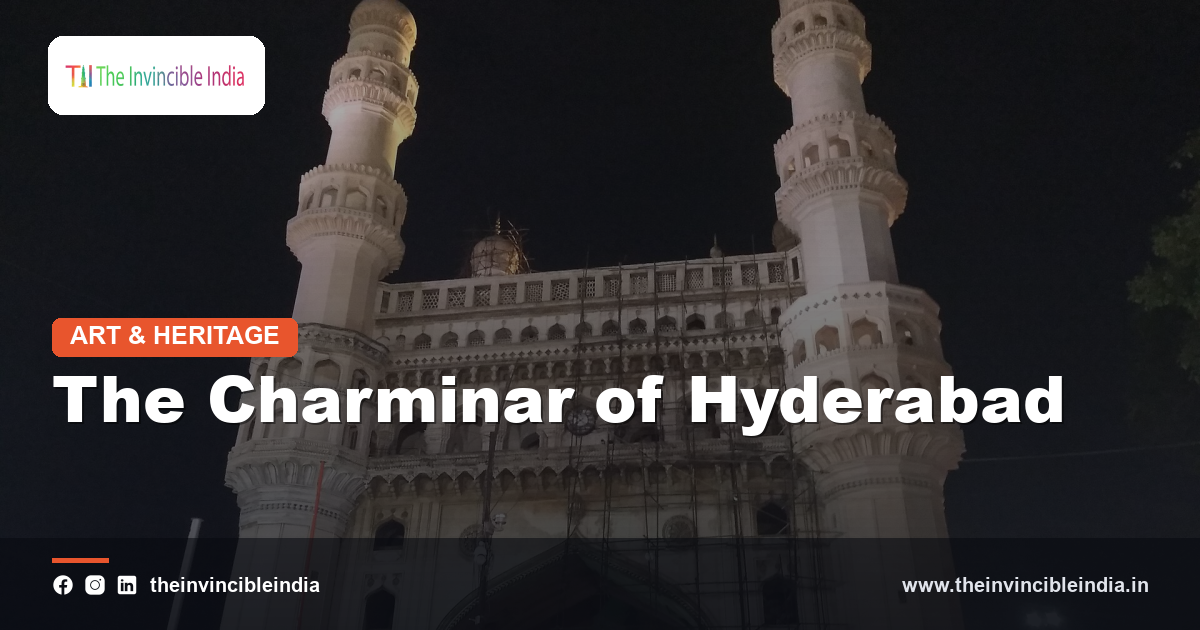
At the heart of Hyderabad’s old city stands the Charminar, a monumental structure of four grand arches and four soaring minarets that has served as the symbolic center of the city since its founding. Built by the Qutb Shahi dynasty that ruled the Golconda kingdom, the Charminar reflects the broader vocabulary of Indo-Islamic architecture also seen in the great Mughal monuments of northern India, adapted here to a distinctly Deccani sensibility. Positioned at the intersection of the city’s four main roads, the monument was conceived as much as an urban centerpiece as a religious structure, with a small mosque occupying its upper floor. This guide explores its history, architectural design, and its continuing role as a defining landmark of Hyderabad.
Quick Facts
| Detail | Information |
|---|---|
| Location | Hyderabad, Telangana, India |
| Style | Qutb Shahi / Indo-Islamic architecture |
| Built By | Qutb Shahi dynasty of Golconda |
| Notable Feature | Four grand arches and four minarets |
| Upper Floor | Contains a small historic mosque |
| Primary Material | Granite, lime mortar, and plaster |
Origins and Founding of Hyderabad
The Charminar was built at the close of the sixteenth century by a ruler of the Qutb Shahi dynasty, which governed the Golconda kingdom in the Deccan region of southern India, and it is closely tied to the founding of Hyderabad as a new capital city. Traditional accounts describe the monument as having been raised to mark the establishment of the new city, positioned at a central crossroads intended to become the focal point of urban life. Its construction came at a time of considerable prosperity for the Qutb Shahi state, supported by the region’s trade in diamonds and other goods, which financed ambitious architectural projects across the kingdom. The choice to build such a prominent monument at the city’s very center reflects the importance its rulers placed on establishing a clear civic and symbolic identity for their new capital. This founding role remains central to how the Charminar is understood today.
The Qutb Shahi Dynasty and Deccani Architecture
The Qutb Shahi rulers of Golconda were significant patrons of a distinct Deccani architectural tradition, one that absorbed influences from Persian, Central Asian, and local South Indian building practices to create a style recognizably different from that of contemporary courts further north. Deccani architecture of this period is often noted for its bold use of arches, decorative stucco work, and a preference for broad, monumental proportions rather than the more delicate ornamentation associated with some northern traditions. The Charminar exemplifies this regional style, combining a strong sense of geometric symmetry with locally adapted structural and decorative techniques. Qutb Shahi patronage extended across mosques, tombs, and fortifications throughout the Golconda kingdom, of which the Charminar remains the most widely recognized surviving example. Understanding this dynastic and regional context situates the monument firmly within the broader development of Indo-Islamic architecture in the Deccan.
The Four Grand Arches
The Charminar takes its name directly from its four monumental arches, each facing one of the cardinal directions and opening onto one of the four main roads that converge at the monument, historically forming the commercial and civic heart of the old city. These arches are constructed on a grand scale, tall and deep enough to allow easy passage of people and traffic beneath the structure while supporting the considerable weight of the floors and minarets above. Their symmetrical arrangement creates a strong sense of order and balance, reinforcing the monument’s role as a formal gateway-like structure at the center of the urban layout. The arches also frame views along each of the four converging streets, making the Charminar a constant visual reference point from multiple directions within the old city. This four-square arrangement is fundamental to both the monument’s structural design and its enduring symbolic identity.
The Four Minarets
Rising from each corner of the structure, the four minarets that give the Charminar its name are slender, tapering towers reaching several stories in height, each articulated with balconies and decorative bands along their length. Constructed with internal spiral staircases, the minarets historically allowed access to upper levels for both practical maintenance and the call to prayer associated with the mosque housed within the building. Each minaret is capped with a distinctive dome, echoing the domed forms found throughout Qutb Shahi and broader Indo-Islamic architecture of the period. The graceful proportion and careful symmetry of the four minarets, rising uniformly at each corner, contribute significantly to the monument’s balanced, almost ceremonial appearance when viewed from a distance. Together with the four arches below, the minarets complete the structure’s naming logic and its immediately recognizable silhouette.
The Mosque on the Upper Floor
The uppermost floor of the Charminar houses a small mosque, positioned so that its prayer hall occupies the western portion of the structure in keeping with the requirement to face toward Mecca during prayer. This placement reflects the monument’s dual identity as both a civic landmark and an active religious space, a combination not uncommon in monumental Indo-Islamic architecture of the period. Access to the mosque level historically required ascending through the building’s interior staircases, separating this more sacred space from the bustling commercial activity at street level below. The mosque’s modest scale relative to the imposing structure beneath it illustrates how religious function could be integrated into an otherwise civic or commemorative monument without dominating its overall design. This continuing religious use distinguishes the Charminar from monuments that serve a purely decorative or historical purpose.
Architectural Style and Ornamentation
The Charminar’s architectural vocabulary draws heavily on the arch-and-dome tradition characteristic of Indo-Islamic building, expressed here through a distinctly Deccani interpretation featuring stucco ornamentation, decorative balustrades, and finely detailed cornices. Surface decoration favors geometric and floral patterning rendered in plasterwork, consistent with broader conventions in Islamic architectural ornament that avoid figural representation on religious structures. The building’s overall massing balances solid, weight-bearing sections with more open, filigree-like elements such as the minaret balconies and upper-floor arcades, creating visual variety across its considerable height. Careful attention to proportion between the arches, the central structure, and the flanking minarets gives the monument a sense of harmony despite its considerable scale. This combination of structural boldness and refined surface ornamentation is characteristic of the finest Qutb Shahi monumental architecture.
Materials and Construction Techniques
Builders of the Charminar relied primarily on granite, a hard and durable stone widely available in the Deccan region, combined with lime mortar and finely finished plaster used for surface decoration and structural bonding. The load-bearing granite core provided the strength necessary to support the tall minarets and multiple internal floors, while lime plaster allowed for the smoother, more refined surfaces needed for decorative stucco work. Construction techniques of the period required considerable skill in coordinating stonemasonry with plasterwork, ensuring that decorative elements adhered securely to the structural framework beneath. The choice of durable, locally sourced materials has contributed significantly to the monument’s survival across more than four centuries, despite exposure to the region’s climate and the pressures of a busy urban environment. These construction choices reflect both practical engineering considerations and the aesthetic priorities of Qutb Shahi architecture.
Central Location at Hyderabad's Crossroads
The Charminar occupies a deliberately chosen position at the intersection of four major roads, a location that has made it the functional as well as symbolic center of Hyderabad’s old city since its construction. This crossroads siting allowed the monument to serve simultaneously as a landmark, a gathering point, and a practical hub for the movement of people and goods through the surrounding markets. Over the centuries, the streets radiating from the Charminar developed into some of the city’s most important commercial districts, reinforcing the monument’s role as an anchor for urban life rather than an isolated architectural showpiece. Its continued centrality within the modern city, despite Hyderabad’s considerable growth, testifies to the enduring success of this original urban planning decision. The Charminar’s location remains inseparable from its identity and function.
The Surrounding Markets and Old City
Immediately surrounding the Charminar lies a dense network of markets and bazaars that have developed over centuries into some of Hyderabad’s most vibrant commercial districts, trading in goods ranging from pearls and jewelry to textiles and spices. These markets grew organically around the monument’s four radiating streets, drawing on its central location to establish themselves as key points of exchange within the historic city. The relationship between monument and marketplace reflects a broader pattern in South Asian urban history, in which major architectural landmarks frequently anchored surrounding commercial activity rather than standing apart from everyday city life. Today, the bustling atmosphere of these markets remains an integral part of the experience of visiting the Charminar, linking the historic monument to the living, working city that has grown up around it. This continuity between past and present commerce is a distinctive feature of the site.
Golconda Fort and the Wider Qutb Shahi Legacy
The Charminar forms part of a broader legacy of Qutb Shahi architecture in the Hyderabad region, which also includes the fortifications and royal tombs associated with nearby Golconda, the dynasty’s earlier capital and stronghold. Golconda Fort, with its extensive fortifications and acoustic and water engineering systems, represents the same architectural and administrative tradition that later produced the Charminar as the centerpiece of the new capital. Comparing the two sites reveals a consistent Qutb Shahi approach to monumental construction, characterized by durable materials, bold structural forms, and careful integration of defensive, religious, and civic functions. The move from Golconda to the newly planned city of Hyderabad marked a significant shift in the dynasty’s architectural priorities, from fortified defense toward more open, civic monumentality. The Charminar stands as the clearest expression of this later phase of Qutb Shahi architectural ambition.
Symbolism as a City Emblem
Beyond its architectural and religious functions, the Charminar has long served as a powerful symbol of Hyderabad itself, appearing widely in depictions of the city and functioning as an immediately recognizable emblem of its history and identity. Its image is closely associated with the broader cultural character of the old city, representing centuries of Deccani history, trade, and courtly patronage in a single monumental form. This symbolic role has only grown over time, as the Charminar came to represent not just the Qutb Shahi dynasty that built it but the layered, cosmopolitan history of Hyderabad as a whole. Civic and cultural institutions across the city frequently draw on the Charminar’s silhouette as a shorthand reference to local identity and heritage. This enduring symbolic weight distinguishes the Charminar from many other historic monuments that remain primarily of antiquarian interest.
Legends and Popular Traditions
Over the centuries, a number of popular stories and traditions have grown up around the Charminar’s construction and purpose, reflecting the deep place the monument holds in local memory and imagination. While such accounts vary in detail and are not always historically verifiable, they speak to the powerful hold the Charminar has exercised on the popular consciousness of the city since its earliest years. Local tradition often frames the monument’s construction in terms of gratitude, civic ambition, or fulfillment of a vow, themes common to popular narratives surrounding major historic monuments across India. Regardless of their precise historical accuracy, these traditions have helped sustain public interest in and affection for the Charminar across many generations. This blending of documented history and popular legend is a common feature of how communities relate to their most cherished landmarks.
Conservation Challenges in a Modern City
As Hyderabad has grown into a large, densely populated modern city, the Charminar has faced considerable conservation challenges, including pollution, vibration from heavy traffic, and the pressures of intense commercial activity immediately surrounding the monument. Heritage authorities have undertaken periodic restoration campaigns to address weathering of the stone and plaster surfaces, structural stabilization, and cleaning to preserve the monument’s appearance and integrity. Balancing the needs of ongoing urban life, including the surrounding markets that depend on proximity to the site, with the requirements of heritage preservation has proven an ongoing and complex task for city planners and conservation authorities alike. Measures such as traffic management around the monument have been considered and implemented at various points to reduce environmental stress on the structure. These efforts highlight the broader challenge of preserving historic monuments that remain fully embedded in active, modern urban environments.
The Charminar in Cultural and Civic Life
The Charminar continues to serve as a focal point for civic and cultural events in Hyderabad, with the surrounding area hosting festivals, gatherings, and celebrations that draw on the monument’s historic and symbolic significance. Its illumination during major festivals and national observances has become a familiar tradition, reinforcing its role as a shared civic landmark for residents of the city regardless of background. Educational and cultural programs centered on the monument help transmit knowledge of its history and architecture to new generations of residents and visitors. The Charminar’s continued relevance in contemporary civic life, rather than its confinement to a purely historical role, distinguishes it from monuments that function solely as static heritage sites. This active, ongoing engagement with the city’s daily and ceremonial life underscores its lasting importance.
Visiting the Charminar
Today the Charminar remains open to visitors, who can view its arches and lower floors and, subject to access arrangements, ascend partway to appreciate its architectural detail and the panoramic views over the surrounding old city. The immediate vicinity, with its markets, eateries, and historic mosques, offers visitors a broader sense of the old city’s character alongside the monument itself. Guided heritage walks and educational materials produced by local and national heritage bodies help visitors understand the site’s history and architectural significance in greater depth. The monument’s accessibility, both physically and in terms of public interest, ensures that it remains one of the most visited historic sites in southern India. This continued public engagement supports both the cultural appreciation and the ongoing conservation of the monument.
The Charminar Today
More than four centuries after its construction, the Charminar remains the most recognizable symbol of Hyderabad, standing at the center of a city that has grown dramatically around it while retaining the monument as its historic and symbolic heart. Its continued use as an active mosque, its role as a magnet for surrounding commerce, and its status as a protected heritage monument together reflect the multiple, overlapping identities the structure has held since its founding. Ongoing conservation work seeks to ensure that the monument survives the pressures of a modern metropolitan environment for future generations to appreciate. As both a historical document in stone and a living civic landmark, the Charminar continues to anchor Hyderabad’s sense of place and history. Its enduring prominence reflects the success of its original conception as the symbolic center of a new capital city.
Sources & Further Reading
- Ministry of Culture, Government of India (indiaculture.gov.in).
- Archaeological Survey of India (asi.nic.in).
Frequently Asked Questions
What is the Charminar?
The Charminar is a monumental structure in Hyderabad featuring four grand arches and four tall minarets, built by the Qutb Shahi dynasty at the center of the old city, with a small mosque on its upper floor.
Who built the Charminar and why?
The Charminar was built by a ruler of the Qutb Shahi dynasty of Golconda, closely tied to the founding of Hyderabad as a new capital city at a central crossroads.
What does Charminar mean?
The name Charminar refers directly to the monument’s four minarets, one rising from each corner of the structure above its four grand arches.
Is the Charminar still used as a mosque?
Yes. The upper floor of the Charminar contains a small mosque that remains in active religious use, reflecting the monument’s continuing dual role as landmark and place of worship.
What surrounds the Charminar today?
The Charminar stands amid a dense network of historic markets and bazaars that have grown around its four radiating streets over many centuries, remaining a vibrant commercial district today.


