

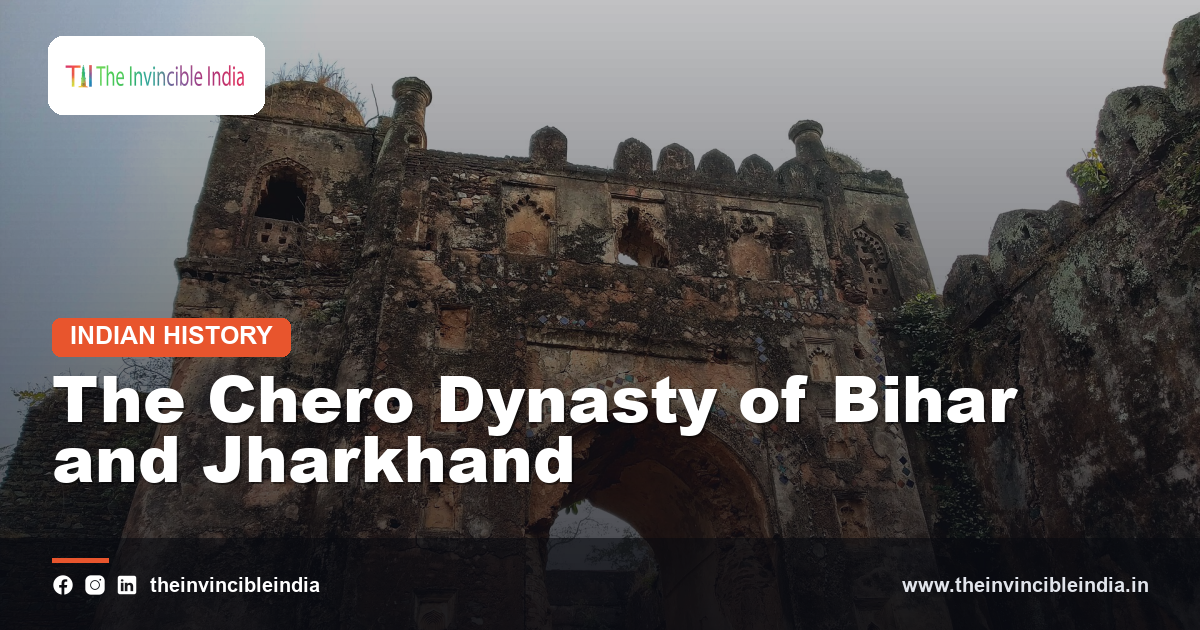
The Chero dynasty, also written as the Chero or Cheru and closely linked with the Kharwar community, refers to a line of chiefs who held the hilly, forested country of the Palamu region in present-day Jharkhand and parts of adjoining Bihar during the later medieval and early modern centuries. Ruling from strongholds in a land of dense forest and broken hills, the Cheros built the two famous Palamu forts and resisted, by turns, the Mughal Empire and later the British. Much of their early history is uncertain and debated by scholars, so this guide keeps to broad terms where the record is thin, in the same spirit as our guide to the eastern plains under the Mughal Empire.
Quick answer: The Chero dynasty was a line of local chiefs, associated with the Chero and Kharwar communities, who ruled the forested Palamu region of present-day Jharkhand and parts of Bihar during the later medieval and early modern periods. They are best remembered for the two Palamu forts in the Betla region and for their long resistance to the Mughals and later the British. Because the surviving records are fragmentary, much of their chronology is debated by historians.
Key Takeaways
- The Cheros were local chiefs who ruled the forested Palamu region of present-day Jharkhand and neighbouring parts of Bihar.
- They are closely associated with the Chero and Kharwar tribal communities of the region.
- Their most famous monuments are the old and new Palamu forts in the Betla area.
- Their power is generally placed in the later medieval and early modern centuries, though exact dates are debated.
- Mughal commanders campaigned against the Cheros of Palamu during the seventeenth century.
- The Cheros were eventually subdued and their power ended under the expanding authority of the British East India Company.
Read on for the history, culture, and legacy in detail.
Quick Facts
| Detail | Information |
|---|---|
| Dynasty | Chero dynasty (Chero / Cheru, linked with Kharwars) |
| Region | Palamu region, present-day Jharkhand and parts of Bihar |
| Terrain | Forested hills of the Chota Nagpur plateau |
| Chief Seat | The Palamu forts, near present-day Betla |
| Period | Later medieval to eighteenth century, dates debated |
| Community | Chero and Kharwar chiefs and clans |
| Chief Adversaries | Mughal Empire and later the British East India Company |
| Succeeded By | British colonial authority in the region |
Who Were the Cheros?
The Cheros were a community of chiefs and clans who held power in the Palamu region of the Chota Nagpur plateau, in what is now Jharkhand and adjoining Bihar. They are closely linked in tradition and scholarship with the Kharwar people, and the two names often appear together in accounts of the region. Rather than a single centralised kingdom, the Chero polity is best understood as a network of chiefs who controlled forts, villages and forest tracts. Their authority rested on local loyalties, control of strongholds and command of the difficult terrain. Much about their origins is uncertain and debated among historians, who rely on fragmentary records and later tradition. The Cheros therefore represent one of the many regional ruling groups whose history survives only in partial and contested form.
Where Did the Chero Dynasty Rule?
The Chero dynasty ruled chiefly over the Palamu region, a tract of forested hills in the western part of present-day Jharkhand, together with parts of neighbouring Bihar. This was country on the Chota Nagpur plateau, a landscape of wooded ranges, rivers and valleys that lay away from the main centres of imperial power in the Gangetic plain. The terrain of dense forest and broken hills favoured local chiefs who knew the land and could defend its passes and strongholds. The region sat on the frontier between the settled plains and the plateau interior, which shaped both its independence and the campaigns launched against it. The country around the Palamu forts, near present-day Betla, formed the heart of Chero power. This geography largely explains how the Cheros maintained their authority for so long.
What Are the Palamu Forts?
The Palamu forts are the most famous monuments associated with the Chero dynasty, a pair of fortresses set in the forested country near present-day Betla in Jharkhand. Tradition distinguishes an older fort, built lower down, from a newer fort constructed on higher ground, and both are linked with the Chero chiefs who held the region. Built of stone and set amid thick forest, the forts combined walls, gateways and bastions with the natural protection of the surrounding terrain. They served as centres of authority, refuge and defence against outside powers. Today the ruined forts stand within a protected forest and wildlife area and draw visitors interested in history and nature alike. The Palamu forts remain the clearest physical reminder of Chero rule in the region.
How Did the Cheros Rise to Power?
The Cheros rose to power in the Palamu region during the later medieval centuries, in a period when local chiefs across the plateau established control over forts and forest tracts. The precise circumstances of their rise are uncertain, and historians reconstruct them from fragmentary records, later chronicles and tradition rather than from a continuous documented history. What emerges is a picture of chiefs who consolidated authority over the Palamu country, built or held strongholds, and governed through clan and local loyalties. Their rise was tied to the broken, defensible geography of the region, which allowed determined leaders to resist larger powers. Because the sources are thin and sometimes conflicting, scholars treat specific claims about the earliest Chero rulers with caution. The emergence of the Cheros is thus best described in general terms as a regional consolidation of power.
Who Were the Kharwars and How Are They Linked?
The Kharwars are a community of the Chota Nagpur region who are closely linked in tradition and scholarship with the Cheros, to the point that the ruling line is sometimes described as Chero-Kharwar. The connection reflects the shared tribal and regional background of the chiefs who held the Palamu country and the overlapping social world of the plateau. Accounts differ on the precise relationship between the two names, and the matter is debated, so it is best described cautiously. What is clear is that the ruling group drew on the people and traditions of the region rather than standing apart from them. This rootedness in local communities helped the chiefs mobilise support and hold their ground. The Chero-Kharwar link is therefore an important, if imperfectly understood, part of the dynasty’s identity.
How Was the Chero Polity Organised?
The Chero polity was organised less as a single unified kingdom and more as a confederation of chiefs centred on strongholds and controlling surrounding territory. A leading chief, holding the Palamu forts, exercised authority over subordinate chiefs and clans who governed their own tracts of the forested country. Power rested on control of forts, command of armed followers and the loyalties of local communities rather than on an elaborate bureaucracy. Revenue came mainly from agriculture and the produce of the forest and land, gathered through local arrangements. This decentralised structure suited the broken terrain and made the region difficult for outsiders to control. It also meant that Chero power could fragment or revive according to the strength of individual leaders. The organisation of the polity thus mirrored the landscape it governed.
What Was the Relationship with the Mughal Empire?
The relationship between the Cheros and the Mughal Empire was marked by episodes of conflict as the empire sought to extend its authority over the plateau frontier. During the seventeenth century, Mughal commanders led campaigns into the Palamu region, and the strongholds of the Cheros were attacked in the effort to bring the area under imperial control. These expeditions were part of the wider Mughal push to subdue the forested and hilly zones that lay beyond the settled plains. The difficult terrain and the defensive strength of the forts made such campaigns demanding. While the Mughals asserted authority at various points, the remoteness of the region limited lasting control. The Chero encounter with the Mughals illustrates the persistent tension between a great empire and the resilient local powers of its frontiers.
How Did the Cheros Defend Their Territory?
The Cheros defended their territory by relying on the natural strength of the Palamu country and on their network of forts and armed followers. The dense forests, hills and difficult paths of the plateau favoured defenders who knew the land and could ambush or delay larger armies. The Palamu forts provided strongholds from which chiefs could resist attack and to which they could retreat in times of danger. Control of passes and the ability to withdraw into the forest made the region costly for outsiders to conquer and hold. Local loyalties and the mobilisation of clan followers added to this defensive capacity. These advantages allowed the Cheros to maintain their independence for long periods despite the pressure of greater powers. Their defence rested as much on geography and local knowledge as on fortifications.
What Role Did Forests and Terrain Play?
Forests and rugged terrain played a central role in the history of the Cheros, shaping their power, their economy and their ability to resist outside control. The Palamu region lies within the wooded ranges of the Chota Nagpur plateau, where thick forest, hills and rivers created a natural barrier to large armies and centralised administration. This environment sustained a way of life tied to agriculture, forest produce and local self-reliance, and it gave the chiefs a secure base. The same terrain that protected the Cheros also kept the region on the margins of the great plains kingdoms. Control of the forest tracts was therefore both the foundation of Chero authority and the reason their land was so often contested. The landscape is inseparable from the story of the dynasty.
How Did the Cheros Interact with Neighbouring Powers?
The Cheros interacted with a range of neighbouring powers on the frontier between the plateau and the plains, including the authorities of Bihar and the rulers of adjoining regions. Relations involved a shifting mixture of conflict, tribute, alliance and accommodation, as the Cheros sought to preserve their autonomy amid stronger states. At times they resisted the advance of outside powers, and at other times they reached arrangements that recognised a measure of overlordship while leaving local authority intact. The position of Palamu, between the settled country and the forested interior, made such dealings a constant feature of Chero history. These interactions reflected the realities of a frontier zone where no single power held unchallenged control. The Cheros thus survived through a combination of resistance and negotiation.
What Do the Sources Tell Us About the Cheros?
The history of the Cheros is reconstructed from fragmentary sources, including later chronicles, Mughal-era records of campaigns, local tradition and the physical evidence of the Palamu forts. No continuous contemporary chronicle of the dynasty survives, so historians piece together its story from scattered references and often conflicting accounts. This means that many details, including the names and dates of individual rulers, are uncertain and debated. The forts and their inscriptions, where they exist, offer valuable material evidence, as do the traditions preserved in the region. Scholars approach the more colourful or precise claims of later tradition with caution. Because of these limits, responsible accounts of the Cheros emphasise general patterns over specific assertions. The fragmentary record is itself a defining feature of how this dynasty is remembered.
How Did British Authority Affect the Cheros?
British authority profoundly affected the Cheros, as the expansion of the East India Company into eastern India during the eighteenth century brought the Palamu region under new control. As the Company extended its power over Bihar and the plateau, the independence of local chiefs such as the Cheros was steadily curtailed. Campaigns, treaties and administrative arrangements gradually subordinated the region to colonial authority, ending the autonomous power of the Chero chiefs. The forested frontier that had long protected them could not withstand the systematic advance of the new rulers. The Palamu country was incorporated into the wider administrative framework of British India. This transition marked the close of the independent history of the Cheros and absorbed their land into the colonial order that reshaped the whole subcontinent.
Why Did Chero Power Decline?
Chero power declined because of a combination of pressures from greater states, internal fragmentation and the eventual advance of British authority. The decentralised nature of the polity, which gave it resilience, also left it vulnerable to division among chiefs and to the loss of unity in the face of determined outside powers. Repeated campaigns, first by the Mughals and later by the British, wore down the autonomy of the region. The resources of a forested, sparsely settled country could not match those of a great empire or a colonial state. As the surrounding political order changed, the Cheros lost the independence that the terrain had long preserved. The decline was gradual rather than sudden, reflecting the slow extension of outside control over the plateau frontier. The result was the end of Chero sovereignty.
What Is the Cultural Legacy of the Cheros?
The cultural legacy of the Cheros survives in the monuments, traditions and memory of the Palamu region, even though much of their documented history is fragmentary. The Palamu forts stand as the most tangible inheritance, preserving in stone the authority once wielded by the Chero chiefs. The communities of the region retain traditions and oral memory connected with the dynasty, which form part of the cultural fabric of Jharkhand and neighbouring Bihar. The Cheros are remembered as an example of a local power that held its own on a difficult frontier for a long period. Their story contributes to the broader history of the plateau and its peoples. This legacy, though modest in surviving records, keeps the Cheros present in the regional heritage of eastern India.
Why Are the Cheros Important in Regional History?
The Cheros are important in regional history as an example of the resilient local powers that shaped the frontier zones of eastern India between the plains and the plateau. Their long control of the Palamu country illustrates how chiefs rooted in local communities and defensible terrain could maintain autonomy in the face of great empires. Their encounters with the Mughals and later the British reflect the wider process by which such regional powers were drawn into and finally absorbed by larger states. The history of the Cheros adds depth to the story of Jharkhand and Bihar, reminding us that the subcontinent’s past was made as much by regional powers as by great dynasties. For students of frontier and regional history, the Cheros offer a valuable case. Their importance lies in this local and frontier dimension of Indian history.
The Chero Dynasty Today
The Chero dynasty is remembered today chiefly through the ruined Palamu forts and the traditions of the Palamu region, set within a landscape now known for its forests and wildlife. The forts, standing amid the woods near Betla, draw visitors interested in history, heritage and nature, and they serve as the lasting symbol of Chero rule. Local communities and historians keep alive the memory of the Chero and Kharwar chiefs, even as scholars continue to debate the details of their past. For readers of Indian history, the Cheros offer a window into the world of the plateau frontier, where regional powers flourished away from the great plains. Efforts to study and preserve the forts help sustain this heritage. The Chero legacy endures in the stone and forest of the Palamu country.
Sources & Further Reading
- Archaeological Survey of India (asi.nic.in).
- Department of Tourism, Government of Jharkhand (tourism.jharkhand.gov.in).
- Ministry of Culture, Government of India (indiaculture.gov.in).
Frequently Asked Questions
Who were the Cheros?
The Cheros were a line of local chiefs, closely associated with the Chero and Kharwar communities, who ruled the forested Palamu region of present-day Jharkhand and parts of Bihar. They are best known for the Palamu forts and their resistance to outside powers.
Where did the Chero dynasty rule?
The Chero dynasty ruled chiefly over the Palamu region on the Chota Nagpur plateau in present-day Jharkhand, together with adjoining parts of Bihar. Their heartland lay in the forested country around the Palamu forts near present-day Betla.
What are the Palamu forts?
The Palamu forts are a pair of stone fortresses in the forested Betla area of Jharkhand that are closely associated with the Chero chiefs. Tradition distinguishes an older lower fort from a newer fort built on higher ground.
Did the Cheros fight the Mughals?
Yes, Mughal commanders campaigned against the Cheros of Palamu during the seventeenth century as the empire sought to extend its authority over the plateau frontier. The difficult forested terrain made such campaigns demanding.
What happened to the Chero dynasty?
Chero power declined under pressure from greater states and was finally ended as the British East India Company extended its authority over the region in the eighteenth century. The Palamu country was then absorbed into the colonial administration.
Why is so little known about the Cheros?
Little is known for certain about the Cheros because no continuous contemporary chronicle survives, and their history is reconstructed from fragmentary records and tradition. As a result, many details, including names and dates of rulers, are debated by historians.


