

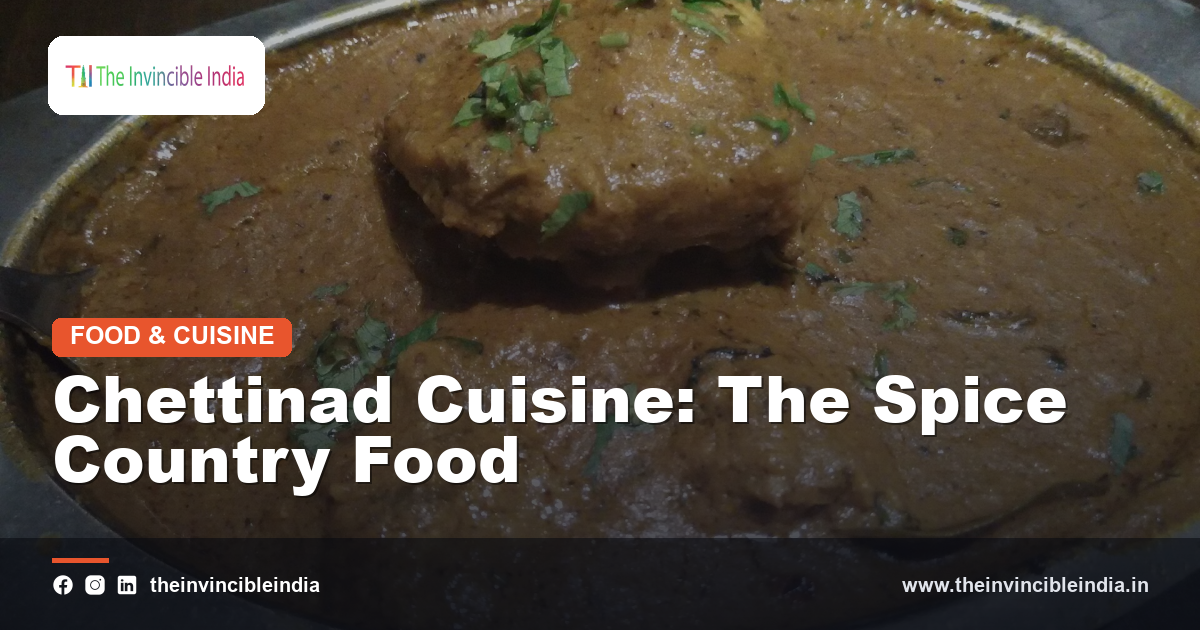
Chettinad cuisine comes from the Chettinad region of southern Tamil Nadu, the historic homeland of the Nagarathar community, and it is widely regarded as one of the most distinctive of India’s regional food traditions. Known for its generous use of freshly ground spices, dried red chillies, and whole peppercorns, the cuisine reflects the trading history of the Nagarathars, who once travelled widely and brought home an appetite for bold, layered flavours. It sits within the wider family of regional cuisines of India, standing apart for its fiery character and its skilled use of stone-ground masalas, roasted lentils, and slow-cooked meat and vegetable preparations that define the food of this compact but influential part of Tamil Nadu.
Quick Facts
| Detail | Information |
|---|---|
| Region | Chettinad, Tamil Nadu |
| Community | Nagarathar (Chettiar) merchants |
| Known For | Bold, freshly ground spice blends |
| Staple Grain | Rice |
| Signature Dish | Chettinad chicken curry |
| Flavour Profile | Fiery, peppery, aromatic |
Origins in the Chettinad Region
Chettinad cuisine takes its name from the Chettinad region, a cluster of small towns and villages in the Sivaganga and Karaikudi belt of southern Tamil Nadu that was historically home to the Nagarathar, a mercantile and banking community also known as the Nattukottai Chettiars. Because the land here is relatively dry and agriculturally modest, the community developed a food culture that leaned on preservation, spice, and resourcefulness rather than abundant fresh produce alone. Over generations, home kitchens refined a repertoire of dishes built around stone-ground masalas and slow cooking, passed down largely through oral tradition and family practice rather than written recipes. This domestic, community-centred origin remains central to how Chettinad food is still understood today, as a cuisine rooted in specific households and rituals rather than in restaurant menus, even though it is now widely enjoyed far beyond its home region.
The Chettinad Spice Blend
At the heart of Chettinad cooking lies a distinctive spice blend built from ingredients such as dried red chillies, black peppercorns, fennel seeds, star anise, and dried caper buds known locally as marathi moggu. These are typically dry-roasted and then ground fresh, often on a traditional stone grinder, rather than prepared in advance and stored for long periods, which helps preserve the intensity of their aroma. The precise combination varies from household to household, giving the cuisine a wide internal diversity even within a single village. This emphasis on freshly ground, aromatic spice mixtures rather than a single fixed masala is one of the clearest markers separating Chettinad food from many other South Indian culinary styles. The resulting dishes are known for a heat that develops gradually and a fragrance that lingers, rather than a flat or one-dimensional spiciness.
Chettinad Chicken and Meat Curries
Chettinad chicken curry is probably the single dish most associated with this cuisine outside Tamil Nadu, and it exemplifies the style’s approach to meat cookery. Pieces of chicken are typically browned and then simmered in a thick, spice-laden gravy built on the region’s characteristic masala, onions, and sometimes coconut, allowing the meat to absorb the flavour slowly over time. Mutton preparations follow a similar logic, often finished as a drier chukka-style dish where the gravy is reduced until it clings to the meat rather than remaining liquid. These meat curries are generally reserved for special meals rather than daily eating in many households, reflecting both the effort involved in preparing the spice base and the cultural association of rich non-vegetarian food with celebration and hospitality within the Nagarathar community.
Seafood in Chettinad Cooking
Although Chettinad itself is not a coastal region, its proximity to Tamil Nadu’s fishing communities and trade routes has meant that fish and shellfish feature prominently in the cuisine as well. Fish is commonly cooked in a tangy, tamarind-based gravy known broadly as meen kuzhambu, where the sourness balances the heat of the spice blend, while crab and prawn preparations are often given a thicker, more intensely spiced treatment. As with the chicken and mutton dishes, the seafood curries rely on the same foundational masala, adapted slightly to suit the more delicate texture of fish and shellfish. This seafood tradition demonstrates how Chettinad cuisine, despite its inland origins, absorbed and reworked ingredients from the wider Tamil coastal economy that the trading Nagarathar community would have been closely connected to through commerce.
Egg Dishes and Everyday Fare
Beyond the well-known meat and seafood specialities, eggs occupy an important place in everyday Chettinad cooking, offering a quicker and more economical way to enjoy the region’s characteristic flavours. Egg curry prepared in the Chettinad style typically features boiled eggs simmered in a spiced onion and tomato gravy, while other preparations incorporate eggs into stir-fried or scrambled dishes eaten with rice or flatbreads. These simpler egg-based dishes tend to appear more often in ordinary household meals than the elaborate meat curries, which are frequently kept for guests or festive occasions. This everyday layer of Chettinad cooking is less celebrated outside the region than its signature curries, but it forms the backbone of daily eating in many Nagarathar homes and shows the practical, resourceful side of the cuisine.
Vegetarian Chettinad Cooking
Despite its reputation for spice-laden meat dishes, Chettinad cuisine also has a substantial vegetarian tradition, since many Nagarathar families observe vegetarian diets on particular days or occasions, and some households are vegetarian altogether. Vegetable-based gravies known as kuzhambu form the core of this side of the cuisine, ranging from the tangy kara kuzhambu to the milder poricha kuzhambu, which uses ground coconut and lentils rather than heavy chilli. Vegetables such as brinjal, drumstick, and okra are commonly used, cooked down slowly in these gravies to absorb their flavour. This vegetarian repertoire is every bit as regionally distinctive as the meat dishes, relying on the same stone-ground spice sensibility, and it demonstrates that Chettinad cooking is defined less by meat itself than by its particular approach to spicing and technique.
Rice and Rice-Based Dishes
Rice forms the staple grain of Chettinad meals, typically served plain alongside the various curries and gravies so that its neutral flavour can balance the intensity of the spicing. A distinctive local preparation is arisi paruppu sadam, a comforting dish combining rice and lentils cooked together with mild seasoning, often served with ghee as a simpler counterpoint to the fierier curries. Fragrant varieties of rice, including seeraga samba, are prized in the region for their aroma and are used in specialty preparations for festive meals. Idiyappam, or steamed rice noodles, and appam, a soft rice pancake, also appear on the Chettinad table, particularly at breakfast or as an accompaniment to lighter curries, showing that rice in this cuisine takes many forms beyond the simple boiled staple.
Lentils, Legumes and Kuzhambu Gravies
Lentils and legumes play a substantial supporting role in Chettinad cooking, both as standalone dishes and as thickening or textural elements within the region’s many kuzhambu gravies. Paruppu usili, a preparation of steamed and crumbled lentils stir-fried with vegetables such as beans, is a well-known example that showcases how lentils are used for texture as much as protein. Toor dal and other pulses are also cooked into thinner, everyday gravies that accompany rice at ordinary meals, offering a gentler alternative to the more intensely spiced specialities. This layered use of lentils, from delicate side dishes to hearty gravies, reflects the broader South Indian reliance on pulses as a nutritional and culinary foundation, adapted here to the specific spice sensibility of the Chettinad kitchen.
Sun-Dried Vegetables and Vathal Preparations
One of the more distinctive features of Chettinad food culture is its tradition of sun-drying vegetables, a practice that likely developed as a response to the region’s relatively dry climate and the need to preserve produce across seasons. Small berries, shallots, and other vegetables are salted and dried in the sun to create vathals, which are then fried and used either as standalone crunchy accompaniments or simmered into vathal kuzhambu, a tangy tamarind-based gravy. This preservation technique allowed households to maintain flavourful, varied meals even when fresh vegetables were scarce, and it remains a hallmark of authentic Chettinad cooking today. The slightly fermented, concentrated flavour that develops during drying gives these preparations a character that cannot be replicated with fresh vegetables alone.
Chettinad Snacks and Tiffin Items
Chettinad’s snack repertoire draws on the wider Tamil tradition of tiffin foods while adding its own regional touches, particularly around festive and celebratory snacking. Seedai, small deep-fried rice flour balls, and murukku, a spiral-shaped savoury snack, are both closely associated with the region and commonly prepared in large batches during festivals. These snacks require considerable skill and patience, often being a communal kitchen activity involving several family members working together. Alongside these savoury items, the region also has a tradition of preparing sweet and savoury tea-time foods that reflect its trading history, incorporating techniques and flavours absorbed through contact with other communities. Such snacks remain an important part of Chettinad’s culinary identity, especially during festive seasons when they are made and shared generously.
Sweets of Chettinad
The sweet side of Chettinad cuisine includes preparations such as paal kozhukattai, a rice dumpling cooked in sweetened milk, and adhirasam, a deep-fried sweet made from rice flour and jaggery that is especially associated with festive occasions and weddings. These sweets tend to rely on jaggery rather than refined sugar, ghee, and rice flour as their core ingredients, reflecting broader South Indian sweet-making traditions while retaining distinctly local techniques. Preparing many of these sweets, particularly adhirasam, requires considerable experience to get the texture right, and recipes are often closely guarded within families. As with the region’s savoury vathals, these sweets demonstrate how Chettinad cuisine transforms a fairly limited set of core ingredients into an impressively varied culinary vocabulary through technique and patience.
Cooking Techniques and Traditional Utensils
Traditional Chettinad cooking relies heavily on specific tools and techniques that have shaped the character of the cuisine over generations. The ammi kal, a flat stone slab used with a stone roller to grind spices fresh for each preparation, remains central to achieving the cuisine’s signature aromatic intensity, even though many modern kitchens now use electric grinders for convenience. Wide, shallow vessels known as uruli were traditionally used for slow cooking over wood fires, allowing gravies to reduce evenly and develop deep flavour. This emphasis on manual grinding and slow, patient cooking distinguishes Chettinad food preparation from quicker, more standardised cooking methods, and it is one of the reasons the cuisine is often described as labour-intensive and best appreciated when made in the traditional way.
Festive and Ceremonial Food
Food occupies a central place in Chettinad social and ceremonial life, particularly around weddings, which historically involved elaborate community feasts prepared by teams of cooks for large numbers of guests. Such occasions, sometimes referred to through the broader term kalyana samayal or wedding cooking, would traditionally be served on banana leaves and include a wide array of vegetarian and non-vegetarian dishes reflecting the household’s hospitality. The scale and generosity of these feasts were historically tied to the trading wealth of the Nagarathar community, whose grand mansions in the region often included large kitchens designed for exactly this kind of communal cooking. Even today, festive Chettinad meals retain this spirit of abundance, bringing together many of the cuisine’s signature dishes in a single elaborate spread.
The Nagarathar Trading Legacy and Its Influence
The Nagarathar community’s history as traders and financiers with connections across Southeast Asia left a lasting imprint on Chettinad cuisine, particularly in its use of certain imported spices such as star anise, which is more commonly associated with Southeast Asian cooking than with typical South Indian food. As merchants travelled and settled temporarily in distant ports, they brought back not only wealth but also new ingredients and culinary ideas, which were gradually absorbed into home cooking back in Chettinad. The grand mansions built with this trading wealth, many of which still stand in the region, often featured expansive kitchens that supported the elaborate cooking traditions associated with community feasts. This connection between commerce and cuisine helps explain why Chettinad food feels distinct even within Tamil Nadu, carrying traces of a wider trading world.
Chettinad Cuisine Beyond Tamil Nadu
Chettinad cuisine has travelled well beyond its home region, becoming one of the most recognisable South Indian culinary styles in restaurants across India and among the Indian diaspora abroad. Its bold, spice-forward flavours have made it particularly popular with diners seeking a more intense alternative to milder South Indian fare, and dishes such as Chettinad chicken now appear on menus far removed from Tamil Nadu. This popularity has, in some cases, led to simplified or adapted versions of the cuisine that differ from the home-cooked originals, particularly in the freshness of the spice grinding and the specific vegetables used in vathal preparations. Nonetheless, this wider recognition has helped introduce many people to the broader idea of regional Indian cooking as something varied and specific rather than a single homogeneous tradition.
Chettinad Cuisine Today
Today, Chettinad cuisine continues to be sustained both by home cooks within the Nagarathar community, who preserve family recipes and techniques, and by restaurants that have carried its flavours to cities across India and beyond. There is a growing interest in returning to more authentic preparation methods, including stone-ground spices and traditional sun-dried vathals, even as convenience-driven shortcuts remain common in commercial kitchens. Food enthusiasts and culinary writers regularly highlight Chettinad cooking as an example of how a relatively small community can produce a culinary tradition of remarkable depth and internal variety. As interest in India’s regional food traditions continues to grow, Chettinad cuisine remains a well-established reference point for bold, spice-driven South Indian cooking, admired for both its intensity and its careful, technique-driven preparation.
Sources & Further Reading
- Ministry of Tourism, Government of India (tourism.gov.in).
- Tamil Nadu Tourism Department (tamilnadutourism.tn.gov.in).
Frequently Asked Questions
What makes Chettinad cuisine different from other South Indian cuisines?
Chettinad cuisine stands out for its freshly ground, intensely aromatic spice blends and its tradition of sun-drying vegetables into vathals, both shaped by the Nagarathar community’s history and the region’s dry climate.
Is Chettinad cuisine always non-vegetarian?
No. While Chettinad chicken and mutton curries are famous, the cuisine also has an extensive vegetarian tradition built around kuzhambu gravies, lentil dishes, and sun-dried vegetable preparations.
What is the Chettinad spice mix made of?
It typically includes dried red chillies, black peppercorns, fennel seeds, star anise, and dried caper buds, dry-roasted and freshly ground rather than stored for long periods.
Which dish is most associated with Chettinad cuisine?
Chettinad chicken curry is the dish most widely recognised outside Tamil Nadu, known for its thick, richly spiced gravy.
Where does the name Chettinad come from?
The name refers to the Chettinad region of Tamil Nadu, historically home to the Nagarathar, also called Chettiar, trading community whose kitchens shaped the cuisine.


