

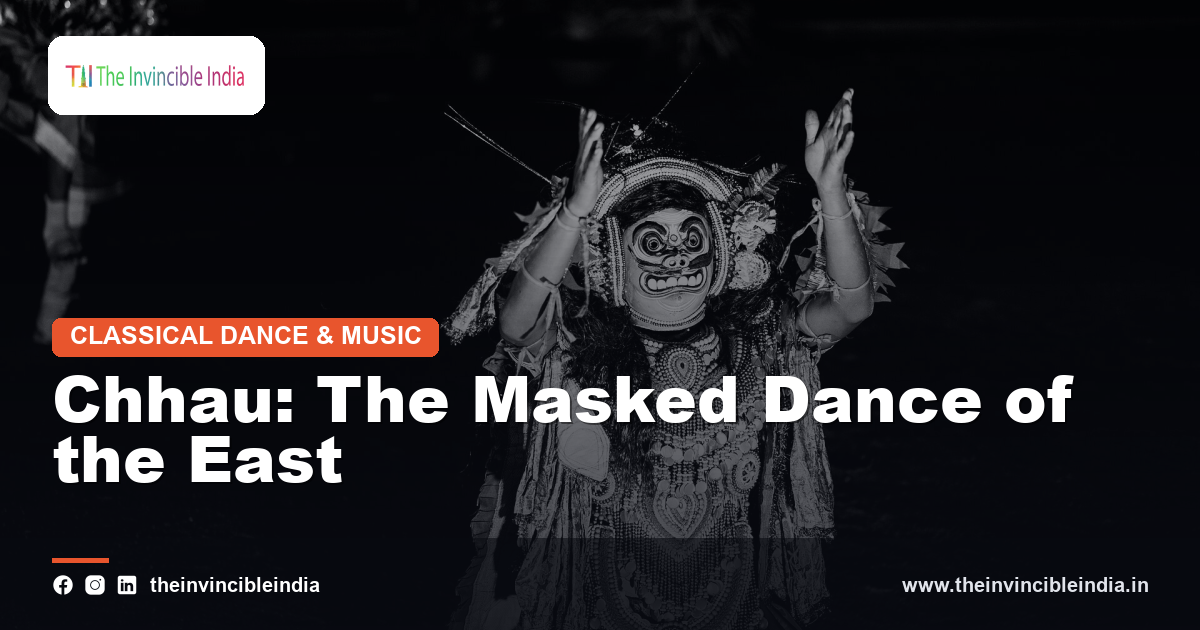
Chhau is a vigorous and dramatic dance form of eastern India, distinguished by its combination of martial movement, acrobatic athleticism and, in two of its three regional styles, striking painted masks worn by the performers. Practised chiefly across parts of Odisha, Jharkhand and West Bengal, Chhau blends elements of dance, drama and folk tradition into a single powerful performing art, standing somewhat apart from the more familiar classical dance forms of India in its martial roots and open-air festival setting. Its performances typically dramatise stories drawn from the great Indian epics and local legends, told entirely through dynamic physical movement rather than spoken dialogue or sung narration. Chhau stands as one of India’s most physically demanding and visually striking traditional dance forms, and this guide explores its styles, masks, music and history.
Quick Facts
| Detail | Information |
|---|---|
| Type | A martial-influenced dance form of eastern India |
| Regions | Odisha, Jharkhand and West Bengal |
| Three styles | Seraikella, Purulia and Mayurbhanj Chhau |
| Masks used in | Seraikella and Purulia styles (not Mayurbhanj) |
| Festival | Traditionally performed during Chaitra Parva |
| Recognition | UNESCO Intangible Cultural Heritage of Humanity |
What Is Chhau
Chhau is a vigorous and dramatic dance form of eastern India, distinguished by its combination of martial movement, acrobatic athleticism and, in two of its three regional styles, striking painted masks worn by the performers. Practised chiefly across parts of Odisha, Jharkhand and West Bengal, Chhau blends elements of dance, drama, martial exercise and folk tradition into a single powerful performing art, traditionally presented in the open air during seasonal festivals rather than in indoor concert halls. Its performances typically dramatise stories drawn from the great Indian epics and local legends, told entirely through dynamic physical movement rather than spoken dialogue or sung narration. Chhau stands as one of India’s most physically demanding and visually striking traditional dance forms.
Three Regional Styles
Chhau exists in three closely related but distinct regional styles, each named after its principal geographic home: Seraikella Chhau, associated with the Seraikella region of present-day Jharkhand, Purulia Chhau, associated with the Purulia district of West Bengal, and Mayurbhanj Chhau, associated with the Mayurbhanj region of Odisha. While all three styles share Chhau’s characteristic emphasis on vigorous, martial-inspired movement and its roots in seasonal festival performance, each has developed its own particular conventions regarding masks, costume, music and choreographic style over a long period of independent regional evolution. This regional diversity within a single named dance tradition reflects a broader pattern across India of shared cultural forms taking on distinctive local character.
Origins in Martial Tradition
Chhau is widely understood to have developed from martial exercises and war-related physical training practised in the region, with many of its characteristic movements, including vigorous leaps, spins and combative gestures, tracing a clear lineage to traditional martial arts and drills once practised by regional warrior communities. This martial heritage remains visible in Chhau’s distinctive movement vocabulary, which favours strength, athleticism and dramatic physical display over the more subtle and intricate hand gestures characteristic of classical dance forms such as Bharatanatyam or Kathak. Over time, these martial movements were gradually stylised and incorporated into a formal performing art associated with seasonal festivals and community celebration.
Seraikella Chhau
Seraikella Chhau, associated with the town of Seraikella in present-day Jharkhand, is characterised by elegant, refined masks and a comparatively graceful, lyrical style of movement that has historically enjoyed patronage and cultivation among the local ruling family and its court. This style places considerable emphasis on subtlety of movement and thematic depth despite retaining Chhau’s underlying athleticism, often drawing its subject matter from nature, mythology and abstract poetic themes rather than exclusively from epic narrative. Seraikella Chhau’s masks, carefully crafted to convey serene or expressive character through fixed facial features, are considered particularly refined examples of the mask-maker’s art within the broader Chhau tradition.
Purulia Chhau
Purulia Chhau, native to the Purulia district of West Bengal, is known for its bold, brightly coloured and often elaborately decorated masks, together with a vigorous, energetic style of movement well suited to open-air performance before large village audiences during seasonal festivals. This style frequently dramatises episodes from the Ramayana and Mahabharata as well as regional legends, with performers enacting gods, demons and heroic warriors through dynamic combat sequences, spins and leaps accompanied by loud, driving percussion and reed instruments. Purulia Chhau’s exuberant, crowd-engaging character reflects its deep roots in rural community festival culture, where it continues to be performed enthusiastically by local troupes each year.
Mayurbhanj Chhau
Unlike the Seraikella and Purulia styles, Mayurbhanj Chhau, associated with the Mayurbhanj region of Odisha, is performed without masks, relying instead entirely on facial expression, along with the same vigorous martial-inspired body movement shared across all three Chhau traditions. This unmasked approach allows performers greater scope for direct facial expressiveness in conveying character and emotion, setting Mayurbhanj Chhau apart within the broader family of Chhau styles while still preserving the shared emphasis on athletic, dynamic movement rooted in regional martial tradition. Mayurbhanj Chhau has also been noted for its relatively greater openness to structured choreographic innovation within a formal performance framework.
The Masks of Chhau
The painted masks used in Seraikella and Purulia Chhau are among the most visually striking elements of the tradition, crafted by skilled local artisans to represent gods, demons, animals, and legendary or historical characters, each mask carefully designed to convey a fixed emotional or symbolic character through form and colour alone. Because the mask conceals the performer’s own facial expression entirely, all emotional communication in these masked styles must be conveyed through body movement, posture and gesture, placing considerable demands on a dancer’s physical expressiveness. Mask-making itself is a specialised traditional craft passed down within particular artisan communities, closely tied to the continued practice of the masked Chhau styles.
Costumes and Adornment
Chhau performers typically wear elaborate and colourful costumes appropriate to the character being portrayed, ranging from the simple attire of a village hero to the ornate, richly decorated garments and headdresses befitting a god, demon or mythological king, often embellished with sequins, embroidery and decorative ornaments. These costumes, combined with the masks used in the Seraikella and Purulia styles, help transform performers visually into the larger-than-life characters of epic and legendary narrative, supporting the dramatic and often supernatural themes explored in Chhau performance. The preparation of costumes and masks before a festival performance is itself considered an important part of the tradition, involving considerable community participation.
Music and Accompaniment
Chhau performances are accompanied by a robust ensemble of traditional instruments, typically including various types of drums that provide the powerful, driving rhythmic foundation essential to the dance’s vigorous martial movements, along with reed instruments such as the shehnai or similar wind instruments that carry the melodic line. This loud, energetic musical accompaniment, well suited to open-air performance before large festival audiences, closely supports the dramatic and athletic qualities of the dance, with rhythmic accents often coordinated precisely with a performer’s leaps, spins and combative gestures. The relationship between music and movement in Chhau is tightly integrated, with percussion playing an essential role in driving the pace of each performance.
Themes and Stories
Chhau performances most commonly dramatise episodes from the great Indian epics, the Ramayana and the Mahabharata, along with stories drawn from regional legend, local deities and, in some styles, more abstract themes inspired by nature and the seasons. These narratives are conveyed entirely through movement, gesture and dramatic staging rather than spoken dialogue, requiring performers to communicate complex stories, characters and emotions using only the dance’s distinctive physical vocabulary. Battle scenes between gods and demons are especially popular and well suited to Chhau’s martial movement style, allowing the athletic, combative elements of the dance to serve dramatic storytelling purposes as well as pure physical display.
Movement Vocabulary
The distinctive movement vocabulary of Chhau combines vigorous leaps, spins, acrobatic jumps and stylised combative gestures with more measured, expressive sequences appropriate to particular characters or moods, requiring performers to master both explosive athleticism and controlled, disciplined movement. This demanding physical vocabulary draws directly on the dance’s martial origins, and dancers typically undergo rigorous physical training from a young age to develop the strength, flexibility and stamina required for sustained, energetic performance, often lasting for extended periods during festival celebrations. The blending of athletic display with narrative and symbolic content distinguishes Chhau from many other Indian dance traditions.
The Chaitra Parva Festival
Chhau is most closely associated with seasonal festival performance, traditionally staged as part of the Chaitra Parva celebrations marking the Hindu new year in the spring, when troupes across the Chhau region perform through the night before large gathered village audiences. These festival performances are deeply embedded in local community life, involving considerable preparation, communal participation and a strong sense of regional identity and pride, with different villages and troupes sometimes presenting distinctive interpretations of shared stories. The connection between Chhau and this specific seasonal festival calendar underscores the dance’s traditional role as an integral part of community religious and cultural celebration.
Training and Transmission
Chhau is traditionally taught within specific communities and families closely associated with the dance, with training beginning at a young age and progressing through years of rigorous physical conditioning, disciplined practice of the dance’s movement vocabulary, and gradual exposure to its narrative and dramatic conventions under the guidance of experienced teachers. This apprenticeship model, similar in spirit to other traditional Indian performing arts, ensures that both the physical technique and the deeper narrative and symbolic knowledge associated with Chhau are passed down accurately from one generation of performers to the next. Formal cultural institutions have more recently begun to support this traditional training system through structured programmes.
UNESCO Recognition
Chhau’s cultural significance received wider international recognition when the dance form was inscribed on the list of the Intangible Cultural Heritage of Humanity maintained by UNESCO, an acknowledgement of its distinctive artistic value and its importance to the communities that continue to practise and preserve it. This international recognition has helped raise awareness of Chhau both within India and abroad, encouraging further documentation, support and interest in a tradition that, like many regional folk and martial performing arts, has historically depended heavily on local community patronage for its continued survival. Such recognition also supports ongoing efforts to sustain the tradition’s distinctive regional styles and associated craft practices.
Chhau in the Modern Era
In recent decades, Chhau has increasingly been presented on formal theatrical stages, both within India and internationally, adapting its traditionally open-air, festival-based performance to more structured concert settings while still striving to preserve its essential martial and dramatic character. Contemporary choreographers and dance companies have sometimes drawn on Chhau’s distinctive movement vocabulary to create new theatrical works, introducing the tradition’s athletic, expressive style to audiences unfamiliar with its regional festival origins. These modern adaptations coexist with, rather than replace, the continued traditional performance of Chhau during the Chaitra Parva festival season in its original regional communities.
Chhau Today
Chhau remains a vital and celebrated performing art today, practised by dedicated troupes across Odisha, Jharkhand and West Bengal and increasingly appreciated by audiences and cultural institutions across India and internationally. Its distinctive fusion of martial vigour, dramatic storytelling and, in two of its three regional styles, striking traditional masks continues to set Chhau apart as one of India’s most physically dynamic and visually memorable dance traditions. Supported by continued community practice, growing institutional recognition and international acknowledgement of its cultural significance, Chhau endures as a powerful living link between regional martial heritage and the broader landscape of India’s traditional performing arts.
Sources & Further Reading
- Sangeet Natak Akademi, national academy for music, dance and drama, on the folk and traditional dance forms of India (sangeetnatak.gov.in).
- Ministry of Culture, Government of India, on India’s intangible cultural heritage (indiaculture.gov.in).
Frequently Asked Questions
What is Chhau dance?
Chhau is a vigorous dance form of eastern India combining martial movement, acrobatics and dramatic storytelling, practised across parts of Odisha, Jharkhand and West Bengal and traditionally performed during seasonal festivals.
What are the three styles of Chhau?
The three regional styles are Seraikella Chhau and Purulia Chhau, both performed with masks, and Mayurbhanj Chhau, which is performed without masks and relies instead on facial expression.
Why do some Chhau dancers wear masks?
In the Seraikella and Purulia styles, painted masks represent gods, demons and legendary characters, concealing the performer’s face so that all emotion is conveyed through body movement and gesture alone.
When is Chhau traditionally performed?
Chhau is most closely associated with the Chaitra Parva festival marking the Hindu new year in spring, when troupes perform through the night before large gathered village audiences.
Has Chhau received international recognition?
Yes, Chhau has been inscribed on UNESCO’s list of the Intangible Cultural Heritage of Humanity, acknowledging its distinctive artistic value and importance to the communities that continue to practise it.


