

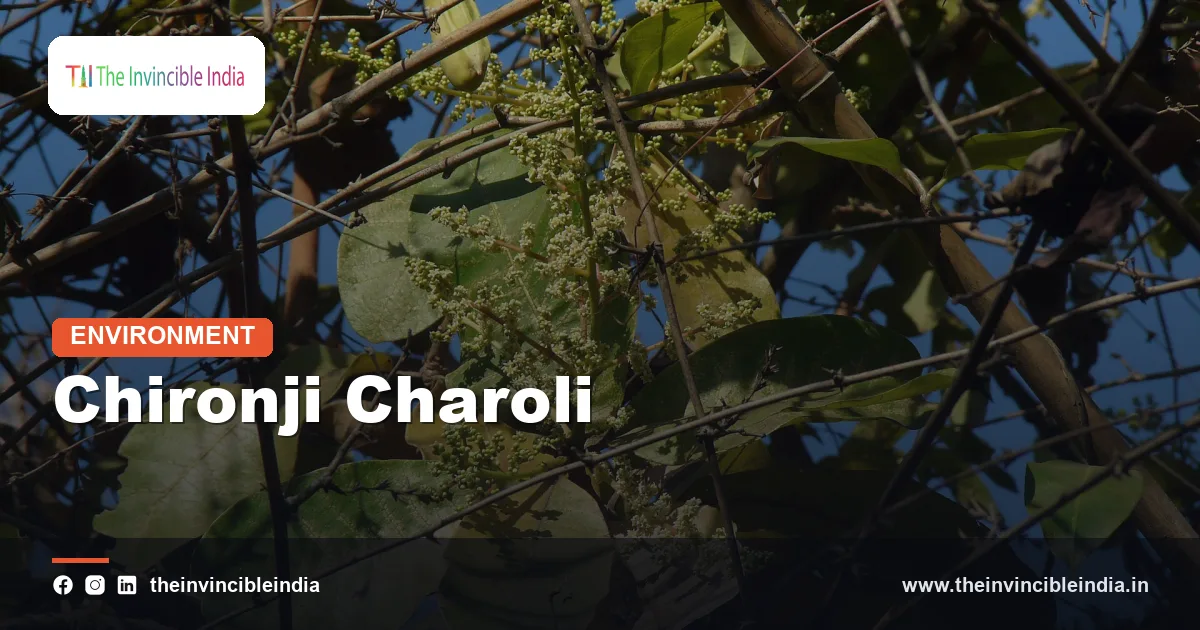
Chironji, also called charoli, is the small, lentil-sized, almond-flavoured seed (kernel) of the forest tree Buchanania lanzan, which grows wild in the dry deciduous forests of central and peninsular India and is used in sweets, desserts and festive dishes. Collected each summer by forest-dwelling communities and sold as a premium dry-fruit ingredient, chironji is one of India’s best-known minor forest products, valued for a delicate, nutty taste that resembles almond but is milder and sweeter.
The seed is tiny, but the story behind it spans a tall forest tree, a short summer harvest, a labour-intensive extraction process and a long chain of traders and sweet makers. This explainer covers what chironji is, which tree it comes from, where it grows, how it is harvested, how it is used in Indian cooking and why it matters to forest livelihoods.
| Quick Fact | Detail |
|---|---|
| Common names | Chironji, charoli, chironjee; also called piyal, achar or char in various regions and the Almondette or cuddapah almond in English |
| Scientific name | Buchanania lanzan (earlier also written as Buchanania latifolia or Buchanania cochinchinensis) |
| Plant family | Anacardiaceae (the mango and cashew family) |
| Native region | India and parts of South and Southeast Asia |
| Where grown in India | Dry deciduous forests of Madhya Pradesh, Chhattisgarh, Jharkhand, Odisha, Maharashtra, Andhra Pradesh, Telangana, Rajasthan and parts of Uttar Pradesh and Gujarat |
| Season | Flowers in winter; fruits ripen and are collected roughly from April to June |
| Part used | The kernel inside a hard-shelled seed within a small fruit |
| Main uses | Sweets, kheer, halwa, laddoo, barfi, milk drinks, garnishes and spice-paste thickeners |
| Notable fact | Most chironji comes from wild trees and is gathered by tribal and rural forest communities |
Key Takeaways
- Chironji is the edible kernel of the fruit of Buchanania lanzan, a deciduous forest tree of the mango family native to India.
- Chironji, also known as charoli, has a mild almond-like flavour and is widely used as a garnish and flavouring in Indian sweets and desserts.
- Most chironji is collected from wild trees in the dry deciduous forests of central India, and the harvest is carried out largely by tribal and rural forest communities.
- The chironji fruit ripens in the hot months, roughly April to June, and each tiny seed must be cracked open by hand to extract the kernel.
- Chironji is classified as a non-timber or minor forest produce, and gathering it supports seasonal incomes for forest-dependent households.
- The chironji tree grows slowly and is hard to cultivate, so conservation of wild trees and careful harvesting are important to keep supplies steady.
What Is Chironji?
Chironji is the small edible seed kernel obtained from the fruit of the chironji tree, Buchanania lanzan, and it is eaten like a nut. The kernel is roughly the size of a lentil, flat or slightly rounded, and cream to pale brown in colour.
The fruit from which it comes is a small drupe, about a centimetre across, which is green when young and turns dark purple-black when ripe. The flesh is thin and sweet-sour, and inside it lies a hard, dark shell that surrounds the kernel. The kernel is the part used in the kitchen.
Chironji has a soft, slightly oily texture and a gentle nutty flavour that many people compare to almond, with a hint of sweetness. It is typically used whole, lightly roasted or soaked, and sprinkled over desserts. The names chironji and charoli are used interchangeably across India, and the spelling varies in English as chironjee or chirounji.
What Tree Does Chironji Come From?
Chironji comes from the chironji tree, Buchanania lanzan, a medium to tall deciduous tree in the family Anacardiaceae, which also includes the mango, cashew and pistachio. It typically grows between 10 and 18 metres tall, and old trees can be larger.
The tree is easy to recognise. The bark is dark grey to blackish and cracks into small rough squares, giving a rough, crocodile-skin pattern. The leaves are large, thick, oblong and leathery, often crowded at the ends of branches, and they are covered with fine hairs underneath. The tree sheds its leaves in the dry season, and new leaves appear around the time of flowering.
The flowers are small, greenish-white or cream, and borne in branched clusters at the ends of twigs. They are pollinated mainly by insects, and the fruit takes several months to mature. In the forests of central India, the chironji tree commonly grows with sal, teak, mahua, tendu and other dry deciduous species.
Where Does Chironji Grow in India?
Chironji grows wild in the dry deciduous forests of central, eastern and peninsular India, with Madhya Pradesh, Chhattisgarh, Jharkhand, Odisha, Maharashtra, Andhra Pradesh and Telangana among the main areas. The tree is also found in parts of Rajasthan, Uttar Pradesh, Gujarat, Karnataka and other states with suitable forest cover.
The species prefers warm, seasonally dry conditions and tolerates poor, shallow and rocky soils. It is found on plateaus, hill slopes and forest edges rather than in wet coastal or high-rainfall areas. It cannot withstand heavy waterlogging, and young trees are sensitive to frost.
The forests of Chhattisgarh and Madhya Pradesh, with their large tribal populations, are particularly associated with chironji gathering. Smaller supplies come from other states, and the tree also occurs in neighbouring countries of South and Southeast Asia. Because the crop is wild-collected and varies from year to year, overall quantities are not tightly measured or reported.
When and How Is Chironji Harvested?
Chironji is harvested in the hot months, usually from April to June, when the small fruits turn dark and ripen on the tree. Collectors, often whole families, pick the fruit from branches or gather it by shaking and lopping twigs, and in the traditional method many go into the forest at dawn to avoid the heat.
After collection, the processing stages are laborious.
- The ripe fruits are dried in the sun, so that the thin flesh shrinks and the hard seed becomes easy to separate.
- The dried fruits are rubbed or pounded to remove the pulp and clean the seeds.
- Each hard seed is cracked open by hand, usually with a stone or a special tool, to release the kernel.
- The kernels are sorted, dried again and graded, with whole, pale kernels fetching higher prices.
Because every kernel must be extracted by hand and each tree yields only a modest quantity of seeds, the process takes a lot of time. It is one reason why chironji is expensive relative to many other nuts and why it is sold in small quantities.
Who Collects Chironji and Why Does It Matter to Forest Livelihoods?
Chironji is collected mainly by tribal and other forest-dwelling communities, and it forms part of the seasonal income that these households earn from minor forest produce. Groups such as the Gond, Baiga, Bhil and others across central India have traditionally gathered forest products such as chironji, mahua flowers, tendu leaves, sal seeds and honey.
Under Indian law, chironji is counted as non-timber or minor forest produce. The Forest Rights Act, 2006, recognises the rights of eligible forest-dwelling communities to collect, use and sell minor forest produce, and several state agencies and cooperatives help organise collection and sale. In some states, government-supported federations and self-help groups buy the kernels and provide support in grading and marketing.
Prices paid to collectors are much lower than the prices that consumers pay in city shops, because the kernels pass through village traders and wholesalers before reaching retail. Efforts to support collectors include direct purchase, fair pricing, cooperatives and simple processing units that let communities shell and grade the kernels themselves. The details differ by state and change over time.
How Is Chironji Used in Indian Cooking?
Chironji is used in Indian cooking as a nut-like garnish and flavouring in sweets, desserts, rich gravies and drinks. Its mild taste and soft texture mean it can sit on top of sweets without overpowering them, and it is often used in place of, or along with, almonds and pistachios.
Common uses
- Sweets: scattered on kheer, halwa, laddoo, barfi, peda, rabri and other milk-based sweets.
- Festive dishes: added to prasad, panjiri and traditional winter sweets in several regions.
- Rich gravies: ground into a paste with other nuts and seeds to thicken and enrich curries in Mughlai and North Indian cuisine.
- Drinks: used in thandai-style drinks, milkshakes and sherbets.
- Baking and confectionery: mixed into cakes, cookies and chikki.
- Traditional preparations: used in some regional tonic and winter foods.
Cooks often dry roast the kernels briefly or soak them to soften them. They are used in small quantities because of their cost, and they are best stored in an airtight container in a cool, dry place to prevent the natural oils from turning rancid.
What Is in Chironji? Is It Nutritious?
Chironji kernels contain fat, protein, carbohydrate and minerals, and they are an energy-dense food like most nuts and seeds. Analyses of Buchanania lanzan kernels commonly report a significant share of oil and a useful amount of protein, although exact values vary with the source and method of analysis.
The oil can also be extracted. Chironji oil is a pale, edible oil that has been used locally in cooking, in traditional preparations and in cosmetics. Studies of the kernel’s oil show that it is rich in unsaturated fatty acids, similar to some other tree nuts.
As with other nuts, chironji should be eaten in moderate portions, and people with nut allergies should be cautious. Traditional systems of medicine have used the tree’s seeds, gum and bark in home remedies, but these are traditional uses and not proven treatments. Chironji is best viewed as a flavourful, nourishing nut-like seed, and not as a medicine.
Can Chironji Be Cultivated?
Chironji can be cultivated, but the tree is slow-growing and difficult to propagate, so most supply still comes from wild trees. The seed has a hard coat and germinates slowly and unevenly, and seedlings grow slowly in their first years.
Research institutions in India have worked on better ways to raise chironji, including nursery techniques for seeds, grafting and budding of selected trees, and trials on farm land and degraded forest. Grafted plants can start bearing earlier than seedlings, but the work is still limited, and commercial orchards remain rare.
Wild-collected supplies also face pressures. These include forest loss, over-harvest of unripe fruit, damage to branches during collection and forest fires in the dry season. Conservation measures, including collecting only ripe fruit, protecting mother trees and planting new saplings, help to keep the resource sustainable.
How Does Chironji Compare With Other Nuts and Seeds?
Chironji differs from almond, cashew and pistachio in size, taste, cost and source. The table below compares these common ingredients used in Indian sweets.
| Ingredient | Plant source | Size and taste | Typical use |
|---|---|---|---|
| Chironji (charoli) | Buchanania lanzan, wild forest tree | Tiny; mild, sweet almond-like | Garnish for sweets, kheer and halwa |
| Almond | Prunus dulcis, orchard tree | Large; firm, nutty | Sweets, snacks, milk drinks |
| Cashew | Anacardium occidentale, coastal plantation tree | Curved; soft, buttery | Sweets, gravies, snacks |
| Pistachio | Pistacia vera, imported orchard crop | Small; green, distinctly flavoured | Garnish, ice cream, sweets |
Chironji is botanically related to cashew and mango, since all three belong to the family Anacardiaceae, but it is the only one of these that is gathered mostly from wild forest trees.
Bottom Line
Chironji is a tiny, almond-flavoured seed that connects the forests of central India with the sweet shops of its cities. Its supply rests on slow-growing wild trees and on the skilled, hard work of forest communities, which makes careful harvesting and fair pricing the main keys to its future.
Frequently Asked Questions
What is chironji?
Chironji is the small, almond-flavoured edible kernel of the fruit of the tree Buchanania lanzan. It is used in Indian sweets, desserts and rich gravies, and it is also known as charoli.
Are chironji and charoli the same?
Yes, chironji and charoli are two names for the same seed from Buchanania lanzan. The name used depends on region and language, and the English spelling also appears as chironjee.
Where does chironji grow in India?
Chironji grows wild in the dry deciduous forests of central and peninsular India, especially in Madhya Pradesh, Chhattisgarh, Jharkhand, Odisha, Maharashtra, Andhra Pradesh and Telangana. The tree prefers warm, seasonally dry conditions and poor, well-drained soils.
When is chironji harvested?
Chironji is harvested in the hot months, roughly from April to June, when the small fruits ripen and turn dark. The seeds are then dried and cracked by hand to remove the kernels.
Why is chironji expensive?
Chironji is expensive because it comes mainly from wild trees, is harvested in a short season and needs every seed to be cracked by hand. The small yield per tree and the labour of extraction raise its price compared with common nuts.
How is chironji used in food?
Chironji is used mainly as a garnish and flavouring in sweets such as kheer, halwa, laddoo and barfi. It is also ground into pastes to enrich gravies and added to milk-based drinks, and it is usually used in small amounts.
{“@context”:”https://schema.org”,”@graph”:[{“@type”:”FAQPage”,”mainEntity”:[{“@type”:”Question”,”name”:”What is chironji?”,”acceptedAnswer”:{“@type”:”Answer”,”text”:”Chironji is the small, almond-flavoured edible kernel of the fruit of the tree Buchanania lanzan. It is used in Indian sweets, desserts and rich gravies, and it is also known as charoli.”}},{“@type”:”Question”,”name”:”Are chironji and charoli the same?”,”acceptedAnswer”:{“@type”:”Answer”,”text”:”Yes, chironji and charoli are two names for the same seed from Buchanania lanzan. The name used depends on region and language, and the English spelling also appears as chironjee.”}},{“@type”:”Question”,”name”:”Where does chironji grow in India?”,”acceptedAnswer”:{“@type”:”Answer”,”text”:”Chironji grows wild in the dry deciduous forests of central and peninsular India, especially in Madhya Pradesh, Chhattisgarh, Jharkhand, Odisha, Maharashtra, Andhra Pradesh and Telangana. The tree prefers warm, seasonally dry conditions and poor, well-drained soils.”}},{“@type”:”Question”,”name”:”When is chironji harvested?”,”acceptedAnswer”:{“@type”:”Answer”,”text”:”Chironji is harvested in the hot months, roughly from April to June, when the small fruits ripen and turn dark. The seeds are then dried and cracked by hand to remove the kernels.”}},{“@type”:”Question”,”name”:”Why is chironji expensive?”,”acceptedAnswer”:{“@type”:”Answer”,”text”:”Chironji is expensive because it comes mainly from wild trees, is harvested in a short season and needs every seed to be cracked by hand. The small yield per tree and the labour of extraction raise its price compared with common nuts.”}},{“@type”:”Question”,”name”:”How is chironji used in food?”,”acceptedAnswer”:{“@type”:”Answer”,”text”:”Chironji is used mainly as a garnish and flavouring in sweets such as kheer, halwa, laddoo and barfi. It is also ground into pastes to enrich gravies and added to milk-based drinks, and it is usually used in small amounts.”}}]}]}


