

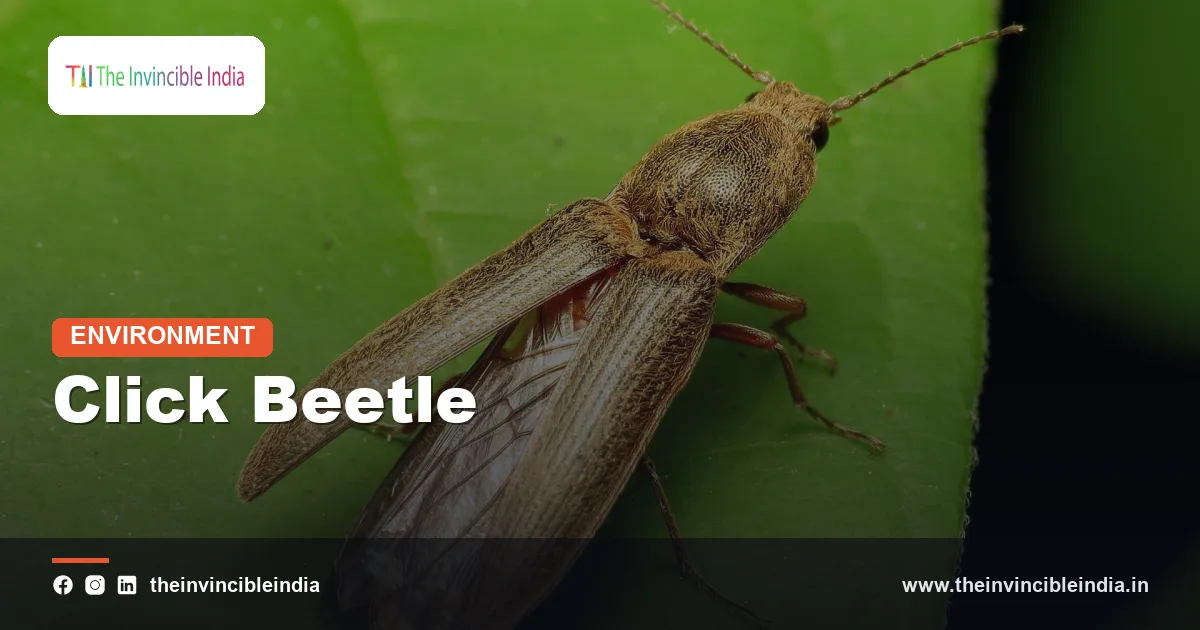
A click beetle is a beetle of the family Elateridae that can snap its body with an audible click, flipping itself into the air to right itself when upturned or to escape a predator. The family is large and worldwide, with thousands of species, and members are common in Indian fields, gardens, grasslands and forests. The adults are elongated, hard-bodied beetles, while their larvae are the slender, tough “wireworms” known to farmers as pests of roots and seeds.
This guide explains how the click works, how to recognise a click beetle, what adults and larvae eat, how the insect develops, and why wireworms matter to Indian agriculture. It also covers the beneficial side of the family and simple, non-chemical ways of managing wireworms.
| Attribute | Details |
|---|---|
| Scientific classification | Order Coleoptera, family Elateridae (click beetles) |
| Other names | Snapping beetles, skipjacks, spring beetles; larvae called wireworms |
| Size | Adults mostly from about 0.5 cm to over 3 cm in length, depending on species |
| Habitat in India | Crop fields, grassland, gardens, scrub, forest floors, rotting logs, light traps near lamps |
| Diet | Adults: pollen, nectar, plant sap or little at all; larvae: roots, seeds, tubers or small soil animals, depending on species |
| Life cycle | Complete metamorphosis (egg, larva, pupa, adult); larval stage can last one to several years |
| Defining trait | Spine-and-notch hinge between the first two thoracic segments that produces the click |
| Role | Some larvae are crop pests; many are soil predators or decomposers; adults feed birds and other animals |
Key Takeaways
- A click beetle is a member of the family Elateridae, which is distinguished by a spring-like hinge that lets the beetle snap its body and flip into the air.
- The click of a click beetle is produced when a spine on the first thoracic segment slips out of a notch on the second segment, releasing stored muscle energy.
- Click beetle larvae are called wireworms, and some species damage seeds, roots and tubers of crops such as potato, sugarcane, groundnut and cereals.
- Click beetle larvae live in soil or rotting wood for months to years, while the adults are shorter-lived and often come to lights at night.
- Not all click beetles are pests, because many larvae are predators of other soil insects and others help break down dead wood.
- Wireworm damage in India is best managed with deep ploughing, crop rotation, clean fields and, where needed, seed protection advised by agricultural extension officers.
What is a click beetle?
A click beetle is any beetle in the family Elateridae, a large group of elongate beetles that can jump with a loud click. The family is part of the order Coleoptera, the beetles, which is the largest order of insects in the world.
More than ten thousand species of click beetles are known worldwide, and the family is found on every continent except Antarctica. In India they range from small brown beetles of a few millimetres to larger, more strikingly patterned forms found in forests. Many are dull brown, black or grey, but some are metallic, mottled or marked with spots.
The name comes from the clicking sound, but several other common names describe the same behaviour, including snapping beetle, skipjack and spring beetle. These names all refer to the beetle’s habit of springing into the air when it is lying on its back.
How does a click beetle click?
A click beetle clicks by locking a peg on its first thoracic segment into a notch on its second segment, building up muscle tension, and then releasing the peg suddenly. The release snaps the body straight like a spring and produces the audible click.
The structure involved has three main parts:
- The prosternal spine: a peg that projects backward from the underside of the front segment of the thorax, called the prothorax.
- The mesosternal notch: a groove or pit on the next segment that receives the spine.
- The muscles: a powerful set of muscles that bend the front of the body and lock the peg against the edge of the notch.
When the beetle is on its back, it arches its body so that the peg is held against the notch. Muscle force builds until the peg slips over the edge and snaps into the notch. The sudden movement bangs the body against the ground, makes the click and throws the beetle upward, often spinning, so that it has a good chance of landing on its feet.
The acceleration is very high, reported to reach several hundred times the force of gravity, even though the beetle is only a few centimetres long at most. The jump can raise the beetle several centimetres into the air, many times its own body length. If the first attempt fails, the beetle simply tries again.
Why do click beetles click and jump?
Click beetles click and jump mainly to turn themselves over when they are on their backs and to startle or escape predators. These two uses are the best-supported explanations for the behaviour.
Righting themselves
Click beetles have short legs and a body that is narrow and hard, so they are not good at turning over by crawling. The click-jump allows a beetle that has fallen on a smooth surface, such as a leaf or a rock, to flip over without needing anything to grip.
Escaping predators
When a bird, spider, ant or other predator grabs or approaches a click beetle, the beetle can drop, play dead and then click itself into the air. The sound and the sudden movement can startle a predator long enough for the beetle to escape.
Other possible uses
Some scientists have suggested that the click may help beetles free themselves from small gaps or the grip of a predator’s mouth. Whatever the exact benefit, the same mechanism serves all of these purposes.
How can you recognise a click beetle?
You can recognise a click beetle by its elongated, parallel-sided body, its pointed rear corners on the front of the thorax and the clicking jump it makes when held or turned over. The body shape is quite consistent across the family.
- Shape: long, narrow and slightly flattened, tapering at the back, like a small, hard grain.
- Pronotum: the plate covering the front of the thorax is often wider at the back, with pointed hind corners that look like small spurs.
- Antennae: usually thread-like, saw-toothed or comb-like, depending on the species and the sex.
- Colour: brown, black, grey or reddish for most species, with some mottled or metallic forms.
- Behaviour: when picked up or placed on its back, the beetle clicks and springs.
Some click beetles carry large false eyespots on the pronotum, which may startle predators. In the American tropics there are also bioluminescent click beetles, but that trait is not a general feature of the family in India.
Where do click beetles live in India?
Click beetles live across India in nearly every land habitat, from cultivated fields and grasslands to forests, gardens and the edges of settlements. Adults are found on vegetation, under bark, on flowers and around lights, while larvae live in the soil or in decaying wood.
In farming areas, the beetles are often noticed at the edges of fields, on crop foliage in the evening, or near lamps in the monsoon, when many insects are drawn to light. In forests, larger species hide under loose bark and in leaf litter. Larvae need soil or wood that stays damp enough for them to move and feed, so the abundance of click beetles often follows rainfall and soil conditions.
Because many species are small, brown and secretive, they are easy to overlook. Entomologists in India have recorded a large number of elaterid species, and the group is still being studied in detail in several regions.
What do click beetles eat?
Adult click beetles eat pollen, nectar, plant juices or soft plant tissue, or in some species eat very little, while the larvae eat roots, seeds and soil animals, depending on the species. The diet varies far more among larvae than among adults.
| Stage | Typical food | Notes |
|---|---|---|
| Adult | Pollen, nectar, plant sap, fungi or little food | Some adults are active at night and come to lights |
| Larva (plant feeders) | Seeds, roots, stems and tubers | These are the pest wireworms of crops |
| Larva (predators) | Insect larvae, worms and other small soil animals | These help control soil pests |
| Larva (wood dwellers) | Decaying wood and the animals living in it | These aid decomposition in forests |
Because the larvae of different species behave so differently, it is wrong to call every click beetle a pest. The same family contains both damaging root feeders and useful predators, which is why careful identification matters before any control is attempted.
What is a wireworm?
A wireworm is the larva of a click beetle, a slender, hard-bodied, cylindrical grub that lives in soil or rotting wood. The name comes from its smooth, tough, wire-like body, which is usually yellow to brown and has a darker head and three pairs of short legs near the front.
Wireworms can be distinguished from other soil grubs by their shiny, firm skin, which resists being squashed, and by the pair of small projections or a notched plate at the tail end. Their tough body protects them from soil abrasion and from predators.
Larvae can live for a long time. In cool regions the larval stage may last for several years, but in the warm tropics and subtropics the development is generally faster. During this period, the wireworm moves down in the soil in dry or cold weather and rises toward the surface when the soil is moist and warm.
What is the life cycle of a click beetle?
A click beetle passes through complete metamorphosis with four stages: egg, larva, pupa and adult. The larval stage is by far the longest, and it is the stage that is most important to farmers.
Egg
Females lay small, pale, oval or round eggs in the soil, often near plant roots, in grassy places or in cracks in rotting wood. A female may lay many eggs, depending on the species.
Larva
The larva hatches and grows through numerous moults, called instars. It feeds and burrows in the soil or wood, and as it grows it can cause increasing damage if it is a plant feeder.
Pupa
When mature, the larva forms a small earthen or woody cell and changes into a pupa. The pupal stage lasts a few weeks, and the pupa gradually acquires the shape and colour of the adult.
Adult
The adult beetle emerges, often waiting in the pupal cell until conditions are suitable, and then comes to the surface to feed, mate and lay eggs. Adults live for weeks to months, and most are active in the warm, humid part of the year.
Why are click beetles important to Indian agriculture?
Click beetles matter to Indian agriculture because the wireworm larvae of some species damage seeds, seedlings, roots and tubers of important crops. Reports from different regions mention damage to potato, sugarcane, groundnut, maize, wheat, vegetables and other crops.
The damage appears in several ways:
- Seeds are hollowed out before germination, causing patchy stands.
- Seedlings wilt or die when the root or the base of the stem is eaten.
- Potatoes and other tubers carry narrow, tunnel-like holes that reduce market value and allow rot-causing organisms to enter.
- Sugarcane setts and young shoots are damaged below ground.
Wireworm injury is often scattered and hard to diagnose, because the damage occurs underground and the pest is rarely seen above it. Fields recently converted from pasture or fallow grass are more at risk, as the larvae are already present in the sod. In India, wireworm genera reported from fields include Agrypnus and Melanotus, although the species involved differ by region and crop.
How can wireworm damage be managed?
Wireworm damage can be managed by good field practices such as deep summer ploughing, crop rotation, careful timing of sowing and removal of weeds and crop residues, along with seed protection when advised by local agricultural experts. Prevention is generally more effective than trying to control the pest after damage appears.
- Deep ploughing in summer: exposes larvae and pupae to heat and to birds, reducing populations.
- Crop rotation: avoiding the same susceptible crop in the same field year after year, and rotating with less favoured crops, breaks the pest’s cycle.
- Clean cultivation: controlling grassy weeds and removing crop residues removes both food and egg-laying sites.
- Proper irrigation and timing: managing soil moisture and sowing when seedlings can grow quickly helps plants outgrow damage.
- Monitoring: simple soil sampling or buried bait, such as germinating seed, can show whether wireworms are present before a crop is sown.
- Professional advice: farmers should consult their local Krishi Vigyan Kendra or state agriculture department before using seed treatments or soil insecticides.
Natural enemies such as birds, ground beetles and certain soil fungi also help to reduce wireworm numbers. Because chemical control can harm useful soil organisms, integrated pest management, which combines several methods, is the preferred approach.
Are click beetles helpful or harmful?
Click beetles are both helpful and harmful, depending on the species and life stage. The family as a whole has an important place in soil and forest ecosystems, even though a few species cause crop losses.
- Harmful: plant-feeding wireworms can reduce crop stands and spoil tubers.
- Helpful as predators: many larvae eat other insect larvae and small soil animals.
- Helpful as decomposers: wood-dwelling larvae help break down dead trees and return nutrients to the soil.
- Food for wildlife: adults and larvae are eaten by birds, lizards, frogs, spiders and other predators.
- Pollen visitors: some adults visit flowers and may carry small amounts of pollen.
- Study value: the click mechanism has interested engineers who design small jumping robots and spring-loaded devices.
Because the picture is mixed, a click beetle found in a garden is not automatically a cause for alarm. Control is justified only where wireworm injury to crops has actually been confirmed.
Bottom Line
The click beetle is best known for its snapping jump, but the family Elateridae is also ecologically important and, through the wireworm larvae of some species, agriculturally significant. Understanding which species are present and how they live makes it easier to protect crops without harming the useful members of this large beetle family.
Frequently Asked Questions
What is a click beetle?
A click beetle is a beetle of the family Elateridae that can snap its body with a click and jump into the air. It does this to flip over when on its back and to escape predators. The larvae are called wireworms.
How does a click beetle jump without using its legs?
A click beetle jumps by releasing a spring-like hinge in its body, not by pushing off with its legs. A spine on the front of the thorax slips out of a notch, and the sudden release of muscle energy throws the beetle into the air. This also produces the clicking sound.
Are click beetles harmful to crops?
The adult click beetles are generally not harmful, but the larvae of some species, called wireworms, can damage crops. Wireworms eat seeds, roots and tubers of crops such as potato, sugarcane and groundnut. Many other click beetle larvae are predators or decomposers and cause no harm.
What is a wireworm?
A wireworm is the larva of a click beetle. It is a slender, tough, yellow to brown grub that lives in soil or rotting wood. Some wireworms feed on plant roots and seeds, while others feed on other small animals.
Do click beetles bite or sting?
Click beetles do not sting, and they are not known to be dangerous to people. They may pinch very lightly with their small jaws if handled, but they are harmless. Their usual defence is to play dead or click and jump away.
How can I control wireworms in my field or garden?
Wireworms can be controlled mainly through good cultural practices such as deep summer ploughing, crop rotation and removing grassy weeds and crop residues. Monitoring the soil before sowing helps to detect them early. Farmers should seek advice from a local agricultural extension officer before using any chemical treatment.
{“@context”:”https://schema.org”,”@graph”:[{“@type”:”FAQPage”,”mainEntity”:[{“@type”:”Question”,”name”:”What is a click beetle?”,”acceptedAnswer”:{“@type”:”Answer”,”text”:”A click beetle is a beetle of the family Elateridae that can snap its body with a click and jump into the air. It does this to flip over when on its back and to escape predators. The larvae are called wireworms.”}},{“@type”:”Question”,”name”:”How does a click beetle jump without using its legs?”,”acceptedAnswer”:{“@type”:”Answer”,”text”:”A click beetle jumps by releasing a spring-like hinge in its body, not by pushing off with its legs. A spine on the front of the thorax slips out of a notch, and the sudden release of muscle energy throws the beetle into the air. This also produces the clicking sound.”}},{“@type”:”Question”,”name”:”Are click beetles harmful to crops?”,”acceptedAnswer”:{“@type”:”Answer”,”text”:”The adult click beetles are generally not harmful, but the larvae of some species, called wireworms, can damage crops. Wireworms eat seeds, roots and tubers of crops such as potato, sugarcane and groundnut. Many other click beetle larvae are predators or decomposers and cause no harm.”}},{“@type”:”Question”,”name”:”What is a wireworm?”,”acceptedAnswer”:{“@type”:”Answer”,”text”:”A wireworm is the larva of a click beetle. It is a slender, tough, yellow to brown grub that lives in soil or rotting wood. Some wireworms feed on plant roots and seeds, while others feed on other small animals.”}},{“@type”:”Question”,”name”:”Do click beetles bite or sting?”,”acceptedAnswer”:{“@type”:”Answer”,”text”:”Click beetles do not sting, and they are not known to be dangerous to people. They may pinch very lightly with their small jaws if handled, but they are harmless. Their usual defence is to play dead or click and jump away.”}},{“@type”:”Question”,”name”:”How can I control wireworms in my field or garden?”,”acceptedAnswer”:{“@type”:”Answer”,”text”:”Wireworms can be controlled mainly through good cultural practices such as deep summer ploughing, crop rotation and removing grassy weeds and crop residues. Monitoring the soil before sowing helps to detect them early. Farmers should seek advice from a local agricultural extension officer before using any chemical treatment.”}}]}]}


