

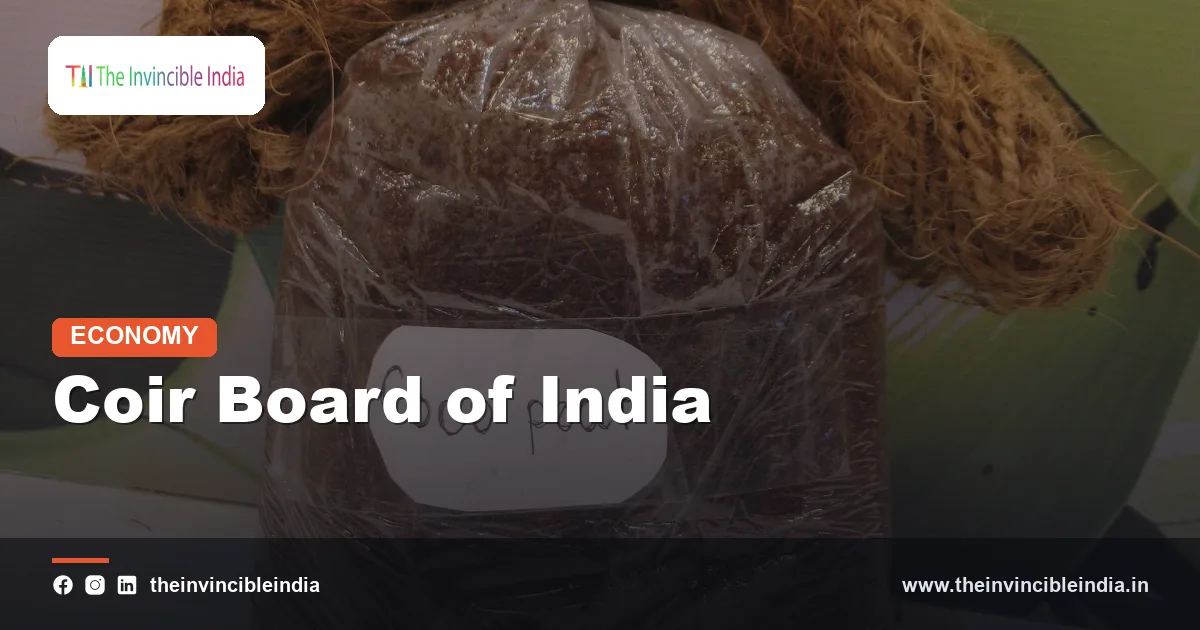
The Coir Board of India is the statutory body, established in 1954 under the Coir Industry Act, 1953 and headquartered in Kochi, Kerala, that promotes the coconut-fibre coir industry and its exports under the Ministry of Micro, Small and Medium Enterprises (MSME). The Coir Board of India supports research, product development, training, marketing and worker welfare for an industry that is concentrated in Kerala and employs mainly rural women.
This explainer covers what the Coir Board of India does, what coir is and how it is made, which products and markets matter, how research and welfare work, and where the industry is located. Figures are approximate and dated, because production and export values change each year. Last updated: 20 October 2026.
| Attribute | Detail |
|---|---|
| Full name | Coir Board of India (commonly, the Coir Board) |
| Established | 1954, under the Coir Industry Act, 1953 |
| Type | Statutory body of the Government of India |
| Administrative ministry | Ministry of Micro, Small and Medium Enterprises (MSME) |
| Headquarters | Kochi, Kerala |
| Raw material | Fibre from the husk of the coconut |
| Key research institutes | Central Coir Research Institute (CCRI), Kalavoor, Alappuzha; Central Institute of Coir Technology (CICT), Bengaluru |
| Traditional hub | Alappuzha (Alleppey) and the coastal belt of Kerala |
| Main workforce | Rural households, with women forming a large majority of spinners |
Key Takeaways
- The Coir Board of India is a statutory body established in 1954 under the Coir Industry Act, 1953, and it has its headquarters in Kochi, Kerala.
- The Coir Board of India works under the Ministry of Micro, Small and Medium Enterprises and is responsible for the development and export promotion of the coir industry.
- Coir is a natural fibre extracted from coconut husk, and India is among the world’s largest producers of coir and coir products.
- The Central Coir Research Institute in Kalavoor, Alappuzha, and the Central Institute of Coir Technology in Bengaluru carry out research and training for the Coir Board of India.
- Coir pith, also called cocopeat, and coir geotextiles are important newer products developed from what was once an agricultural waste or a low-value fibre.
- The coir industry is rural, labour-intensive and mostly home-based, and Kerala is its traditional centre, though Tamil Nadu has become a major fibre-producing state.
What is the Coir Board of India?
The Coir Board of India is the national statutory body that promotes the development of the coir industry, covering everything from fibre extraction and spinning to finished products and exports. It advises the government, runs research, funds schemes for entrepreneurs and artisans, and looks after the welfare of coir workers.
The Board is headed by a Chairman, with members drawn from producers, workers, exporters, state governments and Parliament, as set out in the Coir Industry Act. It operates through a headquarters in Kochi, regional offices, training centres, and research institutes, as well as through its work on trade fairs and export promotion.
What is coir and how is it made?
Coir is a coarse, durable natural fibre taken from the fibrous husk that surrounds the coconut, and it is processed into yarn, mats, ropes and many other products. India’s long coconut-growing coast is the natural source of its raw material.
The basic steps are as follows:
- Husk collection: husks are gathered after the coconuts are used for food, oil or copra.
- Retting or defibring: in the traditional method, husks are soaked in backwater or lagoons for months so the fibres soften, which gives the fine “white fibre” used for spinning. Machines can also crush dry husks to produce “brown fibre”.
- Extraction: fibre is beaten or combed out of the husk, leaving behind coir pith, the dust-like by-product.
- Spinning: fibre is spun into yarn, traditionally by hand with a spinning wheel and now also with motorised machines.
- Weaving and finishing: yarn is woven or twisted into mats, matting, rugs, ropes, nets and geotextiles.
When and why was the Coir Board of India set up?
The Coir Board of India was set up in 1954 after Parliament passed the Coir Industry Act, 1953, to develop an industry that was traditional, scattered and dominated by low-income households. The Act created a board to improve production, marketing and working conditions.
At that time, coir was a major source of rural employment on Kerala’s coast but suffered from low wages, weak organisation and dependence on a few buyers. A central body was expected to introduce better tools, quality standards and export channels. In the decades since, the Board has shifted from supporting manual spinning to promoting mechanisation, product diversification and brand building, and it now sits within the MSME ministry because most coir units are small enterprises.
What products does the coir industry make?
The coir industry makes a broad range of products, including coir fibre, yarn, mats, matting, rugs, ropes, geotextiles and horticultural products made from coir pith. The Coir Board of India encourages product diversification so the industry is not tied to a single low-value item.
| Product group | Examples and uses |
|---|---|
| Fibre | White (retted) fibre for spinning; brown fibre for mattresses, upholstery and stuffing |
| Yarn and rope | Spun yarn for weaving, ropes for fishing and shipping, and twisted products |
| Mats, matting and rugs | Door mats, floor coverings and carpets, a long-standing export item |
| Coir pith (cocopeat) | Growing medium, grow bags and blocks used in horticulture and farming |
| Geotextiles (coir bhoovastra) | Woven or needle-felted nets that control soil erosion on slopes, riverbanks and rural road embankments |
| Value-added items | Rubberised coir, coir boards, handicrafts, furnishings and decor goods |
How have coir pith and geotextiles changed the industry?
Coir pith and geotextiles have changed the industry by turning a waste by-product and a low-value fibre into higher-value goods with growing demand. Coir pith, also known as cocopeat, is the soft, spongy material left after fibre is extracted, and it retains water well, which makes it an attractive growing medium.
Processed pith is compressed into blocks and bricks that can be shipped cheaply and later expanded with water, and it has become a significant export item for horticulture. Coir geotextiles, sometimes marketed as coir bhoovastra, are biodegradable and can help establish vegetation on slopes and embankments. Because they decompose over a few years, they suit temporary erosion control and rural road projects. Both product lines reduce dependence on traditional mats and ropes.
Which research institutes work under the Coir Board of India?
The Coir Board of India runs the Central Coir Research Institute (CCRI) at Kalavoor near Alappuzha in Kerala and the Central Institute of Coir Technology (CICT) in Bengaluru. They develop machines, test products, improve processing and train technicians.
- Central Coir Research Institute (CCRI), Kalavoor, Alappuzha: works on fibre extraction, spinning, product development and testing, and on better processing of coir pith.
- Central Institute of Coir Technology (CICT), Bengaluru: offers technical training and extension in coir technology.
- Training and skill programmes: short courses for artisans, entrepreneurs and women workers in spinning, weaving and product making.
The Board also supports small processing units with technology demonstration and quality testing, which helps exporters meet foreign buyers’ specifications.
How does the Coir Board of India promote exports?
The Coir Board of India promotes exports through international trade fairs, buyer-seller meets, publicity, market research and support to exporters. It also registers exporters and helps them open new markets.
Coir and coir products are exported to many countries, with major buyers in Europe, the United States, China and other parts of Asia and the Middle East. Coir pith products, in particular, have found demand in horticultural markets abroad. Annual export earnings have generally been in the range of several hundred million US dollars, though the exact figure varies by year, and readers should check the latest data from the Board or the Ministry of MSME.
What support does the Coir Board of India give to entrepreneurs and workers?
The Coir Board of India gives entrepreneurs financial assistance, technology and training through schemes, and it provides welfare benefits for workers. Its programmes have included credit-linked support for new coir units, assistance to women artisans, and group insurance and other welfare measures.
Examples of scheme types include:
- Entrepreneur schemes: credit-linked support for setting up new coir enterprises, commonly known through the Coir Udyami Yojana.
- Women-focused support: help with motorised spinning equipment through schemes such as Mahila Coir Yojana, so women spinners can raise their output and earnings.
- Technology upgrading: assistance to modernise machinery and processes.
- Welfare: insurance and social security measures for coir workers, subject to the schemes in force at a given time.
Scheme names, eligibility and subsidy rates are updated periodically under the Ministry of MSME, so applicants should consult official guidelines.
Where is the coir industry located in India?
The coir industry is located mainly in Kerala, with large operations also in Tamil Nadu, Karnataka, Andhra Pradesh, Odisha and West Bengal, and smaller activity in the Northeast. Kerala, particularly Alappuzha, is the traditional heartland, while Tamil Nadu has become a leading producer of coir fibre.
Alappuzha, historically known as Alleppey, is famous for its coir mats and matting, and its backwaters supported the old method of retting husks. Coimbatore and the Pollachi belt in Tamil Nadu have large mechanised fibre-extraction units supplied by coconut-growing districts. Coastal Karnataka, Andhra Pradesh and Odisha also have growing coir clusters. Cooperative societies and private units both operate in the sector, and the largest share of workers are women, especially in spinning.
What challenges does the coir industry face?
The coir industry faces challenges of low wages, dependence on a few export markets, competition from synthetic and other natural fibres, shortage of husk in some areas, and environmental concerns over traditional retting. The Coir Board of India addresses these through mechanisation, product diversification and training.
- Wages and labour: manual spinning pays little, and younger workers often prefer other jobs.
- Market concentration: reliance on a few buyer countries leaves exporters exposed to demand swings.
- Raw material: husk availability can be uneven, and decline in coconut cultivation in some areas affects supply.
- Environment: retting in backwaters can pollute water, so cleaner mechanical extraction is encouraged.
- Quality and branding: consistent quality and international certification are needed for higher-value segments.
Why is coir considered an eco-friendly fibre?
Coir is considered eco-friendly because it is a renewable, biodegradable natural fibre made from coconut husk that would otherwise often be discarded or burnt. Using the husk adds value to a crop already grown for food and oil and reduces the need for synthetic substitutes.
- Renewable raw material: coconut palms bear fruit throughout the year, so husk supply is continuous in coconut-growing regions.
- Biodegradable products: coir geotextiles, mats and ropes break down naturally, unlike many plastic or petroleum-based materials.
- Erosion control: coir nets hold soil on slopes and riverbanks while vegetation takes root, and then decompose into organic matter.
- Soil-free growing: cocopeat is used as a substitute for peat moss in nurseries and greenhouses, which supports efforts to reduce peat extraction abroad.
- Durability: coir fibre resists rot and salt water better than many other plant fibres, so it lasts well in humid and marine conditions.
There are limits to this image. Traditional retting in backwaters can pollute water bodies with organic matter, and coir pith that is dumped in heaps becomes a disposal problem. The Coir Board of India therefore promotes mechanical defibring, which needs no soaking, and composting or processing of pith into saleable products. Treated pith can be washed to reduce salt content before it is sold for horticulture, which also makes it more useful to buyers.
As global buyers look for natural and low-plastic materials, coir products such as grow bags, erosion-control mats and natural-fibre mattresses find new demand. The Board uses this interest to position Indian coir as a sustainable material, with the support of certification, testing and participation in international trade fairs.
Bottom Line
The Coir Board of India, headquartered in Kochi, is the Ministry of MSME body that guides India’s coir industry through research, product development, export promotion and worker welfare. By moving the sector from simple mats and ropes towards cocopeat, geotextiles and mechanised processing, the Board aims to raise incomes for the rural families, many of them women, who depend on coir.
Frequently Asked Questions
What is the Coir Board of India?
The Coir Board of India is a statutory body established in 1954 under the Coir Industry Act, 1953, to promote the coir industry. It is headquartered in Kochi, Kerala, and works under the Ministry of Micro, Small and Medium Enterprises. It runs research, training, export promotion and welfare schemes.
What is coir and where does it come from?
Coir is a natural fibre taken from the husk of the coconut. It is used to make yarn, mats, ropes, geotextiles and other products. The by-product coir pith, or cocopeat, is used as a growing medium in horticulture.
Where is the headquarters of the Coir Board of India?
The headquarters of the Coir Board of India is in Kochi, Kerala. The Board’s Central Coir Research Institute is at Kalavoor near Alappuzha, and its Central Institute of Coir Technology is in Bengaluru. Regional offices operate in other coir-producing states.
Which state is the main centre of the coir industry?
Kerala is the traditional main centre of the coir industry, with Alappuzha as its best-known hub. Tamil Nadu has become a leading state for coir fibre production, and Karnataka, Andhra Pradesh and Odisha also have significant activity. The industry is mostly home-based and rural.
What is coir pith or cocopeat used for?
Coir pith, also called cocopeat, is used mainly as a soil-free growing medium for plants and in grow bags and blocks for horticulture. It holds water well and is a by-product of fibre extraction. It has become an important export product for the coir industry.
How does the Coir Board of India help workers and entrepreneurs?
The Coir Board of India helps workers and entrepreneurs through training, technology support, credit-linked schemes and welfare measures. Schemes such as the Coir Udyami Yojana and Mahila Coir Yojana have supported new units and women spinners. Scheme details and eligibility are revised from time to time, so applicants should check current official guidelines.
{“@context”:”https://schema.org”,”@graph”:[{“@type”:”FAQPage”,”mainEntity”:[{“@type”:”Question”,”name”:”What is the Coir Board of India?”,”acceptedAnswer”:{“@type”:”Answer”,”text”:”The Coir Board of India is a statutory body established in 1954 under the Coir Industry Act, 1953, to promote the coir industry. It is headquartered in Kochi, Kerala, and works under the Ministry of Micro, Small and Medium Enterprises. It runs research, training, export promotion and welfare schemes.”}},{“@type”:”Question”,”name”:”What is coir and where does it come from?”,”acceptedAnswer”:{“@type”:”Answer”,”text”:”Coir is a natural fibre taken from the husk of the coconut. It is used to make yarn, mats, ropes, geotextiles and other products. The by-product coir pith, or cocopeat, is used as a growing medium in horticulture.”}},{“@type”:”Question”,”name”:”Where is the headquarters of the Coir Board of India?”,”acceptedAnswer”:{“@type”:”Answer”,”text”:”The headquarters of the Coir Board of India is in Kochi, Kerala. The Board’s Central Coir Research Institute is at Kalavoor near Alappuzha, and its Central Institute of Coir Technology is in Bengaluru. Regional offices operate in other coir-producing states.”}},{“@type”:”Question”,”name”:”Which state is the main centre of the coir industry?”,”acceptedAnswer”:{“@type”:”Answer”,”text”:”Kerala is the traditional main centre of the coir industry, with Alappuzha as its best-known hub. Tamil Nadu has become a leading state for coir fibre production, and Karnataka, Andhra Pradesh and Odisha also have significant activity. The industry is mostly home-based and rural.”}},{“@type”:”Question”,”name”:”What is coir pith or cocopeat used for?”,”acceptedAnswer”:{“@type”:”Answer”,”text”:”Coir pith, also called cocopeat, is used mainly as a soil-free growing medium for plants and in grow bags and blocks for horticulture. It holds water well and is a by-product of fibre extraction. It has become an important export product for the coir industry.”}},{“@type”:”Question”,”name”:”How does the Coir Board of India help workers and entrepreneurs?”,”acceptedAnswer”:{“@type”:”Answer”,”text”:”The Coir Board of India helps workers and entrepreneurs through training, technology support, credit-linked schemes and welfare measures. Schemes such as the Coir Udyami Yojana and Mahila Coir Yojana have supported new units and women spinners. Scheme details and eligibility are revised from time to time, so applicants should check current official guidelines.”}}]}]}


