

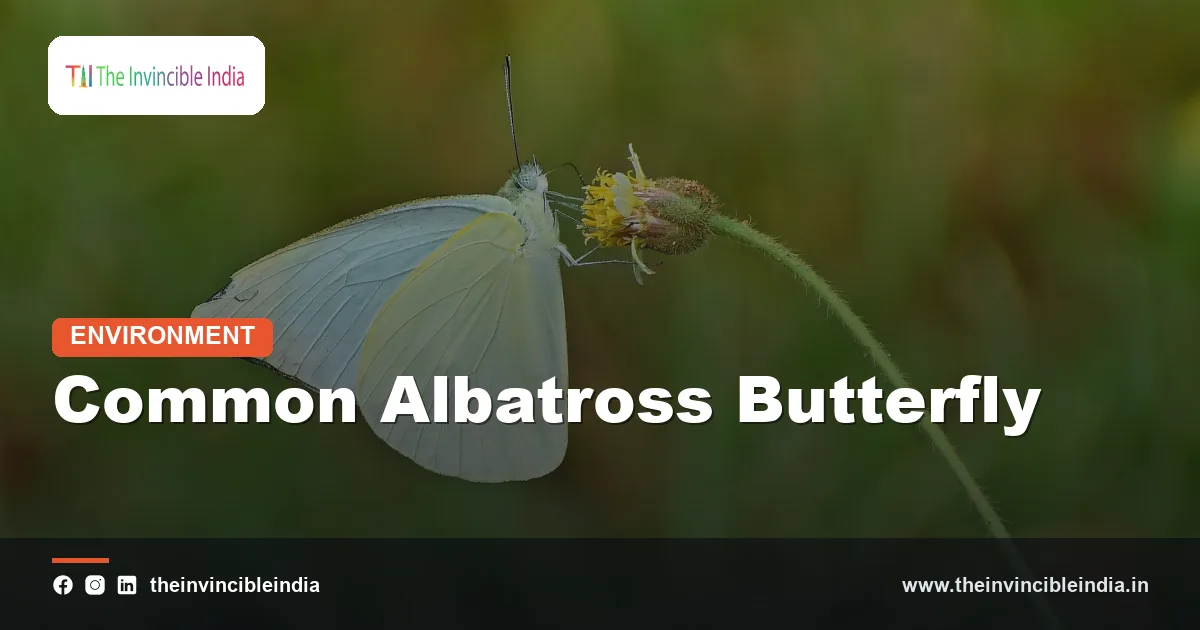
The common albatross (Appias albina) is a medium-sized white butterfly of the family Pieridae, found in the forests, forest edges and hill country of India and across tropical Asia. It is a strong, fast flier that often appears in loose groups, and males are famous for crowding onto damp mud and sand to drink. The species belongs to the albatross butterflies, a group of pierids named for their pale, broad-winged, gliding flight.
This guide explains how to recognise the common albatross, where it lives in India, what its caterpillars eat, how it breeds, and why it gathers in numbers at puddles. It is written for readers who see white butterflies in the monsoon and want to know which one they are looking at.
| Attribute | Details |
|---|---|
| Scientific name | Appias albina (Boisduval, 1836) |
| Family and subfamily | Pieridae (whites and yellows), subfamily Pierinae |
| Wingspan | Roughly 5.5 to 8 cm, with females usually a little larger than males |
| Host plants (larval) | Capparis and Crateva species (caper family) and Drypetes species, among others |
| Range | Peninsular India, the Western Ghats, the Himalayan foothills and the north-east, extending through Sri Lanka and Southeast Asia to northern Australia and the Pacific |
| Habitat | Evergreen and moist deciduous forest, forest clearings, riverbanks, gardens near forest |
| Broods | Several overlapping generations a year, with the largest numbers in and after the monsoon |
| Notable behaviour | Males gather in groups at mud puddles; strong, fast, gliding flight |
Key Takeaways
- The common albatross (Appias albina) is a white butterfly in the family Pieridae that occurs widely in Indian forests and hill regions.
- Male common albatross butterflies are mostly white with narrow dark borders, while females are more heavily marked and often show yellowish tones on the underside of the wings.
- Common albatross caterpillars feed on plants such as Capparis, Crateva and Drypetes, and the adults take nectar from many flowering plants.
- Male common albatross butterflies gather at wet mud and sand to take up sodium and other minerals, a behaviour known as puddling.
- The common albatross breeds in several overlapping broods a year, so adults can be seen for much of the year, with peaks around the monsoon.
- The common albatross is a useful indicator of healthy forest edges and damp, undisturbed streambanks in India.
What is the common albatross butterfly?
The common albatross butterfly is a pierid butterfly, scientifically named Appias albina, that is widespread across South and Southeast Asia and into the Australasian region. The Pieridae are the family of whites, sulphurs and yellows, and the common albatross is one of the larger white members of the group that occurs in India.
The genus Appias contains the albatross butterflies, which are known for strong flight, a preference for forested country and a habit of gathering in numbers at damp ground. Several species occur in India, among them the common albatross, the striped albatross (Appias libythea), the chocolate albatross (Appias lyncida) and the orange albatross (Appias nero). The common albatross is the plainest of these and is often the first one a beginner learns to recognise.
The species was described by the French naturalist Jean Baptiste Boisduval in 1836. Over time it has been recognised in a number of regional subspecies across its enormous range, which reflects how widely the butterfly has spread through island and mainland habitats.
How can you identify the common albatross?
The common albatross can be identified as a medium-sized, mostly white butterfly with narrow dark borders on the forewing, a swift gliding flight and a habit of gathering at puddles. Telling it from other white butterflies takes a little practice, because several Indian pierids share the same overall colour.
Males
Male common albatross butterflies are clean white above, with a dark border that is usually narrow along the front and tip of the forewing and very faint or absent on the hindwing. On the underside the wings are white, sometimes with a faint yellowish or greenish wash near the base or along the veins.
Females
Female common albatross butterflies are more heavily marked than males. The black or grey-brown border on the forewing is broader, the veins are often dusted with dark scales, and the hindwing can carry a dusky margin. Underneath, the female tends to show more yellow, particularly in the dry-season form.
Seasonal forms
Like many tropical butterflies, the common albatross has seasonal forms. Individuals that emerge in the wet season tend to be more boldly marked on the upper surface, while the dry-season form is often paler above and more tinted below. Both forms are the same species and can occur close together during the changeover months.
Practical field marks
- Size: larger and stronger-winged than the small grass-yellows and emigrants that often share the same path.
- Flight: fast and direct, often at head height or above, with frequent long glides.
- Behaviour: several individuals dropping together onto a wet patch of ground, wings held closed.
- Resting posture: wings usually closed over the back, showing the plainer underside.
Where does the common albatross live in India?
The common albatross lives in forested and well-wooded parts of India, including the Western Ghats, the hills of peninsular India, the Himalayan foothills and the north-eastern states. It is most frequent where evergreen or moist deciduous forest meets streams, clearings and roadsides.
Outside India the butterfly is found in Sri Lanka, Bangladesh, Myanmar, Thailand, the Malay Peninsula, the Philippines and Indonesia, and its range continues across the western Pacific to northern Australia. This broad distribution makes the common albatross a good example of a tropical butterfly that has been able to colonise islands as well as continental forest.
Inside India, the species follows rainfall and forest cover. It is common on forest tracks and riverbeds in the Western Ghats and the Eastern Ghats, in the Sahyadri foothills, in the Terai and Duars of the north, and in the humid valleys of Assam, Arunachal Pradesh, Meghalaya and neighbouring states. It is less regular in dry open country, although individuals may wander through gardens and scrub during periods of movement.
What do common albatross caterpillars eat?
Common albatross caterpillars feed on the leaves of a limited group of host plants, chiefly Capparis and Crateva species of the caper family and Drypetes species. Females lay their eggs on young, tender leaves, which give the newly hatched caterpillars soft food.
The larval food plants recorded for the species include:
- Capparis species, which are thorny, scrambling shrubs and climbers of scrub and forest edges.
- Crateva species, medium-sized trees often found beside streams, ponds and temple tanks.
- Drypetes species, including the tree known in India as putranjiva (Drypetes roxburghii), a member of a different plant family that is nevertheless used by several albatross butterflies.
Caper-family plants contain mustard-oil compounds that deter many leaf-eating insects. Pierid butterflies have evolved ways of tolerating these chemicals, and in doing so they have gained access to food that few competitors can use. This close link between a butterfly and a narrow group of plants explains why the common albatross is tied to places where its host plants survive.
What is the life cycle of the common albatross?
The common albatross passes through four stages: egg, caterpillar, pupa and adult, as every butterfly does. The whole cycle takes a few weeks in warm weather, which allows several generations in a single year.
Egg
The female lays small, upright, spindle-shaped eggs on young leaves or shoots of a host plant, either singly or in small scattered groups. The eggs are pale when freshly laid and darken as the caterpillar develops inside.
Caterpillar
The caterpillar is slender and green, often with a paler line along the body, and it blends well with the leaf it rests on. It grows through several moults, called instars, eating tender foliage as it goes. Caterpillars of this group are well camouflaged and usually rest along the midrib of a leaf.
Pupa
The caterpillar pupates as a chrysalis attached to a twig or stem by its tail end and a silk girdle round the middle, with the head pointing upward. This is the characteristic pupal form of the whites and yellows. The chrysalis is green or pale, which helps it blend with vegetation.
Adult
The adult butterfly emerges after about one to two weeks in the chrysalis, expands and dries its wings, and begins to feed on nectar. Adults live for a few weeks, and females lay their eggs during this time.
| Stage | Where it is found | Main activity |
|---|---|---|
| Egg | Young leaves of host plants | Development of the embryo |
| Caterpillar | Leaves of Capparis, Crateva, Drypetes | Feeding and growth through several moults |
| Pupa (chrysalis) | Twigs and stems, head upward, held by a silk girdle | Transformation into the adult |
| Adult | Forest edges, streams, mud patches, flowers | Nectar feeding, puddling, mating, egg-laying |
Why do common albatross butterflies gather at mud puddles?
Common albatross butterflies gather at mud puddles because the wet ground supplies sodium and other minerals that are scarce in nectar. This behaviour is called mud-puddling and is carried out mostly by males.
Nectar is rich in sugar but poor in salts, and plant leaves eaten by caterpillars supply only small amounts of sodium. Male butterflies therefore seek out damp sand, mud, animal dung or the edges of streams, where dissolved salts are easy to drink. In several butterfly families, males pass some of these minerals to females during mating, which can improve the survival of the eggs.
The sight can be striking. On a sandy stream bed in a forest, a group of common albatross males may settle side by side, often mixed with other pierids, swallowtails and blues. They are wary at first but become much less nervous once they begin to feed, which is why puddling groups are among the best opportunities to photograph them.
- Puddling is usually seen on warm, bright mornings.
- Groups can contain only one species or several species together.
- Butterflies often return to the same wet spot day after day.
Does the common albatross migrate?
The common albatross is a strong flier that shows local movements and has been reported moving in numbers in some seasons, but it is not known for a fixed, long-distance annual migration like some other tropical butterflies. Its movements are generally linked to rainfall, the flowering of food plants and the availability of host leaves.
In parts of its range, particularly around the monsoon, observers have noted streams of white butterflies passing in one direction along valleys and forest edges. Such movements may involve several pierid species flying together. They are poorly documented in many regions, and it is best to describe them as occasional and seasonal rather than as a regular route.
Strong flight also helps the common albatross to find scattered host plants. A species that depends on caper-family plants growing in separate patches benefits from being able to travel between them, and this mobility is one reason the butterfly has been able to settle so many islands.
Which butterflies look similar to the common albatross?
Several other white and pale butterflies in India resemble the common albatross, including other albatross species, the Pioneer or Caper White, and the Psyche. Comparing size, wing borders, flight and habitat helps separate them.
| Butterfly | Scientific name | How it differs from the common albatross |
|---|---|---|
| Striped albatross | Appias libythea | Shows more pronounced dark veining and striped markings, especially in the female |
| Chocolate albatross | Appias lyncida | Shows brownish or yellowish tones on the underside in many forms and a different wing pattern |
| Orange albatross | Appias nero | Males show orange on the wings; found in humid forest, especially in the east |
| Pioneer or Caper White | Belenois aurota | Smaller, with distinctive dark veins and a more open-country habitat |
| Psyche | Leptosia nina | Very small, weak and fluttering flight, with a dark spot on the forewing |
Because variation within a single species can be considerable, beginners should rely on several features together rather than on colour alone. A good photograph of the underside of the wings, taken when the butterfly is at rest, is usually the most useful record for identification.
How does the common albatross help the ecosystem?
The common albatross supports forest ecosystems as a pollinator, as food for other animals and as an indicator of habitat quality. Each of these roles is modest for a single butterfly, but together they matter for the whole community.
- Pollination: adults visit many flowers for nectar and carry pollen from one plant to another, particularly on forest edges and in clearings.
- Food web: eggs, caterpillars, pupae and adults are eaten by birds, lizards, spiders, wasps and other predators.
- Indicator value: because the species needs specific host plants and clean, damp ground for puddling, its presence suggests that these resources are intact.
- Public interest: conspicuous puddling groups draw visitors and amateur naturalists to forest trails, supporting nature education.
The caterpillars do not usually cause economic damage, since their host plants are wild shrubs and trees rather than crops. In general, the species is not considered threatened, although its numbers depend on the survival of forest patches, streamside vegetation and host plants.
How can you watch common albatross butterflies responsibly?
You can watch common albatross butterflies responsibly by visiting forest edges and stream beds in the morning, moving slowly, and leaving the habitat undisturbed. Good observation and good conservation go together.
- Look near wet sand, shallow streams and shaded roadside puddles in the warmer part of the morning.
- Approach slowly and avoid sudden movements, which scatter puddling groups.
- Photograph from a short distance and avoid handling the butterflies, because their scales and wings are fragile.
- Do not trample host plants or strip leaves to look for eggs and caterpillars.
- Note the date, place and any host plant you see, since such records are useful to citizen-science projects on Indian butterflies.
The best months in much of India are during and just after the monsoon, when forest vegetation is fresh and the butterflies are most numerous. In the Western Ghats and north-east, forest trails and riverbeds are particularly rewarding in these seasons.
Bottom Line
The common albatross is a widespread, forest-loving white butterfly whose caterpillars use caper-family and Drypetes plants and whose males gather at mud to drink minerals. Recognising it helps visitors to Indian forests understand how butterflies depend on host plants, damp ground and clean streams.
Frequently Asked Questions
What is the common albatross?
The common albatross is a white butterfly of the family Pieridae, scientifically named Appias albina. It lives in forests and hill country across India and tropical Asia. Males are known for gathering at damp mud to drink minerals.
Where can I see the common albatross in India?
You can see the common albatross mainly in forested regions such as the Western Ghats, the Himalayan foothills and the north-eastern states. Stream beds, forest tracks and clearings are the best places to look. The butterfly is seen through much of the year but is most numerous around the monsoon.
What do common albatross caterpillars eat?
Common albatross caterpillars eat the young leaves of Capparis and Crateva species of the caper family and of Drypetes species. Females lay their eggs on tender leaves so that newly hatched caterpillars have soft food. The caterpillars are green and well camouflaged.
Why do common albatross butterflies gather on mud?
Common albatross butterflies gather on mud to take up sodium and other minerals that nectar does not supply. This behaviour, called mud-puddling, is mostly seen in males. The minerals are often passed to females during mating, which benefits the eggs.
How is the male common albatross different from the female?
The male common albatross is mostly white with narrow dark borders, while the female has broader dark borders and often more yellow on the underside. Females are also usually slightly larger. Seasonal forms add further variation to the markings.
Is the common albatross an endangered butterfly?
The common albatross is not considered an endangered butterfly, because it is widespread and occurs across a large area of tropical Asia. Its numbers still depend on forest edges, host plants and damp streamside ground. Loss of forest cover can reduce local populations.
{“@context”:”https://schema.org”,”@graph”:[{“@type”:”FAQPage”,”mainEntity”:[{“@type”:”Question”,”name”:”What is the common albatross?”,”acceptedAnswer”:{“@type”:”Answer”,”text”:”The common albatross is a white butterfly of the family Pieridae, scientifically named Appias albina. It lives in forests and hill country across India and tropical Asia. Males are known for gathering at damp mud to drink minerals.”}},{“@type”:”Question”,”name”:”Where can I see the common albatross in India?”,”acceptedAnswer”:{“@type”:”Answer”,”text”:”You can see the common albatross mainly in forested regions such as the Western Ghats, the Himalayan foothills and the north-eastern states. Stream beds, forest tracks and clearings are the best places to look. The butterfly is seen through much of the year but is most numerous around the monsoon.”}},{“@type”:”Question”,”name”:”What do common albatross caterpillars eat?”,”acceptedAnswer”:{“@type”:”Answer”,”text”:”Common albatross caterpillars eat the young leaves of Capparis and Crateva species of the caper family and of Drypetes species. Females lay their eggs on tender leaves so that newly hatched caterpillars have soft food. The caterpillars are green and well camouflaged.”}},{“@type”:”Question”,”name”:”Why do common albatross butterflies gather on mud?”,”acceptedAnswer”:{“@type”:”Answer”,”text”:”Common albatross butterflies gather on mud to take up sodium and other minerals that nectar does not supply. This behaviour, called mud-puddling, is mostly seen in males. The minerals are often passed to females during mating, which benefits the eggs.”}},{“@type”:”Question”,”name”:”How is the male common albatross different from the female?”,”acceptedAnswer”:{“@type”:”Answer”,”text”:”The male common albatross is mostly white with narrow dark borders, while the female has broader dark borders and often more yellow on the underside. Females are also usually slightly larger. Seasonal forms add further variation to the markings.”}},{“@type”:”Question”,”name”:”Is the common albatross an endangered butterfly?”,”acceptedAnswer”:{“@type”:”Answer”,”text”:”The common albatross is not considered an endangered butterfly, because it is widespread and occurs across a large area of tropical Asia. Its numbers still depend on forest edges, host plants and damp streamside ground. Loss of forest cover can reduce local populations.”}}]}]}


