

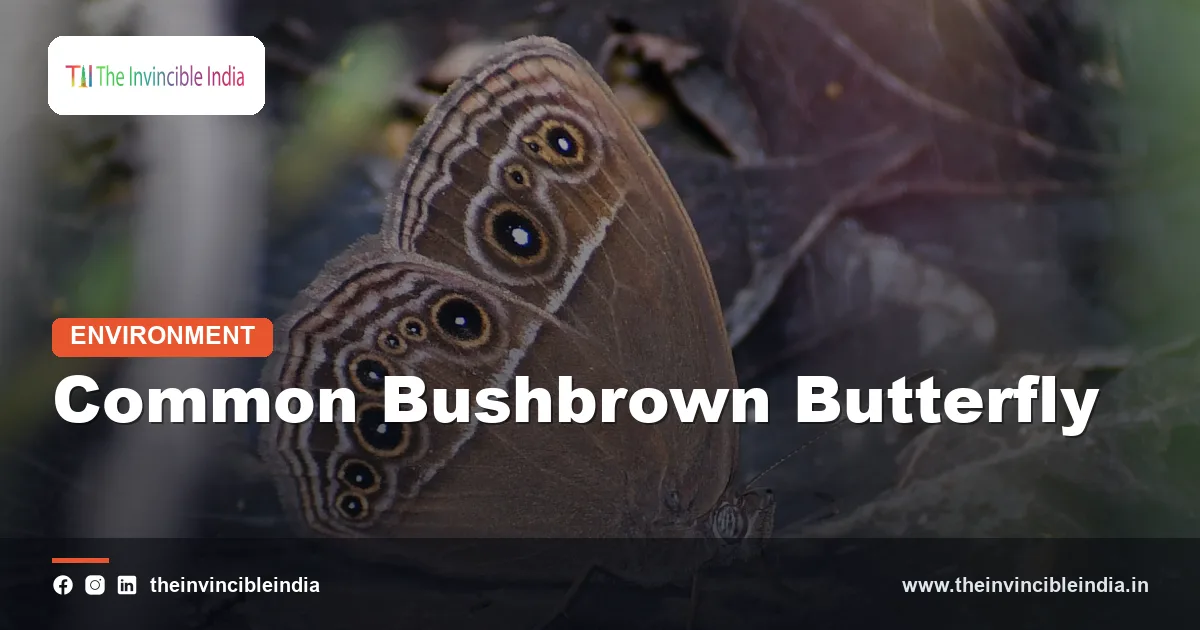
The common bushbrown (Mycalesis perseus) is a small, dull brown butterfly of the family Nymphalidae, found in shady gardens, undergrowth and forest edges across India, and known for the eyespots on its wings and for having different wet-season and dry-season forms. Its caterpillars feed on grasses, and the adults flutter low among shrubs and leaf litter, resting with their wings closed.
The common bushbrown is one of the butterflies most often seen near homes in India without being noticed. This guide explains how to recognise the common bushbrown, how its seasonal forms differ, what it eats, how it grows and where it lives.
Quick Facts: Common Bushbrown at a Glance
| Common name | Common bushbrown |
|---|---|
| Scientific name | Mycalesis perseus (Fabricius, 1775) |
| Family and subfamily | Nymphalidae (brush-footed butterflies), subfamily Satyrinae (the satyrs or browns) |
| Wingspan | Roughly 40 to 60 mm |
| Caterpillar host plants | Grasses of the family Poaceae, including forest-floor and lawn grasses and some bamboos and cereals |
| Range and habitat | Most of India, including the Western Ghats, the peninsula, the Himalayan foothills and the north-east; extends to Sri Lanka and South-East Asia; shady gardens, undergrowth and forest edges |
| Broods | Many overlapping generations a year, with different forms in the wet and dry seasons |
| Notable features | Seasonal polyphenism, underside eyespots, low and weak flight, activity at dawn and dusk, scent-bearing males |
Key Takeaways
- The common bushbrown (Mycalesis perseus) is a small brown satyr butterfly of the family Nymphalidae that occurs widely across India.
- The common bushbrown has two seasonal forms: a wet-season form with prominent eyespots and a dry-season form with faint spots and a leaf-like underside.
- The caterpillar of the common bushbrown feeds on grasses and is green or brown with a forked tail.
- Adult common bushbrowns fly low and weakly in shady undergrowth and are most active in the early morning and at dusk.
- Common bushbrowns feed mainly on rotting fruit and sap rather than flower nectar.
- The common bushbrown is common and widespread, and it is not regarded as a threatened species.
What is the common bushbrown butterfly?
The common bushbrown is a small satyrine butterfly in the genus Mycalesis, a group named “bushbrowns” because they live low in shrubby, shaded places and are brown in colour. It belongs to the family Nymphalidae and the subfamily Satyrinae, the group that includes most of the world’s woodland and grassland browns.
The species was described by the Danish entomologist Johan Christian Fabricius in 1775 as Mycalesis perseus, and the name remains in use. Several subspecies have been described across its large Asian range, reflecting small regional differences in size and in the arrangement of the eyespots.
Among Indian butterflies, the common bushbrown is a typical member of the “browns”: modest in colour, ground-hugging and easily overlooked. Its interest lies in the details of its pattern, in the way it changes with the season and in the habits that allow it to live in the shade.
How can you identify a common bushbrown?
A common bushbrown can be identified by its dull brown wings, a row of eyespots on the underside and a weak, bobbing flight close to the ground. On the upperside the wings are plain brown, usually with a small eyespot on the forewing and sometimes another on the hindwing.
The underside pattern
The underside of the common bushbrown is where the identification is made. It is lighter than the upperside, with a pale band running across both wings and a series of ringed eyespots near the outer margin. In the wet-season form the eyespots are large and clear, with a black centre, a white pupil and a pale yellow or brown ring.
The male
The male has a small tuft or patch of specialised scent scales, which is used in courtship and gives off pheromones. These are usually hidden and are visible only in a close view or a good photograph. The male is a little smaller and plainer than the female, and the upperside is a deeper brown.
Quick field marks
- Small, brown butterfly with rounded wings and a slightly weak flight.
- Pale band and ringed eyespots on the underside, most distinct in the wet season.
- Habit of flying low, usually within a metre of the ground, in shade.
- Closed-wing resting posture, often on a leaf or on the ground.
Why does the common bushbrown have two seasonal forms?
The common bushbrown has two seasonal forms because its wing pattern changes in response to the conditions in which the caterpillar grows, a process known as seasonal polyphenism. The wet-season form has large, conspicuous eyespots, while the dry-season form has small spots and a plain, leaf-like underside.
The difference is not caused by two separate species or by genetic mutations. Instead, temperature and humidity during the caterpillar and pupal stages influence the development of the pattern. A brood that grows up in warm, wet weather emerges with strong eyespots, and one that grows up in cooler, dry weather emerges with faded ones.
| Feature | Wet-season form | Dry-season form |
|---|---|---|
| Eyespots on the underside | Large, bright and well ringed | Small, faint or reduced to dots |
| Overall appearance | Lively, patterned and contrasting | Plain, dull and leaf-like |
| Behaviour | Active, flying freely among vegetation | More sedentary, resting among dry leaf litter |
| Probable benefit | Eyespots draw predators to the wing edge | Camouflage against dry leaves |
One explanation is that eyespots are useful when green vegetation is plentiful and predators such as birds peck at the conspicuous spots, rather than at the body. In the dry season, when the ground is covered with brown leaves, hiding is more useful than distraction.
Where does the common bushbrown live in India?
The common bushbrown lives across most of India, from the peninsula and the Western Ghats to the Himalayan foothills and the north-east, wherever there is shade and grassy undergrowth. Its range extends into Sri Lanka, Nepal, Bhutan, Bangladesh, Myanmar and much of South-East Asia.
It is found in shady gardens, plantation edges, bamboo clumps, damp ravines, forest paths and the undergrowth of moist deciduous woodland. The species is less common in dry, open scrub and in intensely cultivated land with little cover.
The common bushbrown is a frequent visitor to hill-station and village gardens where there are lawns, hedges and flowerbeds in partial shade. It is often found along the edges of forest tracks and near water, where the grasses stay green for longer.
What does the common bushbrown caterpillar eat?
The common bushbrown caterpillar eats grass. A range of wild and cultivated grasses in the family Poaceae are used, including shade-loving forest-floor grasses and lawn grasses, and the species has also been reported on bamboo and on cereal crops such as rice.
The female lays her eggs singly on the blades of grass, often low down in a damp, shady patch. The caterpillar hatches and feeds on the soft leaf blade, resting by day along the midrib of a blade where its green colour hides it.
The caterpillar is not generally considered an important pest of crops. It feeds slowly, remains scattered and is subject to attack by birds, spiders and parasitic wasps. A lawn or grassy hedge-bottom that is left unmown for part of the year can support many of these caterpillars.
How does the common bushbrown develop from egg to adult?
The common bushbrown develops by complete metamorphosis, passing through the stages of egg, caterpillar, pupa and adult, and the cycle takes roughly a month in warm weather. Several broods are produced each year, and in warm, moist regions the generations overlap so that adults are on the wing in most months.
| Stage | What it looks like | Where it is found |
|---|---|---|
| Egg | Small, round, pale and laid singly | Blades of host grass |
| Caterpillar | Green or brownish, spindle-shaped, with a forked tail and a pair of small head horns | Resting on a blade of grass |
| Pupa | Green or brown and compact, hanging from a silk pad | Under a grass blade or on a nearby plant |
| Adult | Brown butterfly with underside eyespots | Shady undergrowth, forest edges and gardens |
Caterpillar shape
Like other satyr caterpillars, the common bushbrown caterpillar is spindle-shaped, tapering at both ends, with two short tail prongs and a pair of small horns on the head. The shape and colour help it to look like a blade of grass or a withered leaf tip, and it stays motionless during the day.
Pupa
The pupa hangs head-down from a silken button, usually in a shaded spot among grass or low plants. It is smooth and rather plump, and its colour matches its surroundings, being green on living plants and brown among dry material.
How does the common bushbrown behave?
The common bushbrown behaves as a shade-loving, low-flying and crepuscular butterfly: it is most active in the early morning and at dusk, flies weakly close to the ground and rests with its wings closed. In the heat of the day it stays hidden among vegetation.
Flight
The flight is a bobbing, fluttering movement that rarely reaches above knee or waist height. If disturbed, the butterfly flies a short distance and then drops into low vegetation, where it blends with the background. This habit makes it easy to flush from grass but hard to follow.
Feeding
Adult common bushbrowns feed on rotting fruit, sap and fermenting plant material rather than on nectar. They are frequently found at fallen fruit in orchards and at damaged bark. These foods provide sugars and some minerals, and they are most accessible in the dry season.
Courtship
Males use scent as part of courtship. The specialised scales on the male wing release a chemical signal that the female detects, and the male often performs a short display before mating. This is typical of the bushbrown group and shows that smell can be as important as colour in butterfly behaviour.
Is the common bushbrown rare or threatened?
The common bushbrown is not rare and is not generally regarded as a threatened butterfly, because it is widespread and uses common grass hosts. It thrives in gardens, plantations and secondary growth as well as in natural forest.
The main local threats are the clearing of shady undergrowth, the mowing of lawns and verges to the ground, and the intensive use of herbicides and pesticides. Leaving patches of long grass and shrubby cover helps the species. Legal protection for butterflies in India depends on the schedules of the Wildlife (Protection) Act, 1972, which are revised from time to time, so readers who need current information should consult the latest schedules.
How does the common bushbrown compare with similar butterflies?
The common bushbrown is easily confused with other small brown satyrs, including other bushbrowns, the four-rings and the evening browns. A few comparisons help separate them.
| Butterfly | Key difference from the common bushbrown |
|---|---|
| Dark-branded bushbrown | Similar size and habit; the male shows a dark brand on the forewing, and the underside pattern differs |
| Common four-ring | Smaller, with a distinctive set of ringed eyespots on the hindwing underside and a habit of living in open grass |
| Common evening brown | Larger, with pointed forewings, active mainly at dusk and often found in leaf litter |
| Common palmfly | Larger and darker, with palm-feeding caterpillars and strong sexual dimorphism |
The best approach is to photograph the underside of the wings, since that is where the key features appear. The size and pattern of the eyespots and the pale band on the underside separate the common bushbrown from most of its relatives.
Why does the common bushbrown matter?
The common bushbrown matters because it is a widespread, easily observed example of how butterflies adapt to seasons, and because it is a small but constant part of the food web of shady undergrowth. Its caterpillars feed on grass, and its adults and young are eaten by birds, lizards and spiders.
For students and amateur naturalists, the species provides an easy introduction to concepts such as polyphenism, eyespot function and scent-based courtship. For gardeners, it is a sign that a piece of land has enough shade, leaf litter and grass to support small insects.
Ways to look for the common bushbrown
- Walk slowly along a shady path or garden edge in the early morning or at dusk.
- Gently part tall grass or shrubs near the ground to flush resting butterflies.
- Check fallen fruit and bark wounds in the dry season.
- Photograph the underside of the wings to see the eyespots and pale band.
Bottom Line
The common bushbrown is a small, shade-loving brown butterfly whose wet-season and dry-season forms look noticeably different and whose caterpillars feed on grasses. It is common across India, easy to find in shaded undergrowth and a good subject for learning how butterflies respond to the seasons.
Frequently Asked Questions
What is a common bushbrown?
The common bushbrown is a small brown satyr butterfly of the family Nymphalidae, scientifically named Mycalesis perseus. It lives in shady gardens, undergrowth and forest edges across India. Its caterpillars feed on grasses.
Why does the common bushbrown look different in different seasons?
The common bushbrown looks different because its wing pattern responds to the temperature and humidity in which the caterpillar grows. The wet-season form has large eyespots on the underside, while the dry-season form has small spots and a plain, leaf-like pattern. This is called seasonal polyphenism.
What does the common bushbrown caterpillar eat?
The common bushbrown caterpillar eats grasses of the family Poaceae. It has been recorded on forest-floor grasses, lawn grasses, bamboo and cereals. The caterpillar is green or brown with a forked tail.
When is the common bushbrown most active?
The common bushbrown is most active in the early morning and at dusk. It flies low and weakly in shaded undergrowth. In the heat of the day it usually rests among vegetation with its wings closed.
What do adult common bushbrowns feed on?
Adult common bushbrowns feed mainly on rotting fruit, sap and fermenting plant material. They rarely take flower nectar. Fallen fruit and damaged bark are good places to find them.
Is the common bushbrown a threatened butterfly?
The common bushbrown is common and adaptable and is not generally regarded as threatened. It uses widespread grasses and thrives in gardens as well as forest. Local numbers can fall where shady undergrowth is cleared or herbicides are used heavily.
{“@context”:”https://schema.org”,”@graph”:[{“@type”:”FAQPage”,”mainEntity”:[{“@type”:”Question”,”name”:”What is a common bushbrown?”,”acceptedAnswer”:{“@type”:”Answer”,”text”:”The common bushbrown is a small brown satyr butterfly of the family Nymphalidae, scientifically named Mycalesis perseus. It lives in shady gardens, undergrowth and forest edges across India. Its caterpillars feed on grasses.”}},{“@type”:”Question”,”name”:”Why does the common bushbrown look different in different seasons?”,”acceptedAnswer”:{“@type”:”Answer”,”text”:”The common bushbrown looks different because its wing pattern responds to the temperature and humidity in which the caterpillar grows. The wet-season form has large eyespots on the underside, while the dry-season form has small spots and a plain, leaf-like pattern. This is called seasonal polyphenism.”}},{“@type”:”Question”,”name”:”What does the common bushbrown caterpillar eat?”,”acceptedAnswer”:{“@type”:”Answer”,”text”:”The common bushbrown caterpillar eats grasses of the family Poaceae. It has been recorded on forest-floor grasses, lawn grasses, bamboo and cereals. The caterpillar is green or brown with a forked tail.”}},{“@type”:”Question”,”name”:”When is the common bushbrown most active?”,”acceptedAnswer”:{“@type”:”Answer”,”text”:”The common bushbrown is most active in the early morning and at dusk. It flies low and weakly in shaded undergrowth. In the heat of the day it usually rests among vegetation with its wings closed.”}},{“@type”:”Question”,”name”:”What do adult common bushbrowns feed on?”,”acceptedAnswer”:{“@type”:”Answer”,”text”:”Adult common bushbrowns feed mainly on rotting fruit, sap and fermenting plant material. They rarely take flower nectar. Fallen fruit and damaged bark are good places to find them.”}},{“@type”:”Question”,”name”:”Is the common bushbrown a threatened butterfly?”,”acceptedAnswer”:{“@type”:”Answer”,”text”:”The common bushbrown is common and adaptable and is not generally regarded as threatened. It uses widespread grasses and thrives in gardens as well as forest. Local numbers can fall where shady undergrowth is cleared or herbicides are used heavily.”}}]}]}


