

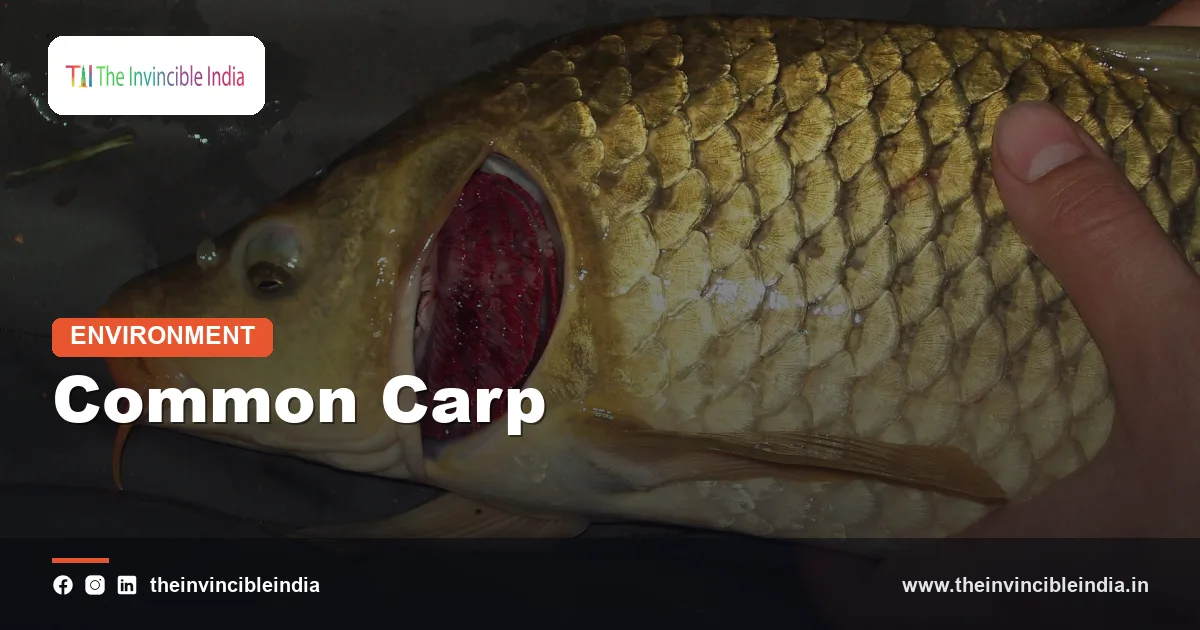
The common carp (Cyprinus carpio) is a hardy, bottom-feeding freshwater fish of the family Cyprinidae that is not native to India but has been introduced and widely farmed in Indian ponds, tanks and reservoirs for its fast growth and ability to tolerate poor conditions. It originates in the rivers and lakes of Europe and Asia and is now one of the most widely distributed fish on Earth.
In India, the common carp is valued as a farmed food fish alongside the native Indian major carps such as catla, rohu and mrigal, yet it is also watched closely by ecologists because it can disturb the bottom of water bodies and compete with local species. This article explains what the common carp is, how to recognise it, how it was introduced to India, how it is farmed, and what its presence means for rivers, lakes and fisheries.
| Quick Facts | Details |
|---|---|
| Common name | Common carp (also called European carp or simply carp) |
| Scientific name | Cyprinus carpio |
| Family | Cyprinidae (carps and minnows) |
| Size | Can exceed a metre and many kilograms in the wild; farmed fish are commonly harvested at roughly 1 kg to 2 kg |
| Native range | Europe and temperate Asia; not native to India |
| Range and habitat in India | Farm ponds, tanks, lakes, reservoirs and some rivers across the country, including Himalayan waters |
| Diet | Omnivore that feeds on the bottom: insect larvae, snails, worms, plants, detritus and feed pellets |
| Breeding and life cycle | Egg-laying; females release very large numbers of sticky eggs on submerged plants in warm, shallow water |
| Status | Introduced species in India; widely farmed; listed as Vulnerable by the IUCN in its native wild range |
Key Takeaways
- The common carp (Cyprinus carpio) is a hardy freshwater fish native to Europe and Asia that was introduced to India and has become a staple of Indian pond aquaculture.
- A common carp has a protrusible mouth, two pairs of barbels near the mouth and a long dorsal fin, and it feeds mainly on the bottom of water bodies.
- The common carp is cultured in India together with the native catla, rohu and mrigal and with other introduced carps in a system called composite carp culture.
- A female common carp can lay hundreds of thousands of eggs in a single season, which makes the species extremely prolific and able to establish itself quickly.
- The common carp stirs up mud while feeding, which can cloud the water, uproot plants and harm native fish when the species escapes into natural waters.
- Although the common carp is farmed as an introduced species in India, wild populations are considered Vulnerable by the IUCN in the fish’s native range.
What is the common carp?
The common carp is a large, thick-bodied freshwater fish in the family Cyprinidae, the world’s largest family of freshwater fishes, and it is one of the oldest and most widely farmed fish in human history. It is native to Europe and Asia but has been moved by people to every continent except Antarctica.
The fish has been cultured for centuries in China and Europe, where it was kept in monastery ponds and village tanks as a source of cheap protein. Selective breeding has produced many varieties, including ornamental forms such as the colourful koi, which are the same species. In India the term common carp usually refers to the wild-type or farmed food forms of Cyprinus carpio, and it is distinguished from the Indian major carps, which are different species native to Indian rivers.
Because the common carp tolerates a wide range of temperature, low oxygen and muddy water, it is known as a “survivor” species. This toughness is the main reason why it is popular with fish farmers and also the main reason why it can become a problem outside farms.
How can you identify a common carp?
A common carp can be identified by its stout, slightly arched body, a long dorsal fin with a strong serrated spine, a toothless mouth that can be pushed forward and two pairs of whisker-like barbels on the upper jaw. The colour ranges from olive-brown to golden-yellow, with a paler belly.
The fish has three recognised forms based on its scales. The scale carp is fully covered in regular scales, the mirror carp has a few very large scales scattered along the body and the leather carp has almost no scales. All belong to the same species and can be found in Indian farms and waters.
Features that distinguish the common carp
- Two pairs of barbels, one short and one long, near the corners of the mouth.
- A long dorsal fin with a stiff, saw-edged spine at its front.
- A thick body that is deeper in the middle and laterally flattened.
- A downward-pointing, protrusible mouth designed for sucking food from the bottom.
- Large scales in the scale and mirror forms, or none in the leather form.
The catla and rohu have no barbels, the mrigal has only a very short pair, and none of them has the long saw-edged dorsal spine, so the common carp is easy to separate from them when it is held in the hand. A mature fish often has a golden or bronze sheen, particularly on the sides.
How did the common carp come to India?
The common carp came to India through deliberate introduction by fisheries authorities, who brought stocks from other countries in the first half of the twentieth century and again in later decades to improve fish production. The aim was to find a hardy fish that could be reared in a wide range of waters.
Different strains were introduced at different times and from different sources, including stocks of European and Asian origin. The scale, mirror and leather forms were all brought in, and they were spread through hatcheries and government fish farms. Because the fish breeds readily in captivity and grows quickly, it spread to farmers across the country within a few decades.
The introduction is part of a larger story of exotic fish in Indian aquaculture, which also includes the silver carp, the grass carp and the tilapia. These species were chosen because they use different parts of the pond and different food sources, so they can be raised together without competing too heavily. The decisions made in the past continue to shape Indian fisheries today.
Where does the common carp live in India?
The common carp lives in farm ponds, village tanks, lakes, reservoirs, canals and some slow-flowing rivers across India, and it has established itself in cooler Himalayan lakes and streams as well as in warm plains. It tolerates both temperate and tropical conditions better than most Indian carps.
The fish favours still or slow water with a soft muddy bottom and some vegetation, where it can search for food in the sediment. It can survive in water with little oxygen, in turbid conditions and in a wide range of temperatures, which allows it to colonise places where native species struggle. In some regions, including the hill states and the Kashmir Valley, it has become established in lakes and reservoirs and is caught as part of the local fishery.
In the plains, the largest numbers of common carp are found in managed ponds, particularly in states with large freshwater aquaculture industries. In natural waters, its numbers are usually controlled by fishing and predation unless the habitat is heavily disturbed.
What does the common carp eat?
The common carp eats a mixed diet of insect larvae, worms, snails, small crustaceans, plant matter and decaying organic material, and it finds most of its food by sucking up mud from the bottom and filtering out edible items. It is therefore classed as an omnivorous bottom feeder.
The fish uses its barbels as touch and taste organs to find food buried in the sediment. It then sucks in a mouthful of mud, sorts out the food with its throat teeth and expels the rest through the gills. This feeding style, known as grubbing, constantly turns over the pond or lake bottom.
In farms, the common carp is also fed on supplementary feed such as rice bran, oilcake and pelleted diets. Because it feeds low in the water column, it is often stocked with surface-feeding and mid-water-feeding species so that all layers of the pond are used efficiently. Its feeding method also releases nutrients from the mud, which can promote the growth of the plankton that other farmed fish eat.
How is the common carp farmed in India?
The common carp is farmed in India mainly in composite carp culture, a system in which several species of carp are raised together in the same pond so that each uses a different food source and zone of the water. The common carp occupies the bottom layer, while catla feeds at the surface and rohu in the middle.
| Species | Origin | Where it feeds in the pond | Main food |
|---|---|---|---|
| Catla | Native to India | Surface | Zooplankton |
| Rohu | Native to India | Middle | Plankton and plant matter |
| Mrigal | Native to India | Bottom | Detritus and decaying matter |
| Silver carp | Introduced from East Asia | Surface | Phytoplankton |
| Grass carp | Introduced from East Asia | Surface and middle | Aquatic weeds and grasses |
| Common carp | Introduced from Europe and Asia | Bottom | Insect larvae, worms and detritus |
Farmers usually stock fingerlings, which are young fish about the size of a finger, and grow them for several months to a year before harvest. A well-managed pond with proper feed, water exchange and aeration can produce a good yield of fish, and the common carp often reaches market size faster than many native species.
Its hardiness lowers risk for small farmers, since it survives better than most species when water quality dips. This is why aquaculture training programmes in many states include the common carp among the recommended species.
Why can the common carp be a problem outside farms?
The common carp can be a problem outside farms because its bottom-feeding habit uproots plants and stirs up mud, which clouds the water, reduces light for aquatic vegetation and harms native fish and invertebrates. In many parts of the world, it is classed as an invasive species.
The ecological risks are well documented in countries where the fish has escaped into the wild. When populations become dense, the water turns murky, submerged plants decline, and the loss of plant cover removes shelter and spawning areas for other fish and for insects and amphibians. The carp may also compete with native species for food and can prey on their eggs and young.
- Turbidity: Constant digging for food keeps sediments suspended in the water.
- Loss of vegetation: Uprooted plants cannot regrow, which removes habitat for waterbirds, insects and fish fry.
- Competition: Carp compete with native bottom-feeding fish for the same resources.
- Nutrient release: Stirring up the mud releases nutrients that can trigger algal blooms.
- Escape into natural waters: Floods and poorly managed farms can release fish into rivers and lakes.
In India, concern is greatest in sensitive waters such as hill lakes, wetlands and rivers that hold unique native fish, including native mahseers and snow trout. Most fisheries experts recommend careful management of exotic species, with stocking restricted to closed farm ponds and monitored reservoirs.
How does the common carp breed?
The common carp breeds by spawning in warm, shallow water, where a female releases a very large number of sticky eggs that attach to submerged plants and are fertilised by one or more males. A single female can produce hundreds of thousands of eggs in a season.
Spawning is triggered by rising temperature, increasing day length and fresh rainfall or inflow of water. The eggs hatch in a few days if the water is warm, and the larvae feed on their yolk sacs before moving on to tiny plankton. Most of the eggs and larvae are eaten by other animals, but the sheer numbers mean that enough survive to keep the population going.
In hatcheries, breeders induce spawning by providing artificial spawning material such as aquatic plants or special mats, and by controlling water temperature. The fertilised eggs are then moved to rearing tanks, from where the fry are sent to farmers. This controlled production is what supplies the millions of seed fish needed for pond culture each year.
Is the common carp good to eat?
Yes, the common carp is eaten widely in India and across the world as a source of affordable animal protein, and its flesh is firm and mildly flavoured. Many consumers value it for its size, availability and price, though some find its numerous small bones difficult.
The fish is eaten fried, curried or steamed, and it is often sold fresh from ponds in local markets. It contains protein, fat and a range of minerals and vitamins, and it contributes to nutrition in regions where fish is a staple. As with all fish, its taste depends heavily on the water in which it was grown. Fish raised in clean, well-managed ponds taste better than those reared in poor or muddy water.
Consumers should ensure that fish is bought fresh, stored on ice and cooked thoroughly. Responsible aquaculture also depends on clean water and sensible use of feed and medicines, which protects both consumers and the environment.
Bottom Line
The common carp is a tough, productive and widely farmed introduced fish that supports livelihoods and food supply in India while demanding careful management. Keeping it in closed ponds, using native species where possible and protecting sensitive wild waters allow the benefits of the common carp to be enjoyed without harming India’s own freshwater life.
Frequently Asked Questions
What is the common carp?
The common carp is a hardy freshwater fish, scientifically named Cyprinus carpio, that belongs to the family Cyprinidae. It is native to Europe and Asia and has been introduced and farmed in India. It feeds on the bottom and tolerates poor water conditions.
Is the common carp native to India?
No, the common carp is not native to India and was introduced for aquaculture. It came from stocks brought from other countries during the twentieth century. India’s native carps include catla, rohu and mrigal.
Why is the common carp farmed in India?
The common carp is farmed in India because it grows quickly, tolerates poor water, breeds readily in hatcheries and occupies the bottom layer of a pond. It is stocked together with catla, rohu, mrigal and other carps in composite culture. This lets farmers use the whole pond and get a better harvest.
Is the common carp an invasive species?
Yes, the common carp is considered an invasive species in many parts of the world because it stirs up mud, uproots plants and competes with native fish. In India, it is mainly kept in managed ponds, but escapes into natural waters can cause harm. Fisheries experts advise careful control of its stocking in sensitive lakes and rivers.
What does the common carp eat?
The common carp eats insect larvae, worms, snails, small crustaceans, plant matter and decaying material from the bottom of the water. In farms it is also fed rice bran, oilcake and pellets. It finds its food by sucking up mud and sorting edible items.
How big can a common carp grow?
A common carp can grow to more than a metre in length and weigh many kilograms in the wild, although farmed fish in India are usually harvested at about 1 kg to 2 kg. Growth depends on food, water temperature and space. In suitable waters the fish can live for many years.
{“@context”:”https://schema.org”,”@graph”:[{“@type”:”FAQPage”,”mainEntity”:[{“@type”:”Question”,”name”:”What is the common carp?”,”acceptedAnswer”:{“@type”:”Answer”,”text”:”The common carp is a hardy freshwater fish, scientifically named Cyprinus carpio, that belongs to the family Cyprinidae. It is native to Europe and Asia and has been introduced and farmed in India. It feeds on the bottom and tolerates poor water conditions.”}},{“@type”:”Question”,”name”:”Is the common carp native to India?”,”acceptedAnswer”:{“@type”:”Answer”,”text”:”No, the common carp is not native to India and was introduced for aquaculture. It came from stocks brought from other countries during the twentieth century. India’s native carps include catla, rohu and mrigal.”}},{“@type”:”Question”,”name”:”Why is the common carp farmed in India?”,”acceptedAnswer”:{“@type”:”Answer”,”text”:”The common carp is farmed in India because it grows quickly, tolerates poor water, breeds readily in hatcheries and occupies the bottom layer of a pond. It is stocked together with catla, rohu, mrigal and other carps in composite culture. This lets farmers use the whole pond and get a better harvest.”}},{“@type”:”Question”,”name”:”Is the common carp an invasive species?”,”acceptedAnswer”:{“@type”:”Answer”,”text”:”Yes, the common carp is considered an invasive species in many parts of the world because it stirs up mud, uproots plants and competes with native fish. In India, it is mainly kept in managed ponds, but escapes into natural waters can cause harm. Fisheries experts advise careful control of its stocking in sensitive lakes and rivers.”}},{“@type”:”Question”,”name”:”What does the common carp eat?”,”acceptedAnswer”:{“@type”:”Answer”,”text”:”The common carp eats insect larvae, worms, snails, small crustaceans, plant matter and decaying material from the bottom of the water. In farms it is also fed rice bran, oilcake and pellets. It finds its food by sucking up mud and sorting edible items.”}},{“@type”:”Question”,”name”:”How big can a common carp grow?”,”acceptedAnswer”:{“@type”:”Answer”,”text”:”A common carp can grow to more than a metre in length and weigh many kilograms in the wild, although farmed fish in India are usually harvested at about 1 kg to 2 kg. Growth depends on food, water temperature and space. In suitable waters the fish can live for many years.”}}]}]}


