

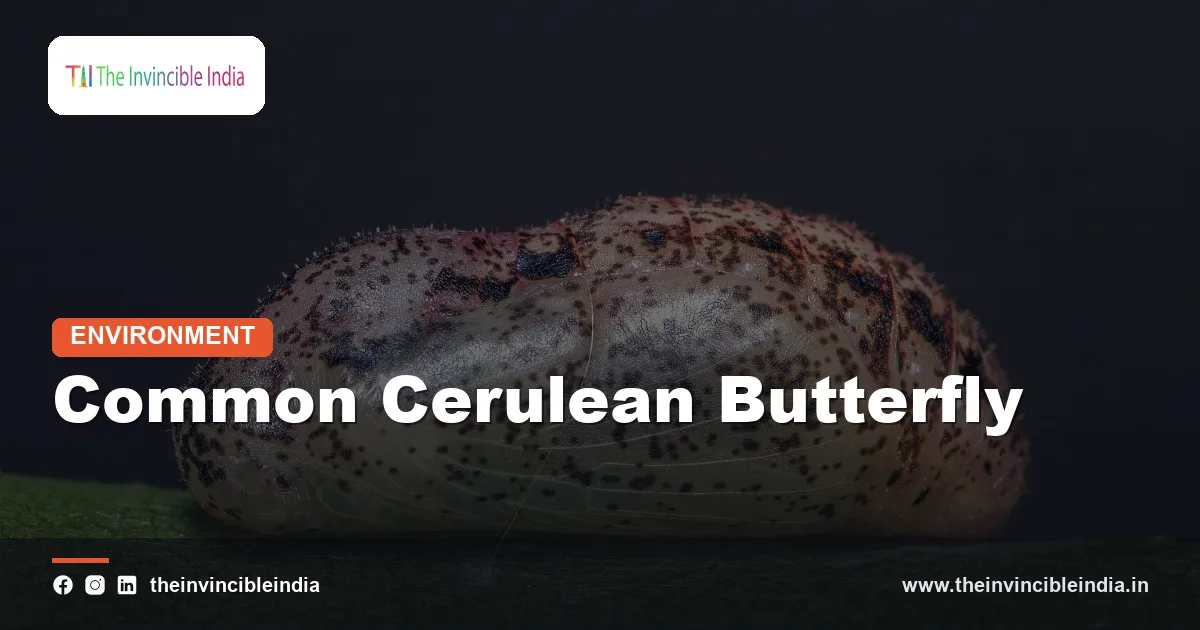
The common cerulean is a small, delicate blue butterfly (Jamides celeno) of the gossamer-winged family Lycaenidae, found in gardens, forest edges and wooded country across much of India, easily recognised by the pale shining blue upper side of its wings and the fine white lines on its brown underside. The butterfly has two slender tails on each hind wing, which, together with a dark spot near them, form a false head that confuses predators.
Although it is only about the size of a thumbnail, the common cerulean is a regular visitor to flowering shrubs and damp patches of ground, and it is one of the more widespread blues in the Western Ghats, the north-east and the peninsula. This explainer describes how to identify the common cerulean, where it occurs, what its caterpillars feed on, how ants take part in its life cycle, and how to find it in your own garden.
Quick Facts
| Common name | Common cerulean |
|---|---|
| Scientific name | Jamides celeno |
| Family | Lycaenidae (gossamer-winged butterflies), subfamily Polyommatinae |
| Wingspan | Roughly 3 to 4 cm |
| Caterpillar host plants | Various legumes (Fabaceae), including Pongamia, Saraca and other flowering trees and shrubs |
| Range | Peninsular India, the Western Ghats, the north-east, the Himalayan foothills, Sri Lanka and tropical Asia |
| Habitat | Gardens, forest edges, shaded paths, plantations and moist wooded country |
| Broods | Several broods a year, with continuous breeding in warm and wet conditions |
Key Takeaways
- The common cerulean (Jamides celeno) is a small blue butterfly of the family Lycaenidae that is found across large parts of India.
- The common cerulean shows a pale, shining blue upper side, while its underside is brown with narrow white wavy lines.
- Each hind wing of the common cerulean carries two fine tails and a dark spot that together look like a false head, which diverts predator attacks.
- Common cerulean caterpillars feed mostly on the buds, flowers and young leaves of legume plants.
- Like many lycaenid butterflies, the common cerulean has caterpillars that are often tended by ants, which protect them in return for sugary secretions.
- Adult common ceruleans visit flowers for nectar and often gather at damp ground to drink minerals, a behaviour known as mud-puddling.
What is the common cerulean butterfly?
The common cerulean is a small tropical butterfly whose scientific name is Jamides celeno, belonging to the family Lycaenidae, which includes the blues, coppers, hairstreaks and their relatives. The family is the second largest among butterflies and is known for small, quick insects with brilliant colours and tails.
The English name uses the word cerulean, which means sky-blue, and it describes the pale blue upper side of the male. The species was first described by Pieter Cramer in 1775 from specimens that reached Europe from Asia, and it has since been found to occur over a very large area, from India eastwards to South-East Asia and Australasia, with local races described in different regions.
Within India the common cerulean is one of several similar “Jamides” blues. These are small, slim butterflies with a distinctive underside pattern, and some are rarer or restricted to forest. The common cerulean is the one most likely to be met in gardens and secondary growth.
How do you identify the common cerulean?
The common cerulean is identified by the pale, shining blue upper side of the wings, the brown underside crossed by narrow white wavy lines, and two thin tails on each hind wing. Seen at rest with wings closed, the butterfly shows mostly the pattern of the underside.
Upper side
The male has a pearly pale blue upper side, with a slight violet tinge in some lights, edged with a thin dark border. The female is paler, often whitish blue, with a wider dark margin on the fore wing. The upper side is visible mainly when the butterfly basks or flies.
Underside
The underside is brownish to greyish brown and marked with white wavy bands edged with darker shades. Near the base of the hind wing there are small dark marks, and near the tails there is a black spot ringed by orange or metallic scales.
Tails
Two tails project from the hind wing, one long and slender, one short. When the butterfly settles, it often rubs its hind wings against each other in a slow, scissor-like motion, making the tails twitch like antennae.
The combination of blue wings, fine white lines underneath and two tails separates the common cerulean from many other small Indian blues, though some close relatives need careful comparison in good light.
Where does the common cerulean live in India?
The common cerulean lives in forest edges, gardens, plantations and wooded country across peninsular India, the Western Ghats, the north-eastern states and the lower Himalayan region. Outside India it ranges through Sri Lanka and wide areas of tropical Asia.
It tends to prefer places with some tree cover and flowering shrubs. Typical sites include:
- Shady lanes and garden borders where flowering shrubs grow.
- Edges of evergreen and moist deciduous forest in the Western Ghats and the north-east.
- Coffee, tea and spice plantations with shade trees.
- Stream banks, damp roadside patches and wet clearings where adults come to drink.
The butterfly is more common in humid regions than in the driest parts of the country. In arid zones of Rajasthan or the Deccan interior, it may appear only after rain or near irrigated gardens and tree plantations.
What do common cerulean caterpillars eat?
Common cerulean caterpillars eat the flower buds, flowers and soft young leaves of legumes and other flowering plants, with many records from trees and shrubs of the pea family (Fabaceae). Widely cited hosts include Pongamia pinnata (known as karanj or pongam), Saraca species (the ashoka group) and other flowering leguminous trees and climbers.
Feeding on buds and flowers instead of tough old leaves gives the caterpillar a nutritious diet, rich in protein. It also means the caterpillars are tied to the flowering seasons of their host plants, which affects when the adult butterflies appear.
| Host plant group | Example | Part eaten |
|---|---|---|
| Flowering legume trees | Pongamia pinnata (karanj) | Flower buds, flowers, young pods and tender leaves |
| Ashoka group | Saraca species | New flushes of flowers and leaves |
| Other legumes | Climbers and shrubs of the pea family | Buds and young shoots |
Host records vary across regions, so local populations may use different plants. Gardeners who grow flowering legume trees and shrubs are more likely to see the caterpillars on their plants.
What is the life cycle of the common cerulean?
The common cerulean develops through complete metamorphosis, passing from egg to caterpillar to pupa to adult in roughly three to five weeks in warm weather. The exact speed depends on temperature, humidity and the availability of fresh host-plant growth.
- Egg: The female lays a small, flattened, whitish egg on a flower bud or a young shoot of the host plant, usually one at a time.
- Caterpillar: The larva is slug-like, short and fairly flat, often green or pinkish to blend with the buds on which it feeds. It bores into or grazes on buds and tender tissue.
- Pupa: The caterpillar turns into a short, smooth chrysalis, which is attached to a leaf or twig by a silk girdle and silk pad.
- Adult: The butterfly emerges, dries its wings and soon feeds and seeks a mate.
Because the family’s caterpillars are small and well camouflaged, they are rarely noticed unless the plant is searched closely. Finding a freshly laid egg or a flattened green larva on a flowering twig is a mark of a patient observer.
Why do ants guard common cerulean caterpillars?
Ants often guard common cerulean caterpillars because the larvae, like many lycaenids, produce sugary secretions that ants feed on, and in exchange the ants drive away small predators and parasitic wasps. This relationship is a well-known example of mutualism in the Lycaenidae.
Many lycaenid caterpillars have a special gland on the back of the abdomen that releases a sweet droplet, and organs that may give off chemical signals to calm or call ants. The ants walk over the caterpillar, stroke it and drink the secretion. Observers who look closely at a flower bud with a cerulean caterpillar often find ants moving around it.
The partnership is not equally close in every species. In some lycaenids the link is loose, with the ants only an occasional visitor, while in others it is tight enough that the caterpillar depends on a specific ant. For the common cerulean, ants are mainly an extra layer of protection rather than an essential partner.
How does the false head protect the common cerulean?
The false head protects the common cerulean by tricking predators into attacking the hind end of the butterfly instead of its real head. The tails look like antennae, the dark spot looks like an eye, and the habit of rubbing the hind wings makes the false antennae move.
A bird or a jumping spider that strikes at the false head usually gets only a torn piece of the wing. The butterfly can often fly away with a small notch missing, which is why wild blues with damaged hind wings are so commonly seen. This pattern is shared by many hairstreaks and blues and is one of the best-known cases of deflection in butterfly defence.
What does the common cerulean feed on as an adult?
The adult common cerulean feeds on flower nectar and on mineral-rich moisture from wet soil, mud and animal droppings. Nectar provides sugar energy for flight, while mud-puddling supplies salts and amino acids that the butterfly cannot get from nectar alone.
Mud-puddling is mostly done by males, and it is common to see a group of blues, often of several species, clustered on the same damp patch of a stream bank or track. The butterflies keep their wings partly open and sip steadily, and they may rise in a cloud when disturbed, then settle again. This is a good time for photography, since the insects are less nervous than when flying.
At flowers, the common cerulean visits small blooms with accessible nectar. Shrubs such as lantana and various small-flowered weeds are frequent favourites in gardens.
How can you attract the common cerulean to a garden?
You can attract the common cerulean by planting flowering legume trees and shrubs, offering small nectar flowers, and leaving a patch of damp soil in partial shade. The combination gives the butterfly both breeding sites and feeding sites.
- Plant or keep flowering leguminous trees such as Pongamia, which serve as caterpillar hosts.
- Grow small-flowered shrubs and herbs that provide easy nectar.
- Keep a shallow, always-damp patch of sand or soil for mud-puddling.
- Avoid broad-spectrum pesticides, which harm small caterpillars.
- Tolerate ants on plants, since they are part of the caterpillar’s protection.
Patience matters. Blues are small and fast, and a gardener may need several visits at different times of day, ideally in the morning when butterflies are most active.
Is the common cerulean threatened?
The common cerulean is not considered threatened, because it is widespread, adaptable and able to use gardens and secondary growth. Its main risks are habitat loss, heavy pesticide use and the clearing of flowering trees that serve as hosts.
Its dependence on flowering trees means it is more vulnerable than butterflies that feed on weeds. Where avenue trees are removed or pruned hard during flowering, caterpillars lose their food. Still, the species continues to turn up regularly in urban parks and village groves, which is a positive sign for the adaptability of many Indian butterflies.
Bottom Line
The common cerulean is a tiny but conspicuous blue butterfly that links flowering trees, ants and damp soil in a single life story. Its false head, ant guards and mud-drinking habits make it a rewarding species to watch, and it is a useful marker of a garden or forest edge with a good mix of flowers and trees.
Frequently Asked Questions
What is the common cerulean butterfly?
The common cerulean is a small blue butterfly (Jamides celeno) of the family Lycaenidae, found across much of India and tropical Asia. It has a pale shining blue upper side, a brown underside with white wavy lines and two fine tails on each hind wing. It is often seen in gardens and forest edges.
How can I identify a common cerulean?
A common cerulean is identified by its pale blue upper side, the brown underside marked with narrow white wavy lines, and the two thin tails on each hind wing. The dark spot near the tails and the habit of rubbing the hind wings help confirm it. Females are paler and have a broader dark border.
What do common cerulean caterpillars eat?
Common cerulean caterpillars eat the flower buds, flowers and tender young leaves of legume plants. Pongamia (karanj) and Saraca (ashoka) are among the commonly cited hosts. Feeding on buds ties the caterpillars to the flowering season of their host trees.
Why do ants follow common cerulean caterpillars?
Ants follow common cerulean caterpillars because the larvae release sugary secretions that the ants like to drink. In return, the ants help guard the caterpillars against small predators and parasites. This kind of partnership is common in the butterfly family Lycaenidae.
What is the purpose of the tails on a common cerulean?
The tails on a common cerulean help create a false head that misdirects predators. Together with a dark spot and the habit of rubbing the hind wings, they look like moving antennae and an eye. Attackers often strike the wing edge and miss the real head.
Where can I see the common cerulean in India?
The common cerulean can be seen in gardens, forest edges and plantations across peninsular India, the Western Ghats, the north-east and the Himalayan foothills. It is easiest to find near flowering shrubs and damp ground where it comes to drink. Mornings after rain are especially good.
{“@context”:”https://schema.org”,”@graph”:[{“@type”:”FAQPage”,”mainEntity”:[{“@type”:”Question”,”name”:”What is the common cerulean butterfly?”,”acceptedAnswer”:{“@type”:”Answer”,”text”:”The common cerulean is a small blue butterfly (Jamides celeno) of the family Lycaenidae, found across much of India and tropical Asia. It has a pale shining blue upper side, a brown underside with white wavy lines and two fine tails on each hind wing. It is often seen in gardens and forest edges.”}},{“@type”:”Question”,”name”:”How can I identify a common cerulean?”,”acceptedAnswer”:{“@type”:”Answer”,”text”:”A common cerulean is identified by its pale blue upper side, the brown underside marked with narrow white wavy lines, and the two thin tails on each hind wing. The dark spot near the tails and the habit of rubbing the hind wings help confirm it. Females are paler and have a broader dark border.”}},{“@type”:”Question”,”name”:”What do common cerulean caterpillars eat?”,”acceptedAnswer”:{“@type”:”Answer”,”text”:”Common cerulean caterpillars eat the flower buds, flowers and tender young leaves of legume plants. Pongamia (karanj) and Saraca (ashoka) are among the commonly cited hosts. Feeding on buds ties the caterpillars to the flowering season of their host trees.”}},{“@type”:”Question”,”name”:”Why do ants follow common cerulean caterpillars?”,”acceptedAnswer”:{“@type”:”Answer”,”text”:”Ants follow common cerulean caterpillars because the larvae release sugary secretions that the ants like to drink. In return, the ants help guard the caterpillars against small predators and parasites. This kind of partnership is common in the butterfly family Lycaenidae.”}},{“@type”:”Question”,”name”:”What is the purpose of the tails on a common cerulean?”,”acceptedAnswer”:{“@type”:”Answer”,”text”:”The tails on a common cerulean help create a false head that misdirects predators. Together with a dark spot and the habit of rubbing the hind wings, they look like moving antennae and an eye. Attackers often strike the wing edge and miss the real head.”}},{“@type”:”Question”,”name”:”Where can I see the common cerulean in India?”,”acceptedAnswer”:{“@type”:”Answer”,”text”:”The common cerulean can be seen in gardens, forest edges and plantations across peninsular India, the Western Ghats, the north-east and the Himalayan foothills. It is easiest to find near flowering shrubs and damp ground where it comes to drink. Mornings after rain are especially good.”}}]}]}


