

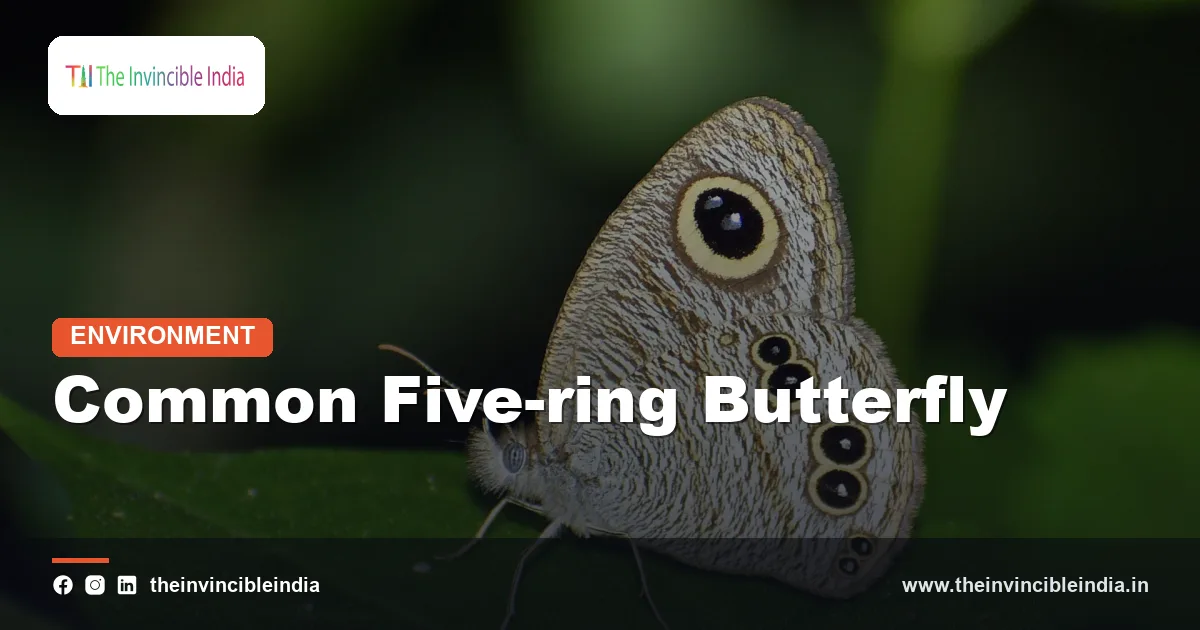
The common five-ring (Ypthima baldus) is a small brown satyr butterfly of India, named for the series of ringed eyespots on the underside of its wings and known for its low, bobbing flight over grass and shaded ground. It is one of the most frequently seen small butterflies in Indian gardens, grassy edges and light woodland.
Although the common five-ring is easy to overlook because of its modest brown colour, its habits and markings reward a closer look. This explainer covers how to identify the common five-ring, where it lives, what its caterpillars eat, how it differs from other ring butterflies and why it is a useful indicator of grassy, shaded habitat. It was last reviewed on 30 October 2026.
| Common name | Common five-ring |
|---|---|
| Scientific name | Ypthima baldus |
| Family | Nymphalidae, subfamily Satyrinae (satyrs and browns) |
| Wingspan | Roughly 3.5 to 4.5 cm |
| Host plants | Grasses (family Poaceae) |
| Range and habitat in India | Grassy, shaded and bushy places, garden edges and light woodland across much of India, from the plains and peninsula to the Himalayan foothills and north-east |
| Flight season and broods | Several broods through the year in warm areas; most numerous during and after the monsoon |
| Notable features | Small brown wings, ringed eyespots on the underside, weak bobbing flight low over grass |
Key Takeaways
- The common five-ring (Ypthima baldus) is a small brown butterfly in the satyr subfamily Satyrinae of the brush-footed family Nymphalidae.
- The common five-ring is named for the series of ringed eyespots on the underside of its hindwings, which are used to tell the ring butterflies apart.
- Common five-ring caterpillars feed on grasses, so the butterfly lives wherever suitable grass grows in partial shade.
- The common five-ring flies weakly and low, with a bobbing flutter, and usually settles quickly among grass and leaf litter.
- The common five-ring is widespread across India, including gardens, field edges and lightly wooded land.
- The common five-ring is easily confused with other Ypthima species, such as the common four-ring and common three-ring, so counting and comparing the eyespots is essential.
What is the common five-ring butterfly?
The common five-ring is a small brown butterfly in the genus Ypthima, a group of satyrs known in English as rings because of the circular eyespots on their wings. The scientific name of the common five-ring is Ypthima baldus, and it belongs to the subfamily Satyrinae, whose members are often called browns or satyrs.
Satyrs are typically shade-loving, weak-flying butterflies that rest with their wings closed and feed on grasses and similar plants as caterpillars. The common five-ring is one of several Ypthima species in India, and watchers treat it as an easy and useful starting point for learning the group.
The English name is a simple descriptive label. It refers to the pattern of rings on the underside of the wings, and the word common is used because it is one of the more frequently encountered members of its group.
How do you identify a common five-ring?
A common five-ring is identified by its small size, its brown colour and the set of ringed eyespots on the underside of its wings, with the hindwing carrying the characteristic row of rings. The upperside is plain brown, usually with a single eyespot near the tip of the forewing.
Upperside
The upperside of the wings is dull brown with little decoration, apart from a conspicuous black eyespot with a pale centre near the forewing tip. Because the butterfly almost always rests with its wings closed, the upperside is seen mainly in flight or when it basks.
Underside
The underside is paler brown or greyish and is marked with fine, wavy, transverse lines that look like faint pencil strokes. Across this background lie the ringed eyespots, each with a dark outer ring, a yellowish halo and a pale or silvery centre. The row of rings on the hindwing is the main identification feature.
Why the number of rings matters
The number and arrangement of rings help separate species of Ypthima. The count can vary slightly between individuals and seasonal forms, so it should be used alongside other features rather than as the only test.
Where does the common five-ring live in India?
The common five-ring lives across much of India in grassy, shaded and bushy places, and it also occurs in Sri Lanka and South-East Asia. It is found from the plains and peninsula to the Himalayan foothills and the north-east, and it is among the more adaptable members of its group.
Typical habitats include:
- Grassy patches under trees and along hedges
- Garden lawns and shrubbery edges, especially where grass is allowed to grow
- Edges of fields, roadsides with grass cover and wasteland
- Light woodland and forest clearings with grassy undergrowth
The common five-ring is less likely in bare, paved or heavily mown areas without grass, and in very dry or treeless open land. It is most at home where grass grows in partial shade, since that provides both host plants for the caterpillars and cover for the adults.
What do common five-ring caterpillars eat?
Common five-ring caterpillars eat grasses, which are plants in the family Poaceae. The female lays small eggs on or near grass blades, and the caterpillars feed on the leaves, usually resting on the plant during the day.
A host plant is the plant on which a butterfly’s caterpillars can feed and grow. For the common five-ring, a number of grass species can serve as hosts, which is one reason the butterfly is so common and widespread. Observers have recorded grasses such as Oplismenus among its food plants, and many other soft-leaved grasses of shaded ground are likely to be used.
Since the caterpillars depend on grass, regular heavy mowing or complete removal of ground cover reduces the butterfly. Letting a corner of a garden stay grassy and slightly untidy is the simplest way to support it.
How does the common five-ring fly and behave?
The common five-ring flies weakly and close to the ground, with a bobbing, fluttering action, and it usually settles within a short distance among grass or leaf litter. Its flight looks hesitant, and it rarely travels far in one go.
Resting and camouflage
When the butterfly lands, it closes its wings, and the brown underside with fine lines blends well into dry grass, soil and leaf litter. The eyespots may draw a predator’s attention to the wing edges rather than to the vulnerable body, a common defence among satyrs.
Feeding
Adults are not strong flower visitors. They are more often seen sipping fluids from rotting fruit, damp ground or sap, although they will visit low flowers occasionally.
Activity pattern
The common five-ring is active in daylight and is often seen in shade or the late afternoon, and it tolerates shadier spots than many other butterflies. On bright days it prefers the edges between sun and shade.
What is the life cycle of the common five-ring?
The common five-ring has the usual four stages: egg, caterpillar, pupa and adult. The female lays eggs on or close to grass, the caterpillars feed and moult several times, and the full-grown caterpillar forms a pupa, from which the adult butterfly emerges.
- Egg: small and laid on or near the host grass
- Caterpillar: feeds on grass blades and is usually green or brownish, matching its food plant
- Pupa: a chrysalis, often attached low among grass or debris
- Adult: a short-lived flying stage that mates and lays the next generation
In warm parts of India the common five-ring can produce several broods a year. The timing varies with rainfall and temperature, and seasonal forms may differ slightly in the strength of the underside markings.
When is the best time to see the common five-ring?
The best time to see the common five-ring is during and after the monsoon, when grass is fresh and the butterfly is at its most numerous. In many parts of India it can be found for much of the year, with fewer individuals in the driest or coldest months.
Look for it in the morning and late afternoon, along shaded grassy edges and under trees. It often flushes from underfoot as you walk, flutters a short distance and settles again.
How is the common five-ring different from other ring butterflies?
The common five-ring differs from other Ypthima species mainly in the number, size and arrangement of the ringed eyespots on the underside. Several ring butterflies share India’s grassy habitats, and they look similar at a glance.
| Species | Key distinguishing feature | Habit |
|---|---|---|
| Common five-ring (Ypthima baldus) | Row of five ringed eyespots on the hindwing underside | Grassy, shaded edges and gardens |
| Common four-ring (Ypthima huebneri) | Typically four rings on the hindwing underside | Grassy ground, open and shaded |
| Common three-ring (Ypthima asterope) | Fewer rings, with a smaller set on the hindwing | Dry grassy and scrub areas |
Because ring counts can vary slightly, photographs of the underside of the hindwing are the best method for confirming which species you have seen.
Is the common five-ring threatened?
The common five-ring is not regarded as a threatened species, since it is widespread and uses common grasses as host plants. Local declines can occur when grassy ground is paved, mown very short or treated heavily with weedkillers.
Small butterflies such as the common five-ring are useful indicators of garden and field-edge quality. Their presence suggests that some grass and shade remain, and that chemical use is not extreme. In India, wild butterflies are covered by wildlife protection rules, so observation and photography are preferred to collecting.
How can you attract common five-rings to a garden?
You can attract common five-rings to a garden by leaving patches of native grass uncut, keeping some partial shade and avoiding pesticides and weedkillers. These simple steps give the caterpillars food and the adults cover.
- Leave a grassy corner under a tree or hedge unmown through the monsoon.
- Avoid spraying insecticides and herbicides on grass and shrubs.
- Keep fallen leaves in a small part of the garden as shelter.
- Add a shallow dish of damp sand or a piece of overripe fruit for adults.
Why do satyr butterflies have eyespots?
Satyr butterflies such as the common five-ring have eyespots mainly to confuse predators, by drawing attacks towards the outer wing edge instead of the head and body. A bird that pecks at a ringed spot may take only a small piece of wing, which allows the butterfly to escape and fly on.
Eyespots may also help in another way, since the rings on the underside can look like the eyes of a larger animal when the butterfly suddenly opens or shifts its wings. Biologists have studied these patterns in many satyr species, and the evidence points to deflection and startle effects as the likeliest explanations. The fine wavy lines on the rest of the underside add camouflage against dry grass and soil.
For observers, the same eyespots are a friendly gift, since they make the group easy to recognise even in a quick photograph taken at a distance.
Bottom Line
The common five-ring is a small, widespread brown satyr of Indian grasslands, gardens and light woodland, recognised by the ringed eyespots under its wings and its low, bobbing flight. Its dependence on grass as a host plant makes it a simple guide to the health of grassy, shaded ground.
Frequently Asked Questions
What is the common five-ring butterfly?
The common five-ring butterfly is a small brown satyr, Ypthima baldus, found across India. It is named for the ringed eyespots on the underside of its wings. It flies weakly and low over grass and shaded ground.
What do common five-ring caterpillars eat?
Common five-ring caterpillars eat grasses in the family Poaceae. The female lays eggs on or near grass blades, and the caterpillars feed on the leaves. This is why the butterfly lives wherever grass grows in partial shade.
Where can you see the common five-ring in India?
You can see the common five-ring in grassy and shaded places across much of India, including gardens, field edges, roadsides and light woodland. It is found from the plains to the Himalayan foothills and the north-east. Fresh monsoon grass often brings the highest numbers.
How can you tell a common five-ring from a common four-ring?
You can tell a common five-ring from a common four-ring by counting the ringed eyespots on the underside of the hindwing. The five-ring usually shows a row of five, and the four-ring typically shows four. Counts can vary slightly, so check the arrangement and compare photographs.
Why does the common five-ring fly so low and weakly?
The common five-ring flies low and weakly because it is a shade-loving satyr that relies on camouflage rather than speed. It settles quickly among grass and leaf litter, where its brown underside blends in. The eyespots may also draw predators away from the body.
Is the common five-ring butterfly common in gardens?
The common five-ring butterfly is common in gardens that have some grass and partial shade. Leaving a patch of grass unmown and avoiding pesticides supports it. Gardens that are paved or mown very short are much less suitable.
{“@context”:”https://schema.org”,”@graph”:[{“@type”:”FAQPage”,”mainEntity”:[{“@type”:”Question”,”name”:”What is the common five-ring butterfly?”,”acceptedAnswer”:{“@type”:”Answer”,”text”:”The common five-ring butterfly is a small brown satyr, Ypthima baldus, found across India. It is named for the ringed eyespots on the underside of its wings. It flies weakly and low over grass and shaded ground.”}},{“@type”:”Question”,”name”:”What do common five-ring caterpillars eat?”,”acceptedAnswer”:{“@type”:”Answer”,”text”:”Common five-ring caterpillars eat grasses in the family Poaceae. The female lays eggs on or near grass blades, and the caterpillars feed on the leaves. This is why the butterfly lives wherever grass grows in partial shade.”}},{“@type”:”Question”,”name”:”Where can you see the common five-ring in India?”,”acceptedAnswer”:{“@type”:”Answer”,”text”:”You can see the common five-ring in grassy and shaded places across much of India, including gardens, field edges, roadsides and light woodland. It is found from the plains to the Himalayan foothills and the north-east. Fresh monsoon grass often brings the highest numbers.”}},{“@type”:”Question”,”name”:”How can you tell a common five-ring from a common four-ring?”,”acceptedAnswer”:{“@type”:”Answer”,”text”:”You can tell a common five-ring from a common four-ring by counting the ringed eyespots on the underside of the hindwing. The five-ring usually shows a row of five, and the four-ring typically shows four. Counts can vary slightly, so check the arrangement and compare photographs.”}},{“@type”:”Question”,”name”:”Why does the common five-ring fly so low and weakly?”,”acceptedAnswer”:{“@type”:”Answer”,”text”:”The common five-ring flies low and weakly because it is a shade-loving satyr that relies on camouflage rather than speed. It settles quickly among grass and leaf litter, where its brown underside blends in. The eyespots may also draw predators away from the body.”}},{“@type”:”Question”,”name”:”Is the common five-ring butterfly common in gardens?”,”acceptedAnswer”:{“@type”:”Answer”,”text”:”The common five-ring butterfly is common in gardens that have some grass and partial shade. Leaving a patch of grass unmown and avoiding pesticides supports it. Gardens that are paved or mown very short are much less suitable.”}}]}]}


