

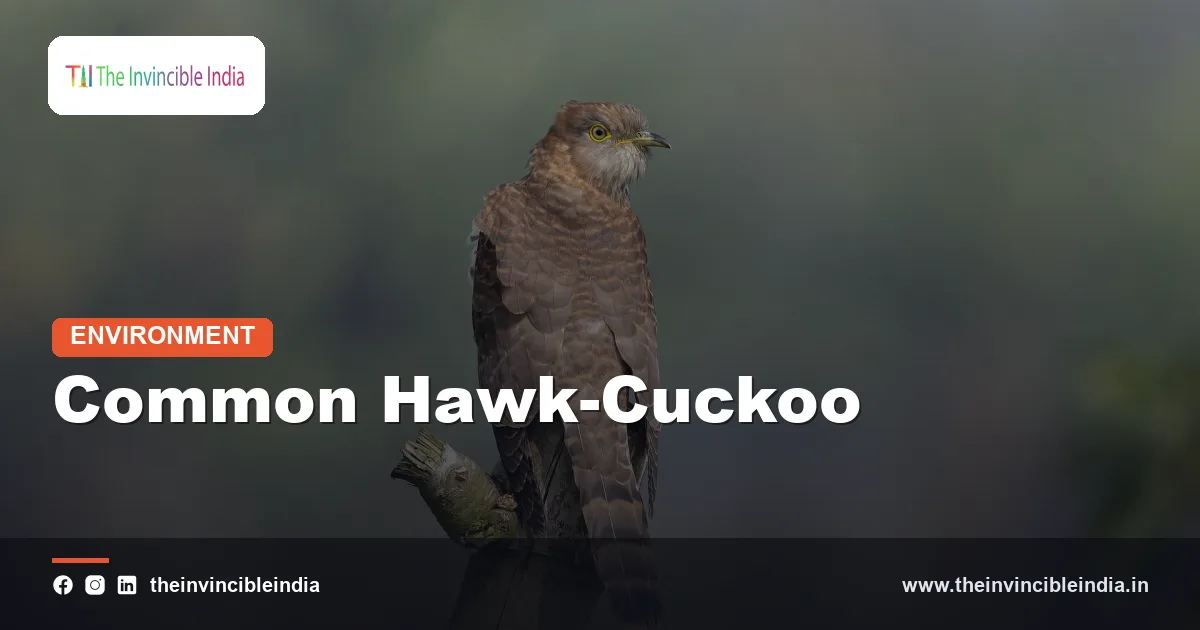
The common hawk-cuckoo (Hierococcyx varius), widely nicknamed the brainfever bird and known in Hindi as the papiha, is a grey, hawk-like cuckoo of the Indian subcontinent whose ceaseless, rising, three-note call fills the hot afternoons and nights of the Indian summer. Its sparrowhawk-like plumage and barred underparts help it approach the nests of other birds, where it lays its eggs.
The common hawk-cuckoo is a brood parasite that leaves the rearing of its young to babblers and other hosts. This explainer covers how to recognise the bird, what the “brainfever” name means, why the call is so persistent, how its parasitic breeding works, where it lives in India, and how the bird is faring. 23 October 2026.
Quick Facts
| Attribute | Detail |
|---|---|
| Common names | Common hawk-cuckoo, brainfever bird, papiha (Hindi) |
| Scientific name | Hierococcyx varius |
| Family | Cuculidae (cuckoos), order Cuculiformes |
| Body length | About 33 to 35 cm, with a long tail |
| Breeding strategy | Obligate brood parasite; lays eggs in the nests of other birds |
| Usual hosts in India | Babblers, especially the jungle babbler and the yellow-billed babbler |
| Calling season | Mainly the hot season and the build-up to the monsoon, from about March to July in many regions |
| Conservation status (IUCN) | Least Concern |
Key Takeaways
- The common hawk-cuckoo is an ash-grey cuckoo about 34 cm long whose barred underparts and long banded tail give it a close resemblance to a small hawk.
- The common hawk-cuckoo gets the nickname brainfever bird from its loud, rising, repeated call, which many listeners hear as the phrase “brain-fe-ver”.
- The common hawk-cuckoo is a brood parasite that lays its eggs in the nests of other birds, chiefly babblers, and does not raise its own young.
- The common hawk-cuckoo calls most during the hot dry months before the monsoon, often in the heat of the day and sometimes through the night.
- The common hawk-cuckoo feeds mainly on insects, especially caterpillars, along with some fruits such as figs.
- The International Union for Conservation of Nature (IUCN) lists the common hawk-cuckoo as a species of Least Concern.
What is the common hawk-cuckoo?
The common hawk-cuckoo is a medium-sized cuckoo of the genus Hierococcyx that lives in the woodlands, groves and gardens of India, Sri Lanka and neighbouring countries. It was long placed in the genus Cuculus and is still sometimes listed under older names in field guides.
The bird is secretive and spends most of its time in the leafy canopy, so more people hear it than see it. It sits upright on a branch with its long tail hanging down, a posture that adds to its resemblance to a hawk. Within India it is common in the peninsula and along the Himalayan foothills, and it is a regular visitor to gardens in towns and cities.
The common hawk-cuckoo belongs to the cuckoo family Cuculidae, which also includes the pied cuckoo, the Asian koel and the sirkeer malkoha. Like the pied cuckoo and the koel, it is an obligate brood parasite.
How can you identify the common hawk-cuckoo?
The common hawk-cuckoo can be identified by its ash-grey upperparts, its whitish underparts with dark streaks or bars and a rusty wash on the breast, its long grey tail with dark bands, and its yellow eye ring, bill base and legs. At a glance it looks like a small hawk, which is why it is often mistaken for one.
Adult plumage
- The crown and back are slaty grey, and the throat is pale grey.
- The underparts are whitish, with a buff or rusty tint on the breast and dark streaks that look like bars.
- The tail is long and grey, crossed by several dark bands and a broad dark band near the tip.
- The eye ring is yellow, and the legs are yellow.
Juvenile plumage
Young common hawk-cuckoos have brown upperparts with pale feather edges and heavily streaked or spotted underparts. They look quite different from adults and can be mistaken for another species. The streaked juveniles are often seen being fed by their foster parents, which are usually much smaller than the cuckoo itself.
Hawk look-alike
The close resemblance to the shikra (Accipiter badius), a small Indian sparrowhawk, is the bird’s best-known trait. Many ornithologists propose that this resemblance may startle small host birds and give the cuckoo a better chance to reach their nests. The idea is widely discussed, though how strongly it works in practice is still debated.
Why is the common hawk-cuckoo called the brainfever bird?
The common hawk-cuckoo is called the brainfever bird because its loud, urgent, repeated call is often heard as the phrase “brain-fe-ver” and grows higher and more frantic with each repetition. English-speaking colonial residents of India coined the nickname, saying the call felt like it could drive a listener to distraction in the summer heat.
The same call is heard differently in other languages. In Hindi and Urdu the bird is the papiha, and many folk renderings of its voice are phrased as a plaintive question such as “pee kahan”, meaning “where is my beloved”. Poetry across north India uses the papiha as an image of longing. The overlap with the rain-longing chatak, which is the pied cuckoo, means that the two birds are sometimes confused in literary and everyday usage.
The nickname captures a real feature of the calling pattern. The notes are delivered in a series of three or more that climbs in pitch and pace, then stops, and then begins again after a short pause.
Why does the common hawk-cuckoo call so persistently?
The common hawk-cuckoo calls so persistently because the male is advertising his territory and trying to attract a female during the breeding season. The call serves the same purpose as a song in other birds, and it can be repeated for long stretches without a break.
Several features make the bird seem relentless to humans. First, the calls peak in the hottest months of the year, from roughly March to July in many regions, when other birds are quieter in the midday heat. Second, the bird continues to call in the evening and often during moonlit nights, which surprises people who do not expect a bird to be active in the dark. Third, the calls are loud and carry over long distances.
Males may call from a hidden perch inside dense foliage, so the sound seems to come from nowhere. Because several males can call at the same time in an area, a colony of calling birds can create a chorus that lasts for hours.
How does the common hawk-cuckoo breed as a brood parasite?
The common hawk-cuckoo breeds by laying its egg in the nest of another bird and leaving the host pair to incubate it and feed the chick. This strategy is called brood parasitism, and it frees the cuckoo from the work and risk of nest-building.
The host species
The main hosts in India are babblers, including the jungle babbler (Argya striata), the yellow-billed babbler and related species that live in small, noisy groups. Babblers build open cup nests in shrubs and trees, and their groups often feed together, which keeps the nest easy to find. Other hosts are recorded now and then, and a few records involve different small songbirds.
The egg and the chick
The cuckoo’s egg is a pale blue that resembles the eggs of babblers, so hosts often accept it. The chick hatches, begs loudly and is fed by the foster parents until it leaves the nest. What happens to the host’s own young differs between cases, and observers report that they often fail to survive because the larger cuckoo chick takes most of the food. The cuckoo chick is noisy and gaping, and the large mouth triggers the parents to keep feeding.
After fledging
The young bird may be fed for some days after leaving the nest, even as it begins to learn to forage for itself. Since it never meets its biological parents, its calling, diet and migratory habits are thought to be largely inherited.
What does the common hawk-cuckoo eat?
The common hawk-cuckoo eats mostly insects, especially hairy and smooth caterpillars, and it also takes ants, termites, beetles and other invertebrates. Fruits such as figs and berries make up a smaller part of its diet.
The bird forages quietly in the canopy, moving between branches and picking prey from leaves, and it sometimes descends to the ground. In places where caterpillar outbreaks occur before the monsoon, hawk-cuckoos and other insect-eaters contribute to keeping the numbers in check. The effect on any single outbreak is hard to measure.
Where is the common hawk-cuckoo found in India?
The common hawk-cuckoo is found across most of India, in deciduous and evergreen woodland, groves, orchards and wooded gardens, from the plains up to moderate elevations in the hills. It is largely absent from very dry desert regions and from high mountains.
The bird occurs through the Indian peninsula, the Western Ghats, the Eastern Ghats and the Himalayan foothills, and it extends into Pakistan, Nepal, Bangladesh and Sri Lanka. It is common in many urban parks and campuses that have large trees. Some local movements follow the seasons, but the common hawk-cuckoo is generally regarded as resident in much of its range. Related species in the same genus, such as Hodgson’s hawk-cuckoo, occur in the Himalaya and northeast India.
Is the common hawk-cuckoo threatened?
The common hawk-cuckoo is not considered threatened; the IUCN rates it as Least Concern because it has a wide range and is common over much of it. Exact population counts are not well established, and the overall trend is thought to be stable.
Possible local pressures include the felling of large trees, the loss of hedgerows and shrubs that support babbler hosts, and heavy pesticide use that reduces insect prey. A decline in babblers would hurt the cuckoo indirectly. Under Indian law, wild birds are protected by the Wild Life (Protection) Act, 1972, which restricts hunting and capture. Gardens, campuses and farm borders with mature native trees help the bird.
How does the common hawk-cuckoo compare with other Indian cuckoos?
The common hawk-cuckoo differs from other Indian cuckoos in its hawk-like grey plumage and in its relentless rising call. The table below compares it with three other cuckoos commonly met in India.
| Bird | Appearance | Typical call | Usual hosts |
|---|---|---|---|
| Common hawk-cuckoo | Grey above, barred below, yellow eye ring, hawk-like | Rising, repeated “brain-fe-ver” phrase | Babblers |
| Pied cuckoo | Black above, white below, crested | Loud metallic “piu-piu-pee-pee” series | Babblers, some bulbuls and warblers |
| Asian koel | Male glossy black; female spotted brown and white | Rising “ko-el” and shrill “kuo-kuo” calls | House crow and jungle crow |
| Indian cuckoo | Grey above, barred below, slimmer, with a four-note call | Four-note call often rendered as “one more bottle” | Drongos and other small songbirds |
The comparison shows that the common hawk-cuckoo shares host species with the pied cuckoo but is easy to tell apart. The Indian cuckoo also looks grey and barred, but its call has a different rhythm and it is a more migratory bird in most regions.
How can you watch and listen for the common hawk-cuckoo?
You can find the common hawk-cuckoo by listening for its call between March and July and then tracing the sound to a leafy tree, because the bird is easier to hear than to see. A pair of binoculars and patience are the main tools.
- Listen in the early morning, at dusk and on moonlit nights, when the call is most noticeable.
- Scan the canopy and the middle branches of large trees where the call seems to come from.
- Look for the upright posture, the long banded tail and the yellow eye ring.
- Avoid repeated playback of calls, since it can stress breeding birds and distract them from feeding.
- Keep away from babbler nests, because repeated visits can cause hosts to desert.
- Log sightings on a citizen-science platform such as eBird to help researchers track calling seasons.
Bottom Line
The common hawk-cuckoo is a hawk-like grey cuckoo whose rising, restless call earned it the name brainfever bird. It is common and not threatened, but it depends on babblers, insects and large trees to complete its parasitic life cycle.
Frequently Asked Questions
Why is the common hawk-cuckoo called the brainfever bird?
The common hawk-cuckoo is called the brainfever bird because its loud, rising and repeated call sounds like the words “brain-fe-ver”. Colonial-era residents of India gave it the name, saying the call grew more frantic with each repetition. The name stuck in English and is still widely used.
Is the common hawk-cuckoo the same as the papiha?
Yes, the papiha is the usual Hindi name for the common hawk-cuckoo. The papiha features in north Indian poetry as a bird of longing. The name is sometimes also applied loosely to other calling cuckoos, so the exact bird in an old poem is not always clear.
Does the common hawk-cuckoo build a nest?
No, the common hawk-cuckoo does not build a nest. It lays its eggs in the nests of other birds, mainly babblers, and the hosts raise the cuckoo chick. This habit is known as brood parasitism.
When does the common hawk-cuckoo call?
The common hawk-cuckoo calls mainly in the hot season, from about March to July in many parts of India. It calls through the day and often at night, including on moonlit nights. The calling peaks when the males are defending territories and seeking mates.
Why does the common hawk-cuckoo look like a hawk?
The common hawk-cuckoo looks like a small hawk, such as the shikra, because of its grey back, barred underparts and long banded tail. Many ornithologists think the look may scare small host birds and give the cuckoo easier access to their nests. How well this works in practice is still debated.
Is the common hawk-cuckoo endangered?
No, the common hawk-cuckoo is not endangered; the IUCN lists it as Least Concern. It is widespread and common in woodland, groves and gardens across India. Loss of large trees and heavy pesticide use are possible local threats.
{“@context”:”https://schema.org”,”@graph”:[{“@type”:”FAQPage”,”mainEntity”:[{“@type”:”Question”,”name”:”Why is the common hawk-cuckoo called the brainfever bird?”,”acceptedAnswer”:{“@type”:”Answer”,”text”:”The common hawk-cuckoo is called the brainfever bird because its loud, rising and repeated call sounds like the words “brain-fe-ver”. Colonial-era residents of India gave it the name, saying the call grew more frantic with each repetition. The name stuck in English and is still widely used.”}},{“@type”:”Question”,”name”:”Is the common hawk-cuckoo the same as the papiha?”,”acceptedAnswer”:{“@type”:”Answer”,”text”:”Yes, the papiha is the usual Hindi name for the common hawk-cuckoo. The papiha features in north Indian poetry as a bird of longing. The name is sometimes also applied loosely to other calling cuckoos, so the exact bird in an old poem is not always clear.”}},{“@type”:”Question”,”name”:”Does the common hawk-cuckoo build a nest?”,”acceptedAnswer”:{“@type”:”Answer”,”text”:”No, the common hawk-cuckoo does not build a nest. It lays its eggs in the nests of other birds, mainly babblers, and the hosts raise the cuckoo chick. This habit is known as brood parasitism.”}},{“@type”:”Question”,”name”:”When does the common hawk-cuckoo call?”,”acceptedAnswer”:{“@type”:”Answer”,”text”:”The common hawk-cuckoo calls mainly in the hot season, from about March to July in many parts of India. It calls through the day and often at night, including on moonlit nights. The calling peaks when the males are defending territories and seeking mates.”}},{“@type”:”Question”,”name”:”Why does the common hawk-cuckoo look like a hawk?”,”acceptedAnswer”:{“@type”:”Answer”,”text”:”The common hawk-cuckoo looks like a small hawk, such as the shikra, because of its grey back, barred underparts and long banded tail. Many ornithologists think the look may scare small host birds and give the cuckoo easier access to their nests. How well this works in practice is still debated.”}},{“@type”:”Question”,”name”:”Is the common hawk-cuckoo endangered?”,”acceptedAnswer”:{“@type”:”Answer”,”text”:”No, the common hawk-cuckoo is not endangered; the IUCN lists it as Least Concern. It is widespread and common in woodland, groves and gardens across India. Loss of large trees and heavy pesticide use are possible local threats.”}}]}]}


