

The common jay (Graphium doson) is a fast-flying, tailless swallowtail of the family Papilionidae, found in the forests and wooded hills of India, and it is recognised by the rows of translucent pale blue-green spots on its black wings. It belongs to a group of swallowtails known as the “graphiums”, which also includes the bluebottles and the swordtails, and it is famous for darting between flowers without ever fully closing its wings while it feeds.
The common jay is one of the most frequently seen swallowtails of the Western Ghats and the north-east, particularly near forest streams and damp tracks. This guide explains how to identify the common jay, where it lives, what its caterpillars eat, how its life cycle works and how to watch it responsibly.
Common Jay Quick Facts
| Common name | Common jay |
|---|---|
| Scientific name | Graphium doson (C. and R. Felder, 1864) |
| Family | Papilionidae (swallowtails) |
| Wingspan | Roughly 6 to 8 cm |
| Caterpillar host plants | Custard-apple family (Annonaceae) trees and climbers, such as Polyalthia, Annona, Artabotrys and Miliusa; also recorded on some magnolia-family plants |
| Range and habitat in India | Western Ghats and southern India, parts of the Eastern Ghats, the Himalayan foothills and the north-east; evergreen and moist deciduous forest, forest streams, plantations and gardens |
| Flight season | Seen through much of the year in warm regions with several broods; often most abundant in and after the monsoon |
| Notable features | Tailless; translucent blue-green spots on black wings; very fast, darting flight; males gather at damp ground; wings quiver while feeding |
Key Takeaways
- The common jay (Graphium doson) is a tailless swallowtail of India, with translucent pale blue-green spots on black wings.
- Common jay caterpillars feed on trees and climbers of the custard-apple family (Annonaceae), including the ashoka tree Polyalthia longifolia.
- The common jay flies extremely fast and often keeps its wings in constant motion while feeding at flowers.
- Male common jays often gather in groups at wet sand and mud, a behaviour called mud-puddling.
- The common jay is found in the Western Ghats, the Eastern Ghats, the Himalayan foothills and the north-east of India.
- The common jay is not considered globally threatened, but it depends on forest cover and on Annonaceae host plants.
What Is the Common Jay Butterfly?
The common jay is a medium-sized swallowtail butterfly, Graphium doson, that lives in tropical and subtropical forests across southern and south-eastern Asia, including large parts of India. It was described by Cajetan and Rudolf Felder in 1864, and it is placed in the family Papilionidae, the swallowtails.
Swallowtails are the family that includes the largest and showiest butterflies in India, such as the birdwings and the mormons. The graphiums form a smaller group within the family, noted for their narrow wings, quick flight and pale green or blue-green markings. Common names in this group, such as bluebottle, jay and swordtail, reflect that colouring.
Unlike many of its cousins, the common jay has no tail on the hindwing. This makes it a useful point of comparison with the tailed jay, which is a closely related species with a clear tail and a similar pattern of spots.
How Can You Identify the Common Jay?
You can identify the common jay by its black wings marked with rows of translucent pale blue-green spots, by the absence of a tail on the hindwing and by its very fast, darting flight. When seen from below, the butterfly shows brownish and pale markings with reddish touches near the base of the wings.
Upperside
On the upperside, the forewing carries a series of elongated, pale spots that look somewhat like a string of windows. The hindwing has a row of larger, rounder spots and a dark border. The ground colour is black or very dark brown, and the spots look pale blue-green or whitish-green depending on the light.
Underside
The underside is a mix of brown, cream and pale green patches with small reddish spots near the hindwing base. Because the common jay rarely rests with its wings closed in open view, the underside is mostly seen in photographs taken at flowers or damp ground.
Shape
The wings are fairly narrow, and the hindwing has a rounded outer edge with no tail. This shape, with the quick flight, helps separate the common jay from the more broad-winged swallowtails.
Where Is the Common Jay Found in India?
The common jay is found in the Western Ghats and other forested parts of peninsular India, in parts of the Eastern Ghats, in the Himalayan foothills and across the north-eastern states. Outside India it ranges across Sri Lanka and much of South-East Asia, which makes it a widespread tropical swallowtail.
The butterfly prefers:
- Evergreen and semi-evergreen forest, as well as moist deciduous forest.
- Forest streams, damp tracks, culverts and roadside seepages where males drink.
- Coffee, tea and mixed plantations that retain tall trees.
- Gardens and campuses in or near wooded regions, especially where ashoka trees or other Annonaceae are planted.
It is mostly a forest and forest-edge butterfly, so its presence in a city or garden usually signals that a wooded area is nearby or that host trees are growing on the site. The species is generally found at low to mid elevations.
What Does the Common Jay Eat?
Common jay caterpillars eat the leaves of trees and climbers of the custard-apple family (Annonaceae), and the adults drink nectar and mineral-rich water. The female lays her eggs on young leaves, and the caterpillars eat the soft new growth.
Host plants
Recorded host plants include members of the Annonaceae such as Polyalthia (including the ashoka tree, Polyalthia longifolia), Annona (custard-apple species), Artabotrys, Miliusa and Uvaria. Some records also include plants of the magnolia family, such as Michelia. Because ashoka trees are planted widely in Indian towns and campuses, the common jay sometimes breeds in surprisingly urban settings.
Adult food
Adult common jays visit a range of flowers, including lantana, ixora, wild forest shrubs and the blooms of garden plants. They typically hover while feeding, with the wings beating rapidly, which is a distinctive habit among swallowtails. Males also feed at wet sand and animal droppings, drawing minerals that are important for reproduction.
What Is the Life Cycle of the Common Jay?
The common jay passes through egg, caterpillar, pupa and adult stages, and in warm regions several generations can occur in a single year. The full cycle takes roughly a month or more depending on weather and food quality.
- Egg: The female lays small, round, pale eggs singly on young leaves of host plants.
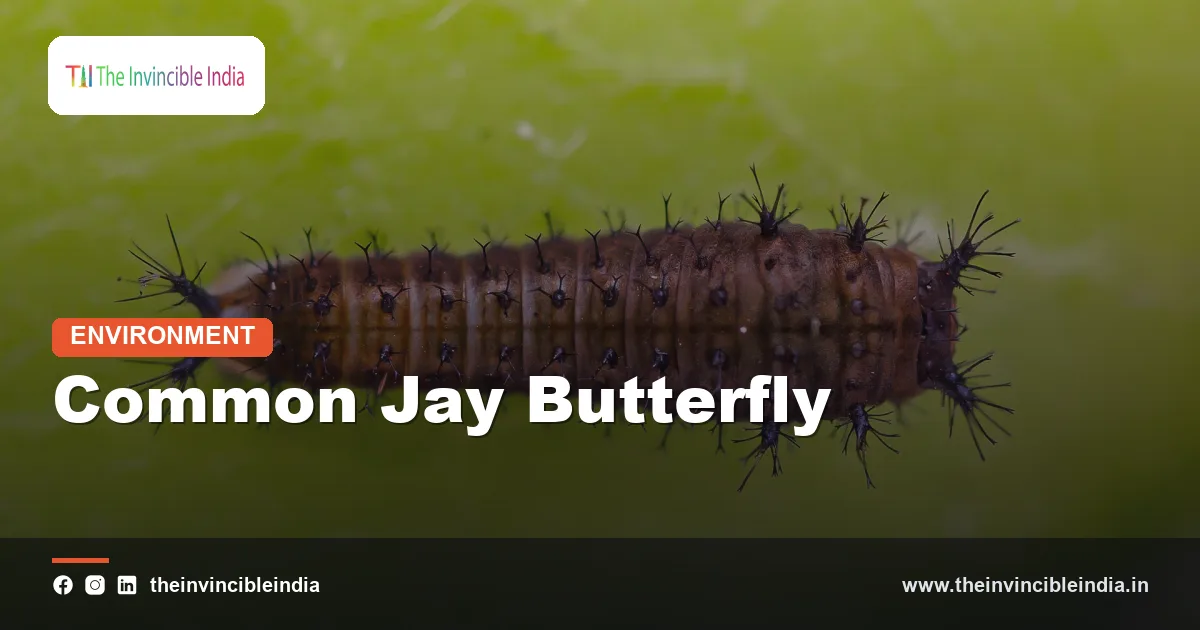
- Caterpillar: The larva is green and smooth, with a tapering body that blends with the leaf. Like other swallowtail caterpillars, it can extend a soft, forked gland called the osmeterium to deter small predators.
- Pupa: When mature, the caterpillar fastens itself to a twig or leaf with a silk pad and a silk girdle. The chrysalis is angular and usually green or brownish, resembling a leaf or a bit of stem.
- Adult: The butterfly emerges, pumps fluid into its wings to expand them and takes its first flights within a few hours.
Gardeners who grow ashoka or custard-apple trees may notice small green caterpillars on the new leaves. These are usually harmless to healthy trees, and the damage is minor compared with the pleasure of seeing the butterflies emerge.
How Does the Common Jay Behave?
The common jay behaves as a fast, restless butterfly that flies in rapid, darting bursts and rarely settles for long. It is easy to recognise by its habit of hovering at flowers while the wings flutter constantly, and by the groups of males that assemble at moist ground.
Fast flight
The swift flight of the common jay is a defence as well as a way to travel. Birds find it difficult to catch fast, erratic fliers, and the butterfly can cover a forest track in moments. In the hottest hours, it flies lower and seeks shade.
Mud-puddling
Males congregate at wet patches, often along streams and damp roads, in groups that may include several swallowtail species. They sip fluid and absorb salts and amino acids. Mixed groups of common jays, tailed jays, bluebottles and other swallowtails are among the most attractive sights in the Indian forest.
Feeding with open wings
While drinking nectar the common jay generally keeps its wings open and quivering. This makes photography tricky but also exposes the beautiful spot pattern, which is the key to identification.
How Is the Common Jay Different from Similar Butterflies?
The common jay differs from similar swallowtails mainly in its lack of a tail, its translucent blue-green spots and its smaller size compared with the bluebottle and the tailed jay. The table below lists the main look-alikes.
| Butterfly | How it differs from the common jay |
|---|---|
| Tailed jay (Graphium agamemnon) | Has a short tail on each hindwing and rounder, yellowish-green spots on a dark background. |
| Common bluebottle (Graphium sarpedon) | Larger, with a continuous broad band of bright blue across both wings rather than separate spots. |
| Spot swordtail (Graphium nomius) | Has a long, thin tail on each hindwing and a more open pattern of pale spots, and is far less often seen than the common jay. |
| Five-bar swordtail (Graphium antiphates) | Pale greenish-white with bold black bars and a long, slender tail on each hindwing. |
| Blue Mormon (Papilio polymnestor) | Much larger, with a broad bluish band on velvety black wings and a short hindwing tail. |
If the butterfly has a tailless hindwing and a series of pale blue-green spots on black wings, and it moves like a dart, the common jay is the most likely species.
Is the Common Jay Threatened?
The common jay is not regarded as globally threatened, and it remains one of the more widespread swallowtails of Indian forests. However, local populations rely on intact forest, streams and Annonaceae host plants, so they can decline when habitat is cleared.
The main pressures include:
- Forest fragmentation caused by roads, mining, dams and settlements.
- Loss of stream-side seepages and damp ground through concrete and channelisation.
- Pesticide use in plantations and gardens.
- Reduction of native Annonaceae trees when land is converted to monoculture crops.
Collecting wild butterflies is prohibited in protected areas, and ethical watching and photography have no impact on the population. Conservation of the common jay is closely tied to forest protection in the Western Ghats, the north-east and other wooded landscapes.
How Can You See and Photograph the Common Jay?
You can see the common jay most easily by visiting forest streams, damp tracks and flowering shrubs in warm, bright weather, especially in the morning and again in the late afternoon. Males that are mud-puddling often stay in one place for several minutes, which gives photographers their best chance.
Practical tips
- Visit damp sand, culverts and stream edges in forest areas, and move slowly and quietly.
- Use a fast shutter speed because the wings quiver even when the butterfly feeds.
- Look near ashoka trees and wild custard-apple relatives in gardens and forest edges.
- Do not disturb mud-puddling groups, which need the minerals and are vulnerable when startled.
- Record sightings with date, place and photographs to support citizen-science butterfly records.
Planting Annonaceae trees and nectar shrubs such as lantana and ixora near a moist, shady spot can encourage visits in suburban gardens within wooded regions.
Bottom Line
The common jay is a fast, tailless swallowtail whose translucent blue-green spots and mud-puddling groups make it a highlight of Indian forest walks. Protecting forest streams and Annonaceae trees is the most direct way to protect the common jay and the many other butterflies that share its habitat.
Frequently Asked Questions
What is the scientific name of the common jay butterfly?
The scientific name of the common jay butterfly is Graphium doson. It was described by C. and R. Felder in 1864 and belongs to the swallowtail family Papilionidae.
Does the common jay have a tail?
No, the common jay does not have a tail on its hindwing. This tailless shape separates it from the closely related tailed jay (Graphium agamemnon), which has a short tail on each hindwing.
What do common jay caterpillars eat?
Common jay caterpillars eat the leaves of custard-apple family (Annonaceae) plants such as Polyalthia, Annona, Artabotrys and Miliusa. They have also been recorded on some magnolia-family plants.
Where is the common jay found in India?
The common jay is found in the Western Ghats, parts of the Eastern Ghats, the Himalayan foothills and the north-east of India. It prefers forests, forest streams and wooded gardens at low to mid elevations.
Why do common jays gather on mud?
Common jays gather on mud and wet sand to take in salts and minerals that are scarce in nectar. This behaviour, called mud-puddling, is mostly seen in males and helps them in reproduction.
How is the common jay different from the common bluebottle?
The common jay differs from the common bluebottle (Graphium sarpedon) in having separate translucent blue-green spots instead of a continuous bright blue band, and in being smaller. Both are fast-flying graphium swallowtails and often appear together at damp ground.
{“@context”:”https://schema.org”,”@graph”:[{“@type”:”FAQPage”,”mainEntity”:[{“@type”:”Question”,”name”:”What is the scientific name of the common jay butterfly?”,”acceptedAnswer”:{“@type”:”Answer”,”text”:”The scientific name of the common jay butterfly is Graphium doson. It was described by C. and R. Felder in 1864 and belongs to the swallowtail family Papilionidae.”}},{“@type”:”Question”,”name”:”Does the common jay have a tail?”,”acceptedAnswer”:{“@type”:”Answer”,”text”:”No, the common jay does not have a tail on its hindwing. This tailless shape separates it from the closely related tailed jay (Graphium agamemnon), which has a short tail on each hindwing.”}},{“@type”:”Question”,”name”:”What do common jay caterpillars eat?”,”acceptedAnswer”:{“@type”:”Answer”,”text”:”Common jay caterpillars eat the leaves of custard-apple family (Annonaceae) plants such as Polyalthia, Annona, Artabotrys and Miliusa. They have also been recorded on some magnolia-family plants.”}},{“@type”:”Question”,”name”:”Where is the common jay found in India?”,”acceptedAnswer”:{“@type”:”Answer”,”text”:”The common jay is found in the Western Ghats, parts of the Eastern Ghats, the Himalayan foothills and the north-east of India. It prefers forests, forest streams and wooded gardens at low to mid elevations.”}},{“@type”:”Question”,”name”:”Why do common jays gather on mud?”,”acceptedAnswer”:{“@type”:”Answer”,”text”:”Common jays gather on mud and wet sand to take in salts and minerals that are scarce in nectar. This behaviour, called mud-puddling, is mostly seen in males and helps them in reproduction.”}},{“@type”:”Question”,”name”:”How is the common jay different from the common bluebottle?”,”acceptedAnswer”:{“@type”:”Answer”,”text”:”The common jay differs from the common bluebottle (Graphium sarpedon) in having separate translucent blue-green spots instead of a continuous bright blue band, and in being smaller. Both are fast-flying graphium swallowtails and often appear together at damp ground.”}}]}]}


