

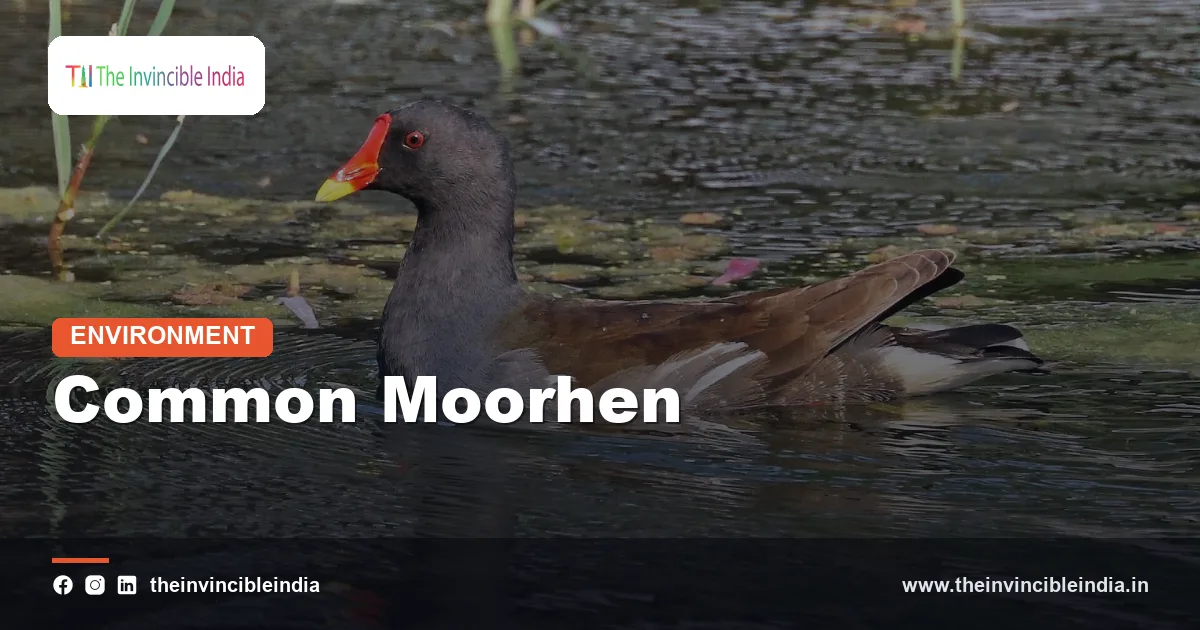
The common moorhen (Gallinula chloropus) is a dark, medium-sized waterbird of the rail family, easily recognised by its red-and-yellow bill, red forehead shield and a white line along its flank, and it is one of the most familiar birds on ponds, tanks and reed-fringed lakes across India. Often called the waterhen or moorhen, the common moorhen bobs its head as it swims and flicks its tail to flash white underneath as it picks its way through floating vegetation.
The common moorhen is found on every continent except Australia and Antarctica, and in India it is a widespread resident with some local movements. This explainer covers how to identify the common moorhen, where it lives, what it eats, how it breeds, how it differs from similar birds such as the coot and the swamphen, and how well it is faring.
| Attribute | Detail |
|---|---|
| Common name | Common moorhen (also moorhen or waterhen; Hindi: jal murghi or pan-murghi) |
| Scientific name | Gallinula chloropus |
| Family | Rallidae (rails, crakes, gallinules and coots) |
| Size | Roughly 32 to 35 cm long |
| Key features | Dark slaty body, red shield, red bill with yellow tip, white flank stripe, yellow-green legs |
| Habitat | Ponds, village tanks, marshes, reedbeds, slow rivers and flooded fields |
| Status in India | Widespread resident, supplemented by some winter visitors |
| IUCN status | Least Concern |
| Diet | Omnivore: aquatic plants, seeds, insects, snails, worms and small animals |
Key Takeaways
- The common moorhen is a dark slaty waterbird with a red-and-yellow bill, a red forehead shield and a white stripe along its flank, and it is among the most widespread rails in India.
- The common moorhen lives on almost any freshwater with reed or weed cover, from village ponds and paddy channels to large lakes and slow rivers.
- Common moorhens swim with a jerky head-bobbing action, walk on floating plants with their long toes and often flick their tails to show a white undertail.
- The common moorhen is an omnivore that eats plants, seeds, insects, snails and worms, and it feeds both in the water and on the bank.
- Common moorhens may raise two or three broods a year, and older chicks sometimes help feed their younger siblings.
- The common moorhen is listed as Least Concern by the IUCN, but it still depends on unpolluted wetlands with cover.
What Is the Common Moorhen?
The common moorhen is a small to medium-sized waterbird belonging to the rail family, Rallidae, and it is one of the world’s most widely distributed wetland birds. The family includes crakes, rails, swamphens and coots, all of which live in or near freshwater and are generally shy, with strong legs and short wings.
The word “moor” in moorhen has nothing to do with moorland. It is derived from an older English word for a marsh or fen, and the bird has long been called the waterhen in India and Britain. The scientific name Gallinula means “little hen” and chloropus means “green-footed”, a reference to its yellowish-green legs.
Taxonomists have separated moorhens from the Americas as a different species. The bird in North and South America is now called the common gallinule, while the Old World bird, including the Indian one, keeps the name common moorhen. Another close relative, the dusky moorhen, lives in Australasia.
How Do You Identify a Common Moorhen?
The common moorhen is identified by its blackish-slate plumage, bright red frontal shield and red bill with a yellow tip, together with a clear white stripe along the side of the body and a white patch under the tail with a black centre. Its legs are yellowish-green with a red band at the top of the shin, and its toes are long and slender.
- Bill and shield: The red shield on the forehead is smaller than the swamphen’s, and the bill is yellow at the tip.
- Flank stripe: A white line runs along the side of the body just above the water.
- Tail: The tail is flicked up and down, showing a white undertail with a black central stripe.
- Swimming: The head moves back and forth with each stroke, giving a jerky, nodding motion.
- Juveniles: Young birds are brownish-grey with a dull greenish bill and no shield, and they develop adult colours over several months.
The common moorhen is easily confused with the Eurasian coot, but the coot has a white bill and shield, lacks the white flank stripe and swims with lobed toes. It is also smaller and finer than the grey-headed swamphen.
Where Is the Common Moorhen Found in India?
The common moorhen is found throughout India, from sea level to the foothills of the Himalaya and in the Western Ghats, wherever there are still or slow-moving freshwater bodies with cover. Outside India the species ranges across Europe, Africa, Asia and many islands.
It is a resident across most of the country, meaning that the same birds are seen year-round, though northern populations may move short distances in winter, and visitors from colder parts of Asia may join resident birds in some regions. Common moorhens are found in sanctuaries such as Keoladeo National Park and Nal Sarovar, but they are equally likely to turn up on a pond beside a village, a temple tank or an urban lake with some reed cover.
| Habitat type | Examples in India |
|---|---|
| Village ponds and temple tanks | Widespread across the plains; moorhens often tolerate people nearby |
| Reed-fringed lakes and jheels | Wetlands in Rajasthan, Gujarat, Uttar Pradesh, Bihar and West Bengal |
| Paddy fields and irrigation channels | Seasonally flooded fields across much of the peninsula and east |
| Backwaters and coastal lagoons | Kerala backwaters, Chilika and other brackish-edge wetlands |
| Hill lakes and slow streams | Foothill wetlands in the Himalaya and the Western Ghats |
What Does the Common Moorhen Eat?
The common moorhen eats a wide variety of foods, including the leaves, stems and seeds of aquatic plants, algae, insects, snails, worms, tadpoles and small fish, and it also scavenges on grain and scraps near human settlements. This flexible diet is one reason why the species has spread so widely.
Moorhens feed in several ways. They pick items from the surface of the water, probe into mud, graze on lawns and grassy banks, and occasionally dabble or tip forward in shallow water. Birds near ponds in parks and gardens may take bread, though feeding wildlife human food is not good for them. Foraging is usually done alone or in pairs, in contrast to the large rafts formed by coots.
How Does the Common Moorhen Breed?
The common moorhen breeds in or beside dense vegetation, building a cup-shaped nest of reed and grass stems just above water level, and it may raise two or more broods in one season. In India the breeding season often follows the monsoon, roughly from June to September, but it varies with local rainfall and water conditions.
A clutch normally contains five to nine buff eggs spotted with reddish-brown. Both parents incubate and care for the young, and the downy black chicks leave the nest within a day or two to swim after their parents. In many populations, young from an earlier brood help feed and guard later chicks, an example of cooperative behaviour in birds.
Courtship and Territory
Moorhens are strongly territorial in the breeding season. A resident pair defends its patch with raised wings, tail flicks and chases, and fights between rivals can be vigorous, with birds standing upright and kicking with their large feet. Pairs may build several spare platforms in their territory, which are used for resting or by the chicks.
How Does the Common Moorhen Behave and Sound?
The common moorhen is a shy but active bird that spends much of the day moving along the edge of vegetation, swimming with a bobbing head and running quickly to cover if disturbed. Its call is a sharp, liquid “kurr-uck” or a series of cackles, given from reeds and often heard before the bird is seen.
Moorhens are not strong fliers, and they fly with legs dangling, but they can cover considerable distances and move between wetlands at night. They can also climb into low bushes, walk across lily pads and dive briefly to escape danger. Because they live close to the shore, they are often seen at close quarters on small ponds, making them a favourite of beginner birdwatchers.
Common Moorhen, Coot, Swamphen and Watercock Compared
| Bird | Bill and shield | Body and size | Behaviour |
|---|---|---|---|
| Common moorhen | Red shield, red bill with yellow tip | Dark slate, white flank stripe; about 32 to 35 cm | Solitary or paired; bobs head, flicks tail |
| Eurasian coot | White bill and shield | Slaty black; about 36 to 38 cm | Gregarious; dives and forms rafts |
| Grey-headed swamphen | Heavy red bill and large red shield | Purple-blue; about 40 to 50 cm | Noisy; clambers in reeds, eats stems |
| Watercock | Greenish bill with red base | Black male; about 28 to 31 cm | Secretive; heard rather than seen |
Is the Common Moorhen Under Threat?
The common moorhen is not threatened and is listed as Least Concern by the International Union for Conservation of Nature (IUCN), thanks to its huge range and adaptability to small, modified water bodies. In India it remains common wherever ponds and reedbeds survive.
Nevertheless, several pressures affect local populations:
- Loss of wetlands: Filling and drainage of ponds and marshes for construction and farming removes nesting sites.
- Pollution: Sewage and agricultural chemicals reduce food and cover in lakes and tanks.
- Predation by dogs and cats: Free-roaming animals take eggs and chicks around urban ponds.
- Clearing of vegetation: Cutting reeds and neat concrete edging remove the cover that moorhens need.
- Disease: Like other waterbirds, moorhens can be exposed to avian diseases such as influenza during outbreaks.
Wild birds, including moorhens, are generally covered by the Wildlife (Protection) Act, 1972, which forbids hunting and the collection of eggs. Maintaining village ponds with some reed margins is the single most helpful step for the species.
Why Is the Common Moorhen a Good Bird for Beginners?
The common moorhen is a good bird for beginners because it is common, lives on small and accessible ponds, is easy to identify and tends to be less shy than many marsh birds. A few minutes at a reed-fringed pond is often enough to see its distinctive head-bobbing and tail-flicking.
- Visit a pond with some emergent reeds, preferably in the early morning or late afternoon.
- Watch the edges of vegetation for a dark bird with a bright red bill walking along the water’s edge.
- Note the white flank line and white undertail, which separate the moorhen from the coot.
- Keep still; moorhens often come into the open after a few quiet minutes.
- Record sightings on a citizen-science platform such as eBird to help track wetland birds across India.
Can the Common Moorhen Live in Cities and Near People?
The common moorhen can live in cities and near people, and it is one of the few wetland birds that regularly breeds on urban lakes, garden ponds and canals, provided that some dense plants grow along the water’s edge. Its tolerance of disturbance and its varied diet make it far more adaptable than most rails.
In Indian towns, moorhens are seen on municipal lakes, institutional campuses, temple tanks and even drainage ponds, where they pick through floating weed and feed along muddy banks. Urban birds tend to become quite tame, and a pair may raise chicks within metres of walkways. However, city life carries risks, including traffic on nearby roads, stray dogs, litter, plastic and the removal of marginal vegetation during lake “beautification” projects.
Keeping a strip of native reeds, sedges and floating plants along a lake edge is the cheapest and most effective way to help moorhens in a town. Such cover gives them nest sites, hides chicks from predators and supports the insects and snails that the birds eat.
How Long Does a Common Moorhen Live?
A common moorhen typically lives for a few years in the wild, though a small number of individuals have been recorded surviving for more than ten years. Survival depends heavily on the winter, the availability of food and the presence of predators.
Young birds face the greatest risk in the first year of life, and many chicks are lost to predators such as crows, herons, snakes, monitor lizards, birds of prey and fishing cats. The species compensates through high reproductive output, since a pair may raise several broods in a season and juveniles mature quickly, often breeding the following year. This fast-turnover strategy is one reason why moorhens recover quickly when wetlands are restored.
Bottom Line
The common moorhen is a widespread, adaptable rail that can be seen on almost any reedy pond in India, recognisable by its red-and-yellow bill and white flank line. Though secure as a species, the common moorhen relies on small wetlands and their vegetation, which makes pond conservation important.
Frequently Asked Questions
What is a common moorhen?
The common moorhen is a dark, medium-sized waterbird of the rail family with a red forehead shield, a red bill tipped in yellow and a white stripe along its flank. It lives on ponds, lakes and marshes across most of the world, including India. It is also called the waterhen.
How can I tell a common moorhen from a coot?
The common moorhen has a red bill and shield with a yellow tip and a white stripe along its flank, while the Eurasian coot has a white bill and shield and no flank stripe. Moorhens also tend to be solitary or in pairs, whereas coots gather in large groups. Coots have lobed toes and dive more often.
Where is the common moorhen found in India?
The common moorhen is found across India on village ponds, temple tanks, reed-fringed lakes, paddy fields, backwaters and slow streams. It is mainly a resident bird, so it can be seen throughout the year. It occurs from the plains up to the foothills of the Himalaya and the Western Ghats.
What does a common moorhen eat?
The common moorhen eats aquatic plants, seeds, algae, insects, snails, worms and small animals. It forages on the water surface, in mud and on grassy banks. Near human settlements it may also pick up grain and scraps.
How many eggs does a common moorhen lay?
A common moorhen usually lays five to nine buff eggs spotted with reddish-brown in a nest of reeds close to the water. It may raise two or more broods in a season. Both parents care for the chicks, and older young sometimes help feed later broods.
Is the common moorhen the same as the common gallinule?
The common gallinule of the Americas was once treated as the same species, but it has been separated from the Old World common moorhen. The Indian bird is the common moorhen, Gallinula chloropus. The two look very similar and belong to the same genus.
{“@context”:”https://schema.org”,”@graph”:[{“@type”:”FAQPage”,”mainEntity”:[{“@type”:”Question”,”name”:”What is a common moorhen?”,”acceptedAnswer”:{“@type”:”Answer”,”text”:”The common moorhen is a dark, medium-sized waterbird of the rail family with a red forehead shield, a red bill tipped in yellow and a white stripe along its flank. It lives on ponds, lakes and marshes across most of the world, including India. It is also called the waterhen.”}},{“@type”:”Question”,”name”:”How can I tell a common moorhen from a coot?”,”acceptedAnswer”:{“@type”:”Answer”,”text”:”The common moorhen has a red bill and shield with a yellow tip and a white stripe along its flank, while the Eurasian coot has a white bill and shield and no flank stripe. Moorhens also tend to be solitary or in pairs, whereas coots gather in large groups. Coots have lobed toes and dive more often.”}},{“@type”:”Question”,”name”:”Where is the common moorhen found in India?”,”acceptedAnswer”:{“@type”:”Answer”,”text”:”The common moorhen is found across India on village ponds, temple tanks, reed-fringed lakes, paddy fields, backwaters and slow streams. It is mainly a resident bird, so it can be seen throughout the year. It occurs from the plains up to the foothills of the Himalaya and the Western Ghats.”}},{“@type”:”Question”,”name”:”What does a common moorhen eat?”,”acceptedAnswer”:{“@type”:”Answer”,”text”:”The common moorhen eats aquatic plants, seeds, algae, insects, snails, worms and small animals. It forages on the water surface, in mud and on grassy banks. Near human settlements it may also pick up grain and scraps.”}},{“@type”:”Question”,”name”:”How many eggs does a common moorhen lay?”,”acceptedAnswer”:{“@type”:”Answer”,”text”:”A common moorhen usually lays five to nine buff eggs spotted with reddish-brown in a nest of reeds close to the water. It may raise two or more broods in a season. Both parents care for the chicks, and older young sometimes help feed later broods.”}},{“@type”:”Question”,”name”:”Is the common moorhen the same as the common gallinule?”,”acceptedAnswer”:{“@type”:”Answer”,”text”:”The common gallinule of the Americas was once treated as the same species, but it has been separated from the Old World common moorhen. The Indian bird is the common moorhen, Gallinula chloropus. The two look very similar and belong to the same genus.”}}]}]}


