

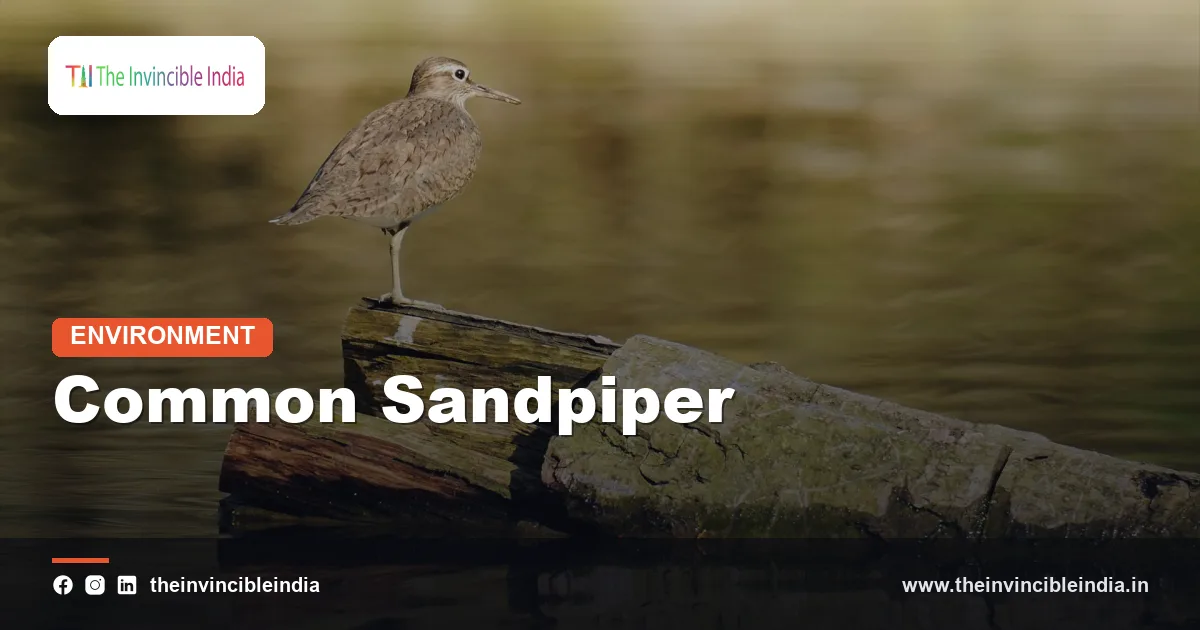
The common sandpiper (Actitis hypoleucos) is a small, brown-and-white wading bird that bobs its tail constantly as it walks along the edges of rivers, lakes, ponds and coastal creeks, and it is one of the most widespread winter visitors to the Indian subcontinent. Most common sandpipers seen in India are migrants that breed in northern Eurasia and arrive after the monsoon, although a smaller number also nest along Himalayan rivers.
The bird is easy to recognise once its habits are known: it is usually seen alone, it teeters its rear end up and down, and it flies low over the water on shallow, stiff, flickering wingbeats while giving a thin, piping call. The sections below explain what the common sandpiper looks like, where it lives, what it eats, how it migrates and breeds, and how to tell it from similar waders.
| Attribute | Details |
|---|---|
| Common name | Common sandpiper |
| Scientific name | Actitis hypoleucos |
| Family | Scolopacidae (sandpipers, snipes and allies) |
| Size | About 19 to 21 cm long, with a wingspan of roughly 32 to 35 cm |
| India range and habitat | Widespread across the country on river banks, lake and pond margins, reservoirs, canals, paddy edges, estuaries and rocky coasts, from the plains to mountain streams |
| Diet | Insects, small crustaceans, molluscs, worms and occasionally tiny fish or tadpoles |
| Breeding and migration | Breeds across temperate Eurasia, including the Himalayas; winters in Africa, South Asia, Southeast Asia and Australasia; most Indian birds are winter visitors from roughly July-August to April-May |
| Conservation status | Least Concern on the IUCN Red List, though numbers have declined in parts of its range |
Key Takeaways
- The common sandpiper is a small Eurasian wader, about 19 to 21 cm long, that is found along inland and coastal water edges across almost the whole of India during winter.
- The common sandpiper is identified by its constant tail-bobbing, its brown upperparts, its white underparts and the white wedge that curves up in front of its folded wing.
- The common sandpiper flies low over water with shallow, stiff, quivering wingbeats and a thin, rapid “swee-wee-wee” call, which separates it from most other Indian sandpipers.
- The common sandpiper feeds mainly on insects, small crustaceans, worms and molluscs picked from mud, stones and shallow water.
- The common sandpiper breeds on gravelly river banks in northern Eurasia and in parts of the Himalaya, laying about four eggs in a ground scrape.
- The common sandpiper is classed as Least Concern by the International Union for Conservation of Nature (IUCN), but it depends on clean, undisturbed water margins that are shrinking in many regions.
What is the common sandpiper?
The common sandpiper is a small shorebird of the family Scolopacidae, the large group that also includes snipes, curlews, godwits, stints and redshanks. Its scientific name is Actitis hypoleucos. The word “common” in its name refers to its very wide distribution across the Old World, not to the ease of seeing it in every habitat.
It is a lightly built bird with a long body, a short neck, a fairly short straight bill and short, greenish-yellow to pale legs. Compared with the long-legged waders of open mudflats, the common sandpiper looks low-slung and compact. It belongs to the group that biologists describe as “waders” in Britain and “shorebirds” in North America, although it is often found far from the sea, beside inland streams and tanks.
The common sandpiper has one close relative, the spotted sandpiper (Actitis macularius) of the Americas. The two species are so similar in shape and behaviour that they are placed together in the genus Actitis. In older books the common sandpiper is sometimes listed under the genus Tringa, so that name may appear in older field guides.
How do you identify a common sandpiper?
A common sandpiper is identified by three features together: a continuously bobbing rear body, a brown back with a white belly, and a white notch between the brown breast-side and the folded wing. No single feature is enough on its own, but together they make the species one of the easier waders to name.
Plumage
In winter the upperparts are plain olive-brown with fine darker barring that is hard to see at a distance. The underparts are clean white, and the brown of the breast sides forms a patch that stops sharply against the white. The white of the belly pushes up in a wedge in front of the bend of the wing, and this “shoulder notch” is a reliable mark. A pale eye-stripe and a thin dark line through the eye give the face a neat but unremarkable look. In breeding plumage the back shows slightly more dark streaking and barring, but the overall impression stays the same.
Structure and posture
The tail extends beyond the folded wing tips, which makes the bird look long-tailed for a sandpiper. The body is held in a roughly horizontal line, and the head often nods forward as the bird walks. The legs are short enough that the belly looks close to the ground.
Voice and flight
The call is a high, thin, piping series, often written as “swee-wee-wee” or “tsi-tsi-tsi”, usually given when the bird is flushed. In flight, the wings are held bowed downward and are beaten in short, quick, quivering strokes interrupted by brief glides. A narrow white wing bar shows on the upper wing, and the rump is dark with white sides to the tail. The bird usually skims low, just above the surface of the water, and often lands a short distance away on the same bank.
Where does the common sandpiper live in India?
The common sandpiper lives in nearly every part of India during winter, wherever there is a shallow water edge with a firm margin to walk on. It is recorded from the Himalayan foothills to the southern tip, and from the western deserts to the north-eastern floodplains and the island groups.
Typical habitats include:
- River banks and sandbars, especially stony or gravelly stretches
- Edges of village ponds, irrigation tanks and reservoirs
- Canals and drainage channels, including those inside towns
- Paddy fields and flooded margins with exposed mud
- Mangrove creeks, estuaries and tidal flats
- Rocky seashores, harbour walls, jetties and boat landings
- Hill streams and mountain lakes, where some birds spend the summer
Unlike many other waders, the common sandpiper does not need broad open mudflats. It is just as likely to be found on a concrete ledge, a boulder in a stream or a floating log. This flexibility is a major reason it is regularly noted even in urban parks and campus ponds, where larger shorebirds are absent.
When does the common sandpiper arrive in and leave India?
The common sandpiper begins arriving in India from about July or August, once breeding in the northern summer is over, and most birds depart by April or May. The earliest returning birds often appear in the plains in the monsoon months, while the bulk of the winter population is settled by October.
Some individuals remain through the summer. These are generally young or non-breeding birds that do not make the full northward journey, and they can be seen on southern coasts and reservoirs in May, June and July. This is why the species can occasionally be recorded in almost every month of the year in India, which sometimes confuses beginners about whether it is resident.
A separate, smaller group of common sandpipers breeds in the Indian Himalaya. These birds nest on gravel bars and river terraces in Jammu and Kashmir, Ladakh, Himachal Pradesh and Uttarakhand during the summer, and they move down to lower elevations when the cold sets in.
Why does the common sandpiper migrate?
The common sandpiper migrates because its northern breeding grounds provide abundant insects and open gravel in summer but become frozen and foodless in winter. Moving south lets the bird find unfrozen water and a steady supply of invertebrates.
The species belongs to the large population of Palearctic waders that use the Central Asian Flyway and neighbouring routes to reach the Indian subcontinent. Birds from northern Europe and Siberia travel south and south-east across Central Asia, and many of them spend the winter in India, while others continue to Southeast Asia or onward. Others from Europe travel towards Africa instead. Because the species is a solitary migrant, it does not travel in the dense flocks that characterise many sandpipers. It moves in small loose groups or alone, mostly at night.
Individual birds show a strong attachment to a particular wintering site. Studies of marked waders in several regions have shown that the same bird often returns to the same stretch of bank year after year, which is one reason local birdwatchers can count on the same stone or jetty hosting a sandpiper every winter.
What does the common sandpiper eat?
The common sandpiper eats mainly small invertebrates, including insects, crustaceans, molluscs and worms, which it picks from the ground and from shallow water. Its diet is more varied than that of many specialised waders, and it changes with habitat and season.
Typical prey include:
- Beetles, flies, midge larvae, water bugs and other aquatic and terrestrial insects
- Small crustaceans such as tiny crabs and amphipods on coastal shores
- Snails and other small molluscs
- Earthworms and marine worms
- Occasional spiders, tadpoles and very small fish
The bird feeds by walking steadily along the margin, stopping to pick at the surface, and sometimes making quick runs after an insect. It will also flick at insects in the air or on rocks. It rarely probes deeply into soft mud in the way that godwits and curlews do, because its bill is relatively short. This surface-feeding style is one reason the species succeeds on hard, stony and artificial edges.
Why does the common sandpiper bob its tail?
The common sandpiper bobs its tail because the movement is a built-in, habitual behaviour of the genus Actitis, and ornithologists still debate its exact purpose. The teetering action, in which the rear half of the body rocks up and down, continues almost without pause while the bird stands or walks.
Several explanations have been proposed. One idea is that the movement helps the bird stay in balance on uneven or wet surfaces. Another suggests that it signals to other sandpipers that the bird is not a threat, which would reduce conflict in a species that otherwise feeds alone. A third idea is that the motion could disturb small prey or help detect it through ripples in shallow water. No single explanation has been firmly established, and the bird may benefit in more than one way.
Whatever the cause, the habit is useful to observers. A small brown wader that teeters on a stone beside a stream is, in most Indian settings, a common sandpiper.
How does the common sandpiper behave?
The common sandpiper is a solitary and fairly confiding bird that defends a feeding territory in winter. It is usually seen singly or in twos and threes, even where many other waders are present, and it is more tolerant of human presence than most shorebirds.
Wintering birds are often territorial. A bird may patrol the same section of bank day after day and chase intruding sandpipers away with short, fast runs and displays. When a threat approaches, the bird typically flies a short distance low over the water and lands again, calling as it goes. It roosts at night on the ground near the water or on low perches such as rocks, boats and fallen branches.
The common sandpiper can also swim a little when needed, and it has been seen to dive into water to escape danger, using its wings to swim underwater for a short distance. Chicks do the same.
How does the common sandpiper breed?
The common sandpiper breeds on the ground close to fast-flowing or gravelly water, laying a clutch of usually four eggs in a shallow scrape. The nest is concealed in vegetation, among boulders or under a bank, often only a short distance from the stream.
The key points of its breeding are:
- The eggs are buff or cream with reddish-brown blotches, which camouflage them against stones.
- Both parents share incubation, which lasts around three weeks.
- The chicks are precocial, meaning they hatch covered in down and leave the nest within hours.
- The young feed themselves, while the parents guide and guard them.
- The chicks can fly at roughly four weeks of age.
In India, breeding takes place mainly in the Himalaya during the summer months, on river terraces and mountain streams at moderate to high elevations. Elsewhere in the country the bird is a non-breeder, and what is seen in the plains is the wintering population.
How is the common sandpiper different from similar birds?
The common sandpiper differs from similar small waders mainly in its tail-bobbing, its low stiff-winged flight and its plain, clean-edged brown and white pattern. Several other Indian waders look superficially alike, so a comparison helps.
| Species | Key difference from the common sandpiper |
|---|---|
| Green sandpiper (Tringa ochropus) | Darker, almost black upperparts, a white rump that stands out in flight, and a ringing “tluit-weet-weet” call |
| Wood sandpiper (Tringa glareola) | Spotted upperparts, longer yellowish legs and a more upright stance |
| Terek sandpiper (Xenus cinereus) | Long, upturned bill with an orange base, and a rapid running feeding style on coastal mud |
| Little ringed plover (Charadrius dubius) | Shorter bill, black neck ring and a fast stop-and-start run instead of a steady walk |
| Temminck’s stint (Calidris temminckii) | Smaller, with a more mouse-like creeping walk and outer tail feathers that show white |
The simplest practical test is to watch the rear end. A bird that keeps pumping its tail while it feeds, flies low with stiff, flickering wings and shows a white wedge at the shoulder is almost certainly a common sandpiper.
Is the common sandpiper threatened?
The common sandpiper is not globally threatened; the IUCN lists it as Least Concern because of its very large range and population. However, some regional populations have declined, and the bird still faces pressure from loss of wetland edges.
The main concerns are the loss of natural river banks through sand mining and embankments, pollution of rivers and ponds, disturbance at breeding sites on gravel bars, and the drying out of small wetlands. Changes in hydroelectric and irrigation projects in the Himalaya can also alter the gravel banks used for nesting.
Because the common sandpiper is adaptable and uses artificial structures, it is more resilient than many wetland specialists. Even so, it serves as a useful indicator of the health of small streams and shorelines, and its continued presence suggests that some shoreline habitat and insect food remain.
How can you watch common sandpipers in India?
Common sandpipers can be watched by visiting almost any open water edge between August and April, and the best approach is to scan banks, rocks and jetties quietly from a distance. The bird is easy to find if the observer looks for movement near the waterline rather than for a distinct silhouette.
- Check river banks, small ponds, tanks and canals early in the morning, when feeding is most active.
- Look for a small bird teetering on a stone, log, concrete ledge or boat.
- Use binoculars rather than approaching closely, since a startled bird will fly off and call.
- Listen for the thin, rapid piping call as the bird takes off.
- Note the white shoulder notch and the low, bowed, flickering flight to confirm the identification.
- Keep records of the date and place, because they help citizen-science efforts such as annual waterbird counts.
Good places to see the species include Keoladeo National Park in Rajasthan, Chilika Lake in Odisha, the Sundarbans creeks, Vembanad Lake in Kerala and the Yamuna and Ganga banks, though it can be found in far humbler places too.
Bottom Line
The common sandpiper is a small, solitary, tail-bobbing wader that visits India in large numbers each winter and breeds along some Himalayan streams. It is easy to recognise by its teetering habit, its stiff-winged low flight and the white notch at its shoulder, and it is a good first species for anyone learning to identify shorebirds.
Frequently Asked Questions
Is the common sandpiper a resident or a migrant in India?
The common sandpiper is mainly a winter migrant in India, arriving from about July or August and leaving by April or May. A smaller population breeds in the Himalaya, and some non-breeding birds stay through the summer, so the species can be seen in many months.
Why does the common sandpiper keep bobbing its tail?
The tail-bobbing is a natural, habitual movement of the genus Actitis, and its exact purpose is still debated. Possible roles include balance on uneven ground, signalling to other sandpipers and helping to detect prey in shallow water.
What does the common sandpiper eat?
The common sandpiper eats small invertebrates, mainly insects, crustaceans, molluscs and worms. It picks them from mud, stones and shallow water, and it occasionally takes tadpoles or tiny fish.
How can I tell a common sandpiper from a green sandpiper?
The common sandpiper is lighter brown above, bobs its tail and shows a white shoulder notch, while the green sandpiper is darker above with a bold white rump in flight. The green sandpiper also has a more ringing call and a less stiff flight.
Where does the common sandpiper breed?
The common sandpiper breeds across temperate and northern Eurasia, laying about four eggs in a ground scrape near gravelly water. In India, it breeds mainly along Himalayan rivers and streams in states such as Jammu and Kashmir, Ladakh, Himachal Pradesh and Uttarakhand.
Is the common sandpiper endangered?
No, the common sandpiper is classed as Least Concern by the IUCN because of its large range and population. Local declines can occur where river banks and small wetlands are lost to mining, pollution or development.
{“@context”:”https://schema.org”,”@graph”:[{“@type”:”FAQPage”,”mainEntity”:[{“@type”:”Question”,”name”:”Is the common sandpiper a resident or a migrant in India?”,”acceptedAnswer”:{“@type”:”Answer”,”text”:”The common sandpiper is mainly a winter migrant in India, arriving from about July or August and leaving by April or May. A smaller population breeds in the Himalaya, and some non-breeding birds stay through the summer, so the species can be seen in many months.”}},{“@type”:”Question”,”name”:”Why does the common sandpiper keep bobbing its tail?”,”acceptedAnswer”:{“@type”:”Answer”,”text”:”The tail-bobbing is a natural, habitual movement of the genus Actitis, and its exact purpose is still debated. Possible roles include balance on uneven ground, signalling to other sandpipers and helping to detect prey in shallow water.”}},{“@type”:”Question”,”name”:”What does the common sandpiper eat?”,”acceptedAnswer”:{“@type”:”Answer”,”text”:”The common sandpiper eats small invertebrates, mainly insects, crustaceans, molluscs and worms. It picks them from mud, stones and shallow water, and it occasionally takes tadpoles or tiny fish.”}},{“@type”:”Question”,”name”:”How can I tell a common sandpiper from a green sandpiper?”,”acceptedAnswer”:{“@type”:”Answer”,”text”:”The common sandpiper is lighter brown above, bobs its tail and shows a white shoulder notch, while the green sandpiper is darker above with a bold white rump in flight. The green sandpiper also has a more ringing call and a less stiff flight.”}},{“@type”:”Question”,”name”:”Where does the common sandpiper breed?”,”acceptedAnswer”:{“@type”:”Answer”,”text”:”The common sandpiper breeds across temperate and northern Eurasia, laying about four eggs in a ground scrape near gravelly water. In India, it breeds mainly along Himalayan rivers and streams in states such as Jammu and Kashmir, Ladakh, Himachal Pradesh and Uttarakhand.”}},{“@type”:”Question”,”name”:”Is the common sandpiper endangered?”,”acceptedAnswer”:{“@type”:”Answer”,”text”:”No, the common sandpiper is classed as Least Concern by the IUCN because of its large range and population. Local declines can occur where river banks and small wetlands are lost to mining, pollution or development.”}}]}]}


