

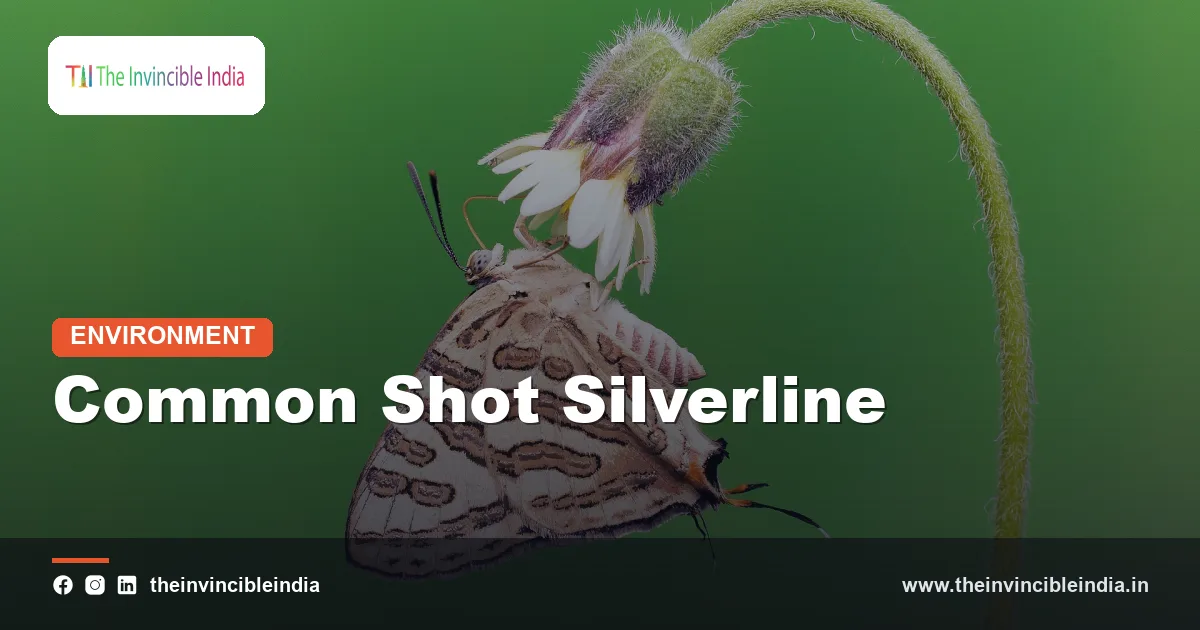
The common shot silverline (Spindasis ictis) is a small, orange-toned lycaenid butterfly of Indian scrub, forest edges and gardens, recognised by the silver-streaked lines on its underside and a pair of fine tails on each hindwing. It belongs to the genus Spindasis, whose members are called silverlines because of the thin silvery bands across the wings. The word “shot” in its name refers to the changing sheen of its colours, which seem to shift as the angle of the light changes.
This article explains what the common shot silverline is, how to identify it, where it lives in India, how its caterpillars live with ants, how it uses its tails to confuse predators and how it differs from other silverlines. It is written for beginners, gardeners and students who want clear, stable facts.
| Common name | Common shot silverline |
|---|---|
| Scientific name | Spindasis ictis |
| Family and subfamily | Lycaenidae (gossamer-winged butterflies), subfamily Theclinae (the hairstreaks and allies) |
| Wingspan | Roughly 2.5 to 3.5 cm, a small butterfly |
| Larval host plants | Not widely documented; silverline caterpillars generally feed on the flowers, buds and young leaves of trees and shrubs, and live with ants |
| Range and habitat in India | Recorded widely from peninsular India to the Himalayan foothills and the north-east; scrub, dry and moist deciduous forest, forest edges and gardens |
| Flight season and broods | Flies for much of the year in warm regions, with several broods and more adults after the rains |
| Notable features | Silver-streaked underside, orange-toned colouring, two fine hindwing tails and an ant-associated life history |
Key Takeaways
- The common shot silverline, scientific name Spindasis ictis, is a small lycaenid butterfly with a wingspan of roughly 2.5 to 3.5 cm.
- The common shot silverline is named for the silvery lines on its underside and for the colour sheen that appears to shift with the light.
- The common shot silverline has two fine tails on each hindwing, and it rubs its hindwings together to draw predators towards the tail end.
- Caterpillars of silverlines, including the common shot silverline, are associated with ants, which guard them in exchange for sugary secretions.
- The common shot silverline lives across India in scrub, open forest, forest edges and gardens, and it is not considered threatened.
- The common shot silverline can be confused with other Spindasis species, so a clear photograph of the underside is the best way to confirm it.
What is the common shot silverline butterfly?
The common shot silverline is a small butterfly in the gossamer-winged family Lycaenidae, scientifically named Spindasis ictis. It belongs to the subfamily Theclinae, which includes the hairstreaks, and to the genus Spindasis, a group of silverline butterflies found across tropical Asia and Africa.
The butterfly is easy to miss because it is small, quick and often perches in dappled light. When it does settle, the delicate silver lines and orange tones of the underside, together with its fine tails, make it distinctive among the many small butterflies of Indian gardens and scrub.
The species is considered widespread in the Indian subcontinent. It is commonly photographed by naturalists because it often basks in sunlight on twigs and leaves, but it is less well known to the public than the larger blues and swallowtails.
Why is it called a silverline?
It is called a silverline because the underside of the wings carries thin, silvery-white lines, edged with dark brown, which run across the forewing and hindwing like fine inlay. Butterflies of the genus Spindasis share this pattern, and the common name is used for the whole group.
The word “shot” in common shot silverline refers to the colours that appear to change with the angle of the light, as in shot silk fabric. The orange, brown and silvery tones of the wings glint and shift when the butterfly moves.
The word “common” is used because the species is one of the more often seen silverlines. Several related species, such as the common silverline, the plumbeous silverline and the long-banded silverline, are also found in India, and the names differ mainly by pattern and colour.
How can you identify a common shot silverline?
A common shot silverline can be identified by its small size, the orange-toned underside crossed by silver-edged dark lines, the two thin tails on each hindwing and a bright spot cluster near the tail end. It usually sits with its wings closed, so the underside pattern is the key feature.
Underside
The underside is a warm yellowish-brown or orange-tinted background crossed by several narrow dark lines with silvery edges. Near the tail end of the hindwing there are black spots with orange and metallic scales, close to the tail bases.
Upperside
The upperside shows orange and dark brown areas, with a sheen that varies with the viewing angle. The sexes differ in the amount of orange and in the brightness of the sheen, and the exact tones depend on light and wear.
Tails
The hindwing has two fine, thread-like tails, one longer and one shorter, at the end of the wing. Together with the marked spots beside them, these form a false head that helps to confuse predators.
Where does the common shot silverline live in India?
The common shot silverline lives in many parts of India, including peninsular regions, the Himalayan foothills and the north-east, in scrub, dry and moist deciduous forest, forest edges and gardens. It is most frequently found in open woodland and scrubby country with plenty of sunlit twigs and flowers.
- Scrub forest and dry deciduous woodland with sunny clearings.
- Moist deciduous forest edges, tracks and road verges.
- Well-planted gardens, campuses and parks with flowering shrubs.
- Plantations and farm borders with trees and hedgerows.
The species avoids dense, dark forest interiors and the driest deserts, but it adapts well to partly open habitats. Silverlines also appear in towns with older trees and shrub borders, provided pesticide use is low.
What do common shot silverline caterpillars eat and why do ants guard them?
Silverline caterpillars generally eat the flowers, buds and young leaves of trees and shrubs, and they live with ants that guard them in exchange for sugary secretions. Host-plant records for the common shot silverline itself are less complete than for showier butterflies, so the plant list should be treated as regional and incomplete.
The partnership with ants is well known in the genus Spindasis. Caterpillars have a small gland that releases a sweet liquid and other glands that give off chemical signals. Ants of the genus Crematogaster, sometimes called acrobat ants, are among those commonly linked with silverlines. They tend the caterpillars and, in many cases, the pupae.
The ants gain food, and the caterpillars gain protection from predators and parasitic wasps. Researchers call such relationships myrmecophily. Ants may even shelter the caterpillars inside their own nest structures on trees, although details vary between species and sites.
How does the common shot silverline life cycle work?
The common shot silverline passes through the four butterfly stages of egg, caterpillar, pupa and adult, and it breeds through much of the year in warm regions. The caterpillar stage is spent close to ants, and the cycle takes several weeks.
| Stage | What happens |
|---|---|
| Egg | A small, flattened egg is laid on a host plant, often near ants or on tender growth |
| Caterpillar | A short, broad, slug-like caterpillar feeds on buds, flowers or young leaves and is tended by ants |
| Pupa | A compact pupa forms on or near the host plant, often still within reach of ants |
| Adult | The butterfly emerges, feeds on nectar and sunlight, mates and lays eggs |
As with other lycaenids, the number of adults rises after the rains, when plants flower and put out new growth. In the dry season, the butterfly survives at low numbers near shaded or irrigated spots.
How does the common shot silverline use its tails to fool predators?
The common shot silverline uses its tails and tail-end markings to create a false head, so predators strike at the wrong end of the butterfly. The thin tails resemble antennae, and the dark, metallic-flecked spots near them look like eyes.
When the butterfly settles, it often rubs its hindwings against each other in a slow motion. This makes the tails wave like moving antennae and draws attention to the hindwing. If a bird, lizard or jumping spider strikes, it often captures only a torn piece of hindwing, and the butterfly flies off with its head and body intact.
Watchers sometimes find silverlines with notches or missing pieces in the hindwings, evidence that this defence works. The behaviour is shared by many hairstreaks and related butterflies, and it is one of the best-known examples of deflection in butterflies.
How is the common shot silverline different from other silverlines?
The common shot silverline differs from other silverlines mainly in the colour tone and exact arrangement of the silver lines on its underside. Several close relatives share its habitat, so careful comparison is needed.
| Butterfly | Key difference from the common shot silverline |
|---|---|
| Common silverline (Spindasis vulcanus) | Very similar; separated by details of the underside lines and the upperside colouring |
| Plumbeous silverline (Spindasis schistacea) | A paler, leaden tone to the underside, and a different line pattern |
| Long-banded silverline (Spindasis lohita) | Longer, more continuous silver bands across the underside |
| Club silverline (Spindasis syama) | Different underside banding and spot arrangement; found in somewhat different habitats |
| Lime blue (Chilades lajus) | Not a silverline; paler underside with fine dark markings and a single short tail |
Because the differences are subtle, many field guides and observers recommend a sharp photograph of the underside, with the wings closed and the tails visible. Variation caused by season, wear and light can add to the difficulty.
How can you find and photograph a common shot silverline?
You can find a common shot silverline by looking on sunlit twigs, leaves and flowers at the edges of scrub, forest tracks and gardens during the warmer part of the morning. The butterfly often returns to the same perch after being disturbed.
- Scan sunlit leaves and twigs at eye level rather than only flowers.
- Watch for a small orange-brown butterfly rubbing its hindwings together.
- Approach slowly, as silverlines are alert but often return to a favoured perch.
- Photograph the underside with the wings closed and the tails in view.
- Note the date, place and any ants nearby, which are useful for records.
Watchers can also search for ant trails on shrubs with tender growth, since ants may lead to caterpillars. Care should be taken not to disturb the ants or crush the caterpillars.
Is the common shot silverline threatened?
The common shot silverline is not generally considered threatened in India, since it is widespread and tolerates partly open habitats. Local declines can still occur where scrub and old trees are cleared and where pesticides remove the ants and insects on which it depends.
Because its caterpillars depend on ants, the butterfly is sensitive to anything that harms ant colonies. Broad-spectrum sprays, heavy burning and total clearance of shrub layers can reduce silverline numbers. Retaining native shrubs, old trees and undisturbed scrub patches is the most useful support.
Home gardeners can encourage silverlines by keeping a few native shrubs and small trees, leaving ants undisturbed on flowering growth and planting nectar-rich flowers such as lantana, tridax and zinnias. A gardener who notices an ant trail on a shrub may find that it is guarding a caterpillar, and this is a sign of a healthy small ecosystem rather than a problem to be sprayed.
Silverlines are also useful teaching subjects for school groups. They show three important ideas at once: how an insect can use body shape to mislead predators, how unrelated species such as ants and butterflies can depend on each other, and how identification in the field often depends on small details like the arrangement of lines and spots. Recording such sightings in public citizen-science platforms helps researchers follow changes in butterfly distribution over time.
Bottom Line
The common shot silverline is a small butterfly with a big story: silver lines on the underside, a false head created by tails and spots, and a close relationship with ants. It is easy to enjoy at home or on a nature walk and a good example of how butterflies depend on other insects.
Frequently Asked Questions
What is the scientific name of the common shot silverline?
The scientific name of the common shot silverline is Spindasis ictis. It belongs to the family Lycaenidae and the subfamily Theclinae. The genus Spindasis contains the butterflies known as silverlines.
Why is it called a silverline?
It is called a silverline because the underside of the wings carries thin silvery lines edged with dark brown. The word “shot” refers to the sheen of colours that seems to change with the angle of the light. The word “common” shows that it is one of the more often seen silverlines.
What are the tails on the common shot silverline for?
The tails on the common shot silverline help to confuse predators by acting as a false head. Together with the spots near them, they look like antennae and eyes. Predators that strike at the tail end often catch only a piece of hindwing, allowing the butterfly to escape.
Do ants live with common shot silverline caterpillars?
Yes, ants live with silverline caterpillars, and this is well known in the genus Spindasis. The caterpillars release sugary secretions that ants eat, and the ants guard the caterpillars from predators and parasites. Ants of the genus Crematogaster are commonly linked with silverlines.
Where can I see a common shot silverline in India?
You can see a common shot silverline in scrub, forest edges, plantations and well-planted gardens across many parts of India. It often perches on sunlit twigs and leaves during the warmer part of the morning. It is less likely to be found in dense, dark forest or very dry desert.
Is the common shot silverline rare?
No, the common shot silverline is not generally considered rare or threatened in India. It is a widespread butterfly that tolerates partly open habitats. Local numbers can fall where scrub is cleared or pesticides are used heavily.
{“@context”:”https://schema.org”,”@graph”:[{“@type”:”FAQPage”,”mainEntity”:[{“@type”:”Question”,”name”:”What is the scientific name of the common shot silverline?”,”acceptedAnswer”:{“@type”:”Answer”,”text”:”The scientific name of the common shot silverline is Spindasis ictis. It belongs to the family Lycaenidae and the subfamily Theclinae. The genus Spindasis contains the butterflies known as silverlines.”}},{“@type”:”Question”,”name”:”Why is it called a silverline?”,”acceptedAnswer”:{“@type”:”Answer”,”text”:”It is called a silverline because the underside of the wings carries thin silvery lines edged with dark brown. The word “shot” refers to the sheen of colours that seems to change with the angle of the light. The word “common” shows that it is one of the more often seen silverlines.”}},{“@type”:”Question”,”name”:”What are the tails on the common shot silverline for?”,”acceptedAnswer”:{“@type”:”Answer”,”text”:”The tails on the common shot silverline help to confuse predators by acting as a false head. Together with the spots near them, they look like antennae and eyes. Predators that strike at the tail end often catch only a piece of hindwing, allowing the butterfly to escape.”}},{“@type”:”Question”,”name”:”Do ants live with common shot silverline caterpillars?”,”acceptedAnswer”:{“@type”:”Answer”,”text”:”Yes, ants live with silverline caterpillars, and this is well known in the genus Spindasis. The caterpillars release sugary secretions that ants eat, and the ants guard the caterpillars from predators and parasites. Ants of the genus Crematogaster are commonly linked with silverlines.”}},{“@type”:”Question”,”name”:”Where can I see a common shot silverline in India?”,”acceptedAnswer”:{“@type”:”Answer”,”text”:”You can see a common shot silverline in scrub, forest edges, plantations and well-planted gardens across many parts of India. It often perches on sunlit twigs and leaves during the warmer part of the morning. It is less likely to be found in dense, dark forest or very dry desert.”}},{“@type”:”Question”,”name”:”Is the common shot silverline rare?”,”acceptedAnswer”:{“@type”:”Answer”,”text”:”No, the common shot silverline is not generally considered rare or threatened in India. It is a widespread butterfly that tolerates partly open habitats. Local numbers can fall where scrub is cleared or pesticides are used heavily.”}}]}]}


