

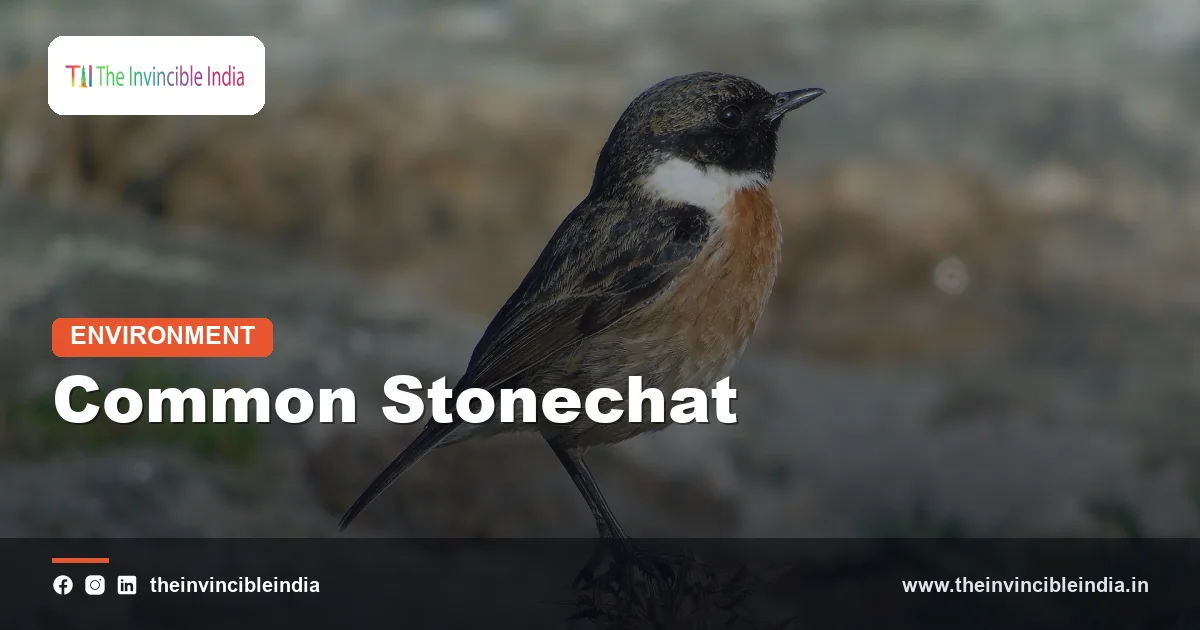
The common stonechat (Saxicola torquatus complex) is a small, upright, perch-hopping chat of Indian open country, the male of which has a black head, a white neck patch and an orange-chestnut breast. The common stonechat is a familiar winter sight on bushes, fences, crop stalks and telephone wires across much of India, where it arrives in large numbers after breeding in the Himalaya and further north.
The name “stonechat” comes from the bird’s alarm call, which sounds like two pebbles being tapped together. This article explains how to recognise the common stonechat, where it lives, what it eats, how it breeds and why taxonomists have recently reorganised the group.
| Quick Fact | Detail |
|---|---|
| Scientific name | Saxicola torquatus (Asian populations now often treated as Saxicola maurus, the Siberian stonechat) |
| Family | Muscicapidae (Old World flycatchers and chats) |
| Indian names | No single standard vernacular name; Indian field guides mostly use the English name |
| Size | About 12 to 14 cm, smaller than a house sparrow |
| Range in India | Breeds in the Himalaya; widespread winter visitor to plains, hills and wetlands |
| Habitat | Open grassland, scrub, crop fields, marsh edges and fence lines |
| Diet | Insects, spiders, small worms and occasionally seeds |
| Breeding season | Roughly May to July in the Himalayan breeding range |
| Conservation status | Least Concern (IUCN) |
Key Takeaways
- The common stonechat is a small chat of open country whose male has a black head, a white neck patch and an orange-chestnut breast.
- The common stonechat is mainly a winter visitor to the Indian plains, arriving from about October and leaving by roughly March or April.
- The common stonechat perches on the top of a bush, wire or stalk and flies down to seize insects on the ground, returning to the same perch.
- The common stonechat gets its name from its sharp “chak-chak” call, which sounds like two small pebbles being struck together.
- The common stonechat breeds in the Himalaya, building a cup nest hidden in grass or a bank and laying about four to six eggs.
- Modern taxonomy splits the Eurasian stonechat group into several species, so Indian birds are often called the Siberian stonechat, but the name common stonechat remains widespread.
What is the common stonechat?
The common stonechat is a small, plump chat of open country that sits upright on exposed perches and feeds mainly on insects. It belongs to the genus Saxicola, whose members, called bushchats and stonechats, are found across Europe, Africa and Asia and share a strong liking for open scrub and grassland.
The birds seen in India belong to a group of Asian populations that have long been treated as subspecies of one widespread species. Several of these forms breed in the Himalaya and the Tibetan plateau, while others breed in Siberia and northern Asia and migrate south in autumn. Different subspecies differ slightly in the colour of the rump and the extent of white on the neck.
The common stonechat is therefore best thought of as a species complex rather than a single, uniform bird. Indian field guides still use the English name common stonechat widely, even where scientific lists have adopted the new species names.
What does the common stonechat look like?
The male common stonechat in breeding plumage has a black head and throat, a white patch on each side of the neck, dark brown upperparts, a white wing patch and an orange-chestnut breast. The rump is usually pale, often whitish or buff in Indian birds, and the underparts fade to pale buff or white towards the belly.
In winter the male looks duller, because fresh feathers have brownish fringes that hide the black head and brighter colour. The female is streaky brown above with a pale orange-buff breast, a faint pale eyebrow and little or no black on the head.
Both sexes show a short tail and large dark eyes, and both flick the tail and wings as they perch. Young birds are spotted and streaked, resembling the female but with more pale speckling. At first glance, a winter stonechat on a wire can be confused with several other small brown birds, but the upright posture and wing-flicking are good clues.
Where is the common stonechat found in India?
The common stonechat is found across most of India in winter, in open grassland, scrub, crop fields, marsh edges and roadside fences, and it breeds in the Himalaya. Large numbers spread across the Indo-Gangetic plain, central India and the peninsula after the monsoon, reaching Sri Lanka at the southern end of their range.
In the breeding season, the species occupies grassy and scrubby slopes at moderate to high altitudes in the Himalaya, including Ladakh, Jammu and Kashmir, Himachal Pradesh and Uttarakhand. Some birds breed near the treeline, in alpine meadows and in scrub on rocky slopes, so they are among the first small birds seen on open Himalayan hillsides in summer.
Wetland edges and reed margins in the plains are especially favoured in winter. The bird can often be found on fences around fields, on wires near marshes, on dry stalks in harvested fields and on low bushes beside canals and roads.
Typical perches
- Tops of bushes and thorny shrubs
- Fence posts and barbed wire around fields
- Dry stalks of crops such as sugarcane and mustard
- Telephone and electric wires over open ground
- Reed tops and bunds at the edge of marshes
What does the common stonechat eat?
The common stonechat eats mainly small insects, including beetles, flies, ants, grasshoppers and caterpillars, along with spiders and small worms. A few small seeds may be taken in winter, but the diet is overwhelmingly animal in origin.
The bird feeds by sitting on a low perch, scanning the ground, and dropping to seize its prey before flying back to the same perch or to another one nearby. It may also hover briefly, or flutter a short distance to catch a flying insect. This perch-and-pounce method is common among chats and flycatchers, and it keeps the bird visible for long periods, which is why stonechats are easy to watch.
By taking large numbers of insects, including pests of crops, the common stonechat provides a small but real benefit to farmland and grassland, especially during the winter months when other insect-eating birds are less abundant.
How does the common stonechat call and sing?
The common stonechat gives a sharp, repeated “chak-chak” alarm call, often preceded by a soft whistle, and a short, scratchy, warbling song in the breeding season. The harsh two-note call is the origin of the English name, since it resembles the tapping together of two pebbles.
Males sing from a prominent perch or while performing a short, fluttering song flight above their territory, mostly in spring and summer on the breeding grounds. In India during winter, the bird is quieter, giving mostly alarm notes and occasional short snatches of song.
Calling is also used to warn mates and young birds of predators such as shrikes, kestrels and cats. A stonechat that stands upright and calls repeatedly from the top of a bush usually indicates that a predator or intruder is nearby.
How does the common stonechat breed?
The common stonechat breeds mainly between about May and July in the Himalaya, building a cup nest of dry grass, moss, roots and hair, hidden in a grass tussock, a bank or a low shrub. The nest is often placed on or very near the ground, making it hard to find.
The female lays about four to six pale blue-green eggs, usually finely spotted with reddish-brown. She does most of the incubation, and both parents feed the nestlings with insects. Pairs may raise more than one brood in a favourable year.
Because the species breeds at altitude, the nesting season is short and tied to the brief mountain summer. Breeding is rarely seen in the Indian plains, where the bird is almost entirely a winter visitor.
| Season | What the common stonechat does |
|---|---|
| September to October | Birds leave breeding areas and arrive on the plains |
| November to February | Birds hold small winter territories on open bushes and fences |
| March to April | Males gain breeding plumage and begin moving north |
| May to July | Nesting in grass and banks in the Himalaya |
Is the common stonechat a migratory bird?
The common stonechat is a migratory bird in India, with populations moving from the Himalaya and northern Asia to the plains and peninsula each winter. The movement is partly altitudinal, as birds descend from high-elevation breeding sites, and partly longitudinal, as birds from Siberia and Central Asia travel south.
Most birds reach India from about October and depart in March or April. Individual birds often return to the same wintering site in later years, defending a small territory around a favourite bush or fence. Wintering numbers tend to be higher in wetland edges and grassland where insects remain plentiful.
Migration is typically nocturnal for small songbirds such as stonechats, and the birds are often noticed appearing suddenly on a patch of open ground after a cold night.
Why has the common stonechat been split into several species?
The common stonechat has been split into several species because genetic and song studies show that the old group contains distinct, separately evolving lineages. Under many modern classifications, the Eurasian stonechat, the Siberian stonechat and the African stonechat are treated as separate species.
For India, the main consequence is that the birds wintering in the plains are often placed in the Siberian stonechat (Saxicola maurus), while the name common stonechat remains in popular use. Some Indian checklists and field guides continue to use the older, broader concept, and bird records on citizen-science platforms may appear under either name.
Observers can handle the difference simply: the practical identification, behaviour and habitat described in this article hold for the whole group, whatever name is used on a checklist.
How is the common stonechat different from similar birds?
The common stonechat is different from similar birds mainly through its upright perch, black head with white neck patch in males and orange-chestnut breast. Several other chats and small birds share its open habitat.
- Pied bushchat: all-black male with a white rump and shoulder patch, larger and more strongly black and white.
- Indian robin: black male with a chestnut rear and a cocked tail, found in dry scrub.
- Black redstart: dark grey and black male with an orange-red tail, usually seen near buildings and walls.
- Whinchat: a related chat with a bold pale eyebrow and white patches at the tail base, only a scarce passage visitor in the north-west.
Female common stonechats can be confused with other small brown chats, but the habit of perching at the very top of a bush and flicking the wings and tail is a reliable guide.
Why does the common stonechat matter?
The common stonechat matters because it is a widespread insect-eating bird of open habitats and a useful indicator of healthy grassland and field margins. By feeding on beetles, flies and caterpillars, the species contributes to natural pest control in farmland and wetlands.
The bird depends on open, uncluttered habitat with plenty of low perches, so it is affected by the conversion of grassland to dense cultivation, heavy pesticide use and the loss of hedgerows and wetland margins. The IUCN lists the species as Least Concern, because the range is vast and populations are large, but local declines are possible where open habitats are lost.
For beginner bird-watchers the stonechat is an ideal first chat to learn, because it sits in the open, stays still and repeats its behaviour at the same perch. A short winter walk along a field edge or marsh bund is usually enough to find one.
Bottom Line
The common stonechat is a small, upright, insect-eating chat that brightens Indian fields and wetland edges every winter, and then breeds in the high Himalaya. Learning its black-headed male, streaky female and “chak-chak” call is a quick route into identifying the bird life of open country.
Frequently Asked Questions
Why is it called the stonechat?
The common stonechat is called the stonechat because its alarm call sounds like two small pebbles being tapped together. The harsh “chak-chak” note is repeated when the bird is disturbed. The word chat refers to this scolding, chattering call.
Where can the common stonechat be seen in India?
The common stonechat can be seen in open grassland, scrub, crop fields, marsh edges and along fences across much of India in winter. It breeds in the Himalaya, including Ladakh, Kashmir, Himachal Pradesh and Uttarakhand. Look for it on the top of a bush, wire or dry stalk.
What does the common stonechat eat?
The common stonechat eats small insects such as beetles, flies, ants, grasshoppers and caterpillars, along with spiders and small worms. It hunts from a low perch and drops to the ground to seize prey. Seeds are only a minor part of the diet.
Is the common stonechat a migrant in India?
The common stonechat is a migrant in India. Birds breeding in the Himalaya and further north move to the plains and peninsula each winter, arriving from about October and leaving by March or April. Some movement is altitudinal, from high hills to lower ground.
How can male and female common stonechats be told apart?
Male and female common stonechats are told apart mainly by the head and breast. The male has a black head, a white neck patch and an orange-chestnut breast, while the female is streaky brown with a pale orange-buff breast. In winter the male is duller, but the white neck patch usually remains visible.
Is the common stonechat the same as the Siberian stonechat?
The common stonechat is often the same bird as the Siberian stonechat in Indian usage. Modern taxonomy treats the Asian populations as a separate species, Saxicola maurus, while older field guides keep them within the broader common stonechat. The identification and behaviour described are the same.
{“@context”:”https://schema.org”,”@graph”:[{“@type”:”FAQPage”,”mainEntity”:[{“@type”:”Question”,”name”:”Why is it called the stonechat?”,”acceptedAnswer”:{“@type”:”Answer”,”text”:”The common stonechat is called the stonechat because its alarm call sounds like two small pebbles being tapped together. The harsh “chak-chak” note is repeated when the bird is disturbed. The word chat refers to this scolding, chattering call.”}},{“@type”:”Question”,”name”:”Where can the common stonechat be seen in India?”,”acceptedAnswer”:{“@type”:”Answer”,”text”:”The common stonechat can be seen in open grassland, scrub, crop fields, marsh edges and along fences across much of India in winter. It breeds in the Himalaya, including Ladakh, Kashmir, Himachal Pradesh and Uttarakhand. Look for it on the top of a bush, wire or dry stalk.”}},{“@type”:”Question”,”name”:”What does the common stonechat eat?”,”acceptedAnswer”:{“@type”:”Answer”,”text”:”The common stonechat eats small insects such as beetles, flies, ants, grasshoppers and caterpillars, along with spiders and small worms. It hunts from a low perch and drops to the ground to seize prey. Seeds are only a minor part of the diet.”}},{“@type”:”Question”,”name”:”Is the common stonechat a migrant in India?”,”acceptedAnswer”:{“@type”:”Answer”,”text”:”The common stonechat is a migrant in India. Birds breeding in the Himalaya and further north move to the plains and peninsula each winter, arriving from about October and leaving by March or April. Some movement is altitudinal, from high hills to lower ground.”}},{“@type”:”Question”,”name”:”How can male and female common stonechats be told apart?”,”acceptedAnswer”:{“@type”:”Answer”,”text”:”Male and female common stonechats are told apart mainly by the head and breast. The male has a black head, a white neck patch and an orange-chestnut breast, while the female is streaky brown with a pale orange-buff breast. In winter the male is duller, but the white neck patch usually remains visible.”}},{“@type”:”Question”,”name”:”Is the common stonechat the same as the Siberian stonechat?”,”acceptedAnswer”:{“@type”:”Answer”,”text”:”The common stonechat is often the same bird as the Siberian stonechat in Indian usage. Modern taxonomy treats the Asian populations as a separate species, Saxicola maurus, while older field guides keep them within the broader common stonechat. The identification and behaviour described are the same.”}}]}]}


