

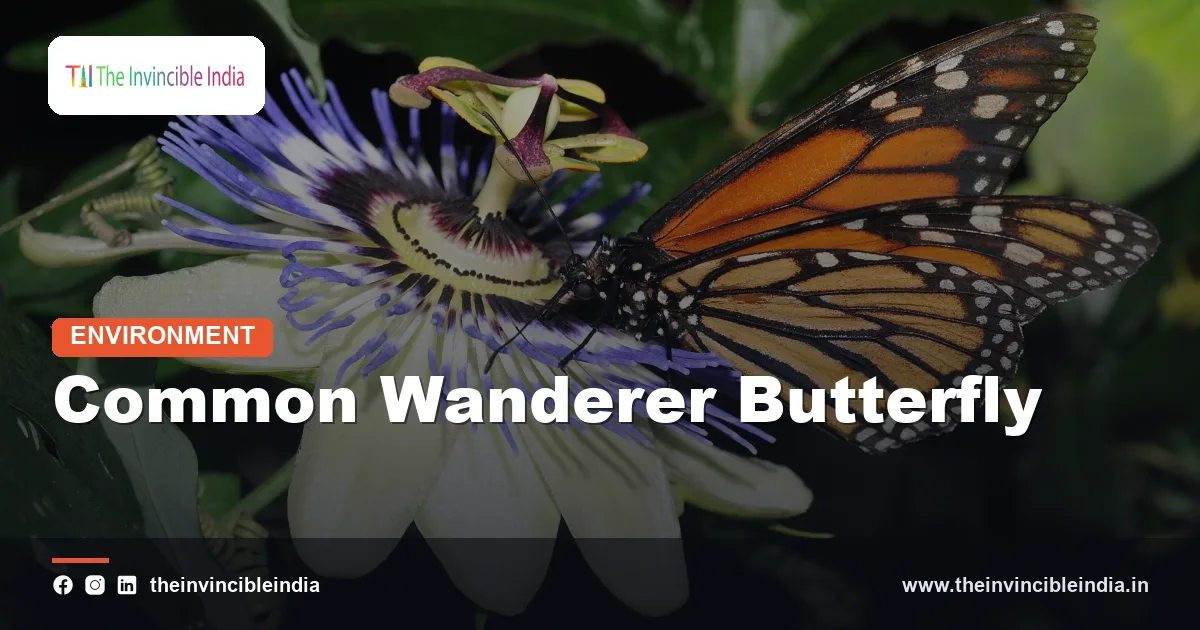
The common wanderer (Pareronia valeria) is a large white-and-black butterfly of the pierid family, found in the scrub, forests and gardens of India, in which the male is pale with black veins and margins and the female is darker. The common wanderer is a strong, restless flier, a frequent visitor to damp ground, and a species whose caterpillars feed on plants of the caper family.
The name "wanderer" reflects the way the butterfly roams across a wide area of open woodland, scrub and gardens, rarely staying long in one spot. This article explains how to identify the common wanderer, where it lives in India, what its caterpillars eat, how it behaves and how to tell it apart from other white butterflies.
| Quick Facts: Common Wanderer | |
|---|---|
| Common name | Common wanderer |
| Scientific name | Pareronia valeria |
| Family | Pieridae (whites and yellows), subfamily Pierinae |
| Wingspan | Roughly 65 to 80 mm |
| Caterpillar host plants | Capparis species and related plants of the caper family (Capparaceae) |
| Range and habitat in India | Scrub jungle, dry and moist deciduous forest, forest edges, hill slopes and gardens, widely recorded in peninsular India including the Western Ghats |
| Flight season and broods | Several broods in a year; seen in many months, often in larger numbers during and after the rains |
| Notable features | Marked difference between the sexes; males gather at damp mud; strong, fast flight |
| Conservation status in India | Widespread and not regarded as threatened |
Key Takeaways
- The common wanderer (Pareronia valeria) is a large pierid butterfly with a wingspan of roughly 65 to 80 mm, found across much of India.
- Male common wanderers are pale, whitish-blue butterflies with black veins and a dark margin, while females are darker and more heavily marked.
- Caterpillars of the common wanderer feed on Capparis and related plants of the caper family, which grow in scrub and forest edges.
- The common wanderer belongs to the family Pieridae and, unlike brush-footed butterflies, uses all six legs for walking.
- Male common wanderers often gather at wet mud or sand to take up salts, a behaviour known as mud-puddling.
- The common wanderer is widespread in India and is not considered threatened.
What is the common wanderer butterfly?
The common wanderer is a butterfly of the genus Pareronia in the family Pieridae, the group that includes the whites, yellows, jezebels and albatrosses. It is one of the larger pierids of the Indian region and is known for its strong, roving flight and its marked differences between males and females.
Pieridae are a large family of butterflies, and many of them are white, yellow or orange. Their caterpillars are typically slender and green, and the chrysalis is held upright by a silk girdle around the middle plus a tail attachment. Adult pierids have six functional legs, unlike the brush-footed butterflies whose front legs are reduced.
The genus Pareronia contains several species known as wanderers in India. The common wanderer is the one most often recorded, and it is a regular in field surveys of scrub jungle, hill slopes and wooded gardens. Its common name, wanderer, is a fitting description of its habit of ranging widely.
How can you identify a common wanderer?
A common wanderer can be identified by its large size, its pale whitish ground colour with a faint bluish tint in the male, black veins and a black outer margin, and a darker, browner female. The combination of size, black-lined veins and wandering flight separates it from smaller white butterflies.
Male
The male is the paler of the two sexes. The wings are white with a slight blue-grey sheen, and the veins are outlined in black, which gives the wings a striped, netted look. The outer margin has a broad black border. At rest, with wings closed, the male shows the black veins on a pale underside with a warm tint.
Female
The female is darker than the male. Her wings carry broader dark areas, and the pale parts are reduced to streaks and patches. Because of this, a female can look like a quite different butterfly from the male, and beginners sometimes record the two as separate species. In the field, the pattern of dark veins and the large size tie the two sexes together.
Similar features
Several features help in confirming a common wanderer:
- A large wingspan for a pierid, noticeably more than a typical small white.
- Black veins that stand out as lines across the wings.
- A fast, strong, direct flight at low to medium height.
- Males settling in groups on damp ground.
Where does the common wanderer live in India?
The common wanderer lives in scrub, deciduous forest, forest edges, hill slopes and wooded gardens across a large part of India, and it is widely recorded in peninsular India and the Western Ghats. It prefers open, sunlit habitat with patches of shade and with host plants nearby.
Typical places to find it include:
- Dry and moist deciduous forests with open clearings.
- Scrub jungle, where Capparis shrubs and climbers grow in tangled thickets.
- Stream banks and damp sandy patches, which attract males.
- Gardens, farm edges and campuses near wooded hills.
Because the butterfly roams, it can turn up in a garden that has no host plants nearby. Breeding, however, is limited to places where the right caper-family plants grow, which is why scrub and forest edges are more reliable than manicured lawns.
Seasonal patterns matter for anyone planning to look for the butterfly. In much of peninsular India the common wanderer is most easily found in the months during and just after the monsoon, when fresh growth on caper-family shrubs supports many caterpillars and flowers are plentiful. In the hottest and driest months, numbers drop and the butterflies concentrate near water, shade and flowering shrubs. In cooler hill areas, the flight period is shorter. Checking the same patch of scrub several times in a year is the best way to learn how the local population rises and falls.
What does the common wanderer caterpillar eat?
The caterpillar of the common wanderer eats the leaves of Capparis species and related plants of the caper family (Capparaceae). These plants are thorny shrubs and climbers of scrub jungle and forest edges, and many of them contain mustard-oil compounds that are distasteful to most herbivores.
The female lays eggs on young leaves of the host plant. After hatching, the caterpillar eats the soft leaf tissue and grows through several moults. Pierid caterpillars are usually green and slender, with fine hairs and faint stripes, and their colour matches the leaves they feed on.
Caper-family plants are tough, drought-hardy shrubs, so the common wanderer does well in dry zones and scrub where many other butterflies struggle. This also means the butterfly depends on the survival of native scrub, a habitat often undervalued and cleared for development.
How does the common wanderer behave?
The common wanderer behaves as an active, strong-flying butterfly that roams widely, visits flowers for nectar and gathers at damp ground to take up minerals. Its flight is fast and direct, and it seldom rests in one spot for long.
- Mud-puddling: Males settle on wet sand, mud and stream edges, sometimes in small groups, to absorb salts and other nutrients.
- Nectar feeding: Adults visit a range of flowers, often with wings held closed while feeding.
- Roaming flight: The butterfly flies at low to medium height along paths, forest edges and hill slopes.
- Basking: In the cooler morning hours, individuals may rest with wings partly open to warm up.
- Roosting: At night the butterfly rests on twigs or leaves with wings closed.
What is the life cycle of the common wanderer?
The common wanderer completes the four butterfly stages of egg, caterpillar, chrysalis and adult, and a full cycle typically takes a month or somewhat longer in warm weather. Several broods follow each other in a year, so the species can be seen in many months.
| Stage | Description |
|---|---|
| Egg | Laid on young leaves of a caper-family host plant; pale and elongated, as in most pierids |
| Caterpillar | Slender and green; feeds on the leaves and grows through several moults |
| Chrysalis | Held upright on a stem or twig by a tail attachment and a silk girdle; green or pale, blending with foliage |
| Adult | Emerges, dries its wings and begins to roam, feed and mate; lives for a few weeks |
Warmth speeds up each stage, and fresh new growth on host plants after the rains supports many caterpillars. This is one reason common wanderers are often more numerous during and after the monsoon than in the hottest, driest months.
Why do male and female common wanderers look so different?
Male and female common wanderers look different because the species shows sexual dimorphism, meaning the two sexes have distinct wing patterns and colours. In the common wanderer the male is pale with black veins, while the female is darker with broader dark areas on the wings.
Sexual dimorphism is common among butterflies and has several possible causes, including mate recognition, differences in the way males and females use their habitat, and protection from predators. Researchers studying wanderers and their relatives have discussed these ideas, although the details differ from species to species. For field observers, the practical lesson is simple: when a dark, heavily marked pierid is seen laying eggs on a caper-family shrub, it may well be a female common wanderer, even if it does not match the pale male shown in many photographs.
How is the common wanderer different from similar white butterflies?
The common wanderer differs from similar white butterflies in its larger size, its strongly black-lined veins and the marked difference between male and female. Several other pierids look broadly similar at a glance, so a few comparisons are useful.
| Butterfly | Scientific name | Distinguishing clue |
|---|---|---|
| Common wanderer | Pareronia valeria | Large; male pale with black veins and margin; female darker |
| Striped albatross | Appias libythea | Smaller; white with black-streaked vein tips on the forewing; strong flier |
| Common gull | Cepora nerissa | Smaller white with black borders and a yellow-tinted underside |
| Pioneer | Belenois aurota | White with dark veins and a bright, open flight; often seen in numbers |
The simplest habit is to check the size and the strength of the black vein lines. The common wanderer is larger and more boldly veined than the typical white butterflies of gardens, and its behaviour at damp ground is also a useful clue.
Which other wanderers occur in India?
Several other butterflies of the genus Pareronia are found in the Indian region, and the common wanderer is only one of them. Related wanderers share the large size, black-lined veins and strong flight of Pareronia, but they differ in the exact colour and extent of the dark markings, and in the part of the country where they occur.
Because taxonomists have revised the classification of the group over time, the names given to local forms can vary between field guides and checklists. An observer who wishes to be precise should compare photographs with a recent checklist and note the location, since the range of each form is part of the identification.
Why does the common wanderer matter?
The common wanderer matters because it is a pollinator, a source of food for predators and a pointer to the health of scrub and forest-edge habitat. Each of these roles connects it to the wider ecology of the region.
- Adults visit flowers for nectar and move pollen between plants as they roam.
- Caterpillars and chrysalises feed birds, lizards and predatory insects.
- The butterfly depends on native caper-family plants, so it indicates intact scrub.
- Its conspicuous size and colour make it a popular species for butterfly walks and citizen science.
Butterflies respond quickly to changes in vegetation, rainfall and temperature, and this makes them useful for long-term monitoring. Common species such as the common wanderer provide the steady records on which such monitoring depends.
How can you see and protect the common wanderer?
You can see a common wanderer by visiting scrub, forest edges or wooded gardens on a warm morning and looking for large pale butterflies near flowers and damp ground. You can protect it by keeping native caper-family shrubs and limiting pesticide use.
- Check wet sand and stream edges, where males cluster to puddle.
- Visit flowering shrubs during the morning, when feeding activity is high.
- Photograph both sexes, since males and females look so different.
- Retain native Capparis shrubs in hedgerows and scrub patches.
- Avoid spraying insecticides near flowering and host plants.
Observation and photography are always preferable to collecting. Sharing records on public biodiversity platforms helps researchers follow the species through the seasons.
Bottom Line
The common wanderer is a large, strongly flying pierid whose male is pale with black veins and whose female is darker. It breeds on caper-family plants, gathers at damp ground, and is widespread across Indian scrub, forest and garden habitats.
Frequently Asked Questions
What is the scientific name of the common wanderer butterfly?
The scientific name of the common wanderer is Pareronia valeria. It belongs to the family Pieridae, the whites and yellows, and to the subfamily Pierinae.
What does a common wanderer look like?
A male common wanderer is a large pale butterfly with black-lined veins and a black outer margin, while the female is darker and more heavily marked. The wingspan is roughly 65 to 80 mm.
What do common wanderer caterpillars eat?
Common wanderer caterpillars eat the leaves of Capparis species and related plants of the caper family. These thorny shrubs and climbers grow in scrub jungle and along forest edges.
Why is it called the common wanderer?
It is called the common wanderer because of its roaming habit of ranging widely through scrub, forest and gardens. The word common reflects that it is one of the more frequently seen wanderers in the genus Pareronia.
Why do common wanderers gather on wet ground?
Common wanderers gather on wet ground to take up salts and minerals, a behaviour known as mud-puddling. It is seen mainly in males, which use these nutrients for reproduction.
Is the common wanderer an endangered butterfly?
No, the common wanderer is not endangered and is regarded as widespread in India. Local numbers can still fall when scrub, forest edges and native host plants are cleared.
{“@context”:”https://schema.org”,”@graph”:[{“@type”:”FAQPage”,”mainEntity”:[{“@type”:”Question”,”name”:”What is the scientific name of the common wanderer butterfly?”,”acceptedAnswer”:{“@type”:”Answer”,”text”:”The scientific name of the common wanderer is Pareronia valeria. It belongs to the family Pieridae, the whites and yellows, and to the subfamily Pierinae.”}},{“@type”:”Question”,”name”:”What does a common wanderer look like?”,”acceptedAnswer”:{“@type”:”Answer”,”text”:”A male common wanderer is a large pale butterfly with black-lined veins and a black outer margin, while the female is darker and more heavily marked. The wingspan is roughly 65 to 80 mm.”}},{“@type”:”Question”,”name”:”What do common wanderer caterpillars eat?”,”acceptedAnswer”:{“@type”:”Answer”,”text”:”Common wanderer caterpillars eat the leaves of Capparis species and related plants of the caper family. These thorny shrubs and climbers grow in scrub jungle and along forest edges.”}},{“@type”:”Question”,”name”:”Why is it called the common wanderer?”,”acceptedAnswer”:{“@type”:”Answer”,”text”:”It is called the common wanderer because of its roaming habit of ranging widely through scrub, forest and gardens. The word common reflects that it is one of the more frequently seen wanderers in the genus Pareronia.”}},{“@type”:”Question”,”name”:”Why do common wanderers gather on wet ground?”,”acceptedAnswer”:{“@type”:”Answer”,”text”:”Common wanderers gather on wet ground to take up salts and minerals, a behaviour known as mud-puddling. It is seen mainly in males, which use these nutrients for reproduction.”}},{“@type”:”Question”,”name”:”Is the common wanderer an endangered butterfly?”,”acceptedAnswer”:{“@type”:”Answer”,”text”:”No, the common wanderer is not endangered and is regarded as widespread in India. Local numbers can still fall when scrub, forest edges and native host plants are cleared.”}}]}]}


