

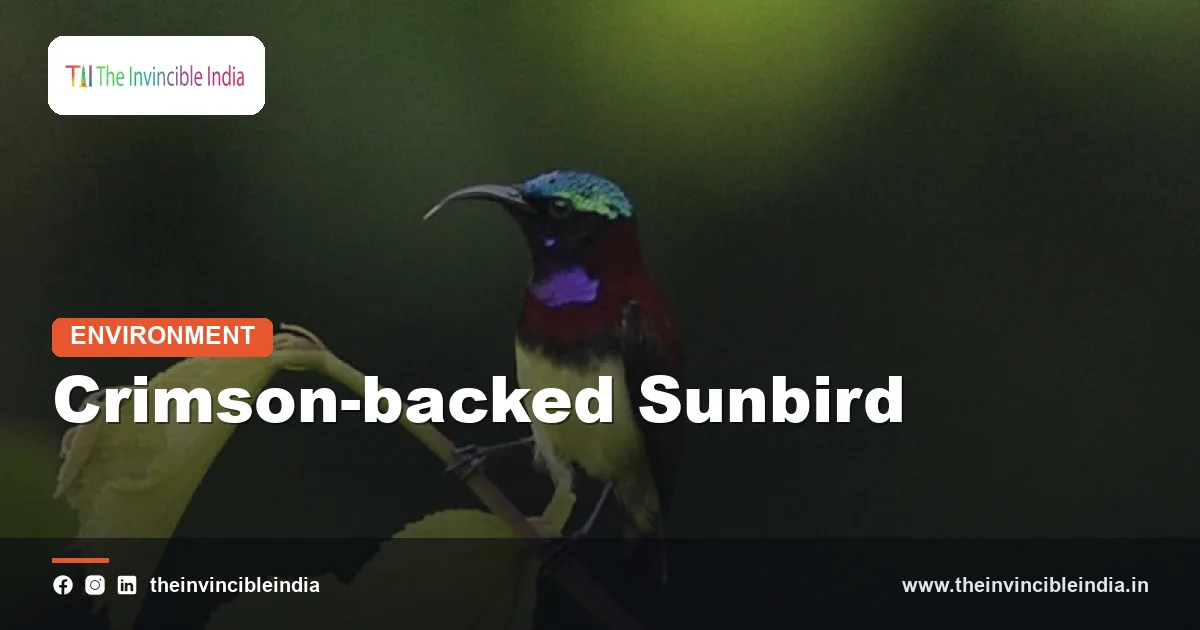
The crimson-backed sunbird (Leptocoma minima), also called the small sunbird, is a tiny nectar-feeding bird endemic to the Western Ghats of India, whose male carries a glittering crimson back and a metallic green, blue and purple head. The crimson-backed sunbird measures only about 8 to 9 cm, which makes it one of the smallest birds in India, and it is found nowhere else in the world except along this mountain chain.
The crimson-backed sunbird is a bird of forest edges, flowering trees, hill gardens and plantations in the Western Ghats, where it works the blossoms for nectar and small insects. This article explains what the crimson-backed sunbird is, how to recognise it, where it lives, what it eats, how it breeds and why an endemic species of this kind matters for conservation.
| Quick Facts: Crimson-backed Sunbird | |
|---|---|
| Scientific name | Leptocoma minima |
| Family | Nectariniidae (sunbirds) |
| Other names | Small sunbird |
| Size | About 8 to 9 cm in length, among the smallest Indian birds |
| India range and habitat | Endemic to the Western Ghats; forest edges, moist forest, plantations and flowering trees on the hills |
| Diet | Flower nectar, small insects and spiders |
| Breeding | Hanging pouch nest of cobweb, moss and plant fibre; usually 2 eggs |
| Conservation status | Least Concern on the IUCN Red List, but restricted to one mountain range |
Key Takeaways
- The crimson-backed sunbird is a tiny, roughly 8 to 9 cm nectar-feeding bird of the sunbird family, Nectariniidae.
- The crimson-backed sunbird is endemic to the Western Ghats, meaning that it breeds and lives naturally only in this mountain range of western India.
- The male crimson-backed sunbird has a crimson back and glittering metallic colours on the head, while the female is plain olive above and yellowish below.
- The crimson-backed sunbird feeds on the nectar of forest and plantation flowers and also eats small insects and spiders, which supply protein.
- The crimson-backed sunbird builds a small hanging pouch nest from cobweb, moss and plant fibre, and the female usually lays two eggs.
- The crimson-backed sunbird is assessed as Least Concern, but its fortunes are tied to the forests of the Western Ghats, a global biodiversity hotspot.
What Is the Crimson-backed Sunbird?
The crimson-backed sunbird is a very small passerine bird of the sunbird family that is endemic to the Western Ghats of southwestern India. Sunbirds are nectar specialists with slender curved bills and brush-tipped tongues, and they take the same role in Asian and African ecosystems that hummingbirds take in the Americas.
The crimson-backed sunbird is often called the small sunbird because of its size. It is closely related to the more widespread purple-rumped sunbird, and the two were once placed in the same genus group by many authorities. The scientific name minima means smallest, a direct reference to its tiny frame.
Being endemic, the crimson-backed sunbird has a naturally small global range, which makes it a species of special interest to conservationists and birdwatchers. Many visitors to the Western Ghats list it among the birds they hope to see because it cannot be found in any other part of India.
How Can You Identify the Crimson-backed Sunbird?
The crimson-backed sunbird is identified by the male’s crimson-red back together with a glittering metallic crown, rump and throat that shift between green, blue and purple depending on the light. The underparts of the male are pale and yellowish, which contrasts with the dark, shining upper body.
The female crimson-backed sunbird is much plainer, with olive upperparts and pale yellowish underparts, and without the red back or glossy colours. As in other sunbirds, young birds resemble the female. The small size, the thin curved bill and the habit of feeding at flowers are the best clues for a first sighting.
Features that help in the field
- A very small bird, noticeably smaller than a house sparrow.
- Male with a vivid crimson back that glows in sunlight, but can look dark in shade.
- Thin, downcurved bill used to probe flowers.
- Quick, darting flight between flowering branches, often high in a tree.
The shifting colours of the male come from the microscopic structure of the feathers, which scatters light. This is why the same bird may look black one moment and brilliantly coloured the next as it turns.
Where Does the Crimson-backed Sunbird Live in India?
The crimson-backed sunbird lives along the Western Ghats, the long mountain chain that runs parallel to the west coast of India. The Western Ghats extend for roughly 1,600 km from the south of Gujarat to the southern tip of the peninsula, and they pass through Maharashtra, Goa, Karnataka, Kerala and Tamil Nadu.
Within this range, the crimson-backed sunbird occupies moist forest, forest edges, clearings, shade plantations of coffee, cardamom and tea, and wooded hill gardens. It tends to avoid the open, dry plains below the hills, where the purple-rumped sunbird takes over.
The bird lives from the lower slopes up into the hills, and it may make local movements to follow trees that are in flower. It does not migrate over long distances.
Why Is the Western Ghats Home Range Important?
The Western Ghats are important because they are one of the world’s recognised biodiversity hotspots and hold a very large number of species that live nowhere else. The mountain range captures the monsoon rains, feeds many of the peninsula’s rivers and supports a mosaic of forest types, which creates many habitats for specialised plants and animals.
In 2012, UNESCO inscribed a series of protected sites in the Western Ghats as a World Heritage Site, recognising their ecological value. The crimson-backed sunbird shares this landscape with other endemic birds, including the Malabar grey hornbill, the Nilgiri flycatcher and the Malabar parakeet.
Because the crimson-backed sunbird depends on the same forests as these species, its health reflects the health of the larger ecosystem. Protecting the ghats therefore protects this small bird along with thousands of other species.
What Does the Crimson-backed Sunbird Eat?
The crimson-backed sunbird eats mainly flower nectar, supplemented by small insects and spiders. Nectar provides the sugar that fuels the bird’s very fast metabolism, while insects supply the protein it needs to grow feathers and to feed its chicks.
The bird visits the blossoms of forest trees, shrubs, mistletoes and plantation plants, and it often forages high in the canopy of flowering trees. It clings to twigs and flower stalks, inserts its bill into the bloom and draws up nectar with its tongue. It also gleans tiny insects from leaves and sometimes snatches them in short flights.
- Nectar sources: flowering forest trees, mistletoes, shrubs and plantation plants.
- Animal food: small insects, spiders and their eggs.
- Feeding style: perching or clinging beside flowers rather than hovering for long.
How Does the Crimson-backed Sunbird Behave?
The crimson-backed sunbird behaves as a restless, fast-moving forager that is usually seen alone, in pairs or in small groups around flowering trees. Because it is so small, it can easily be overlooked among the leaves, and it is often detected first by its thin, high-pitched calls.
Males defend patches of flowers from rivals and from other nectar-feeding birds, flaring their bright feathers and chasing intruders with brief aerial pursuits. The bird sings a thin, fast, twittering series of notes from an open perch, particularly in the breeding season.
The crimson-backed sunbird often feeds high up in the canopy and may associate loosely with mixed groups of small birds. It also comes to the flowers of garden shrubs near forest, and it can sometimes be seen at the blossoms of hill-station gardens, coffee estates and cardamom plantations.
How Can You See the Crimson-backed Sunbird?
The best way to see the crimson-backed sunbird is to visit flowering trees at the edge of Western Ghats forest in the early morning or late afternoon, when the bird is most active. Standing quietly near a tree in bloom and scanning the outer branches with binoculars usually produces a sighting.
Good areas include the forests and plantations of the Western Ghats in Karnataka, Kerala, Tamil Nadu, Goa and Maharashtra, particularly hill stations and wildlife sanctuaries with a mix of forest and flowering trees. Local guides who know which trees are in flower can help visitors find the bird more quickly.
- Visit early in the day, when nectar feeders are most active.
- Scan the tops of flowering trees and mistletoe clumps rather than the ground.
- Use binoculars, since the bird is tiny and often high above the observer.
- Stay on trails and avoid disturbing nests, which hang low in some places.
How Does the Crimson-backed Sunbird Breed?
The crimson-backed sunbird breeds by building a small hanging pouch nest, and the female usually lays two eggs. The nest is made of cobweb, moss, plant fibre and fine scraps, and it has a side entrance, often under a small porch that sheds rain.
The nest hangs from the tip of a twig or a hanging creeper, often at a modest height and in a place that looks natural, like a bundle of dry leaves. The female builds the nest and does most of the incubating, while the male defends the nearby flowers and the pair feeds the chicks insects and nectar.
Breeding in the Western Ghats is linked to flowering seasons and the monsoon cycle, so the exact timing differs between the northern and southern parts of the range.
How Does the Crimson-backed Sunbird Differ From Similar Sunbirds?
The crimson-backed sunbird differs from similar sunbirds mainly in its smaller size, its crimson back and its restricted Western Ghats range. The table below shows how it compares with other sunbirds in the same region.
| Sunbird | Key male features | Range |
|---|---|---|
| Crimson-backed sunbird | Crimson back, glittering metallic head, very small size | Western Ghats only |
| Purple-rumped sunbird | Maroon back, purple rump, yellow belly | Widespread, common in the peninsula |
| Purple sunbird | Looks dark and glossy purple-black | Widespread across India |
| Loten’s sunbird | Long curved bill, maroon breast band | Southern and coastal peninsular India |
In practice, a very small sunbird with a bright red back in the hills of Kerala, Karnataka or Goa is likely to be a crimson-backed sunbird, whereas a similar bird with a yellow belly and maroon back in the lowlands is more likely to be a purple-rumped sunbird.
Why Does the Crimson-backed Sunbird Matter?
The crimson-backed sunbird matters because it pollinates forest flowers and because its presence signals the health of Western Ghats forests. As it moves between blossoms, it carries pollen on its head and bill and so helps many plants to set fruit.
The bird also forms part of the food web, as it eats small insects and in turn may be eaten by larger predators. As an endemic, it adds to the unique character of the Western Ghats, and it is a flagship species for birdwatching tourism in the region.
Because the bird is so small and so dependent on flowering trees, it is a useful reminder that even tiny species have specific needs. A forest with many flowering trees throughout the year will support more nectar feeders than a forest with only a short flowering season.
Is the Crimson-backed Sunbird Threatened?
The crimson-backed sunbird is not currently considered threatened and is assessed as Least Concern on the IUCN Red List. It remains reasonably common in suitable habitat and tolerates plantations and forest edges, which gives it some resilience.
Even so, its restricted range means that large-scale loss of habitat in the Western Ghats would affect it more severely than it would affect a widespread species. The main pressures on the region include forest clearance, mining, expansion of monoculture plantations, road and dam building, and the effects of climate change on flowering patterns.
- Protecting native flowering trees helps nectar feeders year-round.
- Maintaining shade trees in plantations preserves habitat outside protected areas.
- Limiting pesticide use keeps the insect supply healthy for chicks.
The bird, like all wild birds in India, is protected under the Wild Life (Protection) Act, 1972.
Bottom Line
The crimson-backed sunbird is a tiny, brilliantly coloured nectar feeder that is found only in the Western Ghats. It is not threatened now, but its small range makes the long-term protection of the ghats’ forests important for its future.
Frequently Asked Questions
What is the crimson-backed sunbird?
The crimson-backed sunbird is a tiny nectar-feeding bird, about 8 to 9 cm long, that is endemic to the Western Ghats of India. The male has a crimson back and a glittering metallic head, while the female is plain olive and yellowish. It is also known as the small sunbird.
Where is the crimson-backed sunbird found?
The crimson-backed sunbird is found only in the Western Ghats, the mountain range along the west coast of India. It lives in moist forest, forest edges, plantations and wooded hill gardens. It is not found in other parts of India or the world.
What does the crimson-backed sunbird eat?
The crimson-backed sunbird eats mainly flower nectar, which it takes with a thin curved bill and a brush-tipped tongue. It also eats small insects and spiders for protein. Chicks are fed on insects and nectar.
Why is the crimson-backed sunbird called the small sunbird?
The crimson-backed sunbird is called the small sunbird because it is one of the smallest sunbirds and one of the smallest birds in India. It measures only about 8 to 9 cm. Its scientific name, minima, also means smallest.
How does the crimson-backed sunbird nest?
The crimson-backed sunbird builds a small hanging pouch nest of cobweb, moss and plant fibre with a side entrance. The nest hangs from a twig or creeper, and the female usually lays two eggs. Both parents feed the chicks.
Is the crimson-backed sunbird endangered?
The crimson-backed sunbird is not endangered and is assessed as Least Concern on the IUCN Red List. It is fairly common in suitable habitat in the Western Ghats. Because its range is limited, the loss of forest in the ghats could affect it more than it would affect a widespread species.
{“@context”:”https://schema.org”,”@graph”:[{“@type”:”FAQPage”,”mainEntity”:[{“@type”:”Question”,”name”:”What is the crimson-backed sunbird?”,”acceptedAnswer”:{“@type”:”Answer”,”text”:”The crimson-backed sunbird is a tiny nectar-feeding bird, about 8 to 9 cm long, that is endemic to the Western Ghats of India. The male has a crimson back and a glittering metallic head, while the female is plain olive and yellowish. It is also known as the small sunbird.”}},{“@type”:”Question”,”name”:”Where is the crimson-backed sunbird found?”,”acceptedAnswer”:{“@type”:”Answer”,”text”:”The crimson-backed sunbird is found only in the Western Ghats, the mountain range along the west coast of India. It lives in moist forest, forest edges, plantations and wooded hill gardens. It is not found in other parts of India or the world.”}},{“@type”:”Question”,”name”:”What does the crimson-backed sunbird eat?”,”acceptedAnswer”:{“@type”:”Answer”,”text”:”The crimson-backed sunbird eats mainly flower nectar, which it takes with a thin curved bill and a brush-tipped tongue. It also eats small insects and spiders for protein. Chicks are fed on insects and nectar.”}},{“@type”:”Question”,”name”:”Why is the crimson-backed sunbird called the small sunbird?”,”acceptedAnswer”:{“@type”:”Answer”,”text”:”The crimson-backed sunbird is called the small sunbird because it is one of the smallest sunbirds and one of the smallest birds in India. It measures only about 8 to 9 cm. Its scientific name, minima, also means smallest.”}},{“@type”:”Question”,”name”:”How does the crimson-backed sunbird nest?”,”acceptedAnswer”:{“@type”:”Answer”,”text”:”The crimson-backed sunbird builds a small hanging pouch nest of cobweb, moss and plant fibre with a side entrance. The nest hangs from a twig or creeper, and the female usually lays two eggs. Both parents feed the chicks.”}},{“@type”:”Question”,”name”:”Is the crimson-backed sunbird endangered?”,”acceptedAnswer”:{“@type”:”Answer”,”text”:”The crimson-backed sunbird is not endangered and is assessed as Least Concern on the IUCN Red List. It is fairly common in suitable habitat in the Western Ghats. Because its range is limited, the loss of forest in the ghats could affect it more than it would affect a widespread species.”}}]}]}


